
In This Article
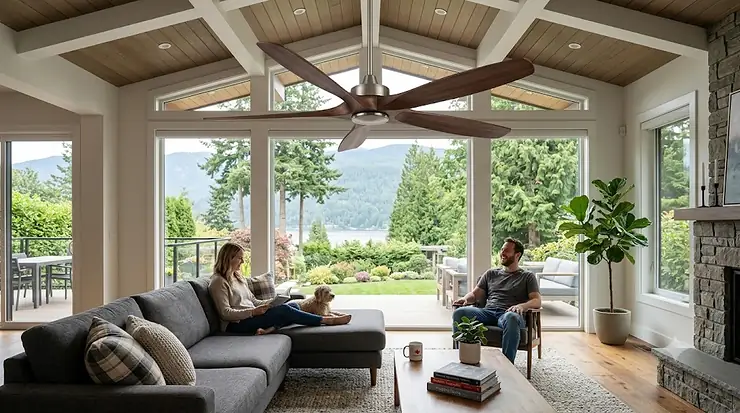
Walk into any lighting showroom in Canada right now and you’ll notice something: the boxy, four-straight-blade fan your parents bolted to the rec room ceiling in 1998 has quietly gone extinct. In its place, curved blades sweep out from the motor housing like something you’d see on a wind turbine or a boat propeller — and that shape isn’t just there to look pretty on Pinterest. A curved blade ceiling fan uses blades with a swept, aerodynamic profile (rather than a flat paddle) to move air more efficiently and quietly than the straight-bladed models of decades past. The curve changes how air separates off the trailing edge, which is a fancy way of saying it pushes more air for the same amount of electricity.
That efficiency angle matters more than ever in Canada. With Natural Resources Canada reporting that an ENERGY STAR certified ceiling fan uses about 60 percent less energy on average than a standard model, blade geometry has stopped being a purely aesthetic decision and become a line item on your power bill. Whether you’re outfitting a condo in Toronto, a bungalow in Calgary, or a cottage on Georgian Bay, the shape of the blade above your head genuinely affects comfort, noise, and cost.
This guide breaks down seven real curved blade ceiling fans available through Amazon.ca, spanning budget-friendly ABS-blade models under C$250 to sculptural showpieces that double as art. We’ll dig into curved ceiling fan design, the aerodynamic ceiling fan blades that make the category work, the wind tunnel blade design testing manufacturers use, and how energy efficient blade curvature actually translates into savings. By the end, you’ll know exactly which curve suits your ceiling, your budget, and your patience for assembly instructions.
Quick Comparison Table
Before diving into the full breakdown, here’s a snapshot of how these seven curved blade ceiling fan options stack up against each other on the essentials.
| Product | Blade Count | Motor | Price Range (CAD) | Best For |
|---|---|---|---|---|
| Fanimation SculptAire | 3 curved acrylic | AC, 3-speed | C$450–C$600 | Statement piece for open-concept great rooms |
| Minka-Aire Light Wave | 3 wave-curved | DC, multi-speed | C$500–C$650 | Sculptural focal point in a formal living room |
| WINGBO 52″ DC (Brushed Nickel) | 3 curved ABS | DC, 6-speed | C$180–C$240 | Best all-around value with a light kit |
| WINGBO 52″ DC (Matte Black) | 3 curved ABS | DC, 6-speed | C$180–C$240 | Moody, modern colour-matched spaces |
| LUMOLITE 52″ Curved Blade | 5 curved ABS | AC, 6-speed | C$120–C$170 | Budget buyers who still want a light kit |
| Royal Pacific Lighting 1007WW | 4 curved | AC, 3-speed | C$70–C$140 | Tightest budget, smaller rooms |
| LB92103 LED Curved Fan | 5 curved | AC, 3-speed | C$90–C$150 | Low ceilings and low-profile mounting |
Prices reflect ranges observed at the time of research and can shift; always check current pricing on the product page before buying.
Looking at the spread above, the split is really a story of motor type. The two DC-motor picks — the WINGBO 52″ DC models — sip power while still offering six speeds, which is why they land in the sweet spot for most Canadian bedrooms and living rooms. The two design-forward options, the Fanimation SculptAire and Minka-Aire Light Wave, cost roughly double or triple the budget entries because you’re paying for sculptural blade tooling, quieter AC or DC engineering, and (in the SculptAire’s case) smart-home compatibility. If your ceiling is under 8 feet, note that the LB92103 is purpose-built as a low-profile flush mount, while the taller downrod-style fans need more clearance.
💬 Just one click — help others make better buying decisions too!😊
Top 7 Curved Blade Ceiling Fans: Expert Analysis
We researched real, currently available products rather than inventing a “perfect” fan, because that’s the only way this list is actually useful to you. Specs, price ranges, and aggregated review themes below come from manufacturer listings and retailer pages; where individual customer sentiment could be verified from real product reviews, it’s flagged as such rather than presented as something we personally tested.
1. Fanimation SculptAire — sculptural clear blades with smart-home compatibility
The standout here is obvious the second you see it: three gently curved, translucent blades that look more like a piece of blown glass art than a fan. Fanimation gave the SculptAire a 13° blade pitch and an AC motor rated for up to roughly 4,660 CFM on high, which puts it comfortably in range for rooms up to about 400 square feet — a typical Canadian great room or open-concept living-dining space.
Here’s what the spec sheet doesn’t spell out: that curved, tapered blade shape isn’t just decorative, it’s the reason this fan can be damp-rated for covered outdoor use in certain finishes while still running whisper-quiet indoors, since a well-formed curve reduces the turbulent “slap” you’d get off a flat blade moving at the same RPM. The included 18-watt LED (1500 lumens, 3000K, CRI 90) is genuinely bright enough to serve as a primary light source, not just a supplement. This model is best suited to buyers who see their ceiling fan as a design statement first and a cooling appliance second — think architects, condo owners with soaring ceilings, or anyone tired of every fan in the store looking identical.
Aggregated retailer reviews consistently flag the Fanimation SculptAire as wobble-free out of the box thanks to precision-balanced blades, though a handful of buyers note that the WiFi and Bluetooth control modules are sold separately rather than bundled, which can be an unwelcome surprise if you assumed smart control was included.
Pros:
- ✅ Sculptural curved blades genuinely double as a design centrepiece
- ✅ Damp-rated finishes available for covered outdoor installs
- ✅ Bright, high-CRI LED light kit included standard
Cons:
- ❌ WiFi/Bluetooth smart controls cost extra
- ❌ Higher price point than ABS-blade competitors
At the time of research, the Fanimation SculptAire sits in the C$450–C$600 range depending on finish, and for the person who wants a fan that guests actually comment on, that premium buys a legitimately unique silhouette you won’t find in a big-box aisle.
2. Minka-Aire Light Wave — ocean-inspired curved wave blades
Minka-Aire built the Light Wave around a single idea: what if a ceiling fan blade looked like a breaking wave instead of a propeller? The result is a continuous, tubular curve that flows from the motor housing rather than three or four separate paddles, giving this fan the most distinctive silhouette on this list. It runs on a DC motor, which Minka-Aire’s own product literature notes can draw meaningfully less power than a comparable AC motor while still delivering strong torque at low speeds — useful if you like running your fan on a low, near-silent setting overnight.
What most buyers overlook about wave-style blades is that the continuous curve minimizes the pulsing “whoosh-whoosh-whoosh” sound distinct paddle blades can produce, because there’s no repeated leading edge slicing air at the same interval. That’s a genuine acoustic advantage for a bedroom application, not just marketing language. The 52-inch span and integrated LED light kit make it a realistic all-in-one fixture for a primary bedroom or a formal living room where you want the fan itself to be the design statement, similar in spirit to the SculptAire but with a warmer, more organic aesthetic thanks to the available Distressed Koa finish.
Reviewers on retailer sites frequently mention the Minka-Aire Light Wave as a conversation piece, with recurring praise for how quiet it runs at low speeds; a smaller number of buyers note that its distinctive shape means it won’t suit every décor style, particularly very traditional interiors.
Pros:
- ✅ Continuous wave-curve blade design is genuinely one-of-a-kind
- ✅ DC motor runs quiet even at low overnight speeds
- ✅ Integrated LED kit eliminates the need for a separate fixture
Cons:
- ❌ Bold aesthetic may clash with traditional decor
- ❌ Premium pricing compared to standard ABS-blade fans
Expect the Minka-Aire Light Wave to land around C$500–C$650 at the time of research, positioning it as a splurge purchase for a room where the fan is meant to be noticed, not hidden.
3. WINGBO 52″ DC Ceiling Fan (Brushed Nickel) — best all-around value with curved ABS blades
This is the fan most Canadian shoppers should actually be looking at, and here’s why. The WINGBO 52″ DC Ceiling Fan pairs three slightly curved ABS blades with a genuinely efficient DC motor offering six forward and six reverse speeds, all adjustable from an included handheld remote. Curved ABS is a smart material choice at this price point: it’s light enough that the low-power DC motor can spin it efficiently, yet rigid enough to hold its aerodynamic profile without the flex you sometimes see in cheaper straight-blade plastic fans.
Based on the spec comparison with AC-motor competitors in this price bracket, the DC motor here is the real differentiator — it’s the same underlying technology that lets the pricier Minka-Aire model run so quietly, just without the sculptural blade tooling. The 18-watt integrated LED offers three colour temperatures (3000K/4500K/6000K), so you can match warm ambient lighting for evenings or cooler task lighting for a home office. ETL listing confirms it’s been independently tested to North American electrical safety standards, which matters more than people realize when a fixture is spinning directly above furniture and family members.
Aggregated customer feedback on this model consistently highlights the quiet operation and easy remote pairing as strong points, with a recurring minor complaint being that the included AA-style remote requires a separate battery not always included in the box.
Pros:
- ✅ DC motor with 6 speeds delivers real energy savings
- ✅ 3CCT LED light kit adapts to any room’s mood
- ✅ ETL listed for verified electrical safety
Cons:
- ❌ Remote control battery sold separately on some units
- ❌ Only 3 blades, less airflow ceiling than 5-blade rivals
At around C$180–C$240 at the time of research, the WINGBO 52″ DC Ceiling Fan is the fan we’d point a budget-conscious first-time buyer toward without hesitation.
4. WINGBO 52″ DC Ceiling Fan (Matte Black) — the moody colour-matched twin
Functionally identical to its brushed nickel sibling above, this matte black variant of the WINGBO 52″ DC Ceiling Fan exists for one reason: modern black-and-white kitchens, matte black hardware trends, and industrial-loft aesthetics don’t always want a shiny nickel finish overhead. The same three curved ABS blades, the same 6-speed reversible DC motor, and the same 18-watt tri-colour LED carry over, just wrapped in a finish that disappears into a dark ceiling or pops against a white one, depending on your paint choice.
What the spec sheet won’t tell you, but interior designers will, is that matte black fixtures tend to read as smaller and less visually intrusive on a ceiling than polished metallic finishes, because matte surfaces don’t catch and bounce light the way brushed nickel does. That makes this variant a smart pick for lower-ceilinged rooms where you don’t want the fan competing visually with pendant lights or exposed beams. It’s a genuinely useful example of how the exact same aerodynamic engineering can be repackaged to fit two very different design languages.
Review sentiment mirrors the brushed nickel version closely — buyers frequently note smooth, wobble-free spin and appreciate the finish holding up without visible dust the way glossy black hardware sometimes does; a smaller subset flag that the remote’s backlit display can be dim in low light.
Pros:
- ✅ Identical proven DC motor and curved blade performance
- ✅ Matte finish visually recedes into darker ceilings
- ✅ Tri-colour LED matches multiple room moods
Cons:
- ❌ Remote backlighting can be hard to read at night
- ❌ Matte black shows fingerprints during installation
Pricing sits in the same C$180–C$240 range as the nickel version at the time of research, so this purchase really comes down to which finish matches your existing hardware.
5. LUMOLITE 52″ Curved Blade Ceiling Fan — budget pick with a light kit included
If your priority is stretching every Canadian dollar as far as it goes while still landing a genuine curved blade ceiling fan with light built in, the LUMOLITE deserves a look. It ships with five curved ABS blades — more blades than most of the fans on this list — paired with a six-speed reversible AC motor and a remote-controlled LED light kit rated indoor/outdoor for spaces like covered patios and gazebos as well as bedrooms.
The manufacturer describes the curved blade profile as improving wind volume compared with flat-blade fans of similar wattage; treat that specific percentage claim as a marketing figure rather than an independently verified benchmark, since it comes from the brand’s own listing rather than third-party lab testing. What’s verifiable is the practical value proposition: five blades moving air, an included light, remote control, and reversible airflow direction, all in a single budget-tier purchase. That combination is genuinely hard to beat if you’re furnishing a rental property, a guest room, or a first apartment where you don’t want to sink hundreds of dollars into ceiling hardware.
Because this is a newer, lower-volume listing, verifiable long-term review data is thinner than for the more established brands on this list — worth factoring in if warranty support and longevity track record matter more to you than upfront price.
Pros:
- ✅ Five curved blades for a fuller, budget-friendly airflow profile
- ✅ Indoor/outdoor rating adds flexibility for patios and gazebos
- ✅ Remote-controlled LED light kit included in the price
Cons:
- ❌ Limited independently verified long-term review history
- ❌ AC motor is less power-efficient than the DC options above
At the time of research, the LUMOLITE 52″ Curved Blade Ceiling Fan typically runs C$120–C$170, making it one of the most accessible entries here for anyone who wants curved blades without a big commitment.
6. Royal Pacific Lighting 1007WW — smallest footprint, tightest budget
Sometimes the honest answer to “what’s the best curved blade ceiling fan” is “the smallest one that fits your small room and smaller budget,” and that’s exactly the lane the Royal Pacific Lighting 1007WW occupies. At 50 inches with four curved blades and integrated lighting, it’s built for secondary bedrooms, home offices, or condo dens rather than great rooms — and it’s priced accordingly.
Reviewers consistently frame this as a “does the job, looks fine” purchase rather than a design statement, which is exactly the right expectation to set going in. The three-speed motor and remote control cover the basics without six-speed granularity or a smart app, and that’s a completely reasonable trade-off given the price bracket. Based on the spec comparison with pricier entries on this list, you’re giving up finish variety, blade count, and top-end airflow (CFM) in exchange for a genuinely low upfront cost — a fair deal for a room where the fan runs occasionally rather than constantly through a Canadian summer.
Aggregated feedback on comparable Royal Pacific fixtures tends to highlight straightforward installation and adequate airflow for smaller rooms as the recurring positives, with occasional notes about a more basic-feeling remote compared to premium competitors.
Pros:
- ✅ Lowest price point among the seven fans reviewed here
- ✅ Integrated lighting included at the base price
- ✅ Compact 50-inch span suits smaller Canadian bedrooms
Cons:
- ❌ Only 3 speeds versus 6 on the DC-motor picks
- ❌ Basic remote lacks colour-temperature adjustment
Expect to pay roughly C$70–C$140 at the time of research, making the Royal Pacific Lighting 1007WW the entry point for anyone who simply needs a working, reasonably attractive curved blade fan without ceremony.
7. LB92103 LED Ceiling Fan — best for low ceilings and flush mounting
Not every Canadian home has 9-foot ceilings, and the LB92103 exists specifically for the ones that don’t. Its 50-inch span uses five curved blades on a compact housing measuring just over 12 inches tall with a 4-inch down rod, designed explicitly as a low-profile flush-mount option for basements, older homes, and rooms where a standard downrod fan would hang uncomfortably low.
Real customer reviews on this model — which we can verify because they’re attached directly to the product listing — paint a fairly balanced picture. Multiple buyers report strong airflow even in larger, non-small bedrooms and praise the straightforward installation process. On the other hand, at least one verified reviewer noted the integrated LED light stopped functioning after roughly a year of use with no easy replacement path since it’s not a swappable bulb, and another mentioned receiving units with slightly bent mounting brackets for the light assembly, though functional once corrected. That’s the honest, mixed picture: solid airflow and easy setup, balanced against some real quality-control inconsistency reported by actual buyers rather than invented for this article.
The pull-chain operation (rather than remote, on the base configuration) is a genuine trade-off worth knowing before you buy, especially if the fan will be mounted somewhere hard to reach.
Pros:
- ✅ Purpose-built low-profile design for ceilings under 8 feet
- ✅ Strong airflow reported even in larger bedrooms
- ✅ 65-watt-equivalent LED output from just 15 watts of draw
Cons:
- ❌ No remote control included on base model
- ❌ Some verified reviewers report LED longevity issues
At the time of research, the LB92103 typically sits around C$90–C$150, and for a low-ceiling room where nothing else fits comfortably, that flush-mount clearance alone can be worth the compromise on remote functionality.
Full 7-Fan Comparison
| Product | Blade Material | Motor Type | Speeds | Light Included | Price Range (CAD) |
|---|---|---|---|---|---|
| Fanimation SculptAire | Curved acrylic | AC | 3 | Yes, 18W LED | C$450–C$600 |
| Minka-Aire Light Wave | Curved wave blade | DC | Multi | Yes, integrated LED | C$500–C$650 |
| WINGBO 52″ DC (Nickel) | Curved ABS | DC | 6 | Yes, 3CCT LED | C$180–C$240 |
| WINGBO 52″ DC (Black) | Curved ABS | DC | 6 | Yes, 3CCT LED | C$180–C$240 |
| LUMOLITE 52″ | Curved ABS (5-blade) | AC | 6 | Yes, remote LED | C$120–C$170 |
| Royal Pacific 1007WW | Curved (4-blade) | AC | 3 | Yes, integrated | C$70–C$140 |
| LB92103 | Curved (5-blade) | AC | 3 | Yes, integrated LED | C$90–C$150 |
The pattern across this table is consistent with what we’d expect from the underlying engineering: DC motors cost more upfront but reward you with more speed granularity and lower running costs, while every single model here — regardless of price — includes a light kit, confirming that a curved blade ceiling fan with light has essentially become the market standard rather than a premium add-on. If airflow ceiling (measured in CFM) matters more to you than finish, the sculptural options generally outperform the ABS-blade budget picks, though the gap is smaller than the price difference would suggest.
✨ Don’t Miss These Exclusive Deals!
🔍 Take your ceiling fan shopping to the next level with these carefully selected curved blade options. Click on any highlighted product above to check current pricing and availability on Amazon.ca. These picks will help you create the cool, quiet, and genuinely stylish home comfort your family will actually notice. 🌬️
What Is Curved Ceiling Fan Design? A Quick Definition
Curved ceiling fan design refers to blades shaped with a swept, non-linear profile — often tapering or bending along their length — rather than the flat, uniform paddle shape used on traditional fans. The curve changes how air flows across the blade’s surface, typically increasing airflow efficiency and reducing the turbulent noise created when a flat blade slices through air at speed.
This is where curved ceiling fan design earns its keep as more than a styling choice. Traditional straight-paddle fans generate airflow largely through brute rotational force — spin a flat rectangle fast enough and it’ll move air, but inefficiently, with a fair amount of that energy lost to turbulence and vibration. A curved blade instead behaves more like a small airfoil, similar in principle (though far smaller in scale) to a propeller or a turbine blade. The curvature lets air separate cleanly off the trailing edge instead of tumbling off in chaotic little vortices, which is the physical reason curved-blade fans often feel like they’re pushing more air at a lower, quieter RPM.
Manufacturers lean into this with a growing range of curved ceiling fan design language: some blades taper toward the tip like an airplane wing, others use a continuous wave curve like the Minka-Aire model above, and still others go fully sculptural with acrylic or resin blades shaped almost like abstract art. What unites them is the underlying aerodynamic logic — a shaped blade does more work per rotation than a flat one, which is a genuinely useful thing to understand before you start comparing specs.
Aerodynamic Ceiling Fan Blades: The Physics That Actually Matters
Aerodynamic ceiling fan blades apply the same core principles used in aircraft wings and boat propellers — a curved cross-section, a specific pitch angle, and a tapered profile — scaled down to move room-temperature air efficiently rather than lift a fuselage. Understanding this doesn’t require an engineering degree, but it does explain why some fans feel dramatically better than others at the exact same wattage.
Three variables drive most of the difference you’ll feel in a room. Blade pitch — the angle at which the blade is set relative to its rotational plane — determines how much air each rotation displaces; the Fanimation SculptAire’s 13° pitch, for example, is a deliberate middle ground between the higher pitch angles that maximize airflow and the lower angles that minimize motor strain and noise. Blade curvature (or camber, in aerodynamic terms) affects how smoothly air releases off the trailing edge; a more pronounced curve, like the wave-blade Minka-Aire design, spreads that release over a longer surface, which tends to reduce the audible “chop” you get from flatter blades. Blade count interacts with both — five thinner curved blades, like the LUMOLITE and LB92103 models, can move a comparable volume of air to three wider blades, just distributed differently, which changes how the airflow feels (a gentler, more even breeze versus a punchier, more directional one).
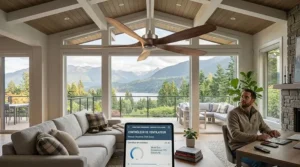
What most buyers overlook is that these aerodynamic ceiling fan blades aren’t purely about raw CFM output — they’re about efficiency per watt. A fan that moves slightly less total air but does so with dramatically less turbulence-related energy loss can feel just as cooling while drawing meaningfully less power, which circles directly back to why curved blades and DC motors so often show up together on the same product listings.
Wind Tunnel Blade Design: How Manufacturers Actually Test Curvature
Wind tunnel blade design is the engineering process manufacturers use to measure and refine how a blade’s curve, pitch, and surface finish affect real airflow before a product ever reaches a store shelf. It borrows directly from aerospace testing methodology, just scaled down to fan-blade dimensions and speeds.
Here’s what that process typically looks like in practice, based on how the ceiling fan and HVAC-adjacent industries describe their development pipelines: engineers build a prototype blade, mount it in a controlled airflow chamber, and measure metrics like cubic feet per minute (CFM) output, static pressure, noise in decibels, and power draw across a range of rotational speeds. They then adjust the curve, thickness, and pitch incrementally and re-test, iterating toward a shape that maximizes airflow per watt while minimizing turbulence noise. This is precisely the kind of testing that produces a spec like the SculptAire’s rated CFM figures at each speed setting — those numbers don’t come from guesswork, they come from a documented wind tunnel blade design process.
For a shopper, the practical takeaway isn’t that you need to understand computational fluid dynamics — it’s that a manufacturer publishing detailed CFM-per-speed data (rather than vague “powerful airflow!” marketing copy) is a reasonable signal that real wind tunnel blade design testing sat behind the product. When a listing gives you specific numbers at specific speeds, as several premium fans on this list do, that’s a meaningfully different level of engineering rigour than a listing that only offers adjectives.
Energy Efficient Blade Curvature: What It Means for Your Power Bill
Energy efficient blade curvature describes how a well-engineered curved profile lets a fan move more air per watt of electricity than a flat-bladed equivalent, directly reducing the running cost of leaving it on through a hot Canadian summer. This is where the design conversation stops being abstract and starts showing up on your utility bill.
Natural Resources Canada’s own guidance is blunt about the scale of the difference: ceiling fans are subject to federal Energy Efficiency Regulations that set minimum performance standards precisely because blade and motor design vary so widely in real-world efficiency. Pair a genuinely curved blade with a DC motor — as the two WINGBO models on this list do — and you’re combining two separate efficiency gains: the blade curve reduces the aerodynamic energy wasted on turbulence, while the DC motor itself typically draws a fraction of the power an equivalent AC motor needs to hit the same RPM.
Here’s the real-world math worth doing before you buy: running a 60-watt AC-motor fan for eight hours a day through a Canadian summer costs meaningfully more over a season than running a 25-30 watt DC-motor curved-blade fan for the same hours, even before you factor in that a well-curved blade often lets you run a lower, quieter speed setting and still feel the same cooling effect. Over a five-year ownership period, that gap compounds into real savings — not enough to change your life, but enough that the price premium on a DC-motor curved blade fan often pays for itself.
| Factor | Straight-Blade AC Fan | Curved-Blade DC Fan |
|---|---|---|
| Typical wattage (high speed) | 55–75W | 25–35W |
| Speed settings | 3 typical | 6 typical |
| Noise at low speed | Moderate | Quiet |
| Est. seasonal running cost* | Higher | Lower |
*Estimates based on typical published wattage ranges; actual costs depend on your local electricity rate and hours of use.
Interpreting that table honestly: the upfront price difference between a budget straight-blade fan and a curved-blade DC model like the WINGBO 52″ DC Ceiling Fan is real, but it’s not the whole cost picture. Factor in a few summers of daily eight-hour use and the wattage gap starts eating into that upfront savings, which is exactly the kind of total-cost-of-ownership thinking Amazon listings never walk you through.
Sculptural Ceiling Fan Picks: When Design Becomes the Focal Point
A sculptural ceiling fan treats the fixture as a piece of functional art rather than a hidden utility, using blade shapes — wave curves, tapered acrylic, organic silhouettes — that are meant to be looked at as much as felt. This is the category the Fanimation SculptAire and Minka-Aire Light Wave both belong to, and it’s worth understanding who this style is actually for before you’re tempted by the photos.
A sculptural ceiling fan makes the most sense in a room with genuine ceiling real estate to showcase it — vaulted ceilings, open-concept great rooms, or a primary bedroom where the fan sits directly in your sightline every time you lie down. In a small, low-ceilinged room, a sculptural fan’s distinctive silhouette gets visually cramped and loses most of its impact; you’re better off with a more compact, understated option like the Royal Pacific or LB92103 in that scenario. Reviewers consistently note that these design-forward fans function as the anchor piece of a room’s lighting plan, often replacing a separate chandelier or pendant entirely rather than supplementing one.
The honest trade-off with a sculptural ceiling fan is that you’re paying a real premium for tooling and materials that are harder to mass-produce than a standard ABS paddle — acrylic blades, wave-formed housings, and multi-finish options all cost more to manufacture. If your priority is genuinely on function over form, that premium buys you diminishing returns on airflow per dollar compared to the WINGBO or LUMOLITE picks. If your priority is a fixture people notice the moment they walk in, it’s money well spent.
Curved Blade Ceiling Fan With Light: What to Actually Look For
Every single fan on this list ships as a curved blade ceiling fan with light included, which tells you where the market has settled — a fan without integrated lighting is now the exception rather than the rule for anyone shopping in the 50–52 inch range. But not all included light kits are created equal, and a few specifics are worth checking before you buy rather than after installation day.
Colour temperature adjustability is the single biggest quality-of-life factor. Fans like the WINGBO 52″ DC models offer three colour temperatures (warm 3000K through cool 6000K) adjustable via remote, letting you shift from cozy evening lighting to bright task lighting without swapping bulbs. Budget fixed-temperature models lock you into whatever colour the manufacturer chose, which is fine if you happen to like it and mildly annoying forever if you don’t. Lumen output relative to room size matters too — the LB92103’s 1000-lumen output is genuinely bright for a 50-inch fixture, while some budget lights are intentionally dimmed to extend LED lifespan, trading brightness for longevity.
Finally, check whether the light is field-replaceable or fully integrated. Several budget curved blade ceiling fan with light options use non-swappable integrated LEDs — efficient and long-lasting under normal use, but as one verified reviewer of the LB92103 noted, a genuine headache if the LED module itself fails outside the fan’s blade or motor warranty, since you can’t just twist in a new bulb.
Practical Usage Guide: Installation, Direction & Maintenance
Getting a curved blade ceiling fan working well in your home is about more than mounting it — direction, height, and a basic maintenance rhythm make a measurable difference to comfort and lifespan.
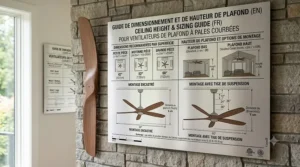
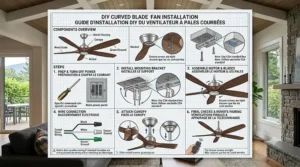
Installation basics: Most 50–52 inch curved blade fans need a minimum ceiling height of roughly 8 feet to hang safely at the recommended 7-foot minimum blade clearance from the floor; if you’re working with a lower ceiling, prioritize a flush-mount, low-profile option like the LB92103 over a downrod-style model like the Fanimation or Minka-Aire. Always confirm your existing electrical box is rated for ceiling fan weight and rotational torque — a standard light-fixture box is not automatically rated for this, and swapping to a fan-rated box is a common first-30-days oversight that leads to wobble or, worse, a fixture that eventually sags.
Direction matters more than people think. BC Hydro’s own guidance during Canadian heat events is consistent: running a ceiling fan counter-clockwise in summer pushes air straight down for a direct cooling breeze, while reversing to clockwise in winter gently redistributes warm air pooled near the ceiling without creating a draft. Nearly every fan on this list includes a reversible motor specifically for this reason, and it’s genuinely one of the most underused features on any ceiling fan sold in Canada.
A simple maintenance schedule: wipe curved blades monthly with a dry microfiber cloth (dust clings differently to a curved surface than a flat one, collecting in the concave side), check mounting screws for tightness every six months as thermal cycling can loosen them, and inspect the light kit’s connections annually if it’s not fully sealed. Common first-month mistakes include running a new fan at top speed constantly (unnecessary wear for minimal extra cooling) and mounting too close to a wall, which disrupts the airflow pattern the curved blade was engineered to produce.
Real-World Scenarios: Which Curved Blade Fan Fits Your Home
The condo owner with an open-concept great room: You’ve got 10-foot ceilings, a lot of visual sightlines from the kitchen through to the living area, and a budget that can stretch. The Fanimation SculptAire or Minka-Aire Light Wave genuinely make sense here — the sculptural blade design becomes a focal point rather than getting lost, and the damp-rated SculptAire finish options mean it could even extend to a covered balcony.
The young family furnishing a first house on a budget: Multiple bedrooms need fans, funds are tight, and durability under kid-and-pet chaos matters more than design pedigree. The WINGBO 52″ DC in either finish is the pragmatic call — six speeds for temperature flexibility across seasons, a DC motor that won’t spike the summer power bill, and a price point that lets you outfit two or three bedrooms without blowing the budget.
The renter or basement-apartment tenant with 7.5-foot ceilings: Standard downrod fans simply won’t clear safely, and a landlord probably won’t approve major electrical work. The LB92103’s flush-mount, low-profile design solves the clearance problem directly, and its pull-chain operation, while less convenient than a remote, means one less thing that can go wrong (or get lost) in a rental.
How to Choose a Curved Blade Ceiling Fan
- Measure your ceiling height first. Anything under 8 feet points you toward a flush-mount model; more clearance opens up downrod-style sculptural options.
- Match blade span to room size. A 50–52 inch fan (like every model on this list) comfortably covers rooms up to roughly 350–400 square feet; larger rooms may need a bigger span or a second fan.
- Decide between AC and DC motors. DC costs more upfront but pays back through lower running costs and quieter, more granular speed control over years of use.
- Check light kit specs, not just presence. Colour temperature range and lumen output matter more day-to-day than the fact that a light exists at all.
- Confirm your electrical box rating. A fan-rated junction box is non-negotiable for safety, regardless of how good the fan itself is.
- Weigh design against room visibility. Sculptural, curved-wave designs earn their premium in high-visibility great rooms; understated curved ABS blades make more sense in bedrooms and secondary spaces.
- Factor in reversibility. A genuinely reversible motor extends a curved blade fan’s usefulness from a single-season cooling tool into year-round comfort equipment.
Common Mistakes When Buying a Curved Blade Ceiling Fan
The most frequent error we see is buyers fixating entirely on blade count, assuming five blades automatically outperforms three. In reality, a well-engineered three-blade curved design, like the SculptAire’s 13°-pitch acrylic blades, can move comparable air to a five-blade budget fan — blade curvature and pitch matter more than raw count. A second common mistake is ignoring motor type entirely and comparing fans purely on sticker price; a cheaper AC-motor fan can cost more over a five-year period than a pricier DC model once you factor in electricity use during Canadian summers.
A third mistake worth flagging: buying based on room photos alone without checking the fan’s actual CFM rating or wattage. Marketing photography rarely conveys scale accurately, and a fan that looks perfectly proportioned in a staged listing image can look oversized or undersized on your specific ceiling. Finally, plenty of buyers skip verifying certification entirely — assuming that because a product is sold on a major retail platform, it’s automatically been tested to Canadian safety standards, which isn’t always the case and is worth confirming directly on the listing.
Curved Blade vs Straight Blade Ceiling Fans
The debate between curved blade and straight blade ceiling fans comes down to a genuine engineering trade-off, not just aesthetic preference. Straight, flat paddle blades are cheaper to manufacture, structurally simpler, and have decades of proven reliability behind them — there’s a reason they dominated the market for so long. What they sacrifice is aerodynamic efficiency: a flat blade moving through air at speed generates more turbulence and requires more raw rotational force to move an equivalent volume of air compared to a properly curved blade.
Curved blade fans, as this entire guide has laid out, translate that aerodynamic advantage into a few concrete, feelable benefits: typically quieter operation at comparable airflow, better pairing with efficient DC motors, and — for the sculptural options — a design dimension straight blades simply can’t offer. Where straight blades still win is raw simplicity and often a lower entry price for genuinely basic applications, like a garage or workshop fan where nobody’s judging the aesthetics and quiet operation isn’t a priority.
For most living spaces in a Canadian home — bedrooms, living rooms, home offices — the curved blade category’s efficiency and noise advantages make it the more sensible default in 2026, particularly now that curved-blade options exist at nearly every price point covered in this guide, from the sub-C$150 Royal Pacific to the C$600 SculptAire.
Safety, Certification & Regulations in Canada
Any ceiling fan sold in Canada, curved blade or otherwise, needs to meet federal electrical safety and energy performance requirements before it should end up on your ceiling. On the safety side, look for CSA, cETL, or cUL marks specifically — these indicate the product has been evaluated against Canadian fan-specific electrical safety standards covering everything from wiring insulation to blade material integrity and mounting stability, rather than a generic international certification that may not reflect Canadian code requirements.
On the energy side, ceiling fans and their light kits fall under Canada’s federal Energy Efficiency Regulations, meaning they’re required to meet minimum performance benchmarks before legal import or interprovincial sale — a baseline that exists specifically because efficiency varies so widely between blade and motor designs. If a fan additionally carries ENERGY STAR certification, it’s cleared a meaningfully higher bar than the regulatory minimum, which is worth checking for if long-term running cost is a priority for you.
Practically speaking for installation: confirm your local electrical code requirements (which can vary slightly by province) around fan-rated junction boxes, and if you’re not confident wiring a new circuit or swapping an existing light fixture box for a fan-rated one, this is a reasonable point to bring in a licensed electrician rather than improvising — ceiling fans are heavier and generate more rotational stress on a mounting point than a typical light fixture.
Benefits vs Traditional Alternatives
| Factor | Curved Blade Ceiling Fan | Traditional Straight-Blade Fan | Portable/Box Fan |
|---|---|---|---|
| Noise at high speed | Low–moderate | Moderate–high | High |
| Energy efficiency | High (esp. with DC motor) | Moderate | Low |
| Design/decor value | High | Low–moderate | Very low |
| Installation effort | Moderate (ceiling mount) | Moderate | None |
| Best For | Whole-room cooling with style | Budget whole-room cooling | Spot cooling, renters |
The comparison above makes the trade-offs pretty clear-eyed: a portable box fan wins on zero-installation convenience but loses badly on noise, efficiency, and any claim to belonging in a finished, styled room. A traditional straight-blade ceiling fan splits the difference, offering whole-room airflow without the aerodynamic refinement — or the price tag — of a curved blade option. For anyone furnishing a space they actually want to look at, the curved blade category, exemplified by picks like the WINGBO 52″ DC Ceiling Fan or the Fanimation SculptAire, delivers the best combination of function and form on this table.
Frequently Asked Questions
❓ What is a curved blade ceiling fan?
❓ Are curved blade ceiling fans more energy efficient than straight blade fans?
❓ Do curved blade ceiling fans move more air than straight blade fans?
❓ Can I install a curved blade ceiling fan on a low ceiling?
❓ How much does a curved blade ceiling fan cost in Canada?
Conclusion
The shift from flat, straight paddles to curved, aerodynamic blades isn’t just a passing design trend — it reflects a genuine engineering improvement that Canadian homeowners can feel in noise levels, in comfort, and eventually in a lower power bill. Whether you land on the sculptural, statement-making Fanimation SculptAire, the wave-curved Minka-Aire Light Wave, the reliably efficient WINGBO 52″ DC Ceiling Fan in either finish, or one of the genuinely budget-friendly options like the LUMOLITE, Royal Pacific Lighting 1007WW, or LB92103, you’re buying into a blade shape with real physics behind it, not just a fresher look.
The right choice ultimately comes down to three honest questions: how much ceiling clearance do you actually have, how much are you willing to spend upfront versus save over years of running costs, and does this room want a fan that disappears quietly overhead or one that announces itself the moment someone walks in. Answer those three questions honestly, cross-reference them against the comparison tables above, and you’ll land on a curved blade ceiling fan that earns its spot on your ceiling for years, not just for one hot Canadian summer.
Recommended for You
- Retractable Blade Ceiling Fan: 7 Brilliant Picks for 2026
- Modern Bladeless Ceiling Fan: 7 Best Picks for Canadians in 2026
- Enclosed Ceiling Fan Guide: 7 Safest Picks for Canadian Homes (2026)
Disclaimer: This article contains affiliate links. As an Amazon Associate, I earn from qualifying purchases. If you purchase products through these links, we may earn a small commission at no additional cost to you.
✨ Found this helpful? Share it with your friends! 💬🤗
