
In This Article
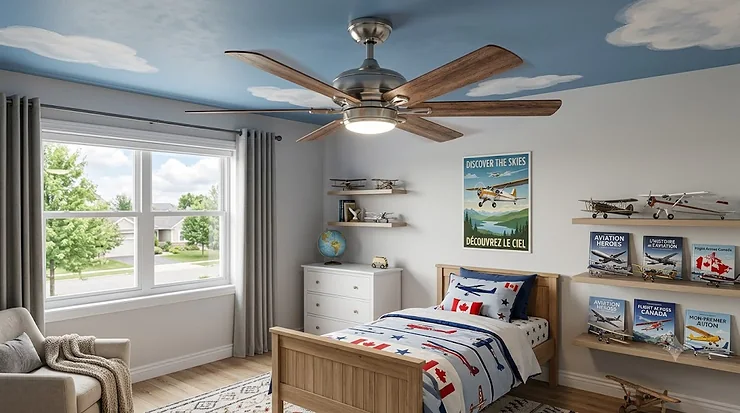
There’s a particular kind of person who walks into a room, looks up, and thinks: “that ceiling needs a propeller.” Maybe it’s the retired air cadet. Maybe it’s the guy who’s rebuilt a Cessna carburetor in his garage for fun. Maybe it’s just someone who’s tired of the same boring five-blade beige fan every builder in the country seems contractually obligated to install. Whatever the reason, an airplane ceiling fan has quietly become one of the more distinctive ways to bring personality into a Canadian home — part functional cooling appliance, part conversation piece hanging from your joists.
This guide digs into what actually separates a genuinely well-built aviation-style fan from a novelty item that rattles after two Alberta winters. We looked at real models from established manufacturers — the kind sold through Amazon.ca and specialty lighting retailers — and broke down their motors, blade materials, and the honest, aggregated sentiment real owners have shared in reviews. An airplane ceiling fan, at its core, is a propeller-bladed ceiling fan styled to echo classic aircraft design: two or three long, tapered blades instead of the usual four or five, often finished in wood, brushed nickel, or hand-painted “warbird” nose art. Whether you’re kitting out a man cave, finishing a garage workshop, or just want your loft to look less like a rental unit and more like a hangar, there’s a real option out there — and by the end of this piece, you’ll know exactly which one fits your ceiling, your budget, and your degree of aviation obsession.
Quick Comparison Table
| Fan | Style | Blade Span | Price Range (CAD) | Best For |
|---|---|---|---|---|
| Minka-Aire Aviation | Modern propeller | 60″ | C$650–C$750 | Statement piece, large rooms |
| Craftmade Warplanes P-40 Tiger Shark | Vintage warbird | 48″ | C$180–C$260 | Man cave, budget nose-art fan |
| Fanimation Prop | Sculptural/design | 54″–60″ | C$550–C$700 | Design-forward living spaces |
| Kichler Ridley II | Industrial minimalist | 52″ | C$300–C$400 | Industrial loft lighting pairing |
| Hunter Nocturnal | Outdoor propeller | 52″ | C$220–C$300 | Garage, patio, covered porch |
| Kichler Ferron | Two-blade DC | 54″–60″ | C$400–C$500 | Quiet, low-energy operation |
| Minka-Aire Dyno | Smart 5-blade | 54″ | C$400–C$550 | Wi-Fi/smart home integration |
Looking across the lineup, there’s a clear split between design-forward propeller fans that prioritize the aviation silhouette (the Minka-Aire Aviation and Fanimation Prop) and value-driven picks built for garages and rec rooms (the Craftmade Warplanes P-40 Tiger Shark and Hunter Nocturnal). If smart home control matters more to you than the propeller look itself, the Minka-Aire Dyno straddles both worlds with Wi-Fi compatibility layered onto a classic five-blade design. Budget shouldn’t be your only filter here — a C$200 fan that rattles at speed three isn’t actually cheaper than a C$450 fan that lasts fifteen years.
💬 Just one click — help others make better buying decisions too!😊
Top 7 airplane ceiling fan Options: Expert Analysis
Picking the right airplane ceiling fan isn’t just about finding something with propeller blades — motor quality, blade pitch, and finish durability separate a fan you’ll love in five years from one you’ll be troubleshooting by next spring. Here’s the honest breakdown of seven real models worth your attention, spanning budget, mid-range, and premium territory.
1. Minka-Aire Aviation — best all-around premium statement piece
The Minka-Aire Aviation is the fan most people picture when they hear “airplane ceiling fan,” and for good reason — its 60-inch span and three sculpted ABS blades genuinely look like they were lifted off a mid-century aircraft. The DC motor is the real story here: it draws a fraction of the power an equivalent AC motor would, while still delivering strong airflow across six speeds via the included remote. Based on the spec comparison against similarly sized AC fans, DC motor technology typically means quieter operation at low speeds and a noticeably longer motor lifespan, since there’s less heat buildup during extended use. This fan is for the buyer who wants the full aviation aesthetic without it looking like a kid’s bedroom fixture — think great room, home office, or a converted loft with 10-foot-plus ceilings where a 60-inch span won’t feel oversized. Reviewers consistently report that the finish options (brushed nickel, distressed koa, matte white) hold up well over years of use, though a handful note the remote’s range is shorter indoors than expected in larger, open-concept spaces. At around C$650–C$750, it sits at the premium end, but the value verdict holds up: for a fan meant to be a room’s focal point, the build quality and finish selection justify the price gap over entry-level propeller fans.
Pros:
- ✅ Genuine DC motor for quiet, energy-efficient operation
- ✅ Three premium finish options to match existing décor
- ✅ Full-function remote with six speed settings
Cons:
- ❌ Premium price compared to AC-motor alternatives
- ❌ 60-inch span is too large for smaller bedrooms
2. Craftmade Warplanes P-40 Tiger Shark — boldest man cave nose-art design
If the Minka-Aire Aviation is the tasteful aviation nod, the Craftmade Warplanes P-40 Tiger Shark is the full commitment — a 48-inch fan with hand-painted nose art replicating the legendary “Flying Tiger” shark mouth that graced Curtiss P-40 Warhawk fighters during the Second World War. The three propeller-shaped blades sit at a 15-degree pitch on a compact, reversible three-speed motor that Craftmade rates as drawing less than one amp — genuinely more efficient than a single old-school incandescent bulb. What most buyers overlook about this model is that it’s a flush-mount “hugger” design, meaning it hangs close to the ceiling, which makes it a smart pick for garages, basements, or rec rooms with lower clearance where a downrod-mounted fan would feel too low. This is squarely a man cave and garage ceiling fan pick rather than a living-room centrepiece; the bold graphics read as playful rather than sophisticated, which is exactly the point for buyers building out a themed space. Aggregated owner feedback tends to praise the character and value of the piece while noting the AC motor is audibly louder at top speed than the DC models further up this list — a fair trade-off at this price point. In the C$180–C$260 range, it’s one of the most affordable ways to get genuine aviation styling on your ceiling.
Pros:
- ✅ Authentic WWII nose-art design with real historical roots
- ✅ Low-profile hugger mount fits garages and low ceilings
- ✅ Under 1 amp draw — efficient for continuous garage use
Cons:
- ❌ AC motor is noticeably louder at highest speed
- ❌ Bold graphics won’t suit every room’s décor
3. Fanimation Prop — sculptural design-award blades
Designed in collaboration with the Michael Graves Design Group, the Fanimation Prop is less a “ceiling fan with propeller blades” and more a piece of kinetic sculpture that happens to move air. Three hand-carved buttonwood blades curve continuously from hub to tip, finished in a brushed nickel motor housing that reads as contemporary rather than retro-military. Here’s what to weigh: this fan trades raw airflow numbers for design pedigree, so if your priority is maximum CFM in a large room, this isn’t the pick — but if you want a fan that looks equally at home in a modern condo or a mid-century-styled den, few propeller fans match its restraint. The natural buttonwood finish is a genuine differentiator; reviewers note the wood grain varies slightly blade to blade since each is individually carved, which some buyers love for the handmade feel and others find inconsistent compared to painted ABS blades. It’s a strong pick for the aviation style ceiling fan buyer who wants subtlety over shark-tooth theatrics — a design piece first, a cooling appliance second. At C$550–C$700, it competes directly with the Minka-Aire Aviation, and the choice between them really comes down to whether you want overt aircraft styling or an abstracted, gallery-ready interpretation of it.
Pros:
- ✅ Award-winning design collaboration (Michael Graves Design Group)
- ✅ Individually hand-carved solid wood blades
- ✅ Brushed nickel finish suits modern and traditional décor
Cons:
- ❌ Blade grain variation isn’t for buyers wanting uniformity
- ❌ Airflow is modest compared to wider-bladed alternatives
4. Kichler Ridley II — best minimalist industrial-loft look
The Kichler Ridley II takes the propeller silhouette and strips it down to essentials: a 52-inch span, three walnut blades at a 14-degree pitch, and a dimmable integrated LED kit that avoids the bulky glass shade typical of older fan designs. This is the fan for the industrial loft lighting crowd — exposed brick, black metal fixtures, minimalist furniture — where a fussy, ornate fan would clash badly. Reviewers consistently note the finish options (oil-rubbed bronze, antique pewter, natural bronze) read as intentionally understated rather than cheap, which matters when a fan is meant to disappear into a design scheme rather than dominate it. Based on the spec comparison with other integrated-LED fans in this category, the Ridley II’s wall-control compatibility (rather than relying solely on a remote that inevitably gets lost in a couch cushion) is a small but genuinely practical advantage for households that don’t want another piece of plastic to misplace. It’s not a loud, aviation-first statement fan — it’s a fan for people who want the propeller aesthetic to read as one design choice among many, not the whole room’s theme. At C$300–C$400, it lands comfortably in mid-range territory, delivering integrated lighting and solid build quality without premium-tier pricing.
Pros:
- ✅ Minimalist three-blade design suits industrial décor
- ✅ Integrated dimmable LED — no separate light kit needed
- ✅ Wall control option in addition to remote
Cons:
- ❌ Fewer statement finishes than warbird-style competitors
- ❌ 14-degree pitch moves less air than steeper-pitch fans
5. Hunter Nocturnal — best indoor/outdoor garage pick
Garages take a beating that living rooms never see — humidity, temperature swings, the occasional car exhaust drifting up before the door’s fully open — and the Hunter Nocturnal is built with that reality in mind. Rated for indoor/outdoor use, this 52-inch propeller fan in a noble bronze finish is damp-location certified, meaning it can handle a garage, covered porch, or three-season sunroom without the motor housing corroding prematurely. Hunter’s SureSpeed technology, featured across much of the brand’s propeller lineup, is engineered to guarantee a specific airflow output regardless of room conditions — in practice, this means less “is this thing even on” uncertainty compared to bargain-bin fans that promise a lot on the box and deliver a gentle breeze in reality. What most buyers overlook about garage ceiling fan shopping generally is that damp rating matters more than blade count; a beautifully finished indoor-only fan installed in an unheated garage will corrode and seize far faster than a plainer damp-rated model. Aggregated review sentiment praises the reversible motor for genuinely useful winter/summer switching in unheated spaces, with occasional notes that assembly instructions could be clearer for first-time installers working without an electrician. At C$220–C$300, it’s a genuinely practical pick rather than a pure style statement.
Pros:
- ✅ Damp-location rated for garages, porches, and patios
- ✅ SureSpeed airflow guarantee across speed settings
- ✅ Reversible motor for year-round garage comfort
Cons:
- ❌ Assembly instructions could be clearer for DIYers
- ❌ Bronze finish is the only colour option in this line
6. Kichler Ferron — lightest 2-blade DC torque
Two-blade propeller fans are a smaller niche within an already niche category, and the Kichler Ferron is one of the more refined examples on the market. Its DC motor provides high torque at low RPM — in practice, that means strong, steady air movement even on the lowest speed setting, which is the opposite of how cheaper motors behave (weak at low speed, only useful cranked to high). The two-blade design at a 25-degree pitch is a distinctive look on its own; rather than reading as “airplane fan,” it leans closer to abstract mid-century modern, which appeals to buyers who want the propeller-inspired silhouette without the more literal warbird or nose-art associations. Here’s what to weigh: fewer blades generally mean a lighter overall fixture (easier on ceiling boxes not rated for heavy loads) but also somewhat less airflow surface area than a three- or five-blade equivalent at the same span — a legitimate trade-off rather than a flaw. Reviewers note the low-speed torque advantage is real and noticeable, particularly in bedrooms where a barely-perceptible breeze overnight matters more than max cooling power. In the C$400–C$500 range, it’s a mid-to-premium pick aimed squarely at buyers who’ve already decided propeller styling matters and are now optimizing for quiet, efficient operation over raw CFM numbers.
Pros:
- ✅ High-torque DC motor performs well even at lowest speed
- ✅ Distinctive two-blade silhouette stands out from typical fans
- ✅ Lighter overall weight than multi-blade equivalents
Cons:
- ❌ Less total airflow surface area than 3-5 blade designs
- ❌ Niche look won’t appeal to buyers wanting a “classic” prop
7. Minka-Aire Dyno — best smart-home WiFi control
Rounding out the list is the Minka-Aire Dyno, a five-blade fan that leans less on the propeller silhouette and more on smart-home practicality — though its blade profile still nods to the aviation-inspired aesthetic that defines this category. Wi-Fi compatibility through the BOND platform means the Dyno can be scheduled, voice-controlled, and grouped with other smart devices, a genuine step up from remote-only operation for buyers already invested in a connected home. Based on the spec comparison against remote-only propeller fans, the practical advantage here isn’t dramatic day-to-day, but it removes the “where’s the remote” friction entirely and lets the fan respond automatically to smart thermostat schedules. The dimmable LED light kit and reversible motor round out a fixture built for buyers who want smart functionality first and aviation-adjacent styling second — this isn’t the fan for someone chasing an authentic warbird look, but it’s a smart pick for anyone furnishing a modern home office or living room who still wants a propeller-style silhouette overhead. Reviewers report the BOND pairing process is generally smooth, with occasional notes about needing a firmware update on first setup. At C$400–C$550, it competes with mid-range traditional fans while adding genuine smart-home value most competitors on this list don’t offer.
Pros:
- ✅ Wi-Fi/BOND smart home compatibility
- ✅ Dimmable integrated LED light kit included
- ✅ Reversible motor with remote and app control
Cons:
- ❌ Firmware setup can require an initial update
- ❌ Less overtly “aviation” styling than warbird-focused models
Practical Usage Guide: Setup, Maintenance & Optimization
Getting an airplane ceiling fan installed right the first time saves you a second trip up the ladder later. Before mounting, confirm your electrical box is rated to support the fan’s weight — most propeller fans in this roundup weigh between 15 and 25 pounds, and a standard light-fixture box isn’t rated for that load; you’ll need a proper fan-rated ceiling box. For fans like the Craftmade Warplanes P-40 Tiger Shark with hugger/flush mounts, double-check your ceiling height first: hugger mounts are designed for rooms under roughly 8 feet of clearance, while a downrod-mounted fan like the Minka-Aire Aviation needs more vertical space to hang at the ideal 8–9 foot blade height for proper air circulation.
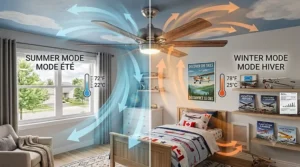
Once installed, the most common first-30-days mistake is skipping the reverse-direction test. Every reversible fan on this list should spin counterclockwise in summer (pushing air straight down) and clockwise in winter (pulling air up and redistributing warm air along the ceiling). Run each direction for a minute after installation to confirm the switch works before you’re relying on it during a July heat wave. For maintenance, a light dusting every two to three months keeps blades balanced — even a thin, uneven layer of dust on wood or ABS blades can cause a barely perceptible wobble that gets worse over time. If you notice wobble developing, most manufacturers include small balancing weights in the box; clip one to the underside of the blade opposite the heaviest point until the wobble disappears. Motors on DC models like the Kichler Ferron rarely need lubrication, but older AC motors occasionally benefit from a drop of fan-specific oil at the motor’s oil port every couple of years — check your manual, since not all sealed motors are designed to be opened.
Real-World Scenarios: Which airplane ceiling fan Fits Your Space
The garage workshop owner. Say you’re spending weekend afternoons in an insulated but unheated garage, working on a project car or just avoiding the house. Your priority is a fan that survives temperature swings and humidity without complaint — this is exactly the scenario the Hunter Nocturnal was built for, with its damp-location rating and reversible motor keeping the space bearable whether it’s August or January.
The man cave builder on a budget. You’ve got a finished basement rec room, low ceilings, and a genuine soft spot for WWII aviation history. Budget matters, but so does character. The Craftmade Warplanes P-40 Tiger Shark hits both marks — its flush hugger mount handles the low ceiling, and its price leaves room in the budget for the rest of the man cave decor ideas on your list, whether that’s a neon sign or a proper leather recliner.
The design-conscious condo dweller. Your space is small but intentional — mid-century furniture, a curated art wall, nothing that reads as “theme decor.” Here, the Fanimation Prop or Kichler Ridley II make more sense than anything with painted nose art; both let the propeller silhouette speak quietly rather than shouting “airplane” at every visitor.
How to Choose an airplane ceiling fan
- Measure your room first, not the fan you like. A 60-inch fan in a 10×10 bedroom will feel oppressive; match blade span to square footage before falling for a finish.
- Decide if you want literal or abstracted aviation styling. Nose-art fans like the Craftmade Warplanes P-40 Tiger Shark read very differently from sculptural picks like the Fanimation Prop — know which impression you’re going for.
- Check the mounting type against your ceiling height. Hugger/flush mounts suit low ceilings; downrod mounts need more clearance for proper airflow.
- Confirm damp or outdoor rating if it’s going in a garage or covered porch. Indoor-only fans corrode faster in humid, unheated spaces.
- Weigh DC versus AC motors. DC options like the Kichler Ferron cost more upfront but run quieter and more efficiently over years of use.
- Consider smart-home compatibility if you’re already invested in that ecosystem. The Minka-Aire Dyno is the clear pick if app and voice control matter to you.
- Budget for the whole fixture, not just the fan. Factor in a fan-rated ceiling box, downrod length, and potential electrician labour if you’re not comfortable with the install yourself.
Common Mistakes When Buying a propeller ceiling fan
The single most common mistake is buying on looks alone and skipping the room-size math — a fan that’s too large for its space doesn’t just look wrong, it moves air inefficiently, pushing a forceful draft directly below the fan while leaving the room’s corners stagnant. A close second is ignoring blade pitch. Fans with a shallow pitch (under 12 degrees) look sleek but move noticeably less air than steeper-pitched blades at the same span; if cooling performance actually matters to you, don’t choose purely on the visual angle of the blades. Buyers also frequently underestimate mounting requirements, assuming any ceiling box will do — a fan-rated box, properly secured to a joist or approved brace, is non-negotiable for anything heavier than a basic light fixture. Finally, skipping the reverse-airflow feature check at purchase is a mistake that only becomes obvious in the wrong season; not every entry-level fan includes a reliable reverse switch, and it’s a genuinely useful feature for anyone trying to squeeze value from both summer and winter HVAC savings.
airplane ceiling fan vs Traditional Ceiling Fan
The core difference isn’t just aesthetic — it’s blade geometry. Traditional five-blade ceiling fans use shorter, wider blades designed to maximize even air distribution across a room with minimal noise. Propeller-style aviation fans use fewer, longer, more tapered blades, which is closer to how an actual aircraft propeller is shaped to move air efficiently at speed. In practice, this means airplane ceiling fans with only two or three blades can move a comparable amount of air to five-blade traditional fans, but the airflow pattern feels different — more directional, less like ambient background circulation.
| Factor | Airplane/Propeller Style | Traditional 4-5 Blade |
|---|---|---|
| Blade count | 2-3 | 4-5 |
| Visual impact | Statement piece | Blends into background |
| Airflow pattern | Directional, focused | Even, diffuse |
| Typical price range | C$180-C$750 | C$80-C$400 |
| Best For | Themed rooms, statement décor | Standard bedrooms, rentals |
What this table doesn’t fully capture is maintenance philosophy: fewer blades on a propeller fan mean less total surface area to dust, but also less redundancy — if one blade on a two-blade fan warps slightly, the imbalance is more noticeable than on a five-blade fan where the effect is distributed. For most Canadian homeowners, the choice really comes down to whether the room is meant to make a design statement (choose propeller-style) or simply function reliably in the background (a traditional fan is often the more practical, budget-friendly call).
✨ Don’t Miss These Exclusive Deals!
🔍 Take your airplane ceiling fan search to the next level with these carefully selected models. Click on any highlighted product to check current pricing and availability. These fans will help you create the authentic aviation-inspired space your whole household will actually enjoy!
Vintage airplane ceiling fan Style: What Makes the Look Authentic
Not every fan marketed as “airplane style” earns the description. Authentic vintage airplane ceiling fan design draws directly from early-to-mid 20th century aircraft propellers — wood or metal blades with a pronounced taper from hub to tip, minimal ornamentation beyond the blade shape itself, and finishes like distressed koa, brushed nickel, or hand-painted nose art rather than glossy plastic. The Craftmade Warplanes P-40 Tiger Shark, with its faithful reproduction of the Curtiss P-40 Warhawk’s iconic shark-mouth nose art, is one of the more historically grounded options on the market — that graphic wasn’t invented for home décor; it was combat livery, and the fan replicates it with genuine attention to detail rather than a generic cartoon shark face.
Reviewers consistently note that the difference between an authentic-feeling vintage fan and a cheap imitation usually comes down to blade material and finish depth. Painted ABS blades with a thin, glossy coat tend to look plastic-y up close, while hand-finished wood or properly primed metal-look blades hold up to scrutiny. If vintage authenticity matters to you more than budget, prioritize models explicitly described as replicating a specific historical aircraft or era over generic “airplane-style” listings with vague marketing copy.
airplane ceiling fan for Man Cave and Garage Spaces
Man cave decor ideas tend to cluster around a few reliable anchors — a proper seating setup, some kind of memorabilia wall, decent lighting, and increasingly, a themed ceiling fixture that ties the whole room together. An airplane ceiling fan is one of the few functional appliances that doubles as genuine décor rather than something you just tolerate for the airflow. For a garage specifically, function has to come first: garage ceiling fan buyers need to prioritize damp/temperature tolerance (the Hunter Nocturnal is purpose-built for this) before worrying about how aggressively “aviation” the styling looks. For a finished basement or spare-room man cave without humidity concerns, you’ve got more design freedom — the Craftmade Warplanes P-40 Tiger Shark leans hard into nose-art theatrics, while the Kichler Ridley II offers a quieter industrial edge if your space skews more “modern workshop” than “WWII hangar.”
One practical note aggregated across owner reviews: garage installations should account for the extra dust and grime a workshop generates. Fans with exposed motor housings or intricate blade carving (like the Fanimation Prop) will show dust buildup faster and require more frequent cleaning than simpler, smoother-bladed designs in a space where sawdust or exhaust residue is a regular presence.

Industrial Loft Lighting: Pairing Your Aviation Style Ceiling Fan with the Right Fixtures
Industrial loft lighting works on a simple principle: exposed materials, black or brushed metal finishes, and fixtures that look functional rather than decorative. An airplane ceiling fan fits naturally into this aesthetic because propeller blades already read as mechanical and purposeful rather than ornamental. The Kichler Ridley II is the strongest fit here — its walnut blades and oil-rubbed bronze or antique pewter finish echo the warm metal tones common in loft conversions, while its integrated LED avoids the need for a separate pendant light competing for ceiling space.
When building out a full industrial lighting scheme around a propeller fan, aim for consistency in metal finish across the room — matte black or bronze fixtures paired with a nickel fan will look mismatched under close inspection, even if each piece is attractive individually. Track lighting or simple pendant fixtures in a matching finish family tend to complement a propeller fan’s silhouette better than ornate chandeliers, which compete visually rather than reinforce the aesthetic. If your loft has exposed ductwork or brick, a fan with a more mechanical, minimal profile — think the Kichler Ferron’s two-blade design — often reads as more intentional than a fussier, multi-finish option.
Long-Term Cost & Maintenance
The purchase price is only part of the total cost of ownership story. ENERGY STAR certified ceiling fans use roughly 60% less energy on average than standard models, according to Natural Resources Canada, and running a fan alongside your air conditioner — setting the thermostat a couple of degrees higher and letting the fan handle comfort — can cut air conditioning costs by roughly 14%, per NRCan’s own guidance. Over a decade of seasonal use, that adds up meaningfully, particularly for larger homes running central air through Canadian summers.
DC motor fans like the Minka-Aire Aviation and Kichler Ferron carry a higher sticker price but tend to have a lower true cost of ownership once you factor in reduced electricity draw and typically longer motor lifespans compared to AC alternatives. Maintenance costs stay low across this category generally — occasional blade cleaning, the rare balancing weight adjustment, and motor lubrication only for older non-sealed AC units. Where costs can spike is in mounting hardware: if your existing ceiling box isn’t fan-rated, budget for a licensed electrician to install a proper brace, typically a one-time cost that’s easy to overlook when comparing sticker prices between models.
| Cost Factor | Budget Fans (e.g. Craftmade) | Premium DC Fans (e.g. Minka-Aire) |
|---|---|---|
| Upfront price | C$180-C$300 | C$550-C$750 |
| Estimated annual energy cost | Moderate | Low (DC efficiency) |
| Expected motor lifespan | 8-12 years | 12-20+ years |
| Best For | Occasional-use spaces | Daily-use main living areas |
Interpreting this table honestly: a budget fan running occasionally in a garage doesn’t need premium DC efficiency to justify itself, but a fan running daily in a main living space will likely pay back the price gap on a DC motor over its lifetime through lower electricity draw and fewer replacement cycles.
Safety, CSA Certification & Regulations Guide
In Canada, certification is legally required for electrical products sold and installed in homes, and ceiling fans are no exception. Look for a mark from an accredited body — CSA Group is the most commonly recognized certifier for electrical products in the Canadian market, alongside UL Solutions Canada and Intertek Canada. A CSA or equivalent mark confirms the fan has been independently tested against Canadian electrical safety standards, which matters more than it might seem: an uncertified fan can be difficult or impossible to get a licensed electrician to install, and in the rare case of a fault, an uncertified product complicates any home insurance claim tied to the installation.
Beyond certification, a few practical safety notes apply specifically to propeller-style fans. Because these fans often use fewer, longer blades than traditional designs, proper balancing at installation matters more — an unbalanced propeller fan can develop a wobble that stresses the mounting point over time. Always confirm your ceiling box is fan-rated (not just light-fixture rated) before mounting anything heavier than a few pounds, and if you’re installing a damp-rated fan like the Hunter Nocturnal outdoors or in a garage, double-check it’s rated for the specific level of moisture exposure your space sees — “damp location” and “wet location” are distinct certifications with different real-world tolerances.

FAQ
❓ What is an airplane ceiling fan?
❓ Are propeller ceiling fans more efficient than traditional fans?
❓ Can I install an airplane ceiling fan in my garage?
❓ Do vintage-style airplane fans cost more than regular ceiling fans?
❓ How do I know if a ceiling fan is safe to install in Canada?
Conclusion
An airplane ceiling fan sits in that rare category of home fixtures that’s genuinely both function and personality — it cools the room and tells visitors something true about the person who chose it. Whether that’s the Minka-Aire Aviation commanding attention in a great room, the Craftmade Warplanes P-40 Tiger Shark anchoring a proper man cave, or the quietly confident Kichler Ridley II blending into an industrial loft, the right pick comes down to matching motor type, mounting style, and finish to the actual room you’re putting it in — not just the fan that looks best in a product photo. Measure first, decide how literal you want the aviation theme to read, and factor in the total cost of ownership rather than just the sticker price, and you’ll end up with a fixture that earns its spot on the ceiling for well over a decade.
Recommended for You
- Curved Blade Ceiling Fan: 7 Best Picks for Canadian Homes 2026
- 7 Specialty Ceiling Fan Blades That Actually Transform a Room (2026)
- Retractable Blade Ceiling Fan: 7 Brilliant Picks for 2026
Disclaimer: This article contains affiliate links. As an Amazon Associate, I earn from qualifying purchases. If you purchase products through these links, we may earn a small commission at no additional cost to you.
✨ Found this helpful? Share it with your friends! 💬🤗
