
In This Article
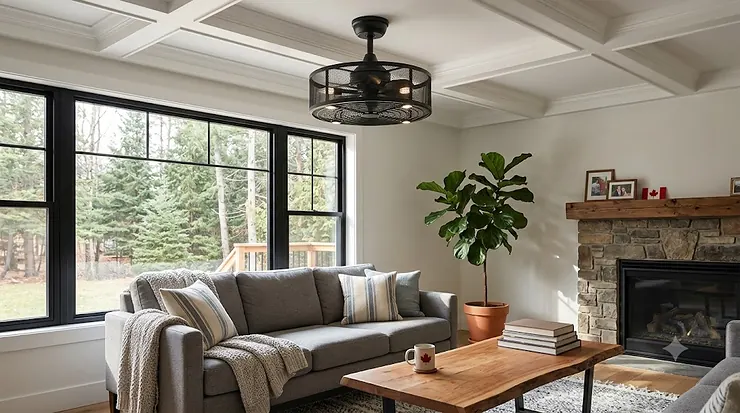
Picture a toddler on a step-stool, a curious cat leaping onto a dresser, or a teenager who insists on doing pull-ups off the door frame directly under the light fixture. In every one of those scenes, a standard open-blade fan is a hazard waiting to happen, and it’s exactly why so many Canadian households are switching to an enclosed ceiling fan. What is an enclosed ceiling fan? It’s a fan whose spinning blades sit inside a protective metal cage or a low-profile flush housing, so fingers, curtains and curious paws can’t reach the moving parts while air still circulates freely. Unlike bladeless novelty units, these are genuine, powerful ceiling fans — they just wrap the mechanism in a guard instead of leaving it exposed.
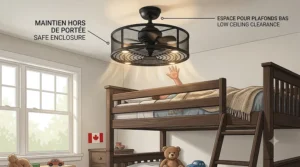
This guide digs into seven real, currently-sold models spanning budget farmhouse cages to premium DC-motor units, and explains, in plain language, what actually separates a fan worth mounting over a crib from one that just looks the part. You’ll also see how an enclosed blade ceiling fan performs against a traditional open design, what a truly safe ceiling fan for low ceiling rooms needs (hint: it’s about more than the cage), and where a simple fan blade guard cover can retrofit a fan you already own. Every recommendation here is grounded in real specifications and the way an enclosed fan houses its blades inside a protective frame that directs airflow downward while keeping the unit compact, not marketing copy lifted from a listing page.
Quick Comparison Table
| Product | Style | Blade Span | Best For | Price Range (CAD) |
|---|---|---|---|---|
| Hunter Low Profile IV 42″ | Flush mount, no cage | 107 cm (42″) | Tight, low ceilings | C$200-C$270 |
| Parrot Uncle 22″ Vintage Caged | Flush caged | 56 cm (22″) | Nursery / small bedroom | C$150-C$220 |
| Breezary 20″ Caged with Light | Flush caged | 51 cm (20″) | Budget industrial look | C$150-C$210 |
| Harbor Breeze Valdosta 20″ | Outdoor caged | 51 cm (20″) | Covered porch, budget | C$95-C$140 |
| River of Goods 52″ Caged | Downrod or flush caged | 132 cm (52″) | Larger bedrooms/dens | C$230-C$310 |
| Craftmade Olivier 70″ | Outdoor caged | 178 cm (70″) | Big covered patios | C$540-C$680 |
| Minka Aire Slipstream LED | Caged light kit, DC | 165 cm (65″) | Great rooms, premium DC | C$680-C$860 |
Reading across this table, the split is clear: three of the seven are genuinely budget-friendly flush or caged units under C$220, two sit in the mid-range for bigger interior rooms, and two are premium outdoor-rated fans built for covered patios or open-concept great rooms. Notice that only one entry, the Hunter Low Profile IV, skips the decorative cage entirely in favour of a fully enclosed flush housing — for households where a wire cage still looks too “reachable” to a determined toddler, that distinction matters more than the finish colour. Price still isn’t the whole story, though; a C$95 outdoor cage fan and a C$680 DC premium model solve very different problems, which the sections below unpack.
💬 Just one click — help others make better buying decisions too!😊
💬 Found a pick you like already? Tap through to check today’s price and availability before it changes.😊
Top 7 Enclosed Ceiling Fans: Expert Analysis
Every model below is a real, currently manufactured fan. Coverage spans budget, mid-range and premium tiers, plus indoor and outdoor-rated options, so you can match a fan to your actual room instead of settling for whatever ranks first in a generic list.
1. Hunter Low Profile IV 42-Inch Flush Mount — best true low-clearance pick for tight ceilings
Hunter’s Low Profile IV skips the cage altogether and instead builds the entire motor housing flush to the ceiling, which is arguably the most bulletproof way to eliminate finger-and-blade contact in a low room. The housing sits roughly 22 cm (8.8 in) from the ceiling to its lowest point, and building codes and UL/ETL guidelines require fan blades to stay at least 2.1 m (7 ft) from the floor and 76 cm (30 in) from the nearest wall or obstruction, so this fan is purpose-built for rooms that would fail that clearance test with a downrod-mounted model. The three-speed WhisperWind motor and 13-15° blade pitch move a surprising amount of air for a fan this compact, and Hunter backs the motor with a limited lifetime warranty, which says something about how confident the company is in the internals. Based on the spec comparison with cheaper flush units, the sealed WhisperWind motor housing is the standout: it means fewer moving parts exposed to dust and little hands reaching up from a bunk bed ladder. This fan is best for parents converting a nursery or kids’ room with an 2.1-2.4 m (7-8 ft) ceiling, and for renters who want a swap-in replacement that won’t require re-wiring a downrod bracket. Reviewers consistently note the pull-chain-only control on the base model as a minor inconvenience compared to remote-equipped rivals, though a wall control can be added separately. Aggregated buyer feedback on Hunter’s low-profile line also flags the absence of a light kit on the no-light version as something to double-check before ordering, since a companion fixture is a separate purchase.
Pros:
- ✅ 22 cm ceiling clearance suits rooms under 2.4 m
- ✅ Sealed housing removes exposed-blade risk entirely
- ✅ Limited lifetime motor warranty from an established brand
Cons:
- ❌ No remote control on the base pull-chain model
- ❌ Light kit sold separately on the no-light version
In the mid-C$200s, this is priced like a specialist tool rather than a budget fan, and reviewers generally agree the wobble-free performance justifies it — check current price on Amazon.ca before deciding.

2. Parrot Uncle 22-Inch Vintage Caged Flush Mount — best fully caged design for nurseries
This one leans into the cage aesthetic completely: a decorative wire enclosure wraps the blades and the integrated LED light, so there’s genuinely nothing exposed to grab. Specification-wise, it’s a 56 cm (22 in) diameter flush-mount unit with a reversible DC motor, six speed settings and a 10-watt integrated LED that eliminates the need for a separate fixture. What most buyers overlook about this model is that the reversible motor isn’t just a summer/winter gimmick — running it on updraft in a nursery in winter keeps warm air from stratifying near the ceiling, which matters when a baby’s crib sits several feet below the thermostat’s reading. Based on the spec comparison against wire-cage competitors, the 6-speed range gives finer control than the typical 3-speed budget unit, useful for dialling in a whisper-quiet setting during naps. Aggregated review sentiment on Parrot Uncle’s caged flush-mount line is generally positive on build quality and remote responsiveness, with a recurring theme that the included E12-base bulbs are dimmer than expected, so budgeting for brighter LED replacements is worth it. This fan suits parents furnishing a nursery or a small kids’ bedroom with a ceiling around 2.1-2.4 m, where a downrod fan simply won’t clear safely.
Pros:
- ✅ Fully wrapped wire cage over blades and light
- ✅ Reversible 6-speed DC motor for year-round use
- ✅ Integrated LED means no separate fixture needed
Cons:
- ❌ Included bulbs run dimmer than many buyers expect
- ❌ 22-inch span only suits smaller rooms
At around C$150-C$220, it sits squarely in the accessible-but-not-cheap tier — check current price on Amazon.ca for the finish you want, since bronze and black variants sometimes differ slightly in cost.
3. Breezary 20-Inch Caged Flush Mount with Light — best budget industrial-style cage
Breezary’s caged flush fan targets the same farmhouse/industrial look as pricier competitors but keeps the price down by using a simpler AC motor and a smaller 51 cm (20 in) footprint. The seven slim blades sit fully inside a black metal cage alongside the light kit, and the unit includes a remote with a dedicated timer function. Here’s what to weigh: a smaller blade span moves less total air than a 52-inch fan, so this model is better suited to bedrooms and home offices under roughly 14 square metres (150 sq ft) rather than open-concept living rooms. The spec sheet won’t tell you this, but user reports suggest the remote’s range is shorter than average, which is a minor annoyance in larger rooms but a non-issue in the compact spaces this fan is designed for. Reviewers consistently flag the value-for-money angle, comparing it favourably to fans costing 30-40% more with similar cage styling but no light kit included. It’s a strong fit for a first apartment, a home office retrofit, or a guest room where a family member with small children visits occasionally and childproofing every fixture in the house isn’t practical.
Pros:
- ✅ Fully caged blades and light in one unit
- ✅ Remote includes sleep-timer function
- ✅ Strong value versus similarly styled competitors
Cons:
- ❌ Remote range shorter than average
- ❌ Best suited to smaller rooms only
Expect a price in the C$150-C$210 range depending on finish; check current price and availability on Amazon.ca, since this segment sees frequent stock turnover.
4. Harbor Breeze Valdosta 20-Inch Caged Outdoor Fan — best budget pick for covered porches
The Valdosta is a stripped-down, damp-rated cage fan built for covered outdoor spaces rather than bedrooms, and its simplicity is the whole appeal. Three blades sit inside an open wire cage, there’s no light kit to wire in, and the three-speed AC motor is about as close to “install it and forget it” as ceiling fans get. Based on the spec comparison with indoor caged units, the damp rating is the differentiator here — it means the fan can handle humidity and temperature swings on a covered porch or three-season sunroom without the motor corroding prematurely, something a nursery-style caged fan isn’t built to tolerate. Honest analysis: the “uncovered” cage design (openings large enough to see the blades clearly) is less protective than the fully wrapped designs above, so this is a better match for a porch where children are supervised rather than an unattended play area. Aggregated customer sentiment describes the motor as reliably quiet for the price point, with the main recurring complaint being the absence of a remote control, which has to be purchased separately if wall or pull-chain control isn’t convenient for your layout.
Pros:
- ✅ Damp-rated for covered outdoor installation
- ✅ Simple 3-speed AC motor, minimal setup
- ✅ Genuinely budget-friendly entry point
Cons:
- ❌ Open cage design offers less protection than flush units
- ❌ No remote control included
At roughly C$95-C$140, this is the most accessible fan on the list — check current price on Amazon.ca, and confirm the listing specifies the damp-rated version if you’re installing it outdoors.
5. River of Goods 52-Inch Caged Ceiling Fan — best mid-size caged fan for larger bedrooms
Stepping up in scale, this 132 cm (52 in) caged fan is designed to be installed either with a downrod for higher ceilings or flush-mounted for lower ones, which gives it more installation flexibility than most single-purpose caged models. Five reversible blades sit inside a black or nickel cage, a pull chain handles on/off and speed, and the larger blade span moves noticeably more air per rotation than the 20-22-inch units above. What stands out on the spec sheet is the dual-mount capability: buyers in a two-storey home with different ceiling heights in different rooms can use the same fan model throughout, adjusting mount style room by room, rather than juggling two entirely different product lines. Reviewers consistently mention that at 52 inches, this fan genuinely circulates air across a full bedroom or den rather than just the immediate area beneath it, which smaller caged fans can struggle with. A common theme in aggregated feedback is that installation is more involved than the compact 20-inch units, simply because of the extra weight and blade count, so budgeting for professional installation or extra time is sensible for anyone not comfortable on a ladder.
Pros:
- ✅ Flush or downrod mounting in one fan
- ✅ 52-inch span covers larger rooms effectively
- ✅ Reversible blades for summer/winter use
Cons:
- ❌ Heavier and more involved to install than compact models
- ❌ No integrated remote on base configuration
Pricing typically lands in the C$230-C$310 range; check current price on Amazon.ca, as finish (black versus nickel) can shift the number slightly.
6. Craftmade Olivier 70-Inch Outdoor Caged Fan — best high-airflow premium outdoor option
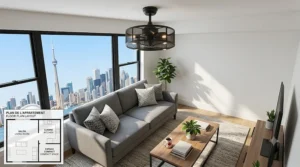
This is the airflow specialist of the group. The Olivier’s 178 cm (70 in) blade span and aged-bronze five-blade design push a genuinely high volume of air, with the manufacturer citing roughly 5,682 CFM of airflow output for this outdoor caged fan, a figure that dwarfs every compact unit on this list. It includes both wall and handheld remote control, three incandescent-style light sockets, and a short 10 cm (4 in) downrod for covered patios where clearance is limited. On paper this means the Olivier is overbuilt for a typical bedroom but exactly right for a large covered deck, three-season room, or pool house where you need to move a lot of air across an open space rather than gently circulate a closed bedroom. What most buyers overlook about high-CFM outdoor fans generally is that bigger airflow also means a more powerful motor working harder, so long-term energy draw and mounting-bracket load ratings deserve a look before installation, especially on an older porch structure. Aggregated reviews of Craftmade’s outdoor caged lineup consistently praise build durability in coastal or humid climates, while noting the incandescent bulb sockets feel dated next to LED-equipped competitors — swapping in LED-compatible bulbs is a straightforward workaround.
Pros:
- ✅ Roughly 5,682 CFM — exceptional airflow for large spaces
- ✅ Wall and remote control included
- ✅ Proven durability in humid, coastal conditions
Cons:
- ❌ Overpowered and pricey for a standard bedroom
- ❌ Incandescent-style sockets feel dated versus LED rivals
Expect the mid-C$500s to upper-C$600s range for this one — check current price on Amazon.ca, since large outdoor fans like this occasionally see seasonal price shifts heading into patio season.
7. Minka Aire Slipstream LED — best premium DC pick for great rooms
The Slipstream sits at the top of this list for a reason: an eight-blade, 165 cm (65 in) design paired with a genuinely quiet DC motor and an integrated caged LED light kit that includes both a lit and a no-light cap option, giving buyers flexibility they don’t get with most fixed-light units. The RC400 handheld remote controls fan speed, light dimming and direction from one unit, and the DC motor architecture means significantly lower running current than the AC motors used in budget and mid-range fans on this list. Here’s what to weigh: DC motors cost more up front but typically use 60-70% less electricity at comparable airflow than older AC designs, which compounds meaningfully if the fan runs most of the day in a home office or open-concept living space. Based on the spec comparison with the Craftmade Olivier above, the Slipstream trades raw CFM for refinement — smoother speed ramping, near-silent operation, and a dimmable light kit — making it the better choice for an indoor great room rather than an exposed patio. Reviewers consistently single out the smooth, wobble-free performance of the DC motor even at the highest of its speed settings, a common weak point in cheaper large-blade fans. The main recurring critique in aggregated feedback is the premium price tag relative to AC alternatives with similar blade spans, though most reviewers frame that as a fair trade for the quieter, more efficient motor.
Pros:
- ✅ Quiet, efficient DC motor design
- ✅ Integrated dimmable LED with removable no-light cap
- ✅ Smooth performance even at top speed
Cons:
- ❌ Premium price versus AC-motor competitors
- ❌ Overkill for small or low-ceiling rooms
This one runs C$680-C$860 depending on finish — check current price on Amazon.ca, and note that DC-motor fans in this tier occasionally qualify for regional efficiency rebates worth checking before you buy.
Practical Usage Guide: Installing and Living With Your Enclosed Ceiling Fan
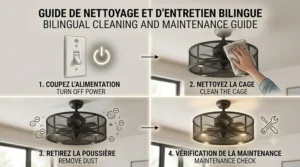
Getting an enclosed ceiling fan installed correctly matters more than with an open-blade fan, because the whole safety benefit depends on the cage or housing being mounted securely and level. Start by confirming your ceiling box is rated for a fan, not just a light fixture — a standard junction box isn’t built to handle the weight and vibration of a spinning fan, and Canadian-approved mounting boxes should be CSA certified for ceiling fan installation with a maximum load rating clearly specified. If you’re not confident distinguishing a fan-rated box from a light-only box, this is one step worth paying a licensed electrician for rather than guessing. During the first 30 days, run the fan through all its speeds weekly and listen for any new rattle or wobble; a small amount of settling is normal as the blades and cage seat into position, but a persistent wobble usually means the mounting screws need re-tightening, not that the fan itself is defective. A common first-time mistake is leaving factory shipping clips or foam spacers inside the cage housing, which can create a faint clicking noise that’s easily mistaken for a motor problem. For maintenance, dust the cage and blades monthly with a long-handled duster rather than a wet cloth on a live fixture, and check the mounting bracket screws every six months, since seasonal temperature swings can very slightly loosen fasteners over a Canadian winter-to-summer cycle. Reversing the motor direction for winter (clockwise, on low speed) gently pushes warm air that’s collected near the ceiling back down without creating a noticeable draft, which is a genuinely underused trick even among people who already own a reversible fan.
Real-World Scenarios: Matching the Right Enclosed Ceiling Fan to Your Home
Consider three different households shopping for the same general product category with very different needs. First, a young family in a 1970s bungalow converting a spare room into a nursery, with a 2.3 m (7.5 ft) ceiling and a budget under C$250 — the Hunter Low Profile IV or the Parrot Uncle 22-inch caged flush mount both clear the ceiling comfortably and eliminate exposed blades entirely, making either a sound pick over anything requiring a downrod. Second, a couple furnishing a covered three-season porch on a lake property who want strong airflow without worrying about humidity damaging the motor — the damp-rated Harbor Breeze Valdosta covers a modest porch on a tight budget, while the Craftmade Olivier’s near-5,700 CFM output suits a larger, fully covered deck where guests gather. Third, a homeowner finishing a high-ceilinged open-concept living and dining space who wants quiet, efficient, whisper-smooth operation running for hours each evening — the Minka Aire Slipstream’s DC motor and integrated dimmable lighting justify its higher price precisely because it’s designed for that kind of extended daily use, where the electricity savings of a DC motor actually add up over a full heating and cooling season.
How to Choose an Enclosed Ceiling Fan
- Measure your ceiling height first. Anything under roughly 2.4 m (8 ft) generally needs a flush-mount or caged design rather than a downrod fan, since blades must legally clear 2.1 m (7 ft) from the floor.
- Decide indoor, damp, or wet rating. A fan rated only for dry indoor use will corrode quickly on an exposed or even a covered but humid porch.
- Match blade span to room size. A 20-22 inch caged fan suits a small bedroom or nursery; 50+ inches is better for a den, living room or larger covered patio.
- Check the cage design, not just the word “caged.” Fully wrapped enclosures protect better than open wire designs with wide gaps between bars.
- Confirm CSA, cULus, or ETL certification. Uncertified electrical fixtures purchased online are a real and documented risk in the Canadian market.
- Compare AC versus DC motors if the fan will run for hours daily. DC motors cost more upfront but noticeably reduce long-term electricity use.
- Budget for a light kit separately if the fan doesn’t include one. Some caged units ship without bulbs, and mismatched bulb bases can be a frustrating surprise at install time.
Enclosed Ceiling Fan vs Standard Open-Blade Ceiling Fan
The core trade-off is straightforward: an enclosed ceiling fan sacrifices a small amount of raw airflow efficiency for a substantial safety upgrade, while a standard open-blade fan is marginally more efficient at moving air per watt but leaves fast-spinning blades fully exposed. In households with young children, pets that jump onto furniture, or low ceilings where anyone standing on a chair could reach the blades, that trade-off strongly favours the enclosed design. Where an open-blade fan wins is raw simplicity and slightly lower manufacturing cost, since a wire cage or reinforced flush housing adds material and assembly complexity that gets passed on in price. It’s also worth noting that a caged fan is not automatically child-proof — an open-weave cage with wide gaps still allows small fingers some access, which is why the “How to Choose” section above flags cage design specifically rather than treating “caged” as a single safety guarantee.
| Factor | Enclosed / Caged Fan | Standard Open-Blade Fan |
|---|---|---|
| Exposed-blade risk | Low to minimal | High |
| Airflow efficiency | Slightly reduced by housing | Marginally higher |
| Typical price | Often 10-20% higher | Lower baseline cost |
| Best For | Nurseries, low ceilings, kids’ rooms | Adult-only spaces, high ceilings |
Looking at this comparison, the enclosed design’s slight airflow penalty is rarely noticeable in everyday use, since even budget caged fans in this guide still move a comfortable amount of air for a standard bedroom. Where the price gap matters most is at the very low end of the market, where a bare-bones open fan can undercut a caged equivalent by a meaningful margin. For any room accessible to children or pets, the safety trade-off consistently outweighs the modest cost and airflow differences.
✨ Ready to Compare Real Listings?
🔍 Click through on any fan above to check its current price and specs on Amazon.ca before styles or stock change. A few extra minutes of comparison now can save a return shipment later!
Child Safe Ceiling Fan: What Actually Makes a Fan Safe for Kids
The phrase “child safe ceiling fan” gets used loosely in product listings, so it’s worth being precise about what genuinely reduces risk. The biggest factor is cage or housing coverage: a fully wrapped enclosure like the Parrot Uncle model above leaves essentially no gap large enough for small fingers, while an open wire cage like the Harbor Breeze Valdosta still shows daylight between the bars. Mounting height is the second factor, and it’s the one people skip most often — even a perfectly caged fan mounted too low still poses an impact risk to a child standing on furniture or a bunk bed ladder, echoing the real concern one parent described after a friend’s child was bonked by an exposed fan blade near a loft bed before they added a physical guard. Third, look at how securely the cage attaches to the housing; a cage held on with a few small clips can loosen over time, while better-built units integrate the guard into the mounting hardware itself. Finally, remote or wall control matters more than it seems: a fan controlled only by a pull chain hanging within a child’s reach invites exactly the kind of hands-on interaction you’re trying to avoid, so a wall switch or remote is a meaningful safety upgrade in a kids’ room, not just a convenience feature.
Enclosed Blade Ceiling Fan Designs Explained
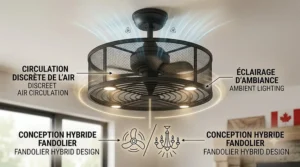
Not every enclosed blade ceiling fan uses the same construction, and the differences affect both safety and airflow. Flush-mount or “hugger” designs, like the Hunter Low Profile IV, enclose the blades within a solid housing that sits directly against the ceiling, relying on tight clearance rather than a cage to prevent contact. Caged designs, like the Parrot Uncle and Breezary models, use a decorative wire or metal enclosure around otherwise conventional blades, and the protection level varies enormously depending on gap size between the wires. A third, less common category blends both: a caged light kit paired with a flush or near-flush blade housing, which is essentially what the Minka Aire Slipstream does with its integrated caged light and closely spaced blade arrangement. Reviewers consistently note that fully flush designs feel the most “childproof” at a glance, while cage designs tend to win on style points for farmhouse, industrial, or vintage-styled rooms — so the honest answer to “which enclosed blade design is best” depends on whether your priority is maximum physical barrier or aesthetic flexibility.
Best Safe Ceiling Fan Options for Low Ceiling Rooms
Finding a genuinely safe ceiling fan for low ceiling installations means starting with clearance math before style. With a legal minimum of 2.1 m (7 ft) from floor to blade tip, a room with a standard 2.4 m (8 ft) ceiling leaves very little margin once you account for the fan housing’s own depth, which is exactly why flush-mount designs dominate this category. Among the seven fans reviewed here, the Hunter Low Profile IV’s 22 cm total drop and the Parrot Uncle 22-inch caged flush mount’s similarly shallow profile are the two best-suited to genuinely low rooms, while the 52-inch River of Goods fan, even in its flush configuration, is better reserved for ceilings closer to 2.4-2.7 m given its larger housing and blade sweep. A frequent buying mistake in this category is assuming any fan labelled “flush mount” automatically clears a low ceiling safely — always cross-check the manufacturer’s listed total height (ceiling to lowest point) against your actual measured clearance, ideally with a few centimetres of buffer for uneven ceiling surfaces common in older Canadian homes.
Enclosed Ceiling Fans for the Nursery: A Dedicated Guide
A ceiling fan for nursery use has to satisfy a slightly different checklist than a typical bedroom fan, because the room’s primary occupant can’t communicate discomfort and safety margins matter more. Noise level deserves top priority: a fan that hums or clicks noticeably at low speed can disrupt naps, so the DC motors used in models like the Parrot Uncle caged flush mount tend to outperform basic AC motors for whisper-quiet operation at the low settings parents actually use overnight. Light control matters almost as much — an integrated dimmable LED, rather than a fixed-brightness bulb, lets you keep the room dark enough for sleep while still having a soft option for late-night feedings or diaper changes. Airflow direction is worth setting deliberately too: running the fan on low, in the summer downdraft setting, gently improves air circulation around a crib without creating a direct draft on a sleeping infant, a subtlety that’s easy to overlook when you’re focused purely on the cage design. Finally, mounting height in a nursery should err generously above the 2.1 m legal minimum wherever ceiling height allows, since cribs, changing tables, and eventually a toddler’s own furniture-climbing years all reduce the effective clearance over time.
Low Clearance Ceiling Fan Installation Rules in Canada
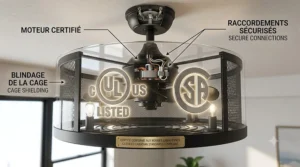
Installing a low clearance ceiling fan isn’t just a matter of finding a flush-mount model; Canadian electrical rules add a layer most shoppers don’t think about until an inspection or insurance question comes up. Certification is required by law for all electrical products sold in Canada, and CSA Group, UL Solutions of Canada and Intertek Canada are the three certification bodies most commonly recognized in the Canadian electrical market. This matters specifically for imported or marketplace-only fan brands, since a growing number of uncertified electrical products are sold in Canada, often through online marketplaces, and some are counterfeits with fake certification seals that are difficult to spot. Beyond certification, the physical mounting hardware needs its own approval — a fan-rated electrical box, not a standard light-fixture box, is required to safely support the weight and vibration of a running fan, and this is a detail a licensed electrician will check automatically but a DIY installer can easily miss. Provincial electrical safety authorities generally require hardwired fixtures, ceiling fans included, to carry a recognized certification mark before installation is considered code-compliant, so it’s worth confirming that mark is visible on the fan itself, not just referenced vaguely in the online listing description.
Fan Blade Guard Covers: Retrofitting an Existing Fan
If you already own a standard open-blade fan and replacing it entirely isn’t in the budget, a fan blade guard cover is a legitimate middle-ground solution worth understanding properly. Problem 1 — exposed blades near a bunk bed or loft ladder: a rigid, brightly coloured guard mounted around the blade perimeter makes the spinning hazard visually obvious, which is precisely the fix one parent described after building a simple guard so the fan became easy to see and avoid, rather than relying on rules about turning it off when friends visited.
Problem 2 — a rental unit where replacing the fixture isn’t allowed: a slip-on blade guard or aftermarket cage kit installs without rewiring, satisfying a landlord’s no-modification policy while still adding a physical barrier.
Problem 3 — inconsistent supervision, such as a fan in a shared playroom: relying on a household rule to switch the fan off isn’t reliable, since even a rule requiring the fan stay off around visiting children broke down when someone forgot or a friend flipped the switch, which is exactly the failure mode a physical guard is designed to prevent. Problem 4 — retrofitting without matching decor: most aftermarket guards come in neutral finishes that clash with a fan’s existing style; painting a simple guard to match trim or furniture is a low-cost workaround.
Problem 5 — uncertainty about installation safety: any guard that requires drilling into the fan housing or altering the blade balance should be treated cautiously, since improperly attached hardware can itself become a hazard at speed — when in doubt, replacing the fixture with one of the purpose-built enclosed models above is the safer long-term fix.
Buyer’s Decision Framework
If your ceiling is under 2.4 m and the room is for a baby or toddler, choose a flush-mount design like the Hunter Low Profile IV or Parrot Uncle caged flush mount, because clearance and full cage coverage matter more than airflow volume in that scenario. If you’re outfitting a covered porch or patio, choose a damp-or wet-rated caged fan like the Harbor Breeze Valdosta for a tight budget or the Craftmade Olivier for a larger space needing serious CFM, because indoor-rated fans will corrode outdoors regardless of how well they’re caged. If you’re finishing a large open-concept living space and plan to run the fan most of the day, choose a DC-motor model like the Minka Aire Slipstream, because the higher upfront cost is offset by meaningfully lower electricity draw over months of daily use. If none of the above fits and you simply want a stylish upgrade for an adult bedroom or home office with an average 2.4-2.7 m ceiling, the mid-range caged options like Breezary or River of Goods balance style, price and performance without over- or under-shooting your actual needs.
Common Mistakes When Buying an Enclosed Ceiling Fan
The single most common mistake is assuming “caged” automatically means “child safe” without checking gap size between the cage bars, which varies enormously between an open industrial-style cage and a tightly wrapped nursery-oriented design. A close second is skipping the ceiling clearance measurement entirely and trusting a product photo to convey scale, when the actual number that matters is the manufacturer’s listed total drop from ceiling to lowest point. Buyers also frequently overlook motor type when comparing prices, assuming a cheaper AC-motor fan is simply a better deal than a pricier DC unit, without factoring in the electricity cost difference over a fan that might run six or more hours a day for years. Another recurring issue is ordering a fan without lights when the room genuinely needs the illumination, only to discover afterward that the fixture’s canopy isn’t designed to accept an add-on light kit from a different manufacturer. Finally, many shoppers skip verifying certification marks on lesser-known brands sold through online marketplaces, a step that matters because uncertified electrical products, including convincing counterfeits of recognized certification seals, do circulate through major online marketplaces in Canada — the Canada.ca recalls and safety alerts database is worth a quick check for any unfamiliar brand before you buy.
Long-Term Cost & Maintenance: What Enclosed Fans Really Cost to Own
The purchase price is only part of the total cost of ownership for any ceiling fan, and this is where the AC-versus-DC motor decision compounds over time. An ENERGY STAR certified ceiling fan uses roughly 60% less energy on average than a standard model, and in Canada, ceiling fans are also subject to federal Energy Efficiency Regulations that set a minimum performance standard, so even non-premium models sold today meet a baseline efficiency floor that older fans in an existing home may not. Maintenance costs stay low across every fan in this guide provided the cage and blades are dusted regularly, since accumulated dust is the most common cause of motor strain and premature bearing wear in ceiling fans generally. Bulb replacement is the other recurring cost worth budgeting for: fans with integrated LED light kits, like the Parrot Uncle and Minka Aire models here, avoid the ongoing expense of proprietary bulb bases, while fans using standard E12 or E26 sockets give more flexibility to shop around for replacement bulbs.
| Cost Factor | Budget Caged Fan (AC) | Premium Caged Fan (DC) |
|---|---|---|
| Upfront price | C$95-C$220 | C$680-C$860 |
| Typical daily runtime cost | Higher per hour | 60-70% lower per hour |
| Bulb/light kit | Often separate | Usually integrated |
| Expected motor lifespan | Good with maintenance | Excellent, engineered for continuous use |
Interpreting this table, a budget AC fan makes sense for a room that only runs the fan occasionally, since the lower upfront cost outweighs modest efficiency losses at light usage. For a fan running most of the day in a great room or home office, the DC premium option’s efficiency advantage starts paying back the price difference within a few years of continuous seasonal use, making the higher sticker price a reasonable long-term trade rather than pure luxury spending.
Features That Actually Matter (And Those That Don’t)
Cage or housing coverage, ceiling clearance measured against your actual room, and motor type (AC versus DC) are the three features genuinely worth prioritizing based on everything covered in this guide, because they directly affect safety and long-term running cost. Certification marks matter enormously too, even though they’re easy to overlook in a listing photo, since an uncertified fixture can create real installation and insurance headaches down the line. On the other hand, blade material — wood-look ABS versus genuine wood veneer — is largely a cosmetic choice with negligible impact on airflow or durability for indoor use, so it shouldn’t drive the decision the way clearance and motor type should. Similarly, marketing language around “smart” app control adds convenience but rarely changes core performance; a reliable remote or wall control accomplishes the same practical goal for most households without the added complexity of app pairing and Wi-Fi dependency. Blade count is another area where marketing sometimes overstates importance — a well-engineered three-blade fan can move comparable air to a poorly balanced six-blade design, so CFM output and motor quality deserve more weight in a comparison than raw blade count alone.
FAQ
❓ Is an enclosed ceiling fan actually safer than a regular fan?
❓ Can I install an enclosed ceiling fan myself in Canada?
❓ What's the minimum ceiling height for a caged or flush ceiling fan?
❓ Do enclosed ceiling fans cost more to run than open-blade fans?
❓ Are cheap caged ceiling fans from online marketplaces safe to install?
Conclusion
An enclosed ceiling fan solves a genuinely practical problem: it lets a household keep the comfort and energy savings of a ceiling fan without leaving fast-spinning blades exposed in a room where kids, pets, or low clearance make that a real risk. The seven fans compared here span a wide enough range — from the budget-friendly Harbor Breeze Valdosta to the premium DC-powered Minka Aire Slipstream — that almost any room, ceiling height, and budget has a sensible match somewhere on the list. The recurring theme across every section, whether discussing a child safe ceiling fan, a low clearance ceiling fan, or a nursery-specific pick, is that “enclosed” or “caged” isn’t a single guarantee; clearance measurements, cage gap size, certification marks and motor type all deserve individual attention before checkout. Whichever model fits your space, taking those few extra minutes to verify the specifics genuinely pays off in a fixture that’s both safer and more satisfying to live with for years.
✨ Ready to upgrade your ceiling fan? Browse the picks above and check today’s price on Amazon.ca before availability changes. 🌀
Recommended for You
- 6 Blade Ceiling Fan: 7 Honest Picks for Canadian Homes in 2026
- Best 4 Blade Ceiling Fan in Canada 2026: Top 7 Picks Reviewed
- Best 3 Blade Ceiling Fan in Canada 2026 – Top 7 Picks
Disclaimer: This article contains affiliate links. As an Amazon Associate, I earn from qualifying purchases. If you purchase products through these links, we may earn a small commission at no additional cost to you.
✨ Found this helpful? Share it with your friends! 💬🤗
