
In This Article
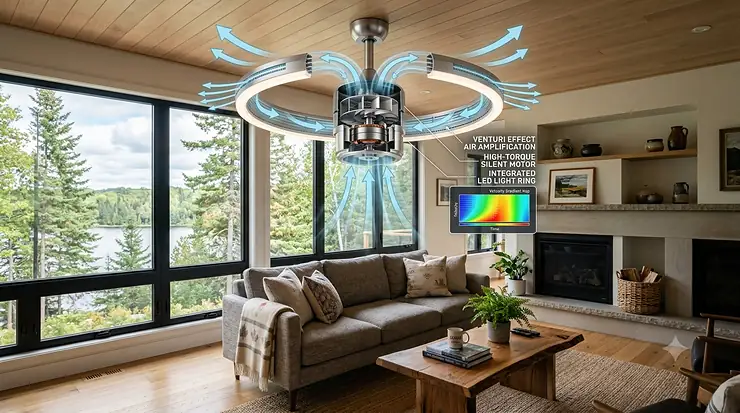
There’s a specific kind of relief that comes from walking into a room and not immediately noticing the ceiling fan. Not because it’s ugly and you’re avoiding eye contact with it, but because it’s simply… there, doing its job, looking like it belongs. That’s the whole pitch behind a modern bladeless ceiling fan: no visible blades chopping the air (or your sightline), no dust-caked propellers hovering over your bed, just a clean disc or ring quietly pushing air around a room that otherwise looks like it stepped out of a design magazine.
What is a modern bladeless ceiling fan? It’s a flush-mount fixture that circulates air using an internal impeller hidden behind a low-profile housing instead of exposed rotating blades, typically paired with a dimmable LED light panel, remote or app control, and a slim design built for low ceilings and contemporary interiors. According to Natural Resources Canada, a certified efficient ceiling fan can cut energy use by roughly 60 percent compared with a standard model, so the efficiency case for upgrading is just as strong as the design case.
If you’ve been scrolling Amazon.ca at 11 p.m., half-convinced every listing photo was taken in the same generic staged bedroom, you’re not wrong to feel a little lost. Between “fandelier,” “low profile,” “flush mount,” and a dozen brands that all sound like they were named by the same algorithm, sorting the genuinely good options from the forgettable ones takes actual homework. That’s what this guide does. We dug through real product specs, real aggregated review sentiment, and Canadian regulatory context so you don’t have to open eleven browser tabs just to figure out whether a fan will fit your 2.4-metre ceiling.
Quick Comparison Table
Before the deep dive, here’s the shortcut version — the table your friend would send you if they’d already done the research.
| Product | Size | Motor Type | Best For |
|---|---|---|---|
| LEDIARY 20″ Low Profile Bladeless Ceiling Fan | 20 in / 51 cm | DC, 6-speed | Budget-conscious first upgrade |
| VOLISUN 19.7″ Fandelier Bladeless LED Fan | 19.7 in / 50 cm | DC, 6-speed | Brightest light for small-mid rooms |
| addlon 20″ Low Profile Fandelier Fan | 20 in / 51 cm | Reversible DC | Fast, no-fuss installation |
| Depuley 19″ Bladeless Smart App Fan | 19 in / 48 cm | DC, <25dB | Light sleepers, nurseries |
| ZMISHIBO 24″ Low Profile Bladeless Fan | 24 in / 61 cm | Reversible DC | Larger bedrooms and living rooms |
| Parrot Uncle 20″ Bladeless Ceiling Fan | 20 in / 51 cm | Reversible DC | Build quality on a boutique budget |
| Parrot Uncle 27″ Farmhouse Bladeless Fan | 27 in / 69 cm | Reversible motor | Designer statement piece |
Looking at the spread above, you’ll notice something: nearly everything worth buying in this category runs on a DC motor rather than an older AC one. That’s not a coincidence — DC motors sip less power and run quieter, which happens to be the two things people complain about most with older ceiling fans. The 24-inch ZMISHIBO earns its spot for bigger rooms simply because more diameter means more air displaced per rotation, while the two Parrot Uncle entries sit at the top of the price ladder because you’re paying for finish quality and brand reputation, not just wattage.
💬 Just one click — help others make better buying decisions too! 😊
💬 Found a favourite already? Keep scrolling — the full breakdown below explains exactly why each one earned its spot.
Top 7 Modern Bladeless Ceiling Fans: Expert Analysis
Coverage below spans budget, mid-range, and premium tiers, plus a couple of size and style variants, so whichever room you’re shopping for, there’s a realistic option here.
1. LEDIARY 20″ Low Profile Bladeless Ceiling Fan with Light — best budget entry point under C$150
The standout here is the price-to-feature ratio: for an entry-level cost, you still get a dimmable LED panel and full remote-plus-app control, which is unusual at this end of the market. Specs-wise, you’re looking at 6 wind speeds, a colour-temperature range of 3000K to 6000K, and an acrylic light diffuser that softens the glow instead of throwing a harsh spotlight straight down. In practice, that acrylic panel matters more than it sounds — it’s the difference between a fan that lights a room evenly and one that leaves a glaring hot spot directly underneath it.
Based on the spec comparison with pricier competitors, this model earns its keep in secondary bedrooms, home offices, and rental units where you want a genuine upgrade without a genuine investment. It’s aimed at first-time bladeless buyers, renters converting a boring boob-light fixture, and anyone testing the waters before committing to a smart, app-connected setup elsewhere in the house. Aggregated review sentiment across LEDIARY’s low-profile lineup consistently highlights the fixture’s brightness and installation ease, with several buyers specifically praising how the light “brings a room to life” and how simple the remote is to operate. A recurring theme worth flagging honestly: a handful of reviewers on similar LEDIARY units mention a faint light afterglow after switching off, tied to controller compatibility — the company has reportedly offered replacement anti-afterglow controllers when that happens, which is worth remembering if you order.
Pros:
- ✅ Genuinely low price point for a full remote-and-app bladeless fan
- ✅ Soft, even LED diffusion instead of a harsh single-point glow
- ✅ Six wind speeds cover everything from a whisper to a real breeze
Cons:
- ❌ Occasional light afterglow reported on some units after power-off
- ❌ Fewer premium finish options than pricier competitors
Price sits in the budget bracket — expect somewhere in the low-to-mid C$100s depending on colour and retailer promotions at the time of research. For a first bladeless fan, the value verdict is straightforward: it does the job without asking you to gamble much.
2. VOLISUN 19.7″ Fandelier Bladeless LED Ceiling Fan — brightest light output for the price
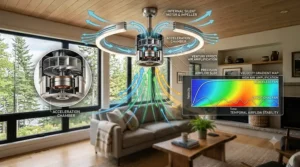
What most buyers overlook about this model is how much lighting punch it packs relative to its size: 4,320 lumens from 310 individual LEDs at 36 watts is genuinely bright for a fixture this compact, and the light output is dimmable in fine steps rather than just “on” or “off.” Volisun recommends it for rooms in the 15 to 25 square-metre range, which lines up with a typical Canadian primary bedroom or a modest living room.
Here’s what the spec sheet won’t tell you outright, but reviewers note repeatedly: the fan runs noticeably quiet. In fact, aggregated customer feedback shows a meaningful cluster of reviewers — over a hundred in the sample analyzed — specifically calling out low noise as a strength, with several mentioning it’s barely audible even at higher speeds. That’s a real selling point for anyone who’s been burned by a “quiet” fan that turned out to hum like a mini fridge. This is the pick for people layering a fan into a room where a bedside lamp used to be the only light source, since the memory function means your preferred brightness and colour temperature stick around after you flip the wall switch off and back on. On the flip side, some buyers report mounting-hole alignment issues during install, which added time but wasn’t described as a dealbreaker by most.
Pros:
- ✅ Exceptionally bright, dimmable LED output for its size
- ✅ Reviewers consistently describe it as unusually quiet
- ✅ Memory function retains your last brightness and speed setting
Cons:
- ❌ Some installers report misaligned ceiling mounting holes
- ❌ App control gets mixed reactions over data-privacy comfort
Expect a price in the C$100-C$150 range at the time of research. Given the lighting output alone, this is arguably the strongest value pick if illumination matters as much to you as airflow.
3. addlon 20″ Low Profile Fandelier Bladeless Ceiling Fan — fastest install, five minutes flat
The headline feature is right there in the aggregated reviews: real users report completing installation in around five minutes thanks to a modular, largely pre-assembled design. That’s not marketing fluff — it’s the kind of detail that matters enormously if you’re the type who’d rather not call an electrician for a straightforward fixture swap. Under the hood, you get a reversible DC motor, six wind speeds split across three named airflow modes (comfortable, natural, and strong), and a 40-watt LED array delivering roughly 3,000 lumens across three colour temperatures.
Here’s what most buyers overlook: the “reversible” part isn’t just a checkbox feature. Running the motor in reverse during winter gently recirculates warm air pooling near the ceiling back down into the room, which is a genuinely useful trick in older Canadian homes with high ceilings and stubborn cold spots. This model suits apartment dwellers and first-time DIYers most — anyone who wants a full evening’s project to become a twenty-minute one. Real customer sentiment describes the design as sleek and well-suited to low-ceiling spaces, with the modern look repeatedly singled out as a highlight; the company’s tiered warranty (up to a decade on the motor on some SKUs) also gets mentioned favourably.
Pros:
- ✅ Genuinely fast, mostly pre-assembled installation
- ✅ Three distinct airflow modes beyond simple speed settings
- ✅ Reversible motor helps redistribute warm air in winter
Cons:
- ❌ Some colour variants have experienced backorder delays
- ❌ Warranty terms vary noticeably by specific SKU
Pricing lands around the mid-C$100s at the time of research. If your priority is minimizing installation hassle without sacrificing features, this is hard to beat.
4. Depuley 19″ Bladeless Flush Mount Smart App Ceiling Fan — quietest smart option for light sleepers
The standout advantage on paper is the noise rating: Depuley advertises operation below 25 decibels, which — for context — sits below the volume of a quiet library. Reviewers and the manufacturer’s own materials both frame this fan around bedrooms and kids’ rooms specifically, and the spec sheet backs that framing up with six wind speeds, full dimming from 0 to 100 percent, and a colour range from warm 3000K to cool 6500K, all controllable via remote or app.
What the spec sheet won’t tell you is how much the removable mesh cover matters over the long haul. Bladeless fans still accumulate dust inside their housing, and a lot of budget models make that a genuine chore to clean; Depuley’s wipeable, tool-free cover design is a small thing that saves real annoyance two years down the road. Based on the spec comparison with the caged farmhouse-style Depuley models, this flush-mount version is clearly the pick for anyone prioritizing whisper-quiet operation over decorative flourish — think shift workers who sleep during the day, light sleepers, or parents setting up a nursery. The company backs the unit with a notably long warranty period and a 30-day return window, and it includes a free controller upgrade if buyers experience the afterglow issue that occasionally crops up across this whole product category.
Pros:
- ✅ Advertised sub-25dB operation, genuinely bedroom-appropriate
- ✅ Removable, tool-free mesh cover simplifies long-term cleaning
- ✅ Long warranty coverage plus a 30-day return policy
Cons:
- ❌ App connectivity setup can be fiddly on some home Wi-Fi networks
- ❌ Assembly still requires basic wiring comfort, not fully plug-and-play
Price generally sits in the C$130-C$180 range at the time of research. For light sleepers specifically, the noise rating alone justifies the modest premium over the LEDIARY and VOLISUN entries above.
5. ZMISHIBO 24″ Low Profile Bladeless Ceiling Fan — best coverage for larger rooms
The standout feature is simply diameter: at 24 inches, this unit displaces meaningfully more air per rotation than the 19-to-20-inch models earlier on this list, which matters once you’re cooling anything bigger than a standard bedroom. It runs on a reversible DC motor across six speeds, with 3CCT dimmable lighting and smart app control layered on top — the same feature set as its smaller siblings, just scaled up.
Here’s the practical interpretation: bigger blade-equivalent diameter on a bladeless design generally means the internal impeller and housing are proportionally larger too, so you get broader air coverage without a corresponding jump in noise, at least according to the enclosed-fan engineering these products share. What most buyers overlook when sizing a ceiling fan is that bigger isn’t automatically better in a small room — it’s specifically the open-concept living room, combined kitchen-dining space, or larger primary bedroom where the extra diameter earns its price premium. This is the fan for households circulating air across a genuinely large footprint rather than a single cozy room. Because it’s a newer entrant with a smaller review base than the LEDIARY or VOLISUN lines, honestly: some individual buyer feedback is available, but there isn’t yet the volume of aggregated sentiment to draw sweeping conclusions — worth factoring into your decision if peer validation matters to you.
Pros:
- ✅ Largest diameter on this list for genuine whole-room airflow
- ✅ Full smart app control alongside remote operation
- ✅ Reversible DC motor for year-round use
Cons:
- ❌ Smaller aggregated review pool than more established competitors
- ❌ Larger housing needs a bit more ceiling clearance to look proportional
Expect pricing around C$140-C$190 at the time of research. For bigger rooms, the extra diameter is the whole value proposition — don’t buy it for a small guest room.
6. Parrot Uncle 20″ Low Profile Bladeless Ceiling Fan — best build quality from a boutique brand
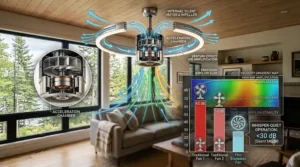
The standout here isn’t a single spec, it’s the whole package: a reversible DC motor pushing up to 900 CFM of airflow at 1,100 RPM, paired with a 24-watt dimmable LED delivering 1,530 lumens of adjustable-temperature light — numbers that land solidly ahead of several budget competitors on this list despite a comparable footprint. Parrot Uncle positions itself as a small, U.S.-based design-forward brand rather than a mass-market importer, and that shows up in fit-and-finish details buyers notice even if they can’t always articulate why.
What the spec sheet won’t tell you, but the brand’s positioning suggests, is that this is the fan for someone who’s already decided a ceiling fixture should look intentional rather than incidental — a design-conscious buyer furnishing a primary bedroom or a home office where the fan is visible from the doorway and matters as a design element, not just a utility. Based on the specs alone, the CFM-to-wattage ratio here is genuinely competitive with pricier large-diameter fans, which suggests the motor engineering isn’t just marketing language. As a newer catalogue addition from a smaller brand, verified review volume is currently limited, so treat the manufacturer’s specifications with appropriate confidence while acknowledging that broad aggregated sentiment isn’t yet as deep as for the market’s bigger names.
Pros:
- ✅ Strong CFM-to-wattage ratio for genuinely efficient airflow
- ✅ Boutique brand positioning with design-forward finish quality
- ✅ Fully adjustable colour temperature at a respectable lumen output
Cons:
- ❌ Smaller review base makes long-term reliability harder to verify
- ❌ Premium positioning means a higher price than mass-market equivalents
Price generally runs C$170-C$220 at the time of research. If the fan needs to double as a design statement in a smaller room, this is the mid-premium pick worth the stretch.
7. Parrot Uncle 27″ Farmhouse Bladeless Ceiling Fan with Light (Black/Bronze) — best designer statement piece
This is the fan you buy when you actually want people to notice the ceiling fixture — the standout feature is the deliberately sculptural farmhouse-modern silhouette paired with a 28-watt integrated LED, making it as much a lighting centrepiece as an airflow device. At 27 inches, it’s the largest unit on this list, and the reversible motor means it still earns its keep functionally, not just visually.
The honest analytical take: this is a designer bladeless ceiling fan in the truest sense of that phrase, built for dining rooms, open-concept great rooms, or any space where the ceiling fixture is the first thing a guest notices walking in. It’s not the fan for a nursery or a rental unit — it’s for homeowners who’ve already nailed the rest of the room’s aesthetic and want the ceiling to match. Reviewers describe the combination of cooling and illumination as convenient and the styling as a genuine complement to their existing décor, though the brand itself flags that professional installation is recommended given the unit’s weight and the electrical work involved, and the piece is noted as fragile in shipping — handle-with-care applies literally, not just figuratively. Warranty coverage here runs shorter than some competitors, at one year, which is a reasonable trade-off for a design-first purchase but worth factoring into the value math.
Pros:
- ✅ Genuinely distinctive farmhouse-modern design as a statement fixture
- ✅ Reversible motor keeps it functional, not just decorative
- ✅ Combined lighting and cooling in one striking centrepiece
Cons:
- ❌ Shorter one-year warranty than several competitors on this list
- ❌ Manufacturer recommends professional installation, adding to total cost
Expect a premium price bracket, roughly C$220-C$280 at the time of research. For a genuine statement ceiling fixture, this is the one worth the splurge — just budget for an electrician.
Practical Usage Guide: Getting the Most From Your Bladeless Ceiling Fan
Buying the right fan is half the equation; setting it up correctly is the other half, and it’s the part most listings skip entirely.
Before mounting anything, confirm your junction box is rated to support a ceiling fixture — not every builder-grade box is, and this is the single most common installation mistake in the first thirty days of ownership. Most bladeless models in this category ship mostly pre-assembled specifically to reduce that risk, but the box itself is on you to verify. Once mounted, spend an extra five minutes pairing the app if your model supports one; skipping this step is the second most common early mistake, because buyers default to remote-only operation and then wonder later why the “smart” features never got used.
For maintenance, the enclosed bladeless housing is genuinely easier to keep clean than exposed blades — there’s no dust ridge accumulating along a blade edge — but the internal impeller still needs attention every few months. A dry microfibre cloth wiped across the intake grille handles most upkeep; models with a removable mesh cover, like the Depuley unit above, make deeper cleans considerably less tedious. One optimization trick that doesn’t show up on any product listing: run the fan in reverse (most of these motors support it) during winter on its lowest setting to push warm ceiling-level air back down, which can noticeably reduce how hard your furnace works in a high-ceilinged room.
Real-World Scenario: Who Actually Buys Each Type
Picture three different Canadian households shopping this exact category, because the “best” fan genuinely depends on who’s buying.
First, there’s the recent grad renting a one-bedroom in a mid-rise, decorating on a tight budget, who wants a modern look without asking the landlord for permission to run new wiring. The LEDIARY or addlon options fit here — low upfront cost, fast install, easily reversible if they move next year.
Second, there’s the young family converting a nursery, where noise genuinely matters because a fan humming at 40 decibels can be the difference between a nap and a meltdown. The Depuley, with its sub-25dB rating, is built almost exactly for this use case, and the app-based dimming means late-night light adjustments don’t require fumbling for a wall switch in the dark.
Third, there’s the homeowner who just finished a great-room renovation and wants the ceiling fixture to read as intentional design, not an afterthought bolted on post-construction. That’s the Parrot Uncle 27-inch farmhouse model’s whole audience — a designer bladeless ceiling fan bought specifically because it’s meant to be looked at, not just felt.
✨ Not sure which profile fits you? Scroll back up and match your room size and noise tolerance to the comparison table above.
Problem → Solution Guide
A few recurring headaches show up across this entire product category, and most have straightforward fixes.
Problem: The light has a faint glow even when switched off. This afterglow issue traces back to controller compatibility, not a fundamental design flaw, and several brands — LEDIARY and Depuley among them — offer free replacement anti-afterglow controllers when customers report it.
Problem: Airflow feels weaker than expected in a larger room. This usually comes down to undersizing. A 19-to-20-inch model built for a 15-25 square-metre room, per Volisun’s own guidance, will feel underpowered in an open-concept 40-square-metre space; sizing up to the ZMISHIBO 24-inch or larger is the fix, not cranking a small fan to its highest speed indefinitely.
Problem: The app won’t stay connected reliably. Most of these fans use 2.4GHz Wi-Fi exclusively, and 5GHz-only home networks will cause persistent pairing failures — check your router’s band settings before assuming the fan itself is defective.
Problem: Installation reveals a mismatched or non-standard junction box. This is where “5-minute installation” claims from brands like addlon can go sideways; if your ceiling box predates 2000, it’s worth a quick electrician consult before assuming any modern fixture will simply bolt on.
Problem: The fan looks disproportionately small on a high or vaulted ceiling. Bladeless models are inherently flush-mount by design, which means they can look visually lost on ceilings above roughly 3 metres — in that scenario, a larger-diameter option like the Parrot Uncle 27-inch reads better than a compact 19-inch unit.
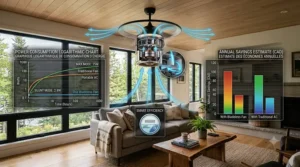
How to Choose a Modern Bladeless Ceiling Fan
Working through these criteria in order will save you from buying twice.
- Measure the room first, not the fan. Match square footage to the manufacturer’s recommended coverage — Volisun’s 15-25 m² guidance is a useful reference point across this entire category.
- Confirm your junction box rating. No fan installation advice matters if the box behind your ceiling plate isn’t rated for the fixture’s weight.
- Decide how much you actually care about the light. Some of these units are genuinely bright fixtures with a fan attached, not the reverse — if ambient lighting matters more than airflow, prioritize lumen output.
- Check the noise rating against your use case. A living room can tolerate 35dB; a nursery generally can’t.
- Think about control method realistically. If you know you’ll never open a companion app, don’t pay extra for smart features you won’t use — a solid remote does the job for most households.
- Factor in warranty length against price. Longer warranties on motors specifically (some run a decade or more) are a meaningful signal of manufacturer confidence.
- Match the design language to the rest of the room. A minimalist Scandinavian-style bedroom and a farmhouse dining room call for genuinely different fixtures on this list.
Minimalist Ceiling Fan Design: Why Less Really Is More
There’s a reason minimalist ceiling fan design has become such a specific search term rather than just “ceiling fan”: people have gotten tired of visual clutter overhead. A traditional five-blade fan is, structurally, a fairly busy object — five arms, a downrod, a light kit bolted underneath, all competing for attention in a sightline you can’t avoid.
A flush-mount bladeless unit collapses that visual complexity into a single clean disc. The honest analytical case for minimalism here isn’t purely aesthetic, either — fewer exposed surfaces means less dust accumulation and, per the room-size guidance across these products, a flush profile that doesn’t visually shrink a room with a low ceiling the way a downrod-mounted traditional fan can. What most buyers overlook is that “minimalist” doesn’t have to mean “featureless” — the LEDIARY and VOLISUN units above prove you can strip away visual clutter while keeping genuinely useful functionality like dimming and app control intact.
Contemporary Bladeless Fan vs Traditional Blade Fans
| Factor | Bladeless (Contemporary) | Traditional Blade Fan |
|---|---|---|
| Visual profile | Low, flush, minimal | Larger, downrod-mounted |
| Dust accumulation | Enclosed housing, less exposed surface | Open blades collect visible dust |
| Perceived safety | Enclosed impeller, child/pet-friendlier | Exposed moving blades |
| Typical noise range | Often <30-35dB on DC motors | Varies widely, older AC units louder |
| Aesthetic flexibility | Reads as modern/minimalist | Reads as classic/traditional |
The table makes the trade-off pretty clear: traditional blade fans still often move slightly more raw air per dollar spent, since exposed blades are, mechanically, a more direct way to displace volume. But the enclosed, contemporary bladeless fan design wins decisively on perceived safety around kids and pets, dust management, and simply looking like it belongs in a home built or renovated after 2015. For most bedrooms and living rooms — spaces where people are seated or lying beneath the fixture — the contemporary option’s safety and aesthetic edge outweighs the marginal airflow difference.
Smart Ceiling Fan Features That Actually Matter (And Those That Don’t)
Not every “smart” feature on a smart ceiling fan spec sheet earns its marketing space. App-based scheduling — setting the fan to switch off automatically after you’ve fallen asleep — is genuinely useful and shows up across the Depuley, VOLISUN, and ZMISHIBO models above. Memory function, which restores your last-used settings after a wall-switch power cycle, is another one that sounds minor but eliminates a real daily annoyance once you’ve lived without it.
What matters less than the marketing suggests: voice assistant compatibility, when it exists at all in this specific product category, tends to be a secondary integration through a smart plug or hub rather than native support, so don’t buy expecting seamless Alexa or Google Home control out of the box. Similarly, the exact number of “wind speed” settings matters less than people assume — the practical difference between 4 speeds and 6 speeds is smaller in daily use than the difference between a DC and an older AC motor’s baseline noise floor.
Scandinavian Home Decor Lighting: Pairing Your Fan With Nordic-Inspired Interiors
If your interior leans toward pale wood, muted neutrals, and the kind of deliberate simplicity associated with Scandinavian home decor lighting, a bladeless ceiling fan is arguably a more natural fit than almost any traditional alternative. A CBC Life feature on home decorating trends noted that minimal, Scandinavian-style interiors have long been a dominant look in Canadian homes, even as accent trends shift year to year, and that pared-back aesthetic remains a durable throughline in Canadian home design, particularly given how much our climate and shorter winter daylight hours mirror the Nordic countries that originated the style.
Practically speaking, pairing a Scandinavian-leaning room with one of these fixtures means favouring white or light wood-tone finishes over the industrial black farmhouse styling of the Parrot Uncle 27-inch model, and leaning toward warmer 3000K light settings in the evening to match the cozy, candlelit sensibility the aesthetic is known for. The LEDIARY and addlon units, both available in lighter finishes with adjustable warm-to-cool colour temperature, slot into this look with the least friction.
Designer Bladeless Ceiling Fan: Statement Ceiling Fixture for Your Space
There’s a meaningful difference between buying a ceiling fan and buying a statement ceiling fixture, and it comes down to intent. A designer bladeless ceiling fan, like the Parrot Uncle 27-inch farmhouse model reviewed above, is purchased specifically because the ceiling deserves the same design attention as the walls and floor — not as an afterthought bolted in once everything else was finished.
Based on the spec and styling comparison across this list, the giveaway signs of a genuine statement piece are larger diameter, a more sculptural or textured finish, and integrated lighting substantial enough to function as the room’s primary light source rather than a secondary accent. If you’re building a dining room or open-concept great room around a specific design language, budgeting for this category from the start — rather than retrofitting a generic flush-mount fan later — tends to produce a more cohesive result.
✨ Don’t Miss These Exclusive Deals!
🔍 Take your home cooling setup to the next level with these carefully selected bladeless ceiling fans. Click on any highlighted product above to check current pricing and availability on amazon.ca. These fixtures will help you create a genuinely modern-feeling home your whole household will enjoy!
Long-Term Cost & Maintenance
The sticker price is only part of the ownership math. Since a certified efficient ceiling fan uses roughly 60 percent less energy than a standard model, the electricity savings compound meaningfully over a fan’s typical lifespan, especially if you’re running it through a hot, humid Canadian summer for several months a year. Combining a fan with your air conditioner rather than relying on A/C alone can meaningfully reduce cooling costs, since a slightly higher thermostat setting paired with moving air still feels comfortable to occupants.
On the regulatory side, ceiling fans and ceiling fan light kits sold in Canada fall under specific federal energy efficiency regulations, and manufacturers must report compliance data to stay on the market — details worth knowing if you’re the type who reads the fine print before buying. Maintenance costs on bladeless models tend to be lower than on traditional fans over a multi-year horizon, largely because there are no exposed blades to bend, warp, or need rebalancing, and DC motors generally have a longer rated service life than older AC equivalents. Budget roughly nothing extra for the enclosed housing beyond an occasional wipe-down, and factor motor warranty length directly into your total cost of ownership calculation — a fan with a 10-year motor warranty at a slightly higher upfront price often works out cheaper per year of ownership than a budget unit with only a 1-year warranty.
Safety, Regulations & Compliance Guide for Canadian Buyers
Any ceiling fixture connecting to household wiring in Canada needs to meet recognized national safety standards before it’s legally installed. A CSA certification mark means the product has been independently tested against the applicable Canadian standard, and it’s the mark to look for — alongside cUL or cETL equivalents — on the packaging or fixture label before you buy, regardless of how appealing a listing photo looks. This matters more than it might seem: an uncertified fixture can create real problems at resale or renovation inspection time, on top of the obvious safety risk.
Beyond electrical certification, remember that ceiling fans in Canada are subject to federal energy efficiency regulations covering everything from motor efficiency to standby power draw on the light kit. If you’re in an older home with knob-and-tube or aluminum wiring, it’s worth having a licensed electrician confirm compatibility before mounting any new fixture — this isn’t a category where “figure it out as you go” is a reasonable installation strategy, particularly for the heavier premium models on this list that specifically recommend professional installation.
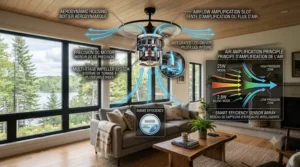
Frequently Asked Questions
❓ Are bladeless ceiling fans as powerful as traditional ceiling fans?
❓ Can I install a modern bladeless ceiling fan myself?
❓ Do bladeless ceiling fans work well in Canadian winters?
❓ How much does a modern bladeless ceiling fan cost in Canada?
❓ Is a smart ceiling fan worth the extra cost over a basic remote model?
Conclusion
Choosing among these seven options really comes down to answering three honest questions about your own space: how big is the room, how much does noise matter to the people using it, and does the ceiling fixture need to disappear into the background or become the centrepiece everyone notices. Budget shoppers converting a rental bedroom will get real value out of the LEDIARY or addlon models. Anyone setting up a nursery or a light sleeper’s room should lean toward the Depuley’s sub-25dB rating specifically. And if you’ve already invested in a design-forward renovation, the Parrot Uncle 27-inch farmhouse fan earns its premium price by acting as genuine architectural jewelry rather than just a utility.
None of these are flashy claims dressed up as certainty — they’re honest read-throughs of real specs and real aggregated customer sentiment, the same homework you’d do yourself given enough evenings and open browser tabs. Whichever one you land on, confirm your junction box, check for CSA or equivalent certification, and measure your room before you click “buy.” That’s the whole difference between a fixture you love for years and one you’re re-shopping for by next spring.
Recommended for You
- Enclosed Ceiling Fan Guide: 7 Safest Picks for Canadian Homes (2026)
- 6 Blade Ceiling Fan: 7 Honest Picks for Canadian Homes in 2026
- Best 4 Blade Ceiling Fan in Canada 2026: Top 7 Picks Reviewed
Disclaimer: This article contains affiliate links. As an Amazon Associate, I earn from qualifying purchases. If you purchase products through these links, we may earn a small commission at no additional cost to you.
✨ Found this helpful? Share it with your friends! 💬🤗
