

In This Article
A modern ceiling fan for home office is a quiet, clean-lined fan, typically 44 to 56 inches (112 to 142 cm) across. It has a matte or metallic finish, a low-noise motor, and often an integrated dimmable LED light. It circulates air and lights your workspace without humming, wobbling, or turning the room into a hardware showroom.

Let’s be honest about the usual home office cooling plan. It’s a desk fan wedged beside the monitor, blasting your notes across the floor and doing a convincing impression of a leaf blower during every video call. A ceiling-mounted fan solves this from above, where the airflow belongs.
The idea isn’t new. The electric ceiling fan dates back to 1882, and Philip Diehl later added the light kit that made the fan-and-light combo a fixture of homes everywhere. What is new is the design. Today’s best options pair brushless DC motors, app control, and sharp matte black silhouettes that look at home next to a standing desk and a ring light.
Here’s what this guide covers. Based on spec comparisons and aggregated review sentiment, I’ve narrowed the field to seven real fans, from budget to premium. I’ll also dig into smart control, light-versus-no-light decisions, and what actually matters when you’re staring at a screen for eight hours. One honest note up front: product availability on amazon.ca changes often, so confirm each listing and its Canadian certification before you buy.
Quick Comparison: Best Modern Ceiling Fan for Home Office at a Glance
| Product | Blade Span | Light | Smart Control | Price Range (CAD) | Best For |
|---|---|---|---|---|---|
| Home Decorators Collection Windward IV | 52″ (132 cm) | Dimmable LED | Remote; Bond hub on related variants | C$150–C$250 | Budget buyers |
| Hunter Dempsey | 44″ (112 cm) | 2 dimmable LED bulbs | Handheld remote | C$200–C$300 | Small offices, low ceilings |
| Minka-Aire Light Wave | 52″ (132 cm) | 16W dimmable LED module | Bond unit (sold separately) | C$250–C$400 | Airflow per dollar |
| Minka-Aire Sabot | 52″ (132 cm) | Integrated LED | Remote | C$300–C$450 | Quiet mid-range |
| Hunter Aeronaut | 52″ (132 cm) | Integrated LED | Wi-Fi (HunterSMART) | C$300–C$450 | Smart-home setups |
| Minka-Aire Symbio | 56″ (142 cm) | 16W integrated LED | Smart-enabled; Alexa | C$450–C$650 | Refined upgrades |
| Minka-Aire Barn LED | 65″ (165 cm) | Dimmable LED | Remote + Bond app | C$700–C$900 | Large offices |
Price ranges are approximate at the time of research, so check current pricing. Read the table in layers. The Hunter Dempsey and Home Decorators Collection Windward IV keep the entry cost low, but only the Hunter Aeronaut ships with Wi-Fi in the box. The Minka-Aire Barn LED costs roughly triple the budget picks, which only makes sense if your room is big enough to need 65 inches of blade.
💬 Just one click — help others make better buying decisions too!😊
Top 7 Modern Ceiling Fan for Home Office Picks: Expert Analysis
1. Home Decorators Collection Windward IV — budget pick with huge review volume
The matte black version of the Home Decorators Collection Windward IV is the sensible starting point for anyone who wants a modern ceiling fan for home office use without a four-figure fan budget.
It has five tapered blades across 52 inches (132 cm), a dimmable LED light kit, a reversible motor, and a remote with a programmable feature. In practice, that means you can set the fan to cool you in summer and push warm air back down in winter. You can also dim the light for late-night work. The manufacturer claims big energy and airflow gains over older fans, but treat those as marketing language and weigh the real-world feedback instead.
Based on the specs, this fan suits budget-conscious remote workers with standard 2.4 m (8 ft) ceilings and rooms around 3.5 m by 3.5 m. The matte black listing carries nearly 2,000 reviews on a major home-improvement retailer’s site, which is a useful sign of how widely it has been installed. I couldn’t verify the individual comments, so I won’t characterize them. A related Windward IV variant is advertised as compatible with a Bond smart hub sold separately. If you want smart control, confirm the exact model first.
Pros:
- ✅ Dimmable LED light kit included
- ✅ Matte black finish matches modern desks
- ✅ Remote control with programmable feature
Cons:
- ❌ Smart control needs extra hardware, if available
- ❌ Motor noise level isn’t well documented
Price range: around C$150–C$250. It’s strong value if you want the look and basic features rather than premium refinement.
2. Hunter Dempsey — low-profile pick for small offices
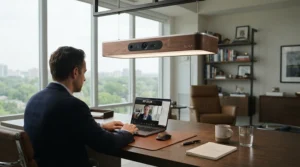
The Hunter Dempsey exists for the room most home offices actually are: a converted bedroom or basement nook with a low ceiling.
The 44-inch (112 cm) matte black model uses a low-profile mount designed for ceilings under about 9 feet (2.7 m). It has four reversible blades, in matte black on one side and dark gray oak on the other. The WhisperWind motor has three speeds, and a handheld remote controls speed and dimming. Two 9.8W LED bulbs sit behind painted cased white glass.
Those bulbs are a quiet advantage. Unlike a sealed LED module, they can be replaced with standard E26 bulbs, so you can choose a warmer or cooler colour temperature later. Retailer listings position the 44-inch size as ideal for home offices, which fits the spec comparison. It moves less air than a 52-inch fan, so it suits rooms up to roughly 3 m by 3 m.
Review sentiment is mixed-to-good. One retailer listing for the matte black 44-inch shows an average of about 3.8 stars across roughly 239 reviews. That’s decent but not glowing, so expect some variation in installation experience.
Pros:
- ✅ Low-profile mount fits ceilings under 2.7 m
- ✅ Reversible blades let you change the look
- ✅ Replaceable dimmable LED bulbs
Cons:
- ❌ Moves less air than 52-inch rivals
- ❌ Middling average rating on some listings
Price range: around C$200–C$300. It’s good value for small rooms with low ceilings.
3. Minka-Aire Light Wave — best airflow per dollar in the mid-range
The Minka-Aire Light Wave is the fan to look at if you want airflow rather than just aesthetics.
Its 52-inch (132 cm) span has three blades with variable pitch, and one retailer listing cites about 3,068 CFM. That’s well above the 2,000 CFM floor that already counts as workable for a small room. The integrated 16W dimmable LED module is described as comparable to a 75W incandescent. It’s smart-capable through a Bond unit sold separately, and it works with a handheld remote.
The geometry matters here. With a 6-inch downrod, the blades sit about 8.5 inches (22 cm) below the ceiling, so tall people in low rooms should measure carefully. It can handle sloped ceilings up to 21 degrees with its canopy, which is handy for attic offices.
Reviewers on one retailer listing (4.3 stars from about 1,768 reviews) praise the bright, dimmable LED and the easy installation. Several also say the AC motor produces a slight buzz and the remote feels cheap. That’s a fair trade at this price, but it matters if you take calls all day.
Pros:
- ✅ Strong airflow for a 52-inch fan
- ✅ Bright dimmable LED with soft-on fade
- ✅ Works on slopes up to 21 degrees
Cons:
- ❌ Reviewers note a slight motor buzz
- ❌ Smart control requires a separate Bond unit
Price range: around C$250–C$400. Great value for bigger rooms where airflow comes first.
4. Minka-Aire Sabot — quiet DC motor at a mid-range price
The Minka-Aire Sabot is positioned as a value offering with an integrated LED, and DC motor efficiency that suits all-day use.
A 52-inch (132 cm) span fits most spare-room offices. It has six speeds and remote dimming, which gives you finer control than a three-speed fan. If you work in a quiet environment, those extra speeds let you find the lowest setting that still keeps your desk comfortable, without the stuffiness of no airflow or the draft of full blast.
From the spec sheet alone, you’d expect a DC motor to run quieter than a standard AC one at the same speed. Review sentiment backs that up. On one retailer listing with about 161 reviews, buyers repeatedly describe quiet operation even on high, and several appreciate the range of speeds. One reviewer said the light was a little dimmer than they preferred, so consider a desk lamp for detailed work.
Pros:
- ✅ Six speeds for fine airflow control
- ✅ Reviewers report very quiet operation
- ✅ Integrated LED with remote dimming
Cons:
- ❌ Light output may feel dim to some
- ❌ Fewer reviews than top-selling rivals
Price range: around C$300–C$450. It’s solid value for people who prioritize silence on calls.
5. Hunter Aeronaut — Wi-Fi smart control in matte black
If your priority is a smart ceiling fan with app control for home office use, the Hunter Aeronaut is the most direct answer here.
The 52-inch (132 cm) flat matte black model is an ENERGY STAR® fan with HunterSMART, formerly SIMPLEconnect, Wi-Fi capability. It works with Apple HomeKit, Google Home, and Amazon Alexa. A reversible six-speed DC motor drives the blades, and a pre-installed control receiver should simplify wiring. An integrated light kit completes the package.
What this means in practice: you can schedule the fan to start before your workday, or tell your assistant to dim the light when a call begins. The Wi-Fi is built in, so there’s no bridge hub to buy. A Canadian retailer lists it under large-room fans (52 to 56 inches), which suits offices of roughly 12 by 12 feet and up.
I couldn’t verify enough real reviews to summarize sentiment fairly, so check recent buyer feedback on the listing before ordering. Pay particular attention to comments about app setup.
Pros:
- ✅ Built-in Wi-Fi, no hub required
- ✅ Works with HomeKit, Google Home, Alexa
- ✅ ENERGY STAR® DC motor, six speeds
Cons:
- ❌ App experience needs checking in recent reviews
- ❌ Pricier than basic remote-only fans
Price range: around C$300–C$450. It’s good value if smart control is on your must-have list.
6. Minka-Aire Symbio — refined mid-premium smart option
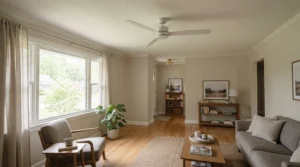
The Minka-Aire Symbio steps up the design a notch, and it’s built for the person who notices how a fan looks from the desk chair.
At 56 inches (142 cm), it covers more floor than the 52-inch options. It pairs DC motor technology with an integrated 16W LED light source, and the listing describes it as a smart fan that works with Alexa. A wall control and sloped-ceiling kit are available as accessories. The upshot is more air in larger rooms and cleaner lines, since the integrated light means no exposed bulbs.
On a retailer listing with about 206 reviews, buyers praise the quiet operation and the easy remote. Several mention voice control with Alexa. That lines up with the spec sheet and gives me reasonable confidence in the motor and control experience.
The honest trade-off is sizing. A 56-inch fan can overwhelm a small bedroom office, so measure first. In a 3.7 m by 4 m room, though, it looks proportionate.
Pros:
- ✅ Larger 56-inch span for bigger rooms
- ✅ Quiet DC motor, per reviewers
- ✅ Alexa voice control support
Cons:
- ❌ Too large for compact spare rooms
- ❌ Wall control sold separately
Price range: around C$450–C$650. It’s worthwhile if you want a polished look and quiet running in a larger space.
7. Minka-Aire Barn LED — near-silent premium for large offices
The Minka-Aire Barn LED is the splurge pick, and Bob Vila’s hands-on review of the 65-inch smart version explains why people pay for it.
It comes with an integrated dimmable LED light kit and can be run by remote or through the Bond Home app on a smartphone. Standard ceiling fans typically move 4,000 to 7,000 CFM, and the reviewer described this one as virtually silent. The ENERGY STAR label estimates an annual running cost of about $9, which is startlingly low for a fan this large.
That 65-inch (165 cm) span is a deliberate choice. It’s for great rooms, open-plan lofts, or double-garage studios, and it’s too big for a standard spare room. The same reviewer put the price at roughly twice that of many top-notch fans, so the value case rests on silence, size, and app control.
I can only report that review verbatim in spirit rather than claim my own testing. If your room is under about 4 m on the short side, scale down to the Minka-Aire Symbio.
Pros:
- ✅ Reported near-silent operation
- ✅ Remote plus app control via Bond
- ✅ Low estimated annual running cost
Cons:
- ❌ Premium price, about twice many rivals
- ❌ Oversized for typical home offices
Price range: around C$700–C$900. It’s strong value only if you truly need the size.
Spec Showdown: Modern Ceiling Fan for Home Office, Side by Side
| Product | Motor | Control | Light Type | Review Signal | Best For |
|---|---|---|---|---|---|
| Home Decorators Collection Windward IV | Reversible (type not verified) | Remote | Dimmable LED kit | ~1,950 reviews | Value hunters |
| Hunter Dempsey | WhisperWind, 3-speed | Remote | 2 replaceable LED bulbs | ~3.8 stars | Low ceilings |
| Minka-Aire Light Wave | AC (per reviewers) | Remote; Bond optional | 16W LED module | ~4.3 stars | Airflow |
| Minka-Aire Sabot | DC | Remote | Integrated LED | Quiet, per reviewers | Quiet calls |
| Hunter Aeronaut | DC, 6-speed | Wi-Fi app + voice | Integrated LED | Not verified | Smart homes |
| Minka-Aire Symbio | DC | Remote; Alexa | 16W integrated LED | Quiet, per reviewers | Larger rooms |
| Minka-Aire Barn LED | Not specified | Remote + Bond app | Dimmable LED | Near-silent, per review | Big spaces |
Reading across the rows, motor type separates the fans more clearly than blade count does. The three DC-motor models, the Minka-Aire Sabot, Hunter Aeronaut, and Minka-Aire Symbio, are where reviewers talk about quiet. The Minka-Aire Light Wave buys more airflow at the cost of some buzz. For pure desk-hours comfort, pick quiet first and airflow second.
How to Choose a Modern Ceiling Fan for Home Office
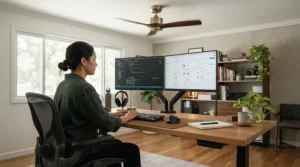
Picking the right fan is mostly about five decisions, made in this order.
- Measure your room and ceiling. A common rule of thumb is a 44-inch fan for rooms up to about 3 m by 3.5 m, and 52 inches for larger ones. If your ceiling is under 2.7 m (9 ft), look at low-profile mounts like the Hunter Dempsey.
- Prioritize noise. DC motors are generally quieter than AC at the same speed. If you spend half your day on calls, this matters more than any other spec.
- Check airflow and efficiency. Sundial Lighting’s CFM guide suggests 4,000 CFM is enough for most needs and 6,000 is better, and it treats an airflow efficiency of about 75 (CFM divided by watts) as efficient.
- Decide on light. Integrated LED saves bulb hunting, while replaceable bulbs give flexibility. More on this below.
- Choose your control. Remote-only is simple. App and voice control add convenience, but add setup and sometimes a hub.
Finally, confirm the fan carries Canadian electrical certification. We’ll return to that in the safety section.
Smart Ceiling Fan With App Control for Home Office: Worth It?
A smart ceiling fan with app control for home office use sounds like gadget fluff until you’re mid-presentation and too far from the remote to change the airflow.
There are two routes. The first is built-in Wi-Fi, as on the Hunter Aeronaut, which works with HomeKit, Google Home, and Alexa. The second is a bridge: the Minka-Aire Light Wave is smart-capable with a Bond unit sold separately, and the Minka-Aire Barn LED is operated through the Bond Home app. Bridges add a device and a bit of cost, but they let you retrofit remote-controlled fans.
Here’s the reasoning behind choosing one. The best use of a smart ceiling fan with app control for home office schedules is automation: fan on at 8:45, light dimmed when the afternoon sun hits your monitor. If you rarely change settings, a remote does the job. If your office is also a bedroom or den, smart control helps because you can shut things off from the sofa.
Reviewers on the Minka-Aire Symbio mention voice commands working with Alexa, which supports the idea that integrations are a real selling point. One tip: before buying any smart ceiling fan with app control for home office use, check your router’s Wi-Fi band compatibility, since many smart devices work best on 2.4 GHz.
Ceiling Fan With Light vs Without Light for Home Office
The ceiling fan with light vs without light for home office debate comes down to one question: what’s your overhead lighting like right now?
If your room has no other overhead source, a ceiling fan with a light is the obvious choice. It saves you a fixture, and models like the Minka-Aire Light Wave include an integrated 16W dimmable LED module. For a dim basement, that’s genuinely useful.
A ceiling fan without light makes sense when you already have recessed lighting or prefer a controlled task-lighting setup. Without the light kit, the fan is lighter and has fewer components that can rattle or fail. It also avoids the ceiling-mounted glare that can reflect on a monitor.
Here’s how I’d reason about it. Overhead light and fan together create changing shadows when blades pass in front of the lamp, which can be distracting on camera. A ceiling fan with light vs without light for home office use is therefore a camera question too. If you take lots of video calls, a dimmable fixture helps, but many people end up adding a desk lamp anyway.
The pragmatic takeaway: choose the light version if the fan will be your only ceiling light. Choose the no-light version if you already have good lighting, then keep the option to add an ENERGY STAR certified light kit later.
High-End Ceiling Fan for Home Office: What the Extra Money Buys
A high-end ceiling fan for home office use costs more, and it’s fair to ask what you get. Looking at the premium picks, it breaks into four things.
First, quieter motors. The Minka-Aire Barn LED was described by a reviewer as virtually silent, and the Minka-Aire Symbio gets quiet praise on retailer listings. Second, better integration: integrated LED modules, smart-home support, and cleaner canopy designs. Third, build and warranty. Minka-Aire listings note a lifetime motor warranty for the original purchaser, though wall controls and electrical components are excluded. Fourth, size options, since premium lines offer larger spans for big rooms.
What the extra cost doesn’t buy is dramatically more cooling. A well-chosen 52-inch fan will cool a standard spare room just as well as a premium one. A high-end ceiling fan for home office use pays off mostly in noise, finish, and smart features.
If you work in silence, spend more. If you mostly want a breeze and a light, the Home Decorators Collection Windward IV or Hunter Dempsey will do the job at a fraction of the price. In other words, buy a high-end ceiling fan for home office use when the experience is the point, not the airflow.
Matte Black Finish: Style, Glare, and Dust
The matte black finish has become the signature look of modern ceiling fans, and 2026 design roundups continue to name it a leading trend alongside natural wood tones.
There’s a practical reason it works in an office. A matte surface scatters light instead of mirroring it, so there are fewer reflective hot spots on the ceiling and, potentially, on your screen. Black also frames a minimalist room well. The Hunter Dempsey, Hunter Aeronaut, and the matte black Home Decorators Collection Windward IV all come in this finish.
Here’s the catch that spec sheets leave out: a matte black finish shows dust. Pale dust on dark blades is visible from a desk chair, so plan on a monthly wipe with a microfibre cloth. A damp cloth followed by a dry one lifts dust without streaking.
Matching also matters. Pair a matte black finish with black hardware elsewhere in the room, such as a monitor arm or shelf brackets, for a cohesive look. If you’d rather avoid maintenance, two-tone blades like the reversible matte black and dark gray oak on the Hunter Dempsey hide dust better.
Integrated Dimmable LED Light: What to Look For
An integrated dimmable LED light is the feature that decides whether your fan doubles as real office lighting or just a night light.
Integrated modules, like the 16W unit on the Minka-Aire Light Wave, are compact and tidy, and the listing compares it to a 75W incandescent. They also tend to include a soft-on feature, so the light fades up over a couple of seconds rather than flashing at you. The trade-off is that you can’t swap the bulb if you dislike the colour. By contrast, the Hunter Dempsey uses two 9.8W replaceable bulbs.
For work, look at three things: lumens, colour temperature, and dimming range. If the fan is your main light, aim for roughly 1,000 lumens or more in a small office, and a neutral-to-warm tone between about 3,000 K and 4,000 K for comfort. One reviewer of the Minka-Aire Sabot found the light dimmer than they’d like, a useful reminder to check lumens on the listing rather than trusting the word “bright.”
Dimming matters most on camera. Pull the integrated dimmable LED light down a notch to cut screen glare, then raise it for paperwork. That flexibility is worth a few dollars more.

Minimalist Blade Design: Does Blade Count Matter?
A minimalist blade design looks calm above a desk, but blade count is a style decision more than an airflow one.
Three-blade fans like the Minka-Aire Light Wave give a stripped-back look, and its variable pitch helps it push a lot of air for its size. Five-blade fans like the Home Decorators Collection Windward IV have tapered blades that look elegant but don’t automatically move more air. Pitch, blade length, and motor power usually matter more than the number of blades.
A minimalist blade design also affects balance and noise. Fewer, well-balanced blades can run smoothly, but any warp or loose screw produces wobble no matter the count. Tighten the blade screws after the first week of use.
For an office, pick the blade style you’d happily stare at through a long afternoon. A reversible set, like the matte black and dark gray oak blades on the Hunter Dempsey, lets you flip the look if you redecorate. Honestly, a minimalist blade design with a quiet DC motor is the better combination than a flashy blade with a noisy one.
Modern Ceiling Fan vs Traditional Alternatives
How does a modern ceiling fan for home office stack up against the usual alternatives?
| Option | Floor Space | Noise | Efficiency | Best For |
|---|---|---|---|---|
| Modern ceiling fan (e.g., Hunter Aeronaut) | None | Low (DC models) | High | Daily use |
| Desk or tower fan | Takes desk or floor space | Medium to high | Moderate | Spot cooling |
| Portable air conditioner | Floor + window | High | Low | Heat waves |
| No fan | None | None | n/a | Cool basements |
The table shows why a ceiling fan wins for everyday use: it takes up zero desk space and runs on very little power. Natural Resources Canada notes that fans don’t actually cool a room but cool the people in it by circulating air, so they pair well with a slightly higher thermostat setting. A desk fan gives targeted cooling but clutters the workspace and tends to be louder. A portable air conditioner solves heat but costs more to run and adds noise.
So the practical approach is layered: let the ceiling fan handle day-to-day comfort, and reserve air conditioning for heat waves.
Practical Usage Guide: Setup and Optimization
Getting a modern ceiling fan for home office installed properly is half the battle, and the first 30 days are where most mistakes happen.
Before you install. Confirm the electrical box is rated to support a ceiling fan, since a standard light-fixture box may not hold the weight or movement. Measure the blade clearance; a commonly cited minimum is about 2.1 m (7 ft) from floor to blades. If you have a low ceiling, choose a flush or low-profile mount like the Hunter Dempsey. Hire a licensed electrician if you’re unsure.
First-use tips. Set the fan to run counterclockwise in summer and clockwise in winter, as Natural Resources Canada recommends. Start at the lowest comfortable speed, since papers on your desk are the first casualty of too much airflow.
Optimization tricks. Program the remote or app so the fan is already moving before the room warms up. Use dimming to match the time of day.
Common mistakes in the first 30 days:
- Skipping the post-install check of blade screws
- Forgetting to pair the remote or app until later
- Choosing a fan that’s too large for the room
- Ignoring dust build-up on dark blades
Real-World Scenarios: Matching the Fan to Your Office
Three quick profiles show how the choice plays out.
The freelance designer in a spare room. She works six to eight hours a day in a 3 m by 3 m room with a 2.4 m ceiling, and the budget is modest. The Hunter Dempsey fits: low profile, dimmable light for evening work, and a size sized for the room. If calls are frequent, the quieter Minka-Aire Sabot is worth the step up.
The remote project manager who loves smart tech. He runs a smart-home setup and wants voice and app control. The Hunter Aeronaut gives built-in Wi-Fi without a hub. A cheaper alternative is the Minka-Aire Light Wave with an added Bond unit, though that adds cost and another device to manage.
The consultant with a loft office. She has a 5 m by 6 m open space with a high ceiling and wants silence on client calls. The Minka-Aire Barn LED has the span and the reported near-silent running that justify the price.
Each profile shows the same principle: match span to room, noise to your calls, and control to how much you like to tinker.
Safety, Regulations, and Energy Efficiency in Canada
Buying a modern ceiling fan for home office use in Canada means checking certification as well as style.
Look for a recognized Canadian safety mark, such as CSA or cUL, on the product or packaging. It matters more than you’d think: one well-known design-led brand’s flagship DC fan lists itself as unavailable for shipping to Canada because of electrical certification. If a listing doesn’t mention Canadian approval, ask the seller before you buy.
On efficiency, Natural Resources Canada states that an ENERGY STAR certified ceiling fan uses about 60% less energy, on average, than a standard model. It also notes that ceiling fans are subject to Canada’s Energy Efficiency Regulations, and that some certified fans offer smartphone or voice control. The Hunter Aeronaut is listed as ENERGY STAR certified, and the Minka-Aire Barn LED carries the label, according to its reviewer.
If your fan has no light and you add a kit later, choose an ENERGY STAR certified light kit. Finally, wiring should follow the Canadian Electrical Code and your provincial rules, so have a licensed electrician confirm the box and connections.
Long-Term Cost and Maintenance
The real cost of a modern ceiling fan for home office use is mostly the purchase price, because running costs are tiny.
As a rough model: a 25W fan running eight hours a day for 250 workdays uses about 50 kWh a year. At an illustrative C$0.13 per kWh, that’s roughly C$6 or C$7, though your provincial rate will differ. The ENERGY STAR label on the Minka-Aire Barn LED estimates about $9 a year, which lines up with that order of magnitude.
| Tier | Typical Range (CAD) | Examples | Value Verdict |
|---|---|---|---|
| Budget | C$150–C$300 | Home Decorators Collection Windward IV, Hunter Dempsey | Best entry value |
| Mid-range | C$250–C$450 | Minka-Aire Light Wave, Minka-Aire Sabot, Hunter Aeronaut | Best balance |
| Premium | C$450–C$900 | Minka-Aire Symbio, Minka-Aire Barn LED | Worth it for noise and size |
The table shows that premium fans don’t save you meaningful energy, since even budget models cost only a few dollars a year to run. What you’re paying for is quiet, finish, and features. Maintenance is light: wipe the blades monthly, re-tighten screws after the first week, and replace LED modules or bulbs only when needed. A warranty, such as Minka-Aire’s lifetime motor coverage for the original purchaser, adds peace of mind.
FAQ
❓ What size fan do I need for a small home office?
❓ Can I control a ceiling fan from my phone?
❓ Will a matte black ceiling fan show dust?
❓ Is a ceiling fan with a light good for video calls?
❓ Do I need an electrician to install one?
Conclusion
Choosing a modern ceiling fan for home office use really comes down to three questions: how big is the room, how much do calls matter, and how smart do you want it?
For tight budgets and standard rooms, the Home Decorators Collection Windward IV and Hunter Dempsey deliver the look and basic features. For quiet, the Minka-Aire Sabot and Minka-Aire Symbio are the sensible picks. If your priority is a smart ceiling fan with app control for home office schedules, the Hunter Aeronaut gives you Wi-Fi without a hub, while the Minka-Aire Light Wave and Minka-Aire Barn LED go smart through Bond. And if you want a high-end ceiling fan for home office space that’s large and near-silent, the Minka-Aire Barn LED is the one.
Whichever you choose, favour a matte black finish if it suits your room, pick an integrated dimmable LED light if the fan is your main light, and keep a minimalist blade design with a quiet motor in mind. Verify Canadian certification, check current pricing and availability, and have the box checked before install.
✨ Ready to cool down your workday?
🔍 Compare the fans above, check current pricing and availability, and pick the one that fits your room, your calls, and your style. Your future focused, comfortable self will thank you! 🌬️
Recommended for You
- Home Office Ceiling Fan: 7 Best Quiet Picks For 2026
- Quiet Ceiling Fan For Home Office: 7 Best Silent Picks 2026
- Ceiling Fan For Breakfast Nook: 7 Best Picks For 2026
Disclaimer: This article contains affiliate links. As an Amazon Associate, I earn from qualifying purchases. If you purchase products through these links, we may earn a small commission at no additional cost to you.
✨ Found this helpful? Share it with your friends! 💬🤗
