
In This Article
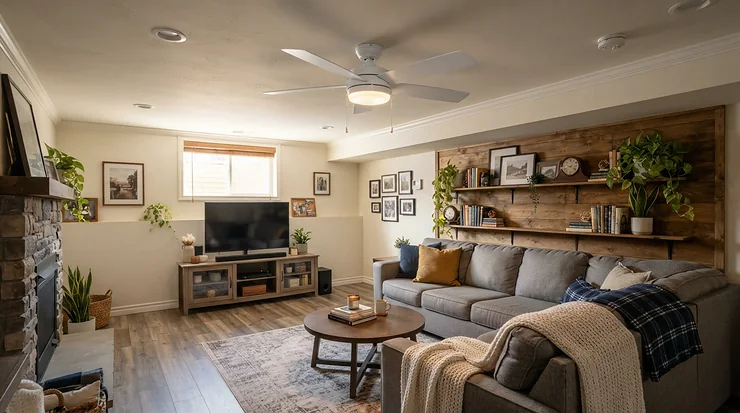
Stand in a typical Canadian basement, stretch an arm overhead, and your knuckles brush the ceiling. Hang a standard downrod fan there and you’ve installed a food processor at forehead height. That’s why a hugger ceiling fan for low basement ceilings is less a style choice than a safety decision. It’s the difference between a cozy rec room and a very short trip to the emergency department.
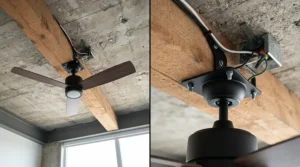
Here’s the part most product listings skip: even the slimmest hugger needs more ceiling than people expect. Do the arithmetic before you shop. A fan that drops 19-25 cm (7.5-10 inches) from the ceiling still needs roughly 2.3-2.4 m (7 ft 7 in to 7 ft 10 in) of total height to keep its blades at the usual 2.1 m (7 ft) clearance. Below that, no hugger on the market will rescue you.
This guide walks through seven real models, the clearance math, the winter-reversing question, and the Canadian certification labels worth checking. Every spec below is translated into what it means in a basement, and every model is judged on published specs and published customer reviews. Reviews can’t be verified for every model, so I say where they’re thin.
What Is a Hugger Ceiling Fan for Low Basement Ceilings?
A hugger ceiling fan for low basement ceilings is a flush-mount fan whose motor housing attaches directly to the ceiling bracket with no downrod. That puts the blades only about 18-30 cm (7-12 inches) below the ceiling. It gives up a little airflow efficiency in exchange for headroom, which makes it the practical choice wherever ceilings sit under roughly 2.4 m (8 feet). Wikipedia’s overview of the ceiling fan covers the broader history and mounting styles if you want more background.
Hugger Ceiling Fans for Basements at a Glance
Here are the seven models ranked for low-clearance basements. Drop figures come from published listings, so confirm them on the exact variant you buy, because adding a light kit can change the number.
| # | Model | Span | Motor | Listed drop from ceiling | Price range (CAD) | Best For |
|---|---|---|---|---|---|---|
| 1 | Hunter Low Profile IV 42-Inch | 42″ | AC, 3-speed | about 19 cm (7.5″) | around C$120-C$190 | Tightest ceilings, simple reliability |
| 2 | Honeywell Glen Alden 52-Inch | 52″ | AC, 3-speed | about 20 cm (8″), no light | around C$150-C$250 | Large basements with a modest drop |
| 3 | Amico 42-Inch Low Profile Fan with Light | 42″ | DC, 6-speed | about 24 cm (9.5″) per one buyer | around C$70-C$130 | Budget buyers wanting light and remote |
| 4 | DREO 44-Inch Low Profile Fan | 44″ | DC, 6-speed | about 24.5 cm (9.7″) | around C$140-C$220 | Quiet, compact rooms |
| 5 | TCL 52-Inch Flush Mount Fan | 52″ | DC, 6-speed | confirm on listing | around C$100-C$180 | Light sleepers, mid-size rooms |
| 6 | DREO Smart 52-Inch Ceiling Fan | 52″ | DC, 12-speed | confirm on listing | around C$200-C$320 | Smart-home setups, big airflow |
| 7 | Fanbulous 52-Inch Low Profile Fan | 52″ | DC, 6-speed | confirm on listing | around C$110-C$190 | App control on a budget |
The Hunter wins on pure headroom, and the Honeywell gives the best span-to-drop ratio among the AC models. The Amico and TCL undercut everyone on price, but the Amico‘s extra drop matters more in a basement than in a bedroom. Buyers with ceilings right at the minimum should shortlist the Hunter or the Honeywell first, then choose a DC model only if they have the spare centimetres.
💬 Just one click — help others make better buying decisions too!😊
Top 7 Hugger Ceiling Fans for Low Basement Ceilings: Expert Analysis
1. Hunter Low Profile IV 42-Inch — lowest drop in the lineup
The standout here is geometry. Hunter lists the housing at roughly 7.5 inches (19 cm), the shallowest drop in this guide, which preserves the most headroom in a cramped lower level.
The fan pairs a 42-inch span with five blades pitched at 13 degrees and a three-speed AC motor drawing about 29 W. Listings show about 2,900 CFM, enough to freshen a den of roughly 10-13 m² (110-140 sq ft). This version has no light kit and uses a pull chain. In a basement that’s a plus, because you lose no extra height to a bowl light and can lean on your existing pot lights. Tuck the chain up so it doesn’t hang at face level.
Based on the specs, this is the pick for anyone whose ceiling is barely tall enough. An AC motor can hum faintly against joists, so a quiet finished room above matters. Published customer reviews across retailer pages repeatedly describe quiet running and a genuinely flush fit. Some buyers find low speed too weak to bother with, and a few report missing hardware or humming.
Pros:
- ✅ Shallowest listed drop in this guide
- ✅ Five blades, quiet operation per reviewers
- ✅ Simple pull chain, no electronics to fail
Cons:
- ❌ Low speed feels weak to some buyers
- ❌ No light or remote on this version
Price range: around C$120-C$190, so check current price. Strong value when headroom is the priority.
2. Honeywell Glen Alden 52-Inch — 52-inch span on an 8-inch drop
Honeywell packs a 52-inch span into an 8-inch (20 cm) drop on the no-light version, which is rare among AC fans.
It uses five reversible blades, a three-speed reversible motor and a pull chain, and is rated for rooms up to about 37 m² (400 sq ft). That span suits a family room, but there’s a catch. With the light kit the total height grows to roughly 34 cm (13.4 inches). In a 7 ft 8 in basement that extra five inches could put the lowest edge right where a tall visitor’s head travels. The no-light conversion cap is the safer basement choice.
Our read of the specs is that this is the best “big room, low ceiling” AC option. The 52-inch span moves more air per revolution than a 42, so you can run it slower and quieter. Reviewers on Amazon describe it as quiet and well balanced, while noting that installation is fiddly. The blade screws arrive pre-installed and have to be removed first, and the hugger mount takes patience.
Pros:
- ✅ Large 52-inch span in a shallow housing
- ✅ No-light cap saves precious height
- ✅ Reversible motor for winter use
Cons:
- ❌ Light kit adds roughly five inches
- ❌ Installation is fiddlier than average
Price range: around C$150-C$250, so check current price. Fair value for a larger basement.
3. Amico 42-Inch Low Profile Fan with Light — cheapest way to get light and breeze
If budget is the brief, the Amico is the entry ticket: a DC motor, six speeds, a remote and a dimmable light for the cost of a mid-range desk lamp.
Listings cite up to about 2,860 CFM, a reversible motor switchable from the remote, three colour temperatures and sleep timers. The claimed 35 dB noise level is a best-case figure, so treat it as marketing until you’ve heard it. Here’s the basement catch. One buyer measured about 9.5 inches (24 cm) from the ceiling to the bottom of the fan and warned shoppers who truly need a low profile to look elsewhere. That’s a couple of inches deeper than the Hunter.
On a 7 ft 10 in or taller ceiling the extra depth is tolerable. On anything lower, it’s disqualifying. The listing also states that fan and light can’t be wired separately, so a single wall switch can’t split the two functions. Shoppers praise the value and the remote. The drop is the recurring caution.
Pros:
- ✅ DC motor with six speeds
- ✅ Remote reversing for winter
- ✅ Light and fan in one purchase
Cons:
- ❌ Drop is deeper than the true low-profile leaders
- ❌ Fan and light can’t be wired separately
Price range: around C$70-C$130, so check current price. Excellent value if your ceiling has the room.
4. DREO 44-Inch Low Profile Fan — quiet DC fan for compact rooms
DREO builds this fan around a brushless DC motor and 14-degree blades, a combination aimed squarely at quiet bedrooms and small dens.
The listing cites about 3,171 CFM, six speeds, five colour temperatures with up to 2,400 lumens, and 1, 4 and 8-hour timers. One review roundup lists the height at 9.67 inches (about 24.5 cm). Here’s a wrinkle: DREO’s feature materials claim 22 dB while the product-detail field lists 40 dB, so treat the quiet claim cautiously. Even the higher figure is still gentle in a room with a furnace running.
A 44-inch span is the sweet spot for smaller basement rooms, where it moves air without overpowering a 3 m by 4 m space. Buyers and roundups praise its low noise and the maker pitches about a 30-minute DIY install, though a first-time installer should budget longer.
Pros:
- ✅ Brushless DC motor, smooth six-speed range
- ✅ Dimmable light with five colour temperatures
- ✅ Remote reversing and timers
Cons:
- ❌ Sits nearly 10 inches below the ceiling
- ❌ Conflicting noise figures on the listing
Price range: around C$140-C$220, so check current price. Pricey for the size but polished.
5. TCL 52-Inch Flush Mount Fan — quietest claim at a modest price
TCL’s flush-mount fan targets light sleepers, with a claimed 25 dB noise level and a reversible DC motor.
It pairs six speeds with a dimmable integrated LED (listings vary between about 20 and 24 W), three colour temperatures, five wood blades and a metal housing. The 52-inch span suits a mid-size family room. Confirm the exact drop on your variant before committing, because this guide couldn’t verify it across versions.
Owners describe it as quiet and powerful, with one reporting more than a year of problem-free running. Their gripes are practical. The lowest speed is still fairly brisk, the light turns back on after a power outage, and the integrated LED means a failed light panel can mean replacing the whole fan. One review summary also flagged a few reports of speed fluctuations and safety worries, so skim the most recent reviews before buying.
Pros:
- ✅ Quiet DC motor, six speeds
- ✅ Large 52-inch span with remote
- ✅ Dimmable light, three colour temperatures
Cons:
- ❌ Integrated LED is not replaceable
- ❌ Light resets to on after outages
Price range: around C$100-C$180, so check current price. Good value if the drop checks out.
6. DREO Smart 52-Inch Ceiling Fan — big airflow with smart control
This is the most feature-complete fan in the guide: 12 speeds, natural, normal and sleep modes, and smart-home integration.
Roundups credit a brushless DC motor with about 5,673 CFM and a claimed 22 dB at low speeds. For comparison, one roundup suggests a 52-inch fan should clear roughly 4,000 CFM to cool a standard bedroom, so this is generous airflow for a large, open basement of 15-25 m². The smart angle matters in a basement more than upstairs. Wi-Fi often fades down there, so check your router coverage first or the “smart” part becomes a remote with extra steps.
Published roundups praise its quietness and feature set. We couldn’t verify a large body of owner reviews, so weigh that praise lightly. Drop is another unknown across variants, so confirm it.
Pros:
- ✅ Very high rated airflow for its class
- ✅ 12 speeds with sleep mode
- ✅ Smart-home control
Cons:
- ❌ Highest price in this lineup
- ❌ Depends on strong basement Wi-Fi
Price range: around C$200-C$320, so check current price. Premium, and only worth it if you’ll use the smart features.
7. Fanbulous 52-Inch Low Profile Fan — app control on a budget
The Fanbulous brings app-controlled operation to a budget slot, with a brushless DC motor and five ABS blades.
Listed figures are about 3,930 CFM, six speeds and 35 dB. ABS blades are lighter than wood, which eases the load on the mount and speeds installation. One user reported a 10-20 minute install, which is promising for DIYers. The trade-off is that plastic blades won’t look as upscale in a finished basement bar or media room.
Its published review pool is thinner than the Hunter or Honeywell‘s, so it’s a value gamble rather than a proven workhorse. Confirm the drop on your variant, because specs aren’t consistent across listings. If you choose it, test it for wobble in the first week while the return window is open.
Pros:
- ✅ App control at a low price
- ✅ Lightweight ABS blades install quickly
- ✅ Brushless DC motor, six speeds
Cons:
- ❌ Thinner review history than the leaders
- ❌ Plastic blades look less premium
Price range: around C$110-C$190, so check current price. Reasonable value if you accept the unknowns.
Basement Installation Guide: From Ceiling Box to First 30 Days
Most hugger problems start with the install, not the fan.
Measure first. Measure from the finished floor to the ceiling at the exact spot where the fan will hang. Subtract the fan’s listed drop to find where the blades will sit. If you can’t keep them at the height your manual specifies, stop there.
Check the box and structure. A fan moves and vibrates, so it needs a support rated for fans, usually marked as acceptable for fan support. A light-fixture box often isn’t. In a finished basement with a drop ceiling, never hang a fan from the ceiling grid. The fan needs a brace or structure above the tiles.
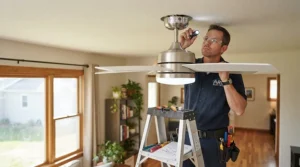
Mind the wiring rules. Fixed electrical work in Canada falls under provincial rules, and many provinces require a licensed electrician for this work. Check yours before you pick up a screwdriver.
First 30 days. Tighten the blade and bracket screws after the first week, because vibration loosens hardware. Watch for wobble, and use the balancing kit if one’s included. Dust the blades monthly. A dusty low fan at eye level gets noticed fast.
Seen from the spec sheet, the install is simple. In real basements, joist spacing, ductwork and old wiring are what turn a 40-minute job into a Saturday.
Real-World Scenarios: Which Fan Fits Which Basement?
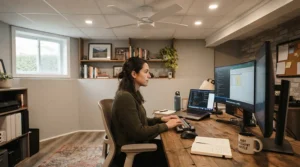
Scenario 1: The 7 ft 6 in laundry-and-gym nook. The ceiling sits at 2.29 m. Even the Hunter leaves blades near 2.09 m, below the common 2.1 m guidance. A wall-mounted or floor fan is the safer move here.
Scenario 2: The 7 ft 10 in rec room. At roughly 2.39 m, the Hunter and Honeywell both clear 2.1 m comfortably, and the DREO 44 squeaks through. For quiet movie nights, the DREO 44-Inch Low Profile Fan earns its premium.
Scenario 3: The 8 ft 2 in family room of 28-32 m². This one wants airflow. The Honeywell Glen Alden 52-Inch (no light) or the DREO Smart 52-Inch Ceiling Fan suits a long room with a sectional and a TV.
Regulations matter too. For instance, City of Oshawa guidance on Ontario’s Building Code says basement secondary suites need a minimum ceiling height of 1.95 m, with 1.85 m under beams and ducts. A ceiling that barely passes habitability still can’t host a fan. Rules vary by province and municipality, so check locally.
Problem → Solution: Common Basement Fan Headaches
The fan wobbles. Check the mounting bracket, tighten the blade screws and use the balancing kit. Don’t blame the blades first, because a loose box causes most wobble.
The room above hears a hum. Hugger motors sit tight against the joists, so vibration travels into the structure. Review roundups note that AC motors carry hum into the ceiling more than DC ones. A DC model such as the DREO 44-Inch Low Profile Fan or TCL 52-Inch Flush Mount Fan is the quieter bet.
Air movement feels weak. Run the fan on a higher speed, or upsize from 42 to 52 inches if the room is large. Check that no furniture sits right under the blades.
The pull chain hangs at head height. Shorten it, or choose a remote-controlled model like the Amico 42-Inch Low Profile Fan with Light.
The floor stays cold in winter. See the winter-reversing section below.
7 Foot Ceiling Clearance: The Math Nobody Prints on the Box
Manufacturers love the word “low,” yet few explain what 7 foot ceiling clearance actually means for blade height. The rule of thumb for most fans is that the lowest blade edge stays at least 2.1 m (7 ft) above the finished floor. The table shows where each fan’s blades land at two ceiling heights, using listed housing drops.
| Fan | Listed drop | Minimum ceiling for 7 ft (2.13 m) blades | Blade height on a 7 ft 6 in (2.29 m) ceiling |
|---|---|---|---|
| Hunter Low Profile IV 42-Inch | 7.5″ | about 7 ft 7.5 in (2.32 m) | about 6 ft 10.5 in (2.09 m) |
| Honeywell Glen Alden 52-Inch | 8″ | about 7 ft 8 in (2.34 m) | about 6 ft 10 in (2.08 m) |
| Amico 42-Inch Low Profile Fan with Light | 9.5″ | about 7 ft 9.5 in (2.38 m) | about 6 ft 8.5 in (2.04 m) |
| DREO 44-Inch Low Profile Fan | 9.7″ | about 7 ft 9.7 in (2.38 m) | about 6 ft 8.3 in (2.04 m) |
The table shows that a true 7 ft ceiling (2.13 m) leaves blades at about 6 ft 4.5 in (1.94 m) even with the Hunter, well under the 7 ft guidance. Hugger design reduces the problem. It doesn’t erase it. The 52-inch models need their own drop confirmed first.
Also note that the number on your fan’s label wins over forum folklore. Some manufacturers set higher figures for the Canadian market. One fan maker’s instructions, for example, ask for 2.5 m (8.3 ft) above the floor in Canada. Always read your own manual, and measure from the finished floor, not the slab.
52 Inch vs 44 Inch Ceiling Fan for Basement: Which Size Wins?
The 52 inch vs 44 inch ceiling fan for basement debate comes down to room volume and drop, not marketing.
| Factor | 44-inch (e.g., DREO 44-Inch Low Profile Fan) | 52-inch (e.g., Honeywell Glen Alden 52-Inch) |
|---|---|---|
| Typical room | Compact dens, offices, small bedrooms | Family rooms up to about 37 m² (400 sq ft) per Honeywell |
| Listed airflow | about 3,171 CFM | 3,930 CFM (Fanbulous) to 5,673 CFM (DREO Smart) |
| Drop | about 24.5 cm | 8-11 inches, varies by model |
| Best For | Quiet, smaller spaces | Open layouts and long rooms |
Looking at the numbers, the 52 moves more air per revolution, so it can run slower and quieter in a big room. That makes it the better choice for a large finished basement. The 44 is easier to place around ducts and pot lights, though, and smaller rooms rarely need 52-inch airflow. Roundups suggest rooms under about 10 m² (100 sq ft) suit 42 to 44 inches. If you’re torn, size by room first and clearance second. A fan that fits the ceiling but starves the room is a bad trade.
Flush Mount vs Downrod: What Changes Below 8 Feet
Choosing between flush mount vs downrod mostly comes down to ceiling height.
| Factor | Flush mount (hugger) | Downrod |
|---|---|---|
| Headroom | Maximum | Minimal |
| Ceiling needed | Roughly 7 ft 7 in+ for 7 ft blades | Typically 9 ft+ for good airflow |
| Airflow | Slightly restricted near ceiling | Best air access |
| Cleaning | Easy, blades are close | Harder, higher reach |
| Best For | Basements under 8 ft | Great rooms, high ceilings |
The table points one way for basements: when the ceiling is 8 ft or lower, downrods usually aren’t an option, as installers commonly advise skipping them entirely. A hugger “feels” slightly more direct because the blades sit nearer the ceiling, and some buyers find a 44-inch hugger as effective as a 52-inch fan on a standard mount. A Hunter, Honeywell or DREO hugger will serve nearly every basement. Save downrods for walk-out levels with taller ceilings.
Buy Reversible Ceiling Fan for Basement in Winter: Does Reversing Really Help?
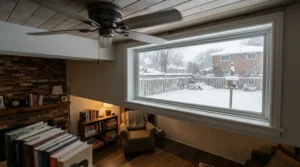
If you plan to buy reversible ceiling fan for basement in winter use, expect modest benefits, not miracles. Natural Resources Canada advises that ENERGY STAR certified ceiling fans feature reversible motors, run counterclockwise in summer and clockwise in winter, and notes that fans cool people, not rooms.
Based on how a hugger works, there are limits. Blades only 20-25 cm from the ceiling have little room to pull a warm layer down. Basements also tend to stay cooler near the floor because of the slab, so low-speed clockwise rotation can gently mix air. We have no measured basement data, so treat any savings promise skeptically.
Practical tips: reverse the fan only after the blades stop, run it on the lowest useful speed, and expect a calmer room rather than a warmer one. DC models like the TCL 52-Inch Flush Mount Fan and Amico 42-Inch Low Profile Fan with Light reverse from the remote. The Hunter Low Profile IV 42-Inch and Honeywell Glen Alden 52-Inch use a switch on the housing.
CSA-Listed Fan Safety Clearance: Reading the Labels That Matter
Ceiling fans are covered by a Canadian electrical product safety standard. The Standards Council of Canada’s notice on CSA’s fan standards explains that ceiling fans now fall under CAN/CSA-C22.2 No. 60335-2-80 rather than the older fans standard.
What does that mean for you? Look for a certification mark showing Canadian approval, such as CSA, cUL or cETL on the fan or its manual. A US-only listing page may not tell you that. Products sold into Canada should carry the right mark, and the box or manual is the place to check.
CSA-listed fan safety clearance has two parts, and they’re easy to confuse. Certification covers how the product is built. The blade height comes from the instructions and your installation. A certified fan hung too low is still hung too low.
For basements, humidity matters. A “dry-rated” fan suits a finished, climate-controlled room. A laundry area or unfinished space may call for a damp-rated fan. Ask an inspector or electrician if you’re unsure.
How to Choose a Hugger Ceiling Fan for Low Basement Ceilings
- Measure the ceiling. Take the floor-to-ceiling height at the exact spot. Reasoning: it decides whether any fan is legal and safe.
- Subtract the fan’s drop. The result is your blade height, and it should meet the manual’s requirement. Reasoning: listed drop is the single most important spec here.
- Match span to room size. Choose 42-44 inches for small rooms and 52 for large ones. Reasoning: undersized fans run hard and loud.
- Pick the motor. DC suits quiet rooms and remotes, while AC is simpler and cheaper. Reasoning: motor type decides noise and speed range.
- Decide on lighting. A light kit adds height, so a no-light fan with pot lights is often better. Reasoning: inches matter.
- Check certification and rating. Look for Canadian marks and decide between dry-rated and damp-rated. Reasoning: this affects safety and moisture tolerance.
Features That Actually Matter (And Those That Don’t)
Matter: the listed drop, a reversible motor, a quiet motor type, and the Canadian certification mark.
Mostly don’t: extreme CFM numbers (the DREO Smart 52-Inch Ceiling Fan‘s 5,673 CFM is useless if the drop puts blades too low), and noise claims on their own. The 22 dB figure on the DREO listing conflicts with another figure of 40 dB, a reminder that spec-sheet decibels differ wildly.
Situational: integrated LED lights (convenient, but the TCL reviews note replacing the whole fan if the panel fails), app control (needs Wi-Fi), and fancy blade finishes.
Spec sheets sell fans on lumens and apps, while basements reward headroom and calm. Pick the fan that fits the ceiling first, then enjoy the extras.
FAQ
❓ Can you install a ceiling fan in a basement with 7 ft ceilings?
❓ Do hugger fans cool as well as downrod fans?
❓ How much does a hugger ceiling fan cost in Canada?
❓ Should a basement ceiling fan be damp-rated?
❓ Can I mount a hugger fan on a drop ceiling?
Conclusion
A hugger ceiling fan for low basement ceilings can make a lower level feel livable, but only if the numbers work first. Measure your floor-to-ceiling height, subtract the fan’s drop, and compare the result with your manual’s clearance rule. A true 7 ft ceiling is too low for any hugger to satisfy the usual 2.1 m guidance.
If you’ve got the height, the picks are clear. The Hunter Low Profile IV 42-Inch is the headroom champion and the reliable no-frills choice. The Honeywell Glen Alden 52-Inch serves bigger rooms with a shallow drop. The Amico 42-Inch Low Profile Fan with Light and TCL 52-Inch Flush Mount Fan keep costs down, the DREO 44-Inch Low Profile Fan and DREO Smart 52-Inch Ceiling Fan add polish and quiet, and the Fanbulous 52-Inch Low Profile Fan offers app control for a modest outlay.
Check for a Canadian certification mark, confirm the drop on your variant, and hire a licensed electrician where your province requires one. If you want a final push, remember that reversing at low speed in winter is a small bonus, not a heating plan.
✨ Ready to find your fit?
🔍 Click through the picks above to check current pricing and availability, and choose the fan that keeps your family comfortable and your heads safe!
Recommended for You
- Modern Ceiling Fan For Home Office: 7 Best Picks For 2026
- Home Office Ceiling Fan: 7 Best Quiet Picks For 2026
- Quiet Ceiling Fan For Home Office: 7 Best Silent Picks 2026
Disclaimer: This article contains affiliate links. As an Amazon Associate, I earn from qualifying purchases. If you purchase products through these links, we may earn a small commission at no additional cost to you.
✨ Found this helpful? Share it with your friends! 💬🤗
