

In This Article
A ceiling fan for basement rec room use is a low-profile or flush-mount (hugger) fan, usually 44 to 52 inches (112–132 cm) across, built for below-grade spaces with ceilings around 2.1–2.4 m (7–8 ft). The best models pair a quiet motor with a dimmable LED light, so one fixture handles both airflow and lighting.
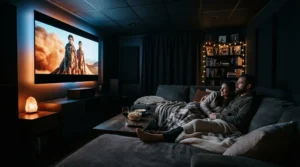
Basements are strange places. They sit in the cool earth, so they feel clammy in July and oddly stuffy in January. Add a sectional, a projector and three teenagers, and the air stops moving altogether. You can open a window, but there’s rarely one big enough to matter.
That’s where a good ceiling fan for basement rec room duty earns its keep. Per Natural Resources Canada’s ceiling fan guidance, fans cool people rather than rooms, and they can cut energy use if you run them with a slightly higher thermostat setting. In a rec room, where bodies and electronics pile up heat, that matters.
Here’s the catch. Low ceilings, humidity, screens, game tables and open-concept layouts all change what “good” means. A fan that’s perfect for a bedroom can be a headache, or a headbump, down there.
So I’ve built this guide around real, published specs and genuine review sentiment, with no invented lab tests and no fake owner stories. You’ll get seven actual models, an honest read on what each does well, and the Canadian-specific context (ceiling heights, electrical safety, humidity) that most roundups skip. Prices are ranges in C$, so check current pricing before you buy.
Quick Comparison: Best Ceiling Fan for Basement Rec Room Picks
Start here if you’re short on time. Everything below gets unpacked in the product sections.
| Fan | Blade Span | Est. Price Range | Light | Best For |
|---|---|---|---|---|
| Prominence Home Benton | 52 in | C$130–C$180 | LED globe | Prominence Home Benton: tight budgets |
| Sofucor Low Profile | 52 in | C$140–C$200 | Dimmable LED | Sofucor Low Profile: DC motor on a budget |
| Hunter Builder Low Profile | 52 in | C$200–C$280 | 3 LED bulbs | Hunter Builder Low Profile: simple, durable setups |
| Westinghouse Comet | 52 in | C$180–C$260 | 16 W dimmable LED | Westinghouse Comet: all-round value |
| Honeywell Carnegie | 52 in | C$220–C$320 | Dimmable LED cage | Honeywell Carnegie: industrial game rooms |
| Hunter Dempsey | 52 in | C$250–C$350 | Dimmable LED | Hunter Dempsey: remote-controlled movie nights |
| Kendal LoPro | 52 in | C$650–C$900 | 1,700 lm LED | Kendal LoPro: premium, brightest light |
Price ranges are estimates drawn from retailer listings I reviewed in autumn 2026, converted to Canadian dollars. Check current price before you commit.
Look at the pattern. The Prominence Home Benton and Sofucor Low Profile undercut everyone, while the Kendal LoPro costs roughly three times the middle group. That premium buys a DC motor and a much stronger light, which we’ll quantify shortly. For most rec rooms the sweet spot is the Westinghouse Comet or Hunter Dempsey, depending on whether you want pull chains or a remote.
💬 Just one click — help others make better buying decisions too!😊
Top 7 Ceiling Fan for Basement Rec Room Picks: Expert Analysis
I grouped these by budget, mid-range and premium. Each section sticks to published specs and the review sentiment I could verify. Where I couldn’t verify something, I say so.
1. Prominence Home Benton — budget hugger for tight ceilings
The Prominence Home Benton is a 52-inch hugger fan (model 51429), which means the motor sits almost flush against the ceiling. That’s the whole point when you’re fighting for every centimetre of headroom.
It ships with reversible walnut and maple blades, a bronze finish and an LED globe light. A flush mount at 52 inches suits a room up to roughly 37 m² (400 sq ft), according to the typical manufacturer sizing for this class. I couldn’t confirm its airflow rating or whether it uses a remote or pull chains, so check the listing before you order.
On paper, this is the “get it up, move on with life” option. It suits a kids’ play area or a utility-style rec room where lighting needs are modest. One retailer lists several hundred reviews, which at least suggests a deep user pool, though I can’t summarize their content reliably.
Pros:
- ✅ Flush mount saves precious headroom
- ✅ Reversible blades match several décor styles
- ✅ Lowest entry price in this lineup
Cons:
- ❌ Airflow and control type unconfirmed
- ❌ Basic globe light won’t carry a large room
Expect around C$130–C$180. Value verdict: decent if the room is small and the light is secondary.
2. Sofucor Low Profile — DC motor and timer at a budget price
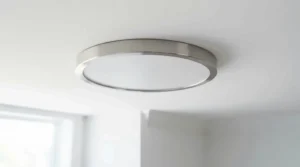
The Sofucor Low Profile is the cheapest way I found to get a DC motor, and DC motors are the quiet, efficient heart of a good basement fan.
It’s a 52-inch flush-mount with three plastic blades, a dimmable light, six speeds, a timer and a reversible motor. A DC motor typically draws 15–30 W versus 50–100 W for older AC motors, a gap ATCO Energy’s ceiling fan breakdown explains clearly. In a room you run for hours, that adds up.
Now the caution. The listing claims 6,500 CFM, which beats published figures from established brands (the premium Kendal LoPro lists about 5,400 CFM with four blades). Treat that number as marketing until proven otherwise. Reviewer volume is strong, with several hundred ratings at one retailer, but I couldn’t verify a consistent rating or recurring complaints.
Plastic blades also mean less visual weight. They suit modern rooms better than rustic ones.
Pros:
- ✅ DC motor, six speeds and a timer
- ✅ Dimmable light for movie-night control
- ✅ Large review pool on retailer pages
Cons:
- ❌ Claimed airflow looks optimistic
- ❌ Plastic blades feel less premium
Expect around C$140–C$200. Value verdict: strong features per dollar, so long as you keep expectations realistic.
3. Hunter Builder Low Profile — dependable workhorse with a lifetime motor warranty
The Hunter Builder Low Profile is the “boring in the best way” pick: a 52-inch fan (model 53327) built to sit flush on ceilings under 2.7 m (9 ft).
It uses a three-speed WhisperWind motor and three 7 W LED bulbs rated at 600 lumens each. Crucially, the listing marks those bulbs as non-dimmable, so your brightness range is on or off. For a laundry-adjacent hobby space, fine. For a home theatre, that’s a real limitation. The 42-inch sibling lists an overall height of just 7.45 inches, which shows how compact this family is.
Control is by pull chain, so you’ll be walking to the fan to change anything. That’s a minor annoyance in a bedroom and a bigger one when the lights are down and the film’s rolling.
Hunter backs the motor with a limited lifetime warranty. I couldn’t verify review sentiment for this exact model, so judge it on brand track record and specs, not on a rating I can’t confirm.
Pros:
- ✅ Very low, flush-mounted housing
- ✅ Limited lifetime motor warranty
- ✅ Three bulbs give even light spread
Cons:
- ❌ Bulbs are non-dimmable
- ❌ Pull chains only, no remote
Expect around C$200–C$280. Value verdict: fair for functional spaces where simplicity wins.
4. Westinghouse Comet — the balanced all-rounder with real efficiency data
The Westinghouse Comet is the one with the most useful published numbers: 3,589 CFM on high, 63 W without the light, and an airflow efficiency of 57 CFM per watt.
Those figures tell a story. It moves a respectable amount of air, but the AC motor draws far more power per CFM than a DC design. The Kendal LoPro lists about 231 CFM/W by comparison. For a fan running a few hours a week, the cost difference is small. For one running daily, it grows.
The light kit is an integrated 16 W dimmable LED, roughly the brightness of a 60 W incandescent bulb, per one retailer listing. Five reversible blades come in finishes from white to matte black. The listing height is about 14.25 inches, so measure carefully: on a 2.3 m (7 ft 6 in) ceiling, that’s a tighter squeeze than a true hugger.
Control is by pull chain in the kit. I couldn’t confirm review data for this model, so rely on the spec sheet.
Pros:
- ✅ Published efficiency and airflow data
- ✅ Dimmable integrated LED, no bulbs to replace
- ✅ Many finish and blade combinations
Cons:
- ❌ Listing height is not ultra-low
- ❌ AC motor uses more power than DC rivals
Expect around C$180–C$260. Value verdict: solid middle ground for 2.4 m (8 ft) basements.
5. Honeywell Carnegie — industrial cage light for game-room swagger
The Honeywell Carnegie is the one you buy for looks first. It has a caged, industrial-style light under a 52-inch blade set, and it suits a bar, a pool table or a man-cave-adjacent space.
Published airflow is 3,376 CFM, with listing dimensions of roughly 52 by 14 inches. That 14-inch height means you must do the headroom maths: on a 2.3 m (7 ft 6 in) ceiling the lowest point sits near 1.9 m (6 ft 4 in), which is uncomfortably low in a walkway. It’s far happier at 2.4 m (8 ft) or taller.
Reviewer sentiment on one listing is mixed but useful. Buyers describe it as reasonably quiet, though a low-pitched whirr on high takes some getting used to. Several say blade installation is fiddly, and one reported some swaying at top speed. Another flagged that using the wrong bulb can melt the socket, so stick to the specified type.
Good news: a remote is included, and the light is dimmable.
Pros:
- ✅ Strong industrial look for game rooms
- ✅ Remote included, light dimmable
- ✅ Decent airflow for the size
Cons:
- ❌ Fiddly blade installation reported
- ❌ Taller profile needs a 2.4 m ceiling
Expect around C$220–C$320. Value verdict: great style per dollar, but not for low ceilings.
6. Hunter Dempsey — remote-controlled quiet for movie nights
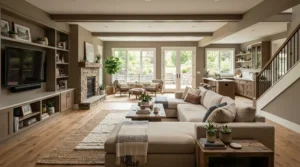
The Hunter Dempsey is the fan I’d shortlist for a home theatre. It’s a 52-inch low-profile design with a handheld remote that controls both fan speed and light.
Hunter says it fits ceilings under 2.7 m (9 ft), and the WhisperWind three-speed motor is marketed as a quiet performer. The 44-inch version lists two dimmable 9.8 W LED bulbs, so expect similar dimmable control here. Being able to drop the light to 20% without leaving the sofa is a bigger win than any CFM number.
Retailer ratings I found cluster around four out of five stars. One page shows 4.0 from 168 ratings, another 4.1 from 98 ratings, and a 44-inch variant sits near 3.8 from 239. Note that several positive reviews were flagged as collected during promotions, so weight them accordingly. Common praise covers easy installation, a clean flush look and enough airflow for kitchens and bedrooms.
Pros:
- ✅ Handheld remote for fan and light
- ✅ Dimmable LED for theatre control
- ✅ Consistent four-star retailer ratings
Cons:
- ❌ Some reviews flagged as promotional
- ❌ Pricier than similar pull-chain models
Expect around C$250–C$350. Value verdict: worth the extra for the remote alone.
7. Kendal LoPro — premium DC motor with a seriously bright light
The Kendal LoPro (model AC21352) is the premium pick, and it’s the only one here where the numbers are genuinely impressive. A DC motor delivers a listed 5,426 CFM on high while drawing just 23.5 W, a published efficiency of about 231 CFM/W.
The housing is also remarkably slim: 3.5 inches with the glass, or 2.75 inches with the light cap. For a 2.3 m basement, that’s the difference between “fits” and “bumps heads”. The 25 W LED kit puts out 1,700 lumens, roughly double what most competitors manage, and the remote handles six speeds, dimming and reverse.
Kendal sells through Canadian lighting retailers, so confirm amazon.ca availability and delivery to your province before ordering. A sibling, the Kendal Caprion, uses three blades, lists 1,600 lm at 3000K with CRI 90, and adds a 2/4/8-hour timer. Warranty runs a lifetime on the motor and five years on the light kit. I couldn’t verify consumer reviews, so the case rests on specs.
Pros:
- ✅ Quiet, efficient DC motor
- ✅ Ultra-low housing, bright 1,700 lm light
- ✅ Remote with dimmer, reverse and six speeds
Cons:
- ❌ Roughly three times the price of mid-range
- ❌ Amazon.ca availability varies by seller
Expect around C$650–C$900. Value verdict: justified if your rec room is also your main lighting source.
The next table puts the published airflow figures side by side so you can compare them honestly.
| Fan | Airflow (High) | Motor Power | Efficiency | Best For |
|---|---|---|---|---|
| Prominence Home Benton | Not confirmed | Not confirmed | Not confirmed | Prominence Home Benton: low-stakes rooms |
| Sofucor Low Profile | 6,500 CFM (claimed) | DC | Not published | Sofucor Low Profile: budget DC |
| Hunter Builder Low Profile | Not confirmed (42 in: 2,534 CFM) | AC | Not confirmed | Hunter Builder Low Profile: no-fuss installs |
| Westinghouse Comet | 3,589 CFM | 63 W | 57 CFM/W | Westinghouse Comet: mid-range balance |
| Honeywell Carnegie | 3,376 CFM | Not confirmed | Not confirmed | Honeywell Carnegie: style-first rooms |
| Hunter Dempsey | Not confirmed | AC | Not confirmed | Hunter Dempsey: theatre control |
| Kendal LoPro | 5,426 CFM | 23.5 W | 231 CFM/W | Kendal LoPro: efficiency and light |
The gap is stark. The Kendal LoPro moves roughly 50% more air than the Westinghouse Comet while using about a third of the power, which is exactly what a DC motor is for. The Sofucor Low Profile claims the biggest figure of all, but because no efficiency data backs it up, I’d treat it as a promising feature set rather than proven performance. Where numbers say “not confirmed,” don’t assume they’re poor; they simply weren’t published where I could verify them.
How to Choose a Ceiling Fan for Basement Rec Room Use
Choosing well is mostly about avoiding three mistakes: too big, too tall, or too loud. Work through these in order.
- Measure ceiling height first. Subtract the fan’s total height from your finished ceiling, then keep blades roughly 2.1 m (7 ft) above the floor, a commonly cited clearance. Under 2.4 m (8 ft), insist on a true hugger.
- Match blade span to floor area. A 52-inch (132 cm) fan suits up to about 37 m² (400 sq ft). Bigger or L-shaped rooms may need two smaller fans.
- Prefer a DC motor if you’ll run it daily. It’s quieter and draws far less power, as the efficiency data above shows.
- Check the light, not just the fan. Dimmable and integrated beats fixed three-bulb kits, especially for screens.
- Insist on a remote. Pull chains in a dark basement lose their charm fast.
- Confirm the rating. Look for a damp- or dry-rated listing, and a recognized safety mark like cETL, cUL or CSA.
- Check the reversing switch. You’ll want it in winter.
The reasoning behind step three is worth a second. A fan spinning four hours a day for years benefits from a motor that sips power, while a fan used on weekends doesn’t need to. Match the motor to the pattern of use, and don’t pay for efficiency you won’t collect.

Ceiling Fan With Bright LED Light for Basement: How Many Lumens You Really Need
Basements are dark. Not “moody” dark, but “where did I leave my phone” dark, because natural light is limited to a few small windows.
A ceiling fan with bright LED light for basement rooms is attractive because it consolidates two fixtures into one. But look at the numbers. Fan light kits in this roundup range from three 600-lumen bulbs on the Hunter Builder Low Profile to the Kendal LoPro‘s single 1,700 lm kit. Widely used lighting rules of thumb suggest around 20 lumens per square foot for living areas. For a 28 m² (300 sq ft) rec room, that’s about 6,000 lumens, far more than any fan can provide alone.
So think in layers. Let the fan light cover ambient lighting at low levels, then add recessed or track lights on a separate dimmer. If you do want one fixture to carry most of the load, a ceiling fan with bright LED light for basement spaces needs to hit 1,500 lumens or more, which currently points to the Kendal LoPro or its Kendal Caprion sibling.
Colour temperature matters too. Warm 2700–3000K reads cozy for lounges, while cooler tones help with tasks. The Kendal Caprion‘s 3000K and CRI 90 is a pleasant middle ground.
Ceiling Fan vs Floor Fan for Basement: Which Moves Air Better?
This is the classic dilemma, and the honest answer is “it depends on what’s in your basement.”
On the one hand, a ceiling fan clears the floor, runs silently once balanced, and circulates air across the entire room. On the other, a floor fan is portable, needs no wiring, and can aim airflow where you want it, such as up the stairs or at a single seating zone. For the ceiling fan vs floor fan for basement debate, wiring and ceiling height decide most cases.
| Factor | Ceiling Fan | Floor Fan | Best For |
|---|---|---|---|
| Floor space | None used | Uses floor and outlet | Kendal LoPro: clear play areas |
| Coverage | Whole room | Directional | Hunter Dempsey: open seating |
| Noise | Low, esp. DC | Varies, often louder | Westinghouse Comet: movie nights |
| Install effort | Needs wiring | Plug and play | Floor fan for renters |
| Winter use | Reverse mode circulates warm air | Limited | Hunter Builder Low Profile: year-round |
The table shows why I lean ceiling for anything permanent. It frees floor space, handles winter circulation, and pairs light with airflow. A floor fan wins when you rent, when you can’t install a fan-rated box, or when you need spot cooling for a workout area.
Consider the cords, too. A floor fan in a rec room full of kids and controllers is a trip hazard waiting for its moment. For a ceiling fan vs floor fan for basement comparison, the ceiling fan usually wins on safety.
Open-Concept Basement Airflow: Sizing, Placement and Moisture
Open-concept layouts feel generous, but they create airflow dead zones. Think of a long basement with a TV area at one end and a bar or gym at the other. One central fan might never touch the corners.
For open-concept basement airflow, I’d split the space into zones and give each its own fan if the zone exceeds roughly 37 m² (400 sq ft). Mount fans centred over the seating areas, not the geometric middle of the room. And keep them at least 20–25 cm (8–10 in) away from walls, beams or ducting, because turbulence kills efficiency.
Also consider return air. Closed utility or storage rooms can starve the main space of circulation, so ask your local building department whether door undercuts or return grilles are required. Good open-concept basement airflow depends as much on where air can go as on how hard you push it.
Here’s the critical caveat: a fan moves air; it doesn’t remove moisture. Canada Mortgage and Housing Corporation’s archived moisture guidance notes that a damp basement generates more moisture than any other part of the house, and recommends dehumidifying in summer. Pair your fan with a dehumidifier and a cheap hygrometer. Don’t expect airflow alone to fix musty air.
Home Theatre Considerations: Quiet, Dim and Shadow-Free
A home theatre in a basement is one of the best uses of the space, and a ceiling fan can quietly ruin it. Three things matter: noise, light control and placement.
On noise, DC motors win. They run smoothly at low speed, which is exactly where you’ll want them during dialogue-heavy scenes. The Kendal LoPro and Sofucor Low Profile are the DC options here. AC fans like the Westinghouse Comet are fine, but you’ll hear a gentle hum in silent moments.
On light, you need dimming without flicker. That rules out the non-dimmable bulbs on the Hunter Builder Low Profile. The Hunter Dempsey‘s remote lets you drop the light without getting up, which is the single most practical home theatre feature in the lineup.
Placement is the sneaky one. A fan directly in a projector’s throw path can cast flicker or shadows onto the screen. Mount fans off-axis, or turn them off for key moments. Also check that your fan’s remote doesn’t conflict with your AV universal remote, since protocols vary by model.
Game Room Lighting: Layer It, Don’t Overload the Fan
Game room lighting has a different job than theatre lighting. You need clarity, not mood.
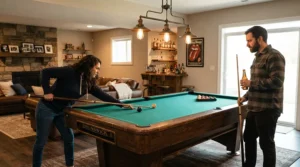
Pool tables, ping-pong and board games all demand even, glare-free light. A single cage fixture like the Honeywell Carnegie looks fantastic but throws a pool of light directly beneath it. For serious game room lighting, add track or recessed fixtures over the play surface and treat the fan light as fill.
Ping-pong deserves a special warning. A table tennis ball is extremely sensitive to airflow, so switch the fan off during matches. Pool is more forgiving, but check cue clearance before choosing any fan with a bulky light kit.
For colour temperature, aim for 3000–4000K over tables and warmer 2700K around lounge seating. If you want flexible game room lighting, put the table lights on their own dimmer circuit, and use the remote on a fan like the Hunter Dempsey to adjust ambient levels separately.

Practical Guide: Installing and Running Your Basement Fan
A good fan installed badly is a bad fan. Here’s the sequence that avoids most first-month regrets.
- Plan the location. Find joists with a stud finder, and mark the centre of your seating zone.
- Check the box. Fan weight needs a box rated to support a ceiling fan, not a standard light box. If you’re adding new wiring, hire a licensed electrician, since many municipalities require a permit.
- Kill the breaker and test the wires. Don’t trust the wall switch alone.
- Assemble blades on the floor. On the Honeywell Carnegie, set aside extra time, given reviewers’ notes about fiddly blade installation.
- Balance and test. Tighten every screw, then watch for wobble on all speeds.
- Set direction by season. Per Natural Resources Canada, run counterclockwise in summer and clockwise at low speed in winter.
First-30-day mistakes:
- Leaving the fan on in empty rooms (it cools people, not spaces).
- Skipping the one-week screw re-tighten.
- Using the wrong bulb type, which can overheat sockets.
- Forgetting to dust the blades before dust cakes on in the humid months.
Pair the remote with a wall-mounted holder, because remotes vanish into sofa cushions faster than socks into dryers.
Real-World Scenarios: Matching the Fan to the Room
Here are three common rec room profiles, with reasoning behind each pick.
The family play zone (2.3 m ceiling, 28 m² / 300 sq ft, budget around C$250). Kids, toys, low ceilings. A true hugger matters more than any other spec. The Hunter Builder Low Profile gives you a proven brand and a lifetime motor warranty, though you’ll accept pull chains. If you want a remote, upgrade to the Hunter Dempsey.
The dedicated home theatre (2.4 m ceiling, 22 m² / 240 sq ft, budget C$600+). Quiet and dimmable are non-negotiable. The Kendal LoPro offers DC silence, 1,700 lumens to dim down from, and an ultra-slim housing. Mount it off the projector axis.
The teen game room (2.5 m ceiling, 37 m² / 400 sq ft, budget around C$300). Style matters, and so does airflow during busy nights. The Honeywell Carnegie brings the cage look with a remote, and the 2.5 m ceiling clears its tall profile comfortably. Add track lighting over the table.
The common thread: ceiling height decides your shortlist, and your use case decides your winner. A fan that fits the ceiling but fights the room’s purpose will annoy you for years.
Safety, Codes and Regulations for a Basement Ceiling Fan in Canada
Basements are regulated more tightly than most homeowners realize. A few points are worth knowing before you cut a hole.
Ceiling height. Rules vary by province and edition, so confirm with your local building department. As one example, the City of Oshawa’s Ontario Building Code guide lists a 1.95 m minimum ceiling height in a basement secondary suite, reduced to 1.85 m under beams and ducting. A fan that hangs low can quietly turn a compliant room into a non-compliant one, which is why hugger designs matter.
Electrical. Use a fan-rated box, follow the manufacturer’s clearance guidance, and have a licensed electrician handle any new circuits. Look for recognized certification marks on the fan.
Energy. Ceiling fans are subject to Canada’s Energy Efficiency Regulations, and ENERGY STAR certified models use about 60% less energy than standard ones, according to Natural Resources Canada. That’s a useful tiebreaker between similar fans.
Moisture rating. Several listings I reviewed are dry-rated only. That’s fine for a conditioned rec room, but not for a damp, unfinished space.
Long-Term Cost and Maintenance: What Your Fan Really Costs
Purchase price is only the opening chapter. Over a decade, a fan’s story is written in electricity, bulbs and noise.
| Tier | Price Range | Motor | Long-Term Trade-off | Best For |
|---|---|---|---|---|
| Budget | C$130–C$200 | AC or DC | Lower upfront, variable durability | Prominence Home Benton, Sofucor Low Profile |
| Mid-range | C$180–C$350 | AC | Reliable, higher power use | Hunter Builder Low Profile, Westinghouse Comet, Honeywell Carnegie, Hunter Dempsey |
| Premium | C$650–C$900 | DC | Highest efficiency, brightest light | Kendal LoPro |
Notice that the premium fan isn’t automatically the cheapest to own. A fan that costs three times as much needs many years of heavy daily use to repay the gap in electricity alone. ATCO Energy calls out DC motors as the efficient choice, and that holds true for daily use; for a weekend-only space, a mid-range fan is perfectly rational.
Maintenance is simple. Dust blades each season, check screws after a week, then once a year. Integrated LED kits like the Westinghouse Comet‘s remove bulb changes, while fans with replaceable bulbs, like the Hunter Builder Low Profile, let you swap in a better lamp. Warranty terms also differ: Kendal lists a lifetime on the motor but only one year on other parts, so keep your receipts.
Frequently Asked Questions
❓ What size ceiling fan for a 400 square foot basement rec room?
❓ Can I install a ceiling fan on an 8 foot basement ceiling?
❓ Do ceiling fans help with basement humidity?
❓ Which way should a basement ceiling fan spin in winter?
❓ Is a DC motor ceiling fan worth it for a basement?
Conclusion
Let’s land this plane. The right ceiling fan for basement rec room use comes down to three honest questions: how high is your ceiling, how do you use the room, and how often will the fan run?
If headroom is tight and money is tighter, the Prominence Home Benton or Hunter Builder Low Profile get the job done. If you want strong value with real published data, the Westinghouse Comet is a sensible middle. For movie nights, the Hunter Dempsey‘s remote control is the feature you’ll thank yourself for. If you want an industrial look and have a 2.4 m or taller ceiling, the Honeywell Carnegie has swagger. And if the rec room doubles as your main living space, the Kendal LoPro delivers the quietest, brightest, most efficient package here, at a premium.
Whichever you choose, treat the fan as one part of a system: dehumidify, layer your lighting, and plan for open-concept basement airflow rather than hoping one fixture fixes everything. Check your local building rules before cutting into the ceiling, and let a licensed electrician handle the wiring.
Your basement deserves better than stale air and one sad bulb. Go give it a breeze. 🌬️
Recommended for You
- Ceiling Fan For Basement Bedroom: 7 Best Damp-Rated Picks 2026
- Hugger Ceiling Fan For Low Basement Ceilings: 7 Best Picks 2026
- Modern Ceiling Fan For Home Office: 7 Best Picks For 2026
Disclaimer: This article contains affiliate links. As an Amazon Associate, I earn from qualifying purchases. If you purchase products through these links, we may earn a small commission at no additional cost to you.
✨ Found this helpful? Share it with your friends! 💬🤗
