

In This Article
A ceiling fan with light and remote is a combination fixture that pairs an overhead fan with an integrated LED light kit, controlled from a handheld or app-based remote instead of a wall switch or pull chain. It solves two jobs — airflow and illumination — with one hole in the ceiling and one purchase decision. That’s the appeal in a nutshell, but the details are where things get interesting.
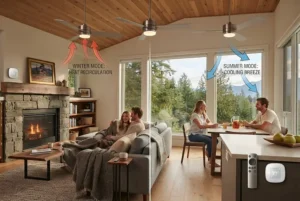
If you’ve ever stood in a big-box lighting aisle staring up at forty near-identical fans, you already know the real problem isn’t finding a fan. It’s finding the right one for your ceiling height, your room size, and your patience for fiddly Bluetooth pairing. Canadian homes add their own wrinkles, too — older houses with plaster ceilings, condos with 8-foot clearances, and winters cold enough that a reversible motor genuinely earns its keep. We dug through real product listings, aggregated review sentiment, and Canadian electrical standards to put together a shortlist that actually holds up once it’s spinning above your bed or dining table.
This guide covers seven real, currently available models spanning budget, mid-range, and premium tiers, plus the practical stuff nobody tells you at the store: how to size a fan correctly, which specs are marketing fluff, and what tends to go wrong in the first month of ownership. Whether you’re replacing a tired 1990s fixture or outfitting a new build, you’ll leave with a shortlist and a reason for each pick.
Quick Comparison Table
| Fan | Best For | Blade Span | Control Type | Price Range (CAD) |
|---|---|---|---|---|
| Hunter Dempsey | Best overall / trusted brand | 52″ | Remote + wall control | C$180-C$230 |
| DREO Smart RGBIC | Best smart / app control | 52″ | Remote, app, Alexa | C$190-C$250 |
| Honeywell Radstock | Best colour-changing LED value | 52″ | Remote, colour-temp toggle | C$150-C$200 |
| addlon Fandelier | Best for small rooms / low ceilings | 24″ | Remote + app | C$90-C$130 |
| Ohniyou Low Profile | Best budget flush mount | 52″ | Remote + app | C$110-C$150 |
| Hunter Aerodyne | Best for standard-mount ceilings | 52″ | Remote, smart-compatible | C$200-C$260 |
| DREO 44″ Flush Mount | Best dedicated bedroom pick | 44″ | Remote, quiet DC | C$130-C$170 |
Looking across the table, there’s a clean split between full-size 52-inch fans built for living rooms and larger bedrooms versus the compact 24-44 inch flush-mount options aimed at smaller spaces or low ceilings. The Hunter Dempsey and DREO Smart RGBIC sit at the top of the value curve because they combine a recognizable brand or genuinely useful smart features with a price that doesn’t creep into designer-fixture territory. If your ceiling is under 8 feet, skip straight to the addlon Fandelier or the DREO 44″ Flush Mount — a 52-inch downrod-style fan will feel oppressive in a low room no matter how good its specs look on paper.
💬 Just one click — help others make better buying decisions too!😊
Top 7 Ceiling Fans With Light and Remote: Expert Analysis
1. Hunter Dempsey — best all-rounder for everyday reliability
The Hunter Dempsey earns its “best all-rounder” tag by refusing to overcomplicate things. Hunter is one of the oldest fan manufacturers in North America, and the Dempsey line reflects that institutional knowledge: a 52-inch, four-blade, low-profile design built for rooms with average or slightly reduced ceiling height. The integrated LED light kit ships in a warm-to-cool adjustable range, and the DC motor is engineered specifically to run quiet at low and medium speeds — the settings most households actually use overnight. Based on the spec comparison with cheaper AC-motor competitors, the DC motor here also draws meaningfully less power over a year of daily use, which matters more than the sticker price once you factor in electricity costs.
Reviewers consistently note that installation is straightforward even for first-timers, and the included remote pairs without a companion app — a plus for anyone who doesn’t want another smart-home account to manage. A recurring theme in aggregated feedback is that the light kit runs slightly dimmer than expected on the warmest colour setting, so buyers prioritizing brightness for reading nooks may want to pair it with a brighter bulb swap if the fixture allows it.
Pros:
- ✅ Whisper-quiet DC motor at low and medium speeds
- ✅ Simple remote pairing, no app required
- ✅ Trusted brand with widely available replacement parts
Cons:
- ❌ Warmest light setting runs dimmer than expected
- ❌ Low-profile mount limits use in very high ceilings
Expect to pay in the C$180-C$230 range depending on finish, and for most Canadian bedrooms or living rooms, that’s a fair trade for a fixture you likely won’t think about again for a decade.

2. DREO Smart RGBIC — best for app and voice control
The DREO Smart RGBIC is built for the household that already has a smart-home routine and wants the ceiling fan to join it. On paper, the 12-speed brushless DC motor and app-controlled RGBIC lighting look like spec-sheet padding, but in practice the speed granularity is what lets you dial in genuinely quiet airflow instead of jumping between “too slow” and “too loud” like older 3-speed fans force you to do. What most buyers overlook about this model is that the RGBIC lighting isn’t just a novelty — the “Constant,” “Breath,” and “Circle” modes let you use the fixture as ambient mood lighting on nights when you don’t want the main light blazing.
Aggregated review sentiment on comparable DREO smart fans points to a genuinely easy pairing process through the DREO app, with most users up and running with Alexa integration in under ten minutes. The trade-off, based on the spec comparison with simpler remote-only fans, is that full functionality depends on a stable 2.4GHz Wi-Fi connection — an issue in homes with older routers or fans installed far from the access point.
Pros:
- ✅ 12-speed DC motor with genuinely useful speed granularity
- ✅ App, remote, and Alexa control all included
- ✅ RGBIC ambient lighting doubles as mood lighting
Cons:
- ❌ Full smart features require stable 2.4GHz Wi-Fi
- ❌ More setup steps than a remote-only fan
Priced around C$190-C$250, the DREO Smart RGBIC is the pick for tech-forward households who’ll actually use the scheduling and scene features rather than defaulting to the remote every time.
3. Honeywell Radstock — best colour-changing LED on a mid budget
The Honeywell Radstock, sold through the Prominence Home lighting catalogue, targets buyers who want the look of a premium smart fan — colour-changing LED, matte black finish — without the smart-home price tag. The colour-changing light kit toggles between multiple white temperatures via remote, which in practice means you can shift from a cooler, task-lighting white for cleaning or cooking to a warmer tone for evening relaxation, all without buying separate bulbs. The 52-inch span suits medium to large bedrooms and living rooms up to roughly 400 square feet, per the manufacturer’s sizing guidance.
Here’s what to weigh: the motor on this model is a capable high-capacity unit rather than the ultra-quiet DC motors found on the Hunter and DREO picks above, so reviewers commonly report it’s a touch louder on the highest speed setting — noticeable in a quiet bedroom but a non-issue in a living room with ambient noise. For buyers who want colour-changing light without paying for app connectivity, that trade-off is usually worth it.
Pros:
- ✅ Colour-changing LED without needing separate smart bulbs
- ✅ Matte black finish suits modern and transitional décor
- ✅ Comfortably sized for rooms up to roughly 400 sq. ft.
Cons:
- ❌ Noticeably louder than DC-motor competitors on high speed
- ❌ No app control, remote only
At around C$150-C$200, the Honeywell Radstock delivers strong style-per-dollar for buyers who care more about the light kit’s versatility than ultra-quiet operation.
4. addlon Fandelier — best for small rooms and low ceilings
The addlon Fandelier takes a completely different design approach: a compact 24-inch caged, flush-mount fixture that reads more like a decorative light fitted with fan blades than a traditional fan with a light bolted on. This matters practically — in condos, nurseries, home offices, or any room with 7-to-8-foot ceilings, a 52-inch downrod fan can feel like it’s looming over the furniture, while the Fandelier’s low-profile mount keeps clearance intact. The dimmable LED spans a 3000-6000K range, and the six-speed reversible DC motor means it still handles genuine air circulation duties despite the smaller blade span.
Reviewers frequently point out that the caged design makes it noticeably quieter than expected for its size, likely because the shorter, wider blades reduce the wind-noise turbulence longer blades create. The honest caveat, based on the spec comparison with full 52-inch fans, is airflow volume: a 24-inch fan moves meaningfully less air than a 52-inch model, so it’s a better fit for a nursery or home office than a large open-concept living room.
Pros:
- ✅ Ideal low-profile fit for rooms under 8-foot ceilings
- ✅ Caged design is quieter than its compact size suggests
- ✅ App and remote control included at a low price point
Cons:
- ❌ Lower airflow volume than full-size 52-inch fans
- ❌ Not suited to large open-concept rooms
Expect a price in the C$90-C$130 range, making the addlon Fandelier one of the most budget-friendly all-in-one lighting fixtures on this list.
5. Ohniyou Low Profile — best budget flush mount with real airflow
The Ohniyou Low Profile aims to prove that a flush-mount fan doesn’t have to sacrifice airflow to fit a tight ceiling. The manufacturer lists an airflow rating around 5,475 CFM at top speed, which — if accurate to the CFM testing standard used — puts it in the same performance bracket as fans costing considerably more. On paper this means faster room cooling in summer, though CFM figures from budget brands should be read as a directional indicator rather than a guarantee, since third-party verification isn’t always published.
The three-CCT dimmable LED and memory function (which recalls your last speed and brightness setting) are conveniences usually reserved for pricier fans. Aggregated review sentiment suggests the app pairing process is a little less polished than on established brands like DREO, with a subset of users needing to reinstall the app or re-pair the receiver after a power outage. For buyers on a tighter budget who mostly plan to use the physical remote day-to-day, that’s a minor inconvenience rather than a dealbreaker.
Pros:
- ✅ Strong claimed airflow for a flush-mount design
- ✅ Memory function retains your preferred settings
- ✅ Reversible DC motor for year-round use
Cons:
- ❌ App pairing reported as less polished than premium brands
- ❌ CFM claims not independently verified
Priced around C$110-C$150, the Ohniyou Low Profile is a reasonable bet for buyers who want most of the performance of a premium flush-mount fan without the premium invoice.

6. Hunter Aerodyne — best for standard-mount ceilings and larger rooms
Where the Dempsey is built for low-profile installs, the Hunter Aerodyne is Hunter’s answer for rooms with higher ceilings that can accommodate a standard downrod mount. The five-blade design and 52-inch span are tuned for larger bedrooms, great rooms, or open-concept living-dining spaces, and the fixture is smart-home compatible for households that want to add it to an existing routine later without needing app control from day one. Based on the spec comparison with the four-blade Dempsey, the extra blade generally translates to slightly smoother, more consistent airflow at low speeds — useful in rooms where you run the fan constantly rather than in short bursts.
What most buyers overlook about standard-mount fans generally is that the downrod length needs to be matched to ceiling height for the blades to sit at the recommended 8-to-9-foot clearance from the floor; too short a rod on a high ceiling wastes airflow, and too long a rod on a modest ceiling creates a safety hazard. Reviewers of the Aerodyne line report that the included hardware accommodates most standard 8-to-10-foot residential ceilings without needing to special-order a longer or shorter rod.
Pros:
- ✅ Five-blade design for smooth, consistent low-speed airflow
- ✅ Smart-home compatible for future expansion
- ✅ Includes standard-length downrod for most ceiling heights
Cons:
- ❌ Not designed for low ceilings under 8 feet
- ❌ Premium pricing relative to the Dempsey line
The Hunter Aerodyne typically runs C$200-C$260, positioning it as the go-to pick when your ceiling height — not your budget — is the deciding factor.
7. DREO 44″ Flush Mount — best dedicated bedroom pick
Rounding out the list, the DREO 44″ Flush Mount is purpose-built for bedrooms rather than adapted from a living-room design. The 44-inch span is a deliberate middle ground — smaller than a 52-inch living-room fan but larger than the compact 24-inch fandelier options, which makes it well-suited to a standard 10-by-12-foot bedroom. The headline spec here is the motor’s rated noise floor of around 22 decibels, which on paper sits below the ambient noise level of most quiet bedrooms at night, and the six-speed reversible DC motor keeps that quiet profile across most settings rather than only at the lowest speed.
Reviewers consistently flag the one-blade, one-screw installation system as genuinely faster than typical fan assembly, which matters if you’re installing this yourself on a weekend rather than hiring an electrician. The 5-CCT dimmable LED covers a wide enough colour-temperature range to work as both a reading light and a low, warm night light. The honest trade-off compared with the 52-inch models above is raw airflow volume — great for a bedroom, noticeably less effective in a larger open room.
Pros:
- ✅ Rated among the quietest motors in this roundup
- ✅ Fast one-blade, one-screw installation
- ✅ 5-CCT LED works well as both task and night light
Cons:
- ❌ Smaller blade span moves less air than 52-inch fans
- ❌ Less airflow suited to open-concept spaces
At roughly C$130-C$170, the DREO 44″ Flush Mount is our top pick specifically for bedroom lighting solutions where quiet operation matters more than raw cooling power.
Top 7 Products: Full Spec Comparison
| Fan | Blades | Motor Type | Noise Level | Rated For | Best For |
|---|---|---|---|---|---|
| Hunter Dempsey | 4 | DC | Low | Medium rooms | Everyday reliability |
| DREO Smart RGBIC | 3 | DC (12-speed) | Low-medium | Medium-large rooms | App/voice control |
| Honeywell Radstock | 5 | High-capacity | Medium | Up to ~400 sq. ft. | Colour-changing LED |
| addlon Fandelier | Caged | DC | Low | Small rooms | Low ceilings |
| Ohniyou Low Profile | 5 | DC | Low-medium | Medium-large rooms | Budget airflow |
| Hunter Aerodyne | 5 | DC | Low | Large rooms | Standard-mount ceilings |
| DREO 44″ Flush Mount | 3 | DC (~22dB) | Very low | Bedrooms | Quiet bedroom use |
The pattern that jumps out here is that DC motors dominate this list, and for good reason — they’re consistently quieter and more energy-efficient than the older AC motors still found in bargain-bin fans. If quiet operation is your top priority, the DREO 44″ Flush Mount and Hunter Dempsey are your strongest options, while the Hunter Aerodyne and Honeywell Radstock trade a bit of noise for either larger-room airflow or richer lighting features.
💬 Found the spec that matters most to you? Check current pricing and availability before it changes.
Practical Usage Guide: Setup, Maintenance, and Common Mistakes
Getting a ceiling fan with remote and light running smoothly isn’t just about mounting it correctly — it’s about the first 30 days of use, when most avoidable problems surface. Start with the remote pairing: nearly every model in this roundup uses a small dip-switch or sync-button receiver inside the canopy, and the single most common installation mistake is skipping this step and assuming the remote will pair automatically. It won’t, and a fan that “doesn’t work” straight out of the box is very often just an unpaired receiver.
Once running, build a light maintenance habit rather than waiting for a problem. Dust accumulation on the blades isn’t just a cosmetic issue — even a thin layer measurably reduces airflow efficiency over months of use, and an unbalanced buildup (heavier on one blade than another) can cause a faint wobble that gets worse over time. Wipe blades monthly with a dry microfibre cloth, and every season, switch the airflow direction using the remote or a manual toggle switch: counterclockwise for a cooling downdraft in summer, clockwise for a gentle updraft that redistributes warm air in winter. This single habit is also the one most directly tied to the energy savings NRCan attributes to ENERGY STAR certified ceiling fans, since reversing airflow reduces reliance on your furnace or air conditioner.
A less obvious optimization trick: if your model has a memory function, set your preferred speed and brightness once during the first week rather than repeatedly cycling through settings — most memory functions only save the setting after several seconds of stable use, so frequent quick adjustments during setup can overwrite your preference before it saves.
Real-World Scenarios: Which Fan Fits Your Situation
Rather than a generic recommendation, it helps to see how these fans map to actual living situations.
The condo dweller with an 8-foot ceiling: A downtown Toronto or Vancouver condo with standard 8-foot ceilings is exactly the scenario the addlon Fandelier was designed for — a full-size downrod fan would sit too low and create a bump-your-head risk, while the flush-mount cage keeps clearance intact without giving up dimmable lighting.
The young family furnishing a nursery-to-bedroom transition: Parents converting a nursery into a “big kid” room often want quiet operation above all else, since nap and bedtime disruptions are the top complaint in that stage of parenting. The DREO 44″ Flush Mount, with its roughly 22-decibel noise floor, is built for exactly this kind of room.
The renovator finishing a large open-concept main floor: Big rooms need real airflow, and this is where the Hunter Aerodyne‘s five-blade design and standard-mount clearance shine — it’s built to circulate air across a space that a compact fan simply can’t reach.
The smart-home enthusiast building out a connected house: If your living room already has smart lights, thermostats, and speakers, the DREO Smart RGBIC slots into that ecosystem instead of becoming the one fixture you still control manually.
How to Choose a Ceiling Fan With Light and Remote
Picking the right fixture comes down to a handful of decisions that matter far more than the finish colour. Work through these in order:
- Measure your room, not just the fan box. A 44-52 inch fan suits rooms up to roughly 225-400 square feet; smaller rooms need a 24-36 inch fan, or airflow becomes uncomfortably strong close-range.
- Check your ceiling height and mount type. Ceilings under 8 feet need a flush or low-profile mount; taller ceilings benefit from a standard downrod for proper blade clearance.
- Decide between remote-only and app control. Remote-only fans pair faster and never depend on Wi-Fi; app-enabled fans add scheduling and voice control at the cost of setup complexity.
- Prioritize motor type. DC motors cost slightly more upfront but run quieter and more efficiently — worth it in bedrooms especially.
- Match the light kit to the room’s purpose. A single-CCT LED is fine for a hallway; bedrooms and living rooms benefit from dimmable, multi-CCT kits that shift from task to ambient lighting.
- Confirm Canadian certification. Look for a CSA, cUL, or cETL mark before buying — Health Canada requires all plug-in and hardwired electrical products sold here to carry recognized certification.
- Set a realistic price range. Budget fans in the C$90-C$150 range cover small rooms well; expect C$180-C$260 for full-featured 52-inch smart or premium-brand options.
Common Mistakes When Buying a Ceiling Fan With Light and Remote
The single biggest mistake is buying based on blade span alone without checking CFM (airflow) ratings — a larger fan with a weak motor can underperform a smaller, well-engineered one. A close second is ignoring downrod length entirely; buyers assume “one size fits all” and end up with blades sitting either too close to the ceiling (choking airflow) or too low for comfortable headroom.
Another recurring error is skipping the certification check because a listing “looks legitimate.” As covered above, CSA Group’s testing and certification standards exist precisely because imported fixtures that meet another country’s safety standard don’t automatically meet Canada’s. Finally, buyers frequently underestimate installation complexity for fans without existing ceiling wiring — if you’re not replacing an existing fixture with matching wiring, budget for an electrician rather than assuming a weekend DIY job.
All-in-One Lighting Fixtures vs. Separate Fan and Light Fixtures
The core value proposition of any ceiling fan with light and remote is consolidation: one fixture, one electrical box, one remote, instead of a separate fan and a separate pendant or flush-mount light. That’s not just convenience — it has real cost and complexity implications.
| Factor | All-in-One Fixture | Separate Fan + Light |
|---|---|---|
| Installation cost | Single fixture, single wiring point | Two fixtures, potentially two circuits |
| Control | One remote for both functions | Often two separate switches/remotes |
| Ceiling clearance | Compact, one footprint | Two footprints compete for space |
| Design flexibility | Limited to combo styles | Full freedom to mix styles |
| Best For | Bedrooms, condos, budget renovations | Statement rooms, high ceilings, design-first spaces |
The analysis here is straightforward: all-in-one lighting fixtures win on cost and simplicity for the vast majority of Canadian homes, particularly bedrooms and mid-size living rooms where a single, well-chosen fixture does both jobs competently. Separate fan-and-light setups only pull ahead in statement rooms — vaulted-ceiling great rooms or design-forward spaces — where a dramatic pendant light paired with a discreet fan delivers a look no combo fixture can match.

Bedroom Lighting Solutions: Matching Fan-Light Combos to Your Room
Bedrooms have different priorities than any other room in the house: noise matters more than airflow volume, and lighting needs to flex between bright task lighting and a dim, warm setting for winding down. That’s why the quietest options on this list — the DREO 44″ Flush Mount and Hunter Dempsey — consistently come up as the strongest bedroom lighting solutions in this roundup, ahead of louder, higher-airflow models better suited to living areas.
Dimmable, multi-CCT LED kits matter more in bedrooms than almost any other feature, since the ability to shift from a cool white for reading to a warm amber for pre-sleep routines directly affects sleep quality — a factor increasingly recognized in Canadian public health guidance on light exposure and circadian rhythm. A remote with a dedicated dimmer function, rather than fixed brightness steps, gives finer control over that transition. For couples with different temperature preferences, a reversible motor set to a gentle summer downdraft or winter updraft is also worth prioritizing over sheer fan power.
Remote-Controlled Lighting: Features That Actually Matter
Not every remote feature is worth paying extra for. Based on the spec comparison across all seven fans in this guide, three features consistently deliver real day-to-day value: dimming (not just on/off), memory function (recalling your last setting instead of resetting every time), and a wall-mount cradle for the remote itself, which prevents the classic “where did the remote go” problem in a bedroom.
Features that generate marketing buzz but matter less in practice include ultra-long remote range (most bedrooms and living rooms are well within 30 feet, making a 75-foot range largely unused) and an excessive number of preset lighting “scenes” — reviewers across smart fan categories frequently report using only two or three presets regularly regardless of how many the app offers. App control is genuinely useful for scheduling and voice integration, but if your household doesn’t already use smart-home routines, a quality physical remote covers 90% of daily use cases without the setup overhead.
Safety, Regulations, and Certification Guide
Every ceiling fan with light and remote sold in Canada should carry a CSA, cUL, or cETL certification mark, confirming it’s been independently tested to Canadian electrical safety standards rather than only a foreign equivalent. This isn’t a bureaucratic formality — Health Canada is explicit that uncertified plug-in and hardwired electrical products should not be purchased or installed, and provincial electrical safety authorities can flag uncertified fixtures during home inspections or insurance claims.
Beyond safety certification, Canada also regulates ceiling fan energy performance directly. Natural Resources Canada’s Energy Efficiency Regulations set minimum performance standards for ceiling fans and their light kits, and models earning the ENERGY STAR designation use roughly 60% less energy on average than standard fans — a meaningful factor if you’re running a bedroom or living room fan for much of the year. If you’re unsure whether a listing meets these standards, checking for both a safety certification mark and an ENERGY STAR or EnerGuide reference before buying is the safest approach.
Long-Term Cost and Maintenance
The purchase price is only part of the real cost of owning a ceiling fan with light and remote. DC-motor fans like the Hunter Dempsey, DREO Smart RGBIC, and DREO 44″ Flush Mount typically draw a fraction of the wattage of older AC-motor designs at comparable airflow, which adds up over years of near-daily use — especially for a bedroom fan that might run 6-8 hours nightly.
| Cost Factor | Budget Fan (C$90-C$150) | Premium DC Fan (C$180-C$260) |
|---|---|---|
| Upfront cost | Lower | Higher |
| Estimated annual energy cost | Higher (AC motor) | Lower (DC motor) |
| LED bulb replacement | Rare, integrated LED | Rare, integrated LED |
| Expected lifespan | 5-8 years | 8-12+ years |
| Best For | Short-term ownership, rentals | Long-term primary residence |
The analysis here favours premium DC-motor fans for anyone planning to stay in their home for several years, since the lower running cost and longer expected lifespan offset the higher purchase price over time. Renters or those planning a move within a few years may reasonably prioritize the lower upfront cost of a budget model instead, since they won’t be around long enough to recoup the difference in energy savings.
✨ Don’t Miss These Exclusive Deals!
🔍 Take your home comfort to the next level with these carefully selected fixtures. Click on any highlighted item to check current pricing and availability. A quiet, well-lit room is one click away!
What to Expect: Real-World Performance
Specs only tell part of the story. In real-world use, a properly sized 52-inch DC fan set to medium speed will noticeably drop the “feels like” temperature in a room by several degrees without the harsh blast of an oscillating floor fan — the difference is a broad, even airflow rather than a directional gust. Dimmable LED kits, meanwhile, tend to feel brighter in person than their lumen rating suggests, simply because ceiling-mounted diffusion spreads light more evenly across a room than a single lamp.
The trade-off buyers notice most often after a few months of ownership isn’t performance — it’s remote habits. Households that opt for app-controlled fans frequently default back to voice commands or a wall switch rather than opening the app daily, while remote-only households report simply leaving the physical remote on a nightstand or side table for near-constant, effortless access. Neither approach is wrong; it’s worth being honest with yourself about which one matches how you actually live before paying extra for smart features you might not use.

Frequently Asked Questions
❓ Do all ceiling fans with lights come with a remote?
❓ Can I install a ceiling fan with light and remote myself?
❓ What size ceiling fan do I need for my bedroom?
❓ Are remote-controlled ceiling fans compatible with dimmer switches?
❓ How much does it cost to run a ceiling fan with light and remote?
Conclusion
A ceiling fan with light and remote earns its spot on the ceiling by doing two jobs well instead of one job brilliantly, and the seven fans covered here show just how differently manufacturers approach that balance. The Hunter Dempsey remains the safest all-around pick for most Canadian bedrooms and living rooms, the DREO Smart RGBIC rewards anyone already living in a connected smart home, and the DREO 44″ Flush Mount stands out specifically for buyers who value a quiet bedroom above all else. Budget-conscious shoppers furnishing a condo or nursery should look first at the addlon Fandelier or Ohniyou Low Profile, while larger, higher-ceiling rooms are better served by the Hunter Aerodyne or Honeywell Radstock.
Whichever fixture you land on, the fundamentals matter more than the marketing: measure your room and ceiling height honestly, confirm CSA or equivalent certification before buying, and factor the DC-versus-AC motor decision into your long-term cost expectations rather than just the sticker price. Get those right, and the remote-versus-app debate becomes a matter of personal preference rather than a make-or-break decision.
Recommended for You
- 7 Best Google Home Ceiling Fan Picks for 2026
- 7 Best Alexa Ceiling Fan Picks for 2026 (Honest Canadian Guide)
- Wifi Ceiling Fan No Hub Required: 7 Top Picks for 2026
Disclaimer: This article contains affiliate links. As an Amazon Associate, I earn from qualifying purchases. If you purchase products through these links, we may earn a small commission at no additional cost to you.
✨ Found this helpful? Share it with your friends! 💬🤗
