
In This Article
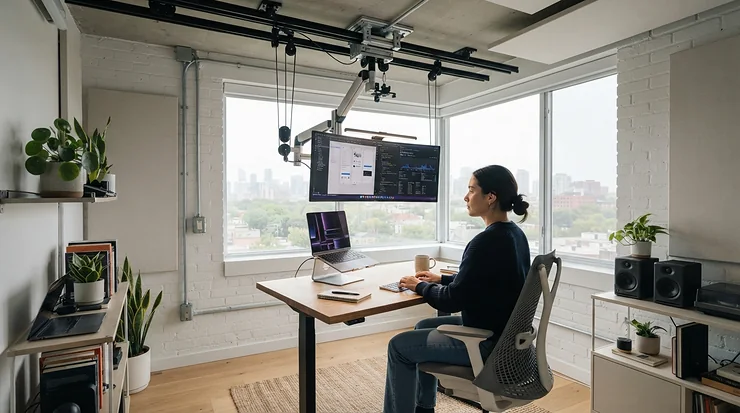
A home office ceiling fan is a quiet, right-sized fan mounted overhead so your workspace stays comfortable without a desk fan hogging the desk. For most small rooms, that means a 36 to 48-inch (91 to 122 cm) span, a whisper-level motor and, ideally, a remote.
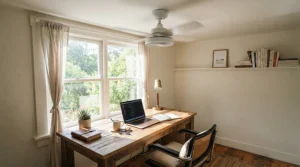
Here’s the thing. Most of us didn’t plan a workspace. We claimed a spare bedroom, a corner of the basement, or the stretch of loft nobody else argued over. Then the air went stale, the laptop started whining like it had somewhere better to be, and the 3 p.m. slump arrived on schedule. The ceiling fan has been moving air around for well over a century, and it remains the most elegant fix, because it takes up zero desk space.
Canadians get a double benefit. In July, a fan makes a warm room feel noticeably more comfortable. In January, run in reverse on low, it nudges heat that has pooled near the ceiling back down to where your cold feet are. Few gadgets earn their keep across both seasons.
This guide cuts through the marketing. We compare seven real fans and unpack 10 x 10 foot room airflow. We explain hugger vs downrod mounting and decode blade span for small rooms. We also show how to buy ceiling fan with remote control for home office use, and how to pick a ceiling fan for small home office layouts. Every verdict rests on published specs, aggregated review themes and honest analysis. Prices are approximate Canadian-dollar ranges gathered in October 2026, so check the current price on Amazon.ca before you commit.
Quick Comparison: Best Home Office Ceiling Fan Picks at a Glance
| Fan | Blade span | Mount | Control | Best For |
|---|---|---|---|---|
| DREO 44-Inch Low Profile | 44 in (112 cm) | Flush | Remote | Best value with quiet calls |
| DREO Smart 44-Inch | 44 in (112 cm) | Flush | Remote, app, voice | Smart-home offices |
| Hunter Newsome 42-Inch | 42 in (107 cm) | Hugger | Pull chain | Simple, proven quiet |
| Hunter Builder Low Profile 42-Inch | 42 in (107 cm) | Low profile | Check listing | Traditional style on a budget |
| Honeywell Carmel 48-Inch | 48 in (122 cm) | Dual mount, 4-in downrod included | Remote | Maximum airflow |
| Hisummer 20-Inch Bladeless | 20 in (51 cm) | Flush | Remote | Tiny or obstructed rooms |
| Minka-Aire Simple 44-Inch | 44 in (112 cm) | Low profile (about 13 in tall) | Remote | Efficiency-minded buyers |
The pattern is clear. Most of the best small-room fans cluster at 42 to 44 inches, and the two that break the pattern do it for a reason. The Hisummer 20-Inch Bladeless trades power for footprint, while the Honeywell Carmel 48-Inch trades visual calm for airflow. If a remote matters to you, the Hunter Newsome 42-Inch and Hunter Builder Low Profile 42-Inch are the two to question first.
💬 Just one click — help others make better buying decisions too!😊
Top 7 Home Office Ceiling Fan Picks: Expert Analysis
1. DREO 44-Inch Low Profile — best value remote-ready pick
This is the fan most 10 x 10 foot offices end up shortlisting, because it brings DC-motor quiet and a remote to a price tier that usually offers neither.
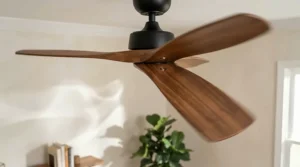
The 44-inch (112 cm) four-blade span suits a 3 m x 3 m room without crowding it. Its six-speed reversible DC motor sits flush to the ceiling, and published airflow figures land around 3,170 to 3,470 CFM depending on which listing you read. In plain terms, DC motors run smoother and draw less power than older AC designs, so there’s no low hum creeping into your microphone. The dimmable light with selectable colour tones also lets you run warm light at dusk and cooler light at 10 a.m.
Based on the spec sheet, it’s built for video-call workers who want one-tap control from the chair. Published reviews back that up. One tech reviewer reported a first-time install in under an hour, and roundups keep praising the low noise. They also note the span runs short of airflow in rooms beyond roughly 16 m² (180 sq ft), which a 10 x 10 foot room never approaches.
Pros:
- ✅ Quiet DC motor with six speeds
- ✅ Remote controls both fan and light colour
- ✅ Flush mount suits 2.4 m (8 ft) ceilings
Cons:
- ❌ Span runs short in rooms above roughly 16 m²
- ❌ Flush mount sacrifices a little airflow versus a downrod
Expect roughly C$90 to C$150, which makes this the value benchmark for the whole list.
2. DREO Smart 44-Inch — best for app, voice and scheduling control
If the first DREO is the sensible choice, this one is the same body with a better brain.
It shares the 44-inch (112 cm) span and brushless DC motor, with airflow around 3,170 CFM, but adds 12 speeds, three fan modes, a timer, and app and voice control. Twelve speeds sounds like a gimmick until you notice that a six-speed fan often jumps from “slightly warm” to “wind tunnel”. Finer steps let you park it at a level that won’t flutter your notes.
On paper, the appeal is hands-free control. Tell your smart speaker to start the fan when your desk lamp goes on, and you’ve automated the one part of the room you’d otherwise forget. It only pays off if you already live in a smart-home ecosystem, though. If you don’t, you’re buying software you won’t use, and one roundup explicitly recommends the non-smart sibling for buyers who want “no software complexity”.
The reviewer who tested it noted very low noise even at higher speeds and an install of under an hour. Roundups flag the short span as the main limit for larger open rooms.
Pros:
- ✅ Twelve speeds allow fine airflow tuning
- ✅ Timer, app and voice control
- ✅ Whisper-quiet DC motor at all speeds
Cons:
- ❌ Smart features add setup and Wi-Fi dependence
- ❌ Short span for rooms above about 16 m²
Plan on roughly C$140 to C$220. Worth it for smart-home households, otherwise the cheaper sibling wins.
3. Hunter Newsome 42-Inch — the quiet, no-fuss classic
Sometimes the right answer is the boring one, and this fan wears boring like a tailored suit.
It’s a 42-inch (107 cm) hugger with five blades at a 13° pitch, a pull-chain AC motor and a 13W LED bowl light. Airflow is rated around 2,650 to 2,700 CFM, which is plenty for 9.3 m² (100 sq ft). That blade pitch matters, since a steeper pitch pushes more air per rotation without needing a bigger motor. The base is roughly 30 cm across, so it looks tidy even on a low ceiling.
The catch is control. There’s no remote in the box, so for anyone set on the remote-control route this one needs a workaround. Third-party remote receivers exist, but check compatibility and warranty terms first. For everyone else, the verdict is straightforward. Reviewers on retail listings describe near-silent running, almost no wobble and easy installation. The one caution repeated in owner feedback is that your ceiling box must be fan-rated before you start.
Pros:
- ✅ Very quiet, with minimal wobble reported
- ✅ True hugger for ceilings under 2.7 m (9 ft)
- ✅ Simple pull-chain operation, nothing to pair
Cons:
- ❌ No remote included
- ❌ AC motor offers fewer speed steps than DC rivals
Expect roughly C$130 to C$200 for a dependable, long-lived workhorse.
4. Hunter Builder Low Profile 42-Inch — traditional style, plain-spoken value
Think of this as the Newsome’s older, more conventional cousin.
It also has a 42-inch (107 cm) span, with five reversible blades, a three-speed WhisperWind motor and an LED light kit included. Reversible blades are a small, practical design perk, since they give you two finishes to match your trim. Three speeds is enough for a 3 m x 3 m room, because you’ll live on low or medium anyway.
Here’s what the spec sheet won’t tell you: I couldn’t verify a meaningful pool of owner reviews for this exact model, so there’s no aggregated sentiment to report. What I can say is that it sits in the same size class and mounting style as the Hunter Newsome 42-Inch, so choose between them mostly on looks and light style. Confirm the control type on the listing, since some buyers will want a remote and this fan isn’t promoted as having one.
Pros:
- ✅ Reversible blades give two finish options
- ✅ LED light kit included
- ✅ Right-sized for a 10 x 10 foot room
Cons:
- ❌ Only three speed settings
- ❌ Thinner review data than the Newsome
Budget roughly C$100 to C$180. Decent value if you like the look, though the Hunter Newsome 42-Inch has more evidence behind it.
5. Honeywell Carmel 48-Inch — most airflow in a still-compact housing
When the office doubles as the warmest room in the house, this is the fan that actually moves air.
The 48-inch (122 cm) five-blade design is rated around 5,200 CFM. Its housing stands roughly 32 to 33 cm tall, and a 4-inch downrod comes in the box, along with a remote and wall cradle. The dual-mount system handles standard and angled ceilings, which matters for loft offices. Dimmable LED lighting rounds it out.
Honest analysis suggests treating 48 inches as the upper limit for a 10 x 10 foot room. One listing claims coverage for rooms up to about 9.3 m² and another claims up to 37 m² (400 sq ft), so ignore manufacturer room-size claims and trust the span. Reviewers praise strong airflow, quiet running and a compact feel on 2.4 m (8 ft) ceilings. They also report a slight wobble on the highest speed, a fiddly installation with many parts, a tight fit for the remote receiver in the canopy, and criticism of the remote itself.
Pros:
- ✅ Roughly 5,200 CFM, the strongest here
- ✅ Dual-mount design with downrod included
- ✅ Remote with wall cradle
Cons:
- ❌ Installation described as fiddly
- ❌ Remote criticized by some reviewers
Budget roughly C$200 to C$300. Great for hot rooms, though pricey for what a small office strictly needs.

6. Hisummer 20-Inch Bladeless — tiny footprint, surprisingly punchy
If a 44-inch fan feels like overkill, or your ceiling is cluttered, this one solves the problem by removing the blades.
It’s a 20-inch (51 cm) bladeless flush-mount fan with a DC reversible motor, an 18W LED light, a remote and six speeds. The listing quotes coverage up to about 10 m² (108 sq ft), so a 100 sq ft office sits right at its ceiling. No blades also means no wobble and nothing to bump, and parents have used it where bunk beds ruled out a conventional fan.
The compromise is power. Reviewers score it roughly 4.5 out of 5 across just under 200 ratings, praising how much velocity it delivers for its size and how well the remote works. They also say plainly it isn’t for large rooms. On a hot afternoon in a closed-door office, that limit will show.
Pros:
- ✅ Bladeless design, nothing to wobble or bump
- ✅ Very low-profile flush mount
- ✅ Remote and six speeds included
Cons:
- ❌ Reviewers advise against large rooms
- ❌ Less airflow than full-size fans
Roughly C$70 to C$130. A smart pick for cramped or low-ceilinged spaces, less so for hot ones.
7. Minka-Aire Simple 44-Inch — premium efficiency with a wet rating
This is the one for buyers who read the fine print and care about watts per cubic foot.
The three-blade 44-inch (112 cm) design runs a DC motor with a six-speed remote. Retail specs list about 13 inches (33 cm) of overall height, roughly 5,320 CFM, an efficiency rating near 111 CFM per watt and a slow 196 rpm. Slow rotation moves a lot of air gently, which means less paper flutter. The wet-location rating adds durability for a damp basement office.
Watch the geometry, though. On a 2.4 m (8 ft) ceiling, 13 inches of height leaves the blades only around 2.1 m (7 ft) above the floor, so measure carefully if you’re tall or your ceiling is lower than standard. I couldn’t verify owner reviews or confirm Amazon.ca availability for this exact listing, so check the listing before relying on any of this.
Pros:
- ✅ Strong airflow for its three-blade span
- ✅ Wet-rated for damp spaces
- ✅ Remote included in the box
Cons:
- ❌ Tight blade clearance on 2.4 m ceilings
- ❌ Reviews and Amazon.ca availability unverified
Expect roughly C$250 to C$400. Excellent engineering, but priced well above what a 10 x 10 foot room demands.
Top 7 Specs and Value Side by Side
| Fan | Published CFM | Motor | Light | Price range | Best For |
|---|---|---|---|---|---|
| DREO 44-Inch Low Profile | 3,170–3,470 | DC | Dimmable, colour tones | C$90–C$150 | Value seekers |
| DREO Smart 44-Inch | About 3,170 | DC | Dimmable | C$140–C$220 | Smart homes |
| Hunter Newsome 42-Inch | 2,650–2,700 | AC | 13W LED bowl | C$130–C$200 | Simplicity |
| Hunter Builder Low Profile 42-Inch | Not verified | WhisperWind | LED kit | C$100–C$180 | Traditional style |
| Honeywell Carmel 48-Inch | About 5,200 | Not stated | Dimmable LED | C$200–C$300 | Hot rooms |
| Hisummer 20-Inch Bladeless | Not published | DC | 18W LED | C$70–C$130 | Tiny rooms |
| Minka-Aire Simple 44-Inch | About 5,320 | DC | Not listed | C$250–C$400 | Efficiency buffs |
Read the table sideways and the logic emerges. The two DREO fans deliver the best balance of quiet, features and price, while the Honeywell Carmel 48-Inch wins on raw airflow. Anyone who values low cost and simplicity above all should compare the Hunter Newsome 42-Inch with the Hisummer 20-Inch Bladeless, and remember that every CFM figure here is a manufacturer claim, not an independent measurement.
Practical Usage Guide: Setting Up Your Home Office Ceiling Fan
Buying the fan is the easy half. Getting it to behave takes about an hour of care, and these steps head off the usual headaches.
- Confirm the box. The electrical box must be rated to carry a ceiling fan, not just a light fixture. If you’re unsure, a licensed electrician can check it in minutes, and rules vary by province.
- Mark your clearances. Aim for blades at least 2.1 m (7 ft) above the floor, with 2.4 to 2.7 m (8 to 9 ft) ideal where possible.
- Balance before you blame. If there’s a wobble, swap blade positions and check screws before anything else, since most wobble is loose hardware.
- Pair the remote early. Do it before the canopy goes on, while you can still reach the receiver.
- Set the seasons. Counterclockwise in summer and clockwise in winter, per Natural Resources Canada’s guidance, with winter on low so there’s no draft.
In the first 30 days, watch for the classic errors. Don’t run the fan at full blast with papers loose on the desk, don’t leave it spinning in an empty room, and don’t ignore a new noise. Dust the blades every few months and re-tighten the screws once after the first week, because new fans settle in.

Real-World Scenarios: Matching Fans to Real Workspaces
The basement office. Imagine a 3 m x 3 m room, a 2.2 m ceiling and a C$100 budget. The DREO 44-Inch Low Profile is the sensible match, because flush mounting protects headroom and the remote saves you from reaching overhead. Move the fan to low in winter and let the heat from the furnace find its way down.
The video-call spare bedroom. Picture a 2.4 m ceiling, daily calls and a smart speaker already on the shelf. The DREO Smart 44-Inch suits this setup, since the twelve gentle speed steps keep noise off the microphone and voice control saves fumbling for a remote. Pair it with a lamp for the camera so you aren’t relying on the fan’s light kit, which can flicker on camera at low dim levels in some setups.
The converted loft. Say you have a 2.7 m ceiling that slopes slightly, a south-facing window and a partner who works in the same room. The Honeywell Carmel 48-Inch covers this, because the dual mount handles the slope and the 5,200 CFM rating handles the afternoon heat. Budget for a bit of patience on install day.
Across all three, the lesson is the same. Ceiling height and control style should decide the fan before price does.
✨ Ready to Shop Smarter?
🔍 Click any fan name above to check current pricing and availability on Amazon.ca. A well-chosen home office ceiling fan means calmer calls, clearer thinking and one less gadget on your desk! 🌀
Problem → Solution Guide: Fixing Common Home Office Ceiling Fan Headaches
Problem: the fan wobbles at high speed. Start with blade screws and balance, since wobble is the single most common complaint. If it persists, check that the ceiling box is secure, because a loose box amplifies every tiny imbalance.
Problem: the remote stops responding. Replace the batteries, then re-pair. Receivers crammed into a tight canopy are a known annoyance with some models, notably the Honeywell Carmel 48-Inch, so leave slack in the wiring.
Problem: papers flutter on the desk. Drop a speed or shift the desk a little off-centre from the blades. Slow, steady airflow beats fast, gusty airflow every time.
Problem: the light flickers on camera. Some LED kits shimmer when dimmed low. Run the light at a higher brightness and use a separate desk lamp for ambience.
Problem: the room feels cold in winter. Flip the switch to reverse and drop to the lowest speed. The goal is gentle mixing of warm air from near the ceiling, not a breeze.
How to Choose a Home Office Ceiling Fan: 6 Steps
- Measure the room and the ceiling. A 10 x 10 foot room is roughly 9.3 m². Ceiling height decides hugger vs downrod mounting before anything else does.
- Pick the span. For 100 sq ft, 42 to 44 inches is the safe middle ground. Larger than 48 inches overpowers the space.
- Check airflow, not just blade count. CFM tells you how much air moves, and 2,500 to 5,000 CFM covers a small office comfortably.
- Choose the motor. DC motors are generally quieter and more efficient, which matters when a microphone is nearby.
- Decide on control. Remote, pull chain or app. If you’ll be seated all day, remote wins.
- Verify efficiency and certification. Natural Resources Canada says an ENERGY STAR certified ceiling fan uses about 60% less energy on average than a standard model, so look for the mark.
Each step narrows the field before price enters the picture. If you follow them in order, the choice usually collapses to two or three fans from the list above.
10 x 10 Foot Room Airflow: What the Numbers Actually Mean
A 10 x 10 foot room with a standard 8-foot ceiling holds about 800 cubic feet of air. A fan rated at 3,000 CFM could, in theory, move that entire volume in roughly 16 seconds. The rating comes from lab conditions at top speed, so real-world movement is gentler. Even so, it tells you something useful: for 10 x 10 foot room airflow, you don’t need a monster fan. A good 42 to 44-inch model has plenty of headroom.
The size guidance you’ll read online disagrees, and that’s worth acknowledging. One calculator suggests 36 to 44 inches for a 10 x 10, another range goes up to 48 inches, and some guides warn that a 60-inch fan leaves only about 76 cm (30 in) from blade tip to each wall. Our synthesis: stay at 44 inches or under unless the room is unusually hot.
Which speed setting you actually use matters more than peak CFM. In an office, you’ll spend most of the day on low or medium, where DC motors like the DREO 44-Inch Low Profile stay near silent. A fan that sounds fine at full blast but rattles at low speed is the one that’ll frustrate you by Wednesday.
Blade Span for Small Rooms: Getting the Diameter Right
Blade span is the diameter of the circle the blades draw as they spin, and it’s the single biggest driver of how a fan feels. Too small and the air never reaches the corners. Too large and you get turbulence, visual bulk and a faint whistle.
For blade span for small rooms, the working rule of thumb runs like this. Under about 7 m² (75 sq ft), choose 29 to 36 inches. From 7 to 13 m² (75 to 144 sq ft), choose 36 to 42 inches, and from 13 to 21 m² (144 to 225 sq ft), choose 44 to 50 inches. A 10 x 10 foot room straddles the first two brackets, which is why fans like the Hunter Newsome 42-Inch and DREO 44-Inch Low Profile feel so right.
Don’t forget wall clearance. Installers commonly aim for roughly 45 cm (18 in) between blade tips and the nearest wall, so a 48-inch fan in a 3 m room is about as large as you should go. The Hisummer 20-Inch Bladeless is the outlier, designed to sidestep this entire calculation.
Hugger vs Downrod Mounting: Which Is Right for Your Ceiling?
A hugger fan, also called flush mount, attaches directly to the ceiling with no downrod. A downrod fan hangs on a pipe that drops the motor lower. The question is simply how much vertical room you have.
Here’s the maths. Blades should sit roughly 2.4 to 2.7 m (8 to 9 ft) above the floor, with 2.1 m (7 ft) as a minimum. Hunter’s buying guide suggests subtracting the fan’s height and then 8.5 ft from your ceiling height, and the remainder is your downrod length. On a 2.4 m (8 ft) ceiling, that leaves nothing, so you need a hugger. At 2.7 m (9 ft), a short 7 to 15 cm (3 to 6 in) rod is plenty.
The trade-offs are real. Blades close to the ceiling have less room to draw air from above, so airflow can dip slightly. A tight mount also transfers motor vibration into the ceiling, which is why quiet DC motors matter more on huggers. One roundup argues that anything with a mount depth above about 25 cm (10 in) is really a standard fan with a short rod. The Honeywell Carmel 48-Inch straddles both worlds, shipping with a 4-inch downrod.
Ceiling Fan for Small Home Office: Tailored Advice by Worker Type
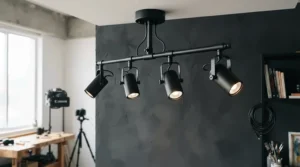
The best ceiling fan for small home office use depends more on how you work than on the square footage.
Video-call-heavy workers. Prioritize DC motors, a stable mount and a light you can dim without flicker. The DREO Smart 44-Inch and DREO 44-Inch Low Profile fit here.
Writers and quiet-focus workers. Slow, steady airflow beats raw power. The Minka-Aire Simple 44-Inch turns at around 196 rpm, which is gentle by design.
Creatives with paper-heavy desks. Keep CFM modest and use low speeds. A fan positioned slightly off-centre from the desk avoids constant fluttering.
Tight spaces and closets-turned-offices. The Hisummer 20-Inch Bladeless and flush mount designs earn their place.
Budget-first buyers. The Hunter Newsome 42-Inch delivers long-term reliability, and the DREO 44-Inch Low Profile adds remote control for little extra.
Whichever type you are, avoid placing the desk directly under the fan’s centre, where airflow is weakest, and avoid sitting in its direct downdraft on high.
Buy Ceiling Fan With Remote Control for Home Office: What to Look For
If you plan to buy ceiling fan with remote control for home office use, the remote deserves as much scrutiny as the motor. You’ll touch it daily, and a bad one is a daily irritation.
- Type. Handheld RF remotes are common, and wall cradles stop them wandering off. App and voice control add flexibility but depend on Wi-Fi.
- Functions. Fan speed, light dimming and colour tone are standard. A timer or memory setting is a nice bonus.
- Receiver fit. The receiver lives in the canopy. Some reviewers of the Honeywell Carmel 48-Inch noted it was tight, so leave extra wiring room.
- Batteries. Check what the remote takes and whether a pull chain remains as backup.
Be wary of one trap. Remote fans typically need constant power, so a wall dimmer on the same circuit can cause trouble, and the manual usually says to leave the switch on. Match the control style to your habits, not your gadget budget. A simple remote you’ll actually use beats an app you won’t.
Home Office Ceiling Fan vs Alternatives: How Do They Compare?
| Option | Footprint | Noise | Running cost | Best For |
|---|---|---|---|---|
| DREO 44-Inch Low Profile | None (ceiling) | Very low | Very low | Everyday office comfort |
| Desk fan | Takes desk space | Moderate | Very low | Personal spot cooling |
| Tower or floor fan | Takes floor space | Moderate | Low | Renters with no install |
| Portable air conditioner | Large, needs venting | Higher | High | Heatwave relief |
Ceiling fans win on footprint and quiet but need a proper installation. Desk and tower fans are portable and cheap, though they occupy space and the airflow is rarely gentle or uniform. A portable air conditioner is the only option here that actually lowers temperature, but it costs far more to run.
For most people, the ceiling fan is the everyday choice. Add AC only for the handful of hot weeks a year, and let the fan do the rest.
Long-Term Cost and Maintenance of a Home Office Ceiling Fan
Running costs are tiny. A fan drawing around 25 W for eight hours uses about 0.2 kWh a day, which at typical Canadian rates works out to roughly C$4 to C$10 a year across a working year. Natural Resources Canada notes that ceiling fans are covered by Canada’s Energy Efficiency Regulations, which set a minimum efficiency standard.
Efficiency varies widely between models. The Minka-Aire Simple 44-Inch lists about 111 CFM per watt, and the best certified fans in the ENERGY STAR database reach well over double that. That’s why DC motors justify a modest premium, since they sip power and last.
Maintenance is minimal. Dust blades a few times a year, re-tighten screws after the first week and again each season, and flip the direction switch in spring and autumn. Remote batteries are the only consumable. Over a decade, a quiet DC fan costs far less in annoyance than a cheap noisy one costs in replacements.
Safety, Regulations and Certification for Canadian Buyers
Canada’s electrical standards moved. According to CSA Group’s page for CSA C22.2 No. 113, requirements for ceiling fans now sit in CAN/CSA C22.2 No. 60335-2-80 rather than the older fans standard. In practice, you don’t need to memorize the numbers. You need to check that the product carries a recognized certification mark acceptable in Canada, such as CSA, cUL or cETL.
This matters on Amazon.ca, because some listings come from US-oriented products that show only a US safety mark. Read the listing and the box before buying. Look at the rating, too. Dry-rated fans suit most offices, while damp or wet ratings, like the one on the Minka-Aire Simple 44-Inch, suit basements prone to moisture.
Finally, respect the install. Use a fan-rated electrical box, turn off the breaker, and call a licensed electrician if anything feels uncertain, since rules differ by province. If your ceiling is lower than 2.1 m to the blades, choose the Hisummer 20-Inch Bladeless or reconsider the room.
Common Mistakes When Buying a Home Office Ceiling Fan
- Going too big. Oversizing creates turbulence and visual clutter, and in a 10 x 10 foot room it also invites wall-clearance trouble.
- Ignoring ceiling height. Mount type is dictated by your ceiling, not by taste. Measure first.
- Trusting CFM alone. CFM is a lab figure. Noise at low speed and real-world feel matter more.
- Skipping the electrical box check. A light-rated box isn’t enough for a spinning fan.
- Overlooking certification. A great price on a listing without a Canadian-accepted mark is no bargain.
- Forgetting the receiver. A remote that won’t fit the canopy is a very expensive paperweight.
- Buying smart features you won’t use. The DREO Smart 44-Inch is excellent, but only for people who’ll use the smarts.
Frequently Asked Questions
❓ Can a ceiling fan replace air conditioning in a home office?
❓ How much airflow should a home office ceiling fan deliver?
❓ Is a DC motor worth it for a home office?
❓ Can I put a ceiling fan in a basement office with a low ceiling?
❓ Can I use a wall dimmer with a remote-controlled ceiling fan?
Conclusion
The best home office ceiling fan for most Canadians is a quiet, flush-mounted 42 to 44-inch model with a remote. The DREO 44-Inch Low Profile delivers that combination at an approachable price, while the DREO Smart 44-Inch adds app and voice control for smart-home offices. Prefer analog simplicity? The Hunter Newsome 42-Inch is the dependable classic, with the Hunter Builder Low Profile 42-Inch as a lower-evidence alternative.
For hot rooms or sloped ceilings, the Honeywell Carmel 48-Inch brings the airflow, and the Hisummer 20-Inch Bladeless is the compact answer when blades won’t fit. If you want premium efficiency and a wet rating, the Minka-Aire Simple 44-Inch deserves a look, once you’ve confirmed availability and blade clearance.
Whichever you pick, measure the ceiling, check the electrical box, confirm a Canadian certification mark and size the span to the room. A fan that fits your space, your ceiling and your call schedule will quietly make every working day a little easier.
Recommended for You
- Quiet Ceiling Fan For Home Office: 7 Best Silent Picks 2026
- Ceiling Fan For Breakfast Nook: 7 Best Picks For 2026
- Flush Mount Ceiling Fan For Kitchen: 7 Best Picks (2026)
Disclaimer: This article contains affiliate links. As an Amazon Associate, I earn from qualifying purchases. If you purchase products through these links, we may earn a small commission at no additional cost to you.
✨ Found this helpful? Share it with your friends! 💬🤗
