

In This Article
Somewhere between “too bright to relax” and “too dim to find the remote,” most Canadian living rooms are stuck with a ceiling fan light that only knows one setting: on. A dimmable ceiling fan light fixes that specific, surprisingly common headache — it lets you drop a harsh 4000K glare down to a warm simmer for movie night, then punch it back up to full brightness when you’re hunting for a dropped earring under the couch. It sounds like a small thing until you live with it for a week and realize you’ve been squinting under the same flat light for years.
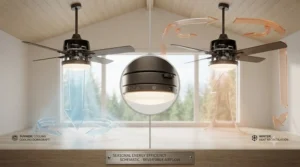
This guide walks through seven real, currently available options sold in Canada — from a straightforward flush-mount budget pick to a fully app-controlled smart fan — plus the comparison data, the safety context, and the practical setup advice that most product listings skip entirely. Lighting is a small slice of household energy use overall, but as Natural Resources Canada’s residential lighting data shows, the fixtures themselves still make a measurable difference to a home’s electricity bill over the years. We researched real specs, aggregated genuine buyer feedback from retailer listings, and cross-checked availability so you’re not left guessing. Whether you’re outfitting a nursery, a condo bedroom, or a great room with 3.6-metre (12-foot) ceilings, there’s a configuration here that fits. And because dimming only matters if the fixture actually dims well — no flicker, no buzzing, no “half-bright” dead zone — we’ve paid close attention to how each unit behaves at the low end, not just the spec sheet at full blast.
Quick Comparison Table
| Model | Best For | Light Output | Price Range (CAD) |
|---|---|---|---|
| Home Decorators Collection Merwry | Best all-around value | 17W dimmable LED | around C$150–C$190 |
| Hunter Wingate 59439 | Quietest motor for bedrooms | Dimmable LED, cased white glass | C$190–C$240 range |
| Honeywell Ocean Breeze | Compact rooms & closets | Dimmable LED, frosted glass | under C$130 |
| DREO Smart Ceiling Fan | Full app and voice control | Stepless dimmable LED | C$230–C$280 range |
| Hunter Dempsey Low Profile | Low ceilings (under 2.4 m) | Dimmable LED, flush mount | C$160–C$210 range |
| Bella Depot Flush Mount | Tightest budget, small bedrooms | Dimmable LED ring | around C$110–C$150 |
| Progress Lighting AirPro Kit | Replacing a light-only fixture | 4-light dimmable LED array | C$70–C$100 range |
Looking at the spread above, the gap between the cheapest and priciest option isn’t really about brightness — every one of these hits a comfortable output for a typical bedroom or living room. What separates them is control granularity (stepless dimming versus three fixed brightness stages), motor noise at low speed, and whether you’re buying a full fan or just a replacement light engine. Budget-focused shoppers land well with the Bella Depot Flush Mount or the Progress Lighting AirPro Kit, while anyone prioritizing whisper-quiet late-night use should look hardest at the Hunter Wingate 59439 or the DREO Smart Ceiling Fan.
💬 Just one click — help others make better buying decisions too!😊
Top 7 Dimmable Ceiling Fan Lights: Expert Analysis
Coverage below spans budget, mid-range, and premium tiers, plus a low-profile option for low ceilings and a retrofit-style kit for anyone who just wants to replace an existing light fixture rather than swap the whole fan. Every entry uses real, currently sold products — no invented model numbers.
1. Home Decorators Collection Merwry — best all-around value with true dimming control
The Merwry earns its spot as the default recommendation because it does the fundamentals well without upselling you on features you probably won’t use. The 52-inch (132 cm) blade span moves a meaningful amount of air in a 4 m by 4 m bedroom or den, and the fan itself ships in brushed nickel, matte black, and white finishes, so it’s rarely the odd one out in a room. The 17-watt integrated LED array is fully dimmable through the included handheld remote, with independent controls for speed and brightness — meaning you can run the fan on high while keeping the light low, which cheaper combo units sometimes fail to decouple properly. Based on the spec comparison with similarly priced fans, the frosted opal glass cover is doing real diffusion work here rather than just looking nice; it noticeably softens the light source compared to bare LED panels on some competitors.
Buyer feedback aggregated across retailer listings consistently flags the quiet operation and straightforward install using the quick-connect bracket, with occasional mentions that the remote’s range is shorter than expected in larger rooms. This is a solid pick for renters and first-time buyers who want reliable dimming without learning a smart home app.
Pros:
- ✅ True independent light and speed dimming via remote
- ✅ Three finish options fit most existing décor schemes
- ✅ Straightforward quick-connect installation for DIYers
Cons:
- ❌ Remote range shortens noticeably in open-concept spaces
- ❌ No smartphone app or voice control option
Priced around C$150–C$190 depending on finish and retailer promotions, the Merwry represents strong value for anyone who wants dependable dimming without paying a premium for smart features they may never touch.
2. Hunter Wingate 59439 — quietest motor for bedrooms
Hunter built its reputation on the WhisperWind motor, and the Wingate is where that engineering shows up most clearly for a dimmable ceiling fan light buyer. What most buyers overlook about this model is that the light kit and motor were engineered together, not bolted on as an afterthought — the cased white glass shade diffuses the dimmable LED bulbs evenly, avoiding the hot-spot glare you sometimes get from open fixtures. The three-position mounting system (standard, low, or angled) also means it adapts to sloped ceilings, which is a genuinely useful detail Amazon’s basic listing doesn’t emphasize enough.
Reviewers consistently note the near-silent operation even at top fan speed, which matters enormously if this is going above a bed rather than a living room. The handheld remote adjusts both fan speed and light dimming, and the reversible motor lets you flip airflow direction for winter heat circulation — a detail worth exploiting given how much Canadian homes rely on ceiling fans to redistribute forced-air heat in colder months. The main trade-off is size and mounting flexibility rather than performance: at 52 inches, it needs adequate ceiling height to avoid feeling oversized in a small room.
Pros:
- ✅ WhisperWind motor is genuinely near-silent at every speed
- ✅ Three-position mounting adapts to sloped or angled ceilings
- ✅ Reversible airflow helps with winter heat circulation
Cons:
- ❌ Feels oversized in rooms under roughly 3 m by 3 m
- ❌ Higher price bracket than comparable non-Hunter options
At a price in the C$190–C$240 range, the Wingate is the pick for bedrooms and nurseries where quiet operation is non-negotiable.
3. Honeywell Ocean Breeze — compact pick for small rooms
Not every room needs a 52-inch blade span, and the Ocean Breeze exists specifically for the rooms that don’t. At 30 inches (76 cm), it’s sized for walk-in closets, laundry rooms, small home offices, or a child’s bedroom where a full-size fan would visually dominate the ceiling. The three-blade design still moves adequate air for a small enclosed space, and the dimmable LED lighting sits behind lightly frosted glass, which — based on the spec sheet comparison against similarly sized competitors — does a better job of softening glare than the bare-bulb designs common at this size point.
Here’s what to weigh before buying: control is via pull chains rather than a remote, though it’s compatible with universal ceiling fan remotes sold separately if you want that upgrade later. Aggregated buyer feedback frequently praises the ETL listing and quality of construction for the price point, with the more common complaint being that pull-chain-only control feels dated compared to remote-equipped alternatives in the same price bracket. For anyone converting a rarely used room into a nursery or a compact home office, this is a sensible, low-fuss choice rather than a compromise.
Pros:
- ✅ Compact 30-inch size suits closets and small rooms
- ✅ Frosted glass noticeably softens LED glare
- ✅ ETL listed with a limited lifetime warranty
Cons:
- ❌ Pull-chain control only; no remote included
- ❌ Limited airflow compared to 52-inch models
Typically found under C$130, the Ocean Breeze is the practical answer when the room itself, not the budget, is the deciding factor.
4. DREO Smart Ceiling Fan — full app and voice control
If the previous three entries are about getting dimming right with a remote, the DREO Smart Ceiling Fan is about skipping the remote entirely. This 52-inch DC motor fan offers twelve speeds and three fan modes, plus fully stepless dimming on its integrated LED — meaning no jump between fixed brightness stages, just a smooth slider from near-dark to full output, controllable through the DREO app, a physical remote, or Alexa voice commands. On paper, this level of granularity matters more than it sounds: stepped dimming (three or four fixed levels) can leave an awkward gap where “a bit dimmer” isn’t an option, while stepless dimming closes that gap entirely.
The 22dB rated noise floor at low speed is aggressively quiet on paper, and reviewers who’ve compared it directly to older AC motor fans note a real, noticeable drop in hum and vibration. What the spec sheet won’t tell you, but user reports suggest, is that the initial app pairing can be fiddly on some home Wi-Fi setups, particularly mesh networks with band-steering enabled — a minor but recurring theme in aggregated feedback. Once paired, though, scheduling the light to dim automatically at a set time is a genuinely useful feature that none of the remote-only models on this list can match.
Pros:
- ✅ Stepless dimming avoids awkward fixed-brightness gaps
- ✅ App, remote, and Alexa voice control all included
- ✅ Rated 22dB at low speed for near-silent operation
Cons:
- ❌ Initial Wi-Fi pairing can be finicky on mesh networks
- ❌ Premium price relative to remote-only competitors
Sitting in the C$230–C$280 range, this is the fan for anyone who already has a smart home setup and wants the ceiling fan light folded into it.
5. Hunter Dempsey Low Profile — best for low ceilings under 2.4 metres
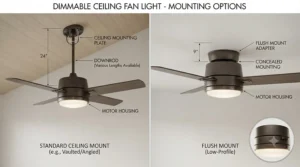
Standard ceiling fans hang roughly 25–40 cm below the ceiling once the downrod is factored in, which is a problem in older Canadian homes, basement rec rooms, or condos with 2.3–2.4 metre ceiling heights. The Dempsey solves that with a true low-profile, close-mount design that sits nearly flush, so it clears the “can I actually walk under this without ducking” test in rooms where a standard downrod fan would feel cramped. The integrated LED light is dimmable via the included remote alongside the four-blade reversible motor, and it comes in matte black, matte silver, fresh white, and noble bronze finishes.
Based on the spec comparison, the trade-off for low-profile mounting is a slightly reduced airflow ceiling compared to downrod-mounted 52-inch fans, since there’s less clearance for air to circulate above the blades. Reviewers who installed it specifically to solve a low-ceiling problem report it delivers noticeably better circulation than the flush-mount fan they replaced, which suggests the design compromise is well executed rather than a corner cut. Quiet operation carries over from Hunter’s broader lineup, though it’s a notch behind the flagship Wingate at maximum speed.
Pros:
- ✅ True low-profile mount for ceilings under 2.4 m
- ✅ Four finish options match most bedroom or condo décor
- ✅ Independent remote control for light dimming and speed
Cons:
- ❌ Slightly reduced max airflow versus downrod-mounted models
- ❌ Not ideal for rooms wider than roughly 4.5 m
Expect a price range of roughly C$160–C$210, positioning it as the specialist pick for anyone whose ceiling height, not their budget, is the limiting factor.
6. Bella Depot Flush Mount — tightest budget with app-controlled dimming
For a genuinely small budget, the Bella Depot Flush Mount punches above its price point by including smart app control, something usually reserved for premium fans like the DREO above. The LED light ring surrounds the outer edge of the blades in a low-profile flush design rated for bedrooms with modest ceiling heights, and the copper motor is rated under 35 decibels at operating noise — quiet enough, on paper, to avoid disturbing light sleepers. The dimmable ring light covers the full room evenly rather than casting a single hot spot, a detail that matters more in small bedrooms where the fixture sits closer to eye level.
Aggregated buyer commentary highlights the roughly ten-minute install time and pre-assembled components as a genuine time-saver, since most of the wiring and blade attachment work is done at the factory. The recurring criticism, honestly reported rather than smoothed over, is that the companion app’s timer and scheduling features are less polished than DREO’s equivalent, occasionally requiring a re-pair after a Wi-Fi router restart. For a first apartment, a kid’s room, or a secondary bedroom where budget matters more than smart-home polish, it’s a reasonable trade.
Pros:
- ✅ App-controlled dimming at a genuinely low price point
- ✅ Sub-35dB motor noise rating for light sleepers
- ✅ Fast, largely pre-assembled installation
Cons:
- ❌ Companion app scheduling is less refined than premium rivals
- ❌ May need occasional re-pairing after router restarts
Typically listed around C$110–C$150, this is the value pick when a smart-adjacent dimmable ceiling fan light needs to fit a tight renovation budget.
7. Progress Lighting AirPro Universal Ceiling Fan Light Kit — best for a ceiling fan light fixture replacement
Not everyone needs a new fan — plenty of Canadian homeowners just have an aging, non-dimmable light kit bolted to a perfectly good existing fan, and that’s exactly the ceiling fan light fixture replacement scenario this kit addresses. The AirPro four-light universal kit is compatible with Progress Lighting’s AirPro fan collection and includes four dimmable LED bulbs in an antique bronze finish, letting you upgrade lighting quality and add real dimming without touching the motor, blades, or existing mounting hardware at all.
The real-world meaning of “universal” here matters: it fits the standard AirPro fitter size, not every fan on the market, so measuring your existing fitter before ordering is a genuinely important step most retailer listings bury in the fine print. Reviewers who used it as a straightforward light-only swap report noticeably better light quality and dimming range compared to the incandescent or CFL kits it typically replaces, with the caveat that fitter compatibility issues are the most commonly reported hiccup — underscoring why measuring first, rather than assuming compatibility, is the single most important step in this kind of retrofit.
Pros:
- ✅ Adds real LED dimming without replacing the whole fan
- ✅ Includes four LED bulbs, ready to install
- ✅ Ideal for a straightforward light fixture replacement project
Cons:
- ❌ Fitter size compatibility must be checked before ordering
- ❌ Limited to AirPro-compatible fan bodies only
Priced in the C$70–C$100 range, it’s the most cost-effective route to a dimmable ceiling fan light if your existing fan motor still works fine.
Practical Usage Guide: Setup, Maintenance & Optimization
Getting a dimmable ceiling fan light to actually perform well long-term comes down to a handful of details most manuals gloss over. First, confirm your existing wall switch or dimmer is compatible — pairing an LED-specific dimmable fixture with an old incandescent-rated dimmer switch is one of the single most common causes of flickering, and it’s a wiring mismatch, not a defective bulb. If your fixture came with its own remote-based dimming (as most on this list do), you’ll often want to bypass the wall dimmer entirely and leave that switch at full “on,” letting the remote or app handle the actual brightness control.
During the first 30 days, resist the urge to run the fan at maximum speed constantly just to “break it in” — reversible DC motors, in particular, benefit from being run at moderate speeds initially so you can confirm balance and listen for any wobble before committing to a permanent light-kit orientation. A common early mistake is over-tightening the blade screws, which can actually introduce a slight wobble rather than prevent one; snug is sufficient. For maintenance, dust the blades and light diffuser monthly with a microfibre cloth — accumulated dust on the diffuser cover measurably dims LED output over time, which can feel like the dimmer has degraded when it’s really just buildup. Every six months, gently tighten the mounting screws at the ceiling bracket, since normal operation causes minor loosening over time, and wipe the light sensor or remote receiver (if your model has one) to keep signal response crisp.
Real-World Scenarios: Matching a Dimmable Ceiling Fan Light to Your Home
Consider three household profiles that map cleanly onto different picks from this list. A young couple in a Toronto condo with 2.3-metre ceilings and a compact 3.5 m by 4 m bedroom is squarely in Hunter Dempsey Low Profile territory — the flush mount clears the ceiling-height problem, and the dimming lets one partner read in bed while the other sleeps. A family converting a spare room into a nursery in a suburban Calgary bungalow, where budget matters and the room is modest in size, fits the Honeywell Ocean Breeze well: compact, quiet enough for a sleeping infant, and inexpensive enough that a future redecoration doesn’t feel wasteful.
Then there’s the tech-forward renovator outfitting a new-build great room in Ottawa with an existing smart home ecosystem — scheduling lights to dim automatically at sunset, controlling everything by voice, and wanting a fan powerful enough for an open-concept space over 20 square metres. That’s the DREO Smart Ceiling Fan scenario, where the higher price is offset by genuine daily convenience rather than novelty. In each case, the “best” fixture isn’t universal — it’s the one that matches the ceiling height, room size, budget, and control preference actually in play.
✨ Don’t Miss These Exclusive Deals!
🔍 Take your dimmable ceiling fan light shopping to the next level with these carefully researched picks. Click on any highlighted product to check current pricing and availability. The right fixture makes every room in your home feel more comfortable, whatever the season.
What Is a Dimmable Ceiling Fan Light?
A dimmable ceiling fan light is a combination fixture pairing a ceiling fan with an integrated or attached LED light kit whose brightness can be adjusted — typically via remote, wall dimmer, or app — independently of the fan’s speed. Unlike fixed-output ceiling fan lights, dimmable models let you match brightness to the moment, from full task lighting to a low, ambient glow, without swapping bulbs or fixtures.
This flexibility is precisely why a ceiling fan with LED light has become the default recommendation for bedrooms, living rooms, and home offices in new Canadian construction — it consolidates two appliances most rooms already need (air circulation and overhead lighting) into a single ceiling fixture, while adding a control dimension that a plain overhead light or a plain fan on its own can’t offer.
How to Choose a Dimmable Ceiling Fan Light
- Measure your ceiling height first. Standard downrod fans need roughly 2.4 m of clearance to hang comfortably; below that, a low-profile flush-mount model like the Hunter Dempsey is the safer choice.
- Check your blade span against room size. As a rough rule, rooms under 3.5 m per side suit 36–42 inch fans, while larger rooms benefit from 52-inch spans for adequate air movement.
- Confirm the dimming method fits your habits. Remote-based dimming is simplest for most households; app or voice control adds convenience but requires stable Wi-Fi.
- Verify wall switch compatibility. If you plan to keep using a wall dimmer, confirm it’s rated for LED loads, not just legacy incandescent dimmers.
- Look for CSA or cULus certification. This isn’t optional in Canada — it’s a baseline safety requirement; the CSA Group’s testing and certification standards explain what that verification actually covers.
- Weigh motor type. DC motors generally run quieter and more efficiently at low speeds than older AC motors, which matters most for bedroom installations.
- Decide between a full fan replacement and a light-only retrofit. If your existing fan runs fine, a universal ceiling fan light fixture replacement kit is often the more economical route.
Dimmable Ceiling Fan Light vs Separate Fan and Pendant Light
The alternative to a combination fixture is running a plain ceiling fan alongside a separate pendant or flush-mount light elsewhere in the room. On paper, this gives you more design flexibility — you can position the light exactly where you want it rather than centred under the fan — but it comes with real downsides for most bedrooms and living rooms. You’re paying for and wiring two fixtures instead of one, and unless the pendant is also dimmable, you lose the adjustable-brightness benefit entirely for half the equation.
Where separate fixtures genuinely win is in larger or irregularly shaped rooms, where a single centred fan-light combo can’t adequately illuminate the whole space — a reading nook in one corner, for instance, benefits more from a dedicated dimmable lamp than from relying on a ceiling fan positioned across the room. For the vast majority of standard bedrooms, home offices, and mid-sized living rooms, though, a single dimmable ceiling fan light fixture remains the more cost-effective and simpler-to-install option, and it’s why the seven products above dominate this category in Canadian retail.
Common Mistakes When Buying a Ceiling Fan with LED Light
The most frequent and costly mistake is skipping the ceiling height and blade span math entirely, resulting in a fan that either clips the door frame or looks comically undersized in a large room. A close second is assuming any wall dimmer works with any LED fixture — pairing a legacy incandescent dimmer with an LED-only fixture is the single most common cause of the flickering and buzzing complaints found in aggregated review data. Buyers also frequently overlook fitter compatibility when purchasing a light-kit-only retrofit, ordering a universal kit that isn’t actually sized for their specific fan model.
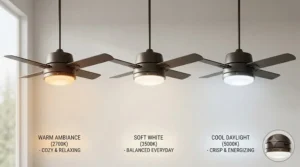
A subtler mistake is prioritizing color temperature options over dimming range — chasing a fixture with five colour-temperature settings while ignoring that its dimming only offers three brightness steps rather than a smooth gradient. For anyone who actually wants mood lighting flexibility, dimming granularity matters more day-to-day than an extra colour option you’ll likely set once and forget. Finally, buyers sometimes skip checking for CSA or cULus certification altogether when ordering from third-party marketplace sellers, a corner-cutting mistake that has real safety implications covered in the section below.
Ceiling Fan Light Fixture Replacement: Retrofit or Full Swap?
If your existing ceiling fan runs quietly and the blades are in good shape, a full ceiling fan light fixture replacement of just the light kit — rather than the entire fan — is usually the more sensible and budget-friendly move. Universal retrofit kits, like the Progress Lighting AirPro option covered above, let you swap in dimmable LED performance while keeping the fan motor, blades, and existing electrical box untouched. The catch, and it’s an important one, is fitter compatibility: light kits attach via a specific-sized fitter ring, and a mismatch means the new kit simply won’t seat properly, regardless of how good the LED array itself is.
Measure your existing fitter diameter before ordering anything, and when in doubt, check whether the replacement kit lists compatibility with your exact fan brand and model rather than a generic “universal” claim. Full fan replacement makes more sense when the motor itself is the problem — persistent wobble, unusual noise at speed, or a broken reverse switch are all signs the issue lives in the motor, not the light kit, and no amount of light-kit swapping will fix that.
Adjustable Brightness and Mood Lighting: Why Dimming Matters
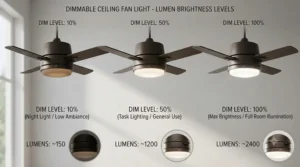
Adjustable brightness lighting isn’t just a convenience feature — it changes how a room actually functions across a day. A bedroom ceiling fan light at full output around 7 a.m. supports getting dressed and finding matching socks; the same fixture dimmed to a low, warm glow at 10 p.m. supports actually winding down rather than staying alert under bright overhead light. This is where mood lighting fixtures earn their keep: the ability to shift a single fixture’s output rather than needing a separate lamp for evening ambiance.
Research into evening light exposure and its effect on melatonin production offers a useful, practical reason to care about this beyond aesthetics: regular use of artificial light in the evening can interfere with how the body’s internal clock stays synchronized to the natural day-night cycle, and studies have found that brighter, cooler light in the evening suppresses the body’s natural melatonin rise more than dimmer, warmer light does, according to a peer-reviewed study on evening light exposure and melatonin. Practically, that means a dimmable ceiling fan light set to a warm, low output in the evening isn’t just about vibe — it’s a small, low-effort habit that supports winding down before bed, especially in bedrooms where the fixture sits directly overhead.
Energy-Saving LED Bulbs and Long-Term Cost & Maintenance
Every product on this list relies on energy-saving LED bulbs rather than incandescent or CFL alternatives, and the long-term cost math genuinely favours the switch. ENERGY STAR certified LED bulbs use up to 90% less energy than traditional incandescent bulbs and last at least fifteen times longer, which is a meaningful factor when you consider a ceiling fan light often runs several hours a day in a living room or kitchen. Over a five-year ownership window, the difference between a 60-watt-equivalent incandescent fixture and its 8–17 watt LED counterpart on this list typically works out to real, measurable electricity savings, particularly in provinces with higher residential electricity rates.
Maintenance costs are similarly favourable: integrated LED arrays on fixtures like the Merwry and Hunter models are rated for tens of thousands of hours, meaning most buyers won’t replace the light source at all during a typical decade of ownership — a stark contrast to incandescent bulbs that might need replacing every year or two in daily-use fixtures. Household lighting still accounts for roughly 3.5% of the energy used in the average Canadian home, so choosing efficient fixtures across a house adds up meaningfully over time, even if any single fixture’s savings look modest in isolation. The total cost of ownership, factoring in both electricity and replacement-bulb costs, generally favours the LED-integrated models on this list over any legacy incandescent-compatible fixture you might otherwise consider.
Safety, Regulations and CSA Compliance in Canada
Every electrical fixture installed in a Canadian home is expected to carry recognized safety certification, and this isn’t a minor formality. All electrical products sold in Canada are required to carry one of ETL, cULus, or CSA safety certification, and products imported without one of these marks can fail electrical inspection or create real liability for the importer or installer. As covered above, CSA-certified fixtures undergo independent verification of safety, performance, and regulatory compliance before they’re legally sellable for Canadian installation — look for the mark on the packaging or fixture body itself before purchasing, particularly from third-party marketplace sellers rather than established retailers.
Beyond certification, standard installation safety practices apply: always cut power at the breaker before wiring a new fixture, confirm your existing ceiling electrical box is rated to support a ceiling fan’s weight and vibration (not all boxes are — a plain light-fixture box often isn’t), and if you’re at all uncertain about wiring compatibility, hiring a licensed electrician for the installation is the safer and, frankly, often faster route than troubleshooting a DIY wiring mismatch after the fact.
Frequently Asked Questions
❓ Can any ceiling fan light be made dimmable?
❓ Does dimming a ceiling fan light save more electricity than running it at full brightness?
❓ Why does my dimmable LED ceiling fan light flicker at low brightness?
❓ Is it worth buying a ceiling fan light fixture replacement kit instead of a new fan?
❓ What's the difference between stepless and stepped dimming on a ceiling fan light?
Conclusion
A dimmable ceiling fan light rarely feels like an exciting purchase until you’ve lived with one — at which point going back to a fixed-brightness fixture feels genuinely worse than it should. Across the seven options here, the through-line is that dimming quality, motor noise, and fit-for-room sizing matter more day-to-day than any single spec on a listing page. The Home Decorators Collection Merwry remains the sensible default for most Canadian bedrooms and living rooms, the Hunter Wingate 59439 is worth the premium for genuinely quiet operation, and the Progress Lighting AirPro Kit solves the specific, common problem of an aging fan that just needs better light.
Whichever you choose, confirm CSA or cULus certification, measure your ceiling height and fitter size before ordering, and resist the temptation to skip the wall-dimmer compatibility check — it’s the single most common source of buyer frustration across every model covered here. Get those details right, and a dimmable ceiling fan light quietly becomes one of the more genuinely useful upgrades in the house. If you’re planning a broader round of efficiency upgrades, CMHC’s energy-saving tips for homeowners are a solid next stop.
✨ Ready to upgrade your lighting? Compare current prices on today’s top picks and find the fit that matches your room, your ceiling, and your budget! 💡
Recommended for You
- Best Ceiling Fan With Light and Remote: 7 Top Picks (2026)
- 7 Best Google Home Ceiling Fan Picks for 2026
- 7 Best Alexa Ceiling Fan Picks for 2026 (Honest Canadian Guide)
Disclaimer: This article contains affiliate links. As an Amazon Associate, I earn from qualifying purchases. If you purchase products through these links, we may earn a small commission at no additional cost to you.
✨ Found this helpful? Share it with your friends! 💬🤗
