
In This Article
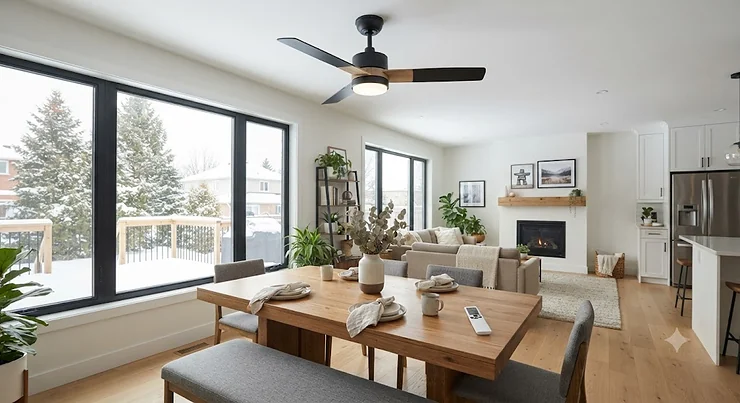
A dining room ceiling fan with remote is a fixture mounted above the dining table that combines air circulation with lighting, controlled wirelessly instead of by a pull chain or wall switch. Good ones stay quiet enough for conversation, dim smoothly for dinner ambiance, and look intentional rather than accidental hanging over your good china.
Here’s the thing nobody tells you when you’re shopping for a dining room ceiling fans with remote: the dining room is the one room in the house where a fan has to do double duty as both climate control and centrepiece. Your bedroom fan can hide in a corner and hum along unnoticed. Your dining room fan is on display every single time you host, and it’s spinning eight feet above everyone’s heads while they eat. That combination — visibility plus proximity — is exactly why the wrong fan (too loud, too plain, too industrial-looking, or controlled by a clunky pull chain you have to reach across the table for) sticks out like a sore thumb.
We dug into real product specs, aggregated Amazon review patterns, and Canadian energy and safety standards to put together this guide. Whether you’re outfitting a cozy condo dining nook or a great room with an open-concept kitchen, you’ll find a fan here sized and styled for the job, plus the reasoning to pick between them with confidence.
Quick Comparison Table
| Fan | Blade Span | Motor Type | Best For |
|---|---|---|---|
| Hunter Dempsey | 52″ | AC | Everyday budget-conscious buyers |
| Prominence Home Ashby | 52″ | AC | Farmhouse and transitional dining rooms |
| Westinghouse Jax | 56″ | AC | Larger open-concept dining/kitchen combos |
| Parrot Uncle Crystal Fandelier | 52″ | DC | Formal dining rooms wanting chandelier drama |
| Fanimation Kute | 44″–60″ | DC | Smart-home households, flexible sizing |
| Hunter Georgetown | 52″ | DC | Quiet operation with express install |
| Minka-Aire Light Wave | 52″ | AC | Design-forward, sculptural statement pieces |
Looking at the table, the split between AC and DC motors tells you most of what you need to know before you even open a spec sheet: DC models like the Parrot Uncle Crystal Fandelier, Fanimation Kute, and Hunter Georgetown run quieter and sip less power, while the AC options keep upfront cost down for anyone furnishing a whole house at once. Blade span matters more in a dining room than almost anywhere else in the home, since you’re working around a table, a light fixture height, and foot traffic all at once — the 44″ Fanimation Kute variant suits a breakfast nook, while the 56″ Westinghouse Jax is built for a sprawling great-room table.
💬 Just one click — help others make better buying decisions too!😊
Top 7 Dining Room Ceiling Fans with Remote: Expert Analysis
1. Hunter Dempsey — best all-around budget pick with LED and remote
The Hunter Dempsey earns its spot by doing the fundamentals well without asking you to spend a fortune to get them.
Specs-wise, it’s a 52-inch, four-blade fan with an integrated dimmable LED light kit, a low-profile mount, and a handheld remote controlling both fan speed and light brightness. That low-profile mount matters in dining rooms with standard eight-foot ceilings — you get real headroom, and it reads as intentional rather than makeshift, since a downrod-mounted fan hanging too low over a table can feel like it’s about to clip someone’s water glass. Based on the spec comparison against similarly priced fans in this category, the Dempsey’s four-blade design and reversible motor put it a notch above cheaper three-blade competitors on stability and winter-mode air circulation.
Reviewers consistently report that the Dempsey is easy to install and that the remote’s range comfortably covers a dining room from the kitchen doorway; a recurring complaint in user feedback is that the light kit’s globe attracts dust faster than expected, which is a fair trade-off for the price point.
Pros:
- ✅ Genuinely low price for a name-brand fan with LED and remote
- ✅ Low-profile mount suits standard eight-foot ceilings
- ✅ Reversible motor for summer/winter airflow switching
Cons:
- ❌ AC motor runs noticeably louder than DC alternatives
- ❌ Light globe shows dust buildup faster than sealed designs
At around C$150-C$220 depending on finish, the Hunter Dempsey is the fan to buy if you want dining-room-appropriate style without stretching the budget.
2. Prominence Home Ashby — best for farmhouse and transitional dining rooms
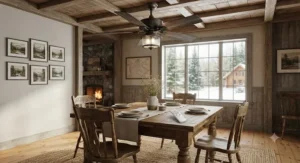
The Prominence Home Ashby leans hard into the warm, layered-wood look that so many Canadian dining rooms have adopted over the past few years.
It’s a 52-inch, five-blade fan with dual-finish reversible blades (so you effectively get two looks in one purchase), a tri-mount design that adapts to standard, low-profile, or angled-ceiling installs, and an integrated globe light kit dimmable from 20% to 100%. What most buyers overlook about tri-mount fans is that this flexibility means the same fan works whether your dining room has a flat eight-foot ceiling or a vaulted one — you’re not locked into a single downrod length, which saves a return trip to the store if your ceiling turns out taller than you measured.
Aggregated review sentiment for the Ashby line skews positive on assembly clarity, with buyers noting the instructions are unusually clear for a flat-pack fan; a common complaint is that the remote’s build quality feels a little lightweight compared with the fan itself.
Pros:
- ✅ Dual-finish blades give two style options in one fan
- ✅ Tri-mount flexibility for different ceiling heights
- ✅ Dimmable globe light suits dinner-table ambiance
Cons:
- ❌ Remote housing feels less premium than the fixture
- ❌ AC motor is mid-pack for noise, not whisper-quiet
Priced in the C$150-C$230 range, the Prominence Home Ashby is the practical choice for a farmhouse-leaning dining room that still needs to work on multiple ceiling types.
3. Westinghouse Jax — best for larger open-concept dining and kitchen combos
The Westinghouse Jax is built for square footage — this is the fan you reach for when your dining table sits inside a big, open kitchen-and-dining great room rather than a tidy, boxed-in room.
At 56 inches with a brushed-nickel finish and an included five-speed wall control, the Jax is one of the few fans in this roundup that’s explicitly labelled as a Canadian-certified product meeting the Canadian Electrical Code (cUL/cETL/CSA marked), which matters if you want a paper trail for insurance or resale purposes down the line. Here’s what the spec sheet won’t tell you outright: a 56-inch blade span moves noticeably more air per rotation than a 52-inch fan at the same speed setting, so in a large open-concept space you can often run the Jax on a lower speed than you’d need with a smaller fan elsewhere, which also means less motor noise during dinner.
User feedback commonly highlights the Jax’s minimal assembly and sturdy mounting hardware; a recurring criticism is that the wall control that ships with it feels more utilitarian than decorative, so some buyers swap it for a handheld remote kit.
Pros:
- ✅ CSA/cETL-marked for Canadian electrical code compliance
- ✅ 56-inch span efficiently cools large open-concept rooms
- ✅ Included wall control plus remote-compatible receiver
Cons:
- ❌ Industrial styling won’t suit every formal dining room
- ❌ Wall control’s look is more functional than decorative
Expect a price in the C$180-C$260 range, making the Westinghouse Jax a smart pick for bigger rooms where coverage matters more than delicate styling.
4. Parrot Uncle Crystal Fandelier — best for formal dining rooms wanting chandelier drama
If you’ve been torn between a chandelier and a fan for your dining room, the Parrot Uncle Crystal Fandelier is built to end that debate by being both at once.
This 52-inch, five-blade fan integrates crystal-accented lighting into the fan housing itself, runs on a reversible DC motor with six speeds, and includes both 4-inch and 10-inch downrods to fine-tune drop height for different ceiling heights. Based on the spec comparison, the DC motor here is the real differentiator versus AC-driven chandelier-fan hybrids: six speeds means finer control at the low end, which is exactly what you want in a room where the fan is running while people are seated close underneath it and can feel every gust.
Reviewers frequently mention that the crystal accents genuinely photograph well and elevate a dining room’s formality, framing it as delivering “chandelier energy” without sacrificing function; a common critique is that dusting the crystal elements takes noticeably longer than wiping down a plain blade fan.
Pros:
- ✅ Crystal detailing doubles as dining room chandelier
- ✅ Six-speed DC motor for fine low-speed control
- ✅ Two downrod lengths included for ceiling flexibility
Cons:
- ❌ Crystal accents require more frequent dusting
- ❌ Premium look comes with a premium price tag
Budget around C$220-C$320 for this one — a legitimate contender if you were leaning toward a chandelier purchase anyway.
5. Fanimation Kute — best for smart-home households wanting flexible sizing
The Fanimation Kute stands out for one specific reason: it comes in three blade spans — 44, 52, and 60 inches — under a single design, so you can size it precisely to your dining room instead of settling for whatever size happens to look right.
The fan runs a six-speed reversible DC motor rated up to roughly 7,045 CFM airflow depending on size, ships with a TR360 handheld remote, and supports optional WiFi connectivity through Fanimation’s fanSync system (receiver sold separately) for smartphone or voice-assistant control. What most buyers overlook about smart-compatible fans like this is that the WiFi piece is optional, not mandatory — you can run it as a straightforward remote-control fan today and add the smart receiver later if you decide you want app control without buying a whole new fixture.
Aggregated feedback on the Kute line trends toward praise for how quiet the DC motor stays even at higher speeds, which reviewers specifically call out as a step up from the manufacturer’s older AC-motor models; some buyers note the optional LED light kit sold separately adds meaningfully to the total cost.
Pros:
- ✅ Three blade-span options for precise room sizing
- ✅ Optional WiFi/smart-assistant compatibility
- ✅ DC motor stays quiet even at higher speeds
Cons:
- ❌ LED light kit is sold as a separate accessory
- ❌ WiFi receiver is an added-cost extra, not included
Pricing lands around C$300-C$420 for the fan body, with the light kit and smart receiver adding to that if you want them — the Fanimation Kute rewards buyers who plan to grow into smart-home features over time.
6. Hunter Georgetown — best for whisper-quiet operation with express install
The Hunter Georgetown is the fan for anyone who’s sat under a noisy AC-motor fan during a dinner party and vowed never again.
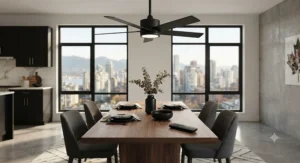
It’s a 52-inch, six-speed DC-motor fan with Hunter’s Express Install system, a brushed-nickel finish, LED lighting, and remote control as standard equipment. Here’s what the spec sheet undersells: DC motors like this one typically draw a fraction of the wattage of comparable AC motors while running quieter across every speed, not just the lowest setting — that’s the difference between a fan you notice and one you forget is even on, which is exactly the goal in a room built around conversation. The Express Install hardware also genuinely cuts assembly time versus older Hunter mounting systems, according to installer commentary circulating in home-improvement forums.
Reviewers routinely single out the Georgetown’s quiet operation as its strongest selling point, describing it as close to silent at low-to-medium speeds; the most common critique is that the six-speed remote’s button layout takes a session or two to memorize.
Pros:
- ✅ DC motor delivers genuinely whisper-quiet operation
- ✅ Express Install system shortens assembly time
- ✅ Six-speed control for precise airflow tuning
Cons:
- ❌ Remote’s six-speed layout has a learning curve
- ❌ Costs more upfront than Hunter’s AC-motor lines
At roughly C$280-C$380, the Hunter Georgetown is worth the premium the moment you value quiet over cost savings.
7. Minka-Aire Light Wave — best for a design-forward statement piece
The Minka-Aire Light Wave is the fan you buy when the dining room ceiling fan needs to double as a design element people comment on, not just a utility overhead.
Its three blades twist in a distinctive sculptural curve, paired with an etched-lens integrated 16-watt LED light that’s fully dimmable via the included handheld remote, and the motor housing includes a manual reverse switch. What most buyers overlook about sculptural blade designs like the Light Wave is that the variable pitch isn’t purely cosmetic — the twisting profile is engineered to move air efficiently despite looking nothing like a standard flat blade, so you’re not sacrificing performance for the artistic silhouette. This is the fan most likely to make guests ask where you got your ceiling fan, which isn’t a sentence you can say about most fans on this list.
Reviewers describe the etched lens as producing a notably soft, even glow rather than the harsher point-source light some integrated LED kits produce; a recurring theme in feedback is that installation is more involved than a standard fan due to the unconventional blade-and-motor assembly, so budgeting extra time (or hiring help) is worth factoring in.
Pros:
- ✅ Sculptural blade design doubles as a design statement
- ✅ Etched-lens LED produces soft, even ambient light
- ✅ Full-function remote with dimming and reverse control
Cons:
- ❌ Assembly is more involved than standard fan designs
- ❌ Premium design commands a premium price
Expect to pay in the C$400-C$600 range for the Minka-Aire Light Wave — a genuine splurge, but one aimed squarely at buyers who want their dining room ceiling fan to look like it was chosen, not just installed.
Practical Usage Guide: Setting Up Your Remote-Controlled Dining Room Fan
Getting a new fan up and running smoothly comes down to a handful of steps most buyers skip past, then regret skipping.
Start by matching the fan’s dip-switch or pairing code between the remote and the receiver before you mount the fan body — doing this on the ground, with the receiver accessible, saves an awkward ladder trip later if the pairing doesn’t take the first time. Once installed, run through all fan speeds and light dimming levels immediately to confirm the remote’s full range works, rather than assuming it’s fine because the “on” button worked. In the first 30 days, the most common mistake buyers make is mounting the fan too close to the table — leave at least seven feet of clearance from the floor to the blades, and ideally position the fan so its edge doesn’t hang directly over diners’ heads at the table’s centre.
For maintenance, wipe blades monthly with a dry microfibre cloth (a pillowcase slid over each blade works surprisingly well for catching dust rather than scattering it) and check that mounting screws haven’t loosened after the first few weeks of use, since new installations settle slightly. If your remote’s range seems to shrink over time, it’s almost always a battery issue rather than a fixture problem — cheap batteries lose effective range well before they die completely.
Real-World Scenarios: Matching Fans to Dining Rooms
Picture three different Canadian households, and the right fan looks different for each one.
First, a young couple in a Toronto condo with an open-concept kitchen-dining area and a standard eight-foot ceiling, on a tight budget after furniture costs: the Hunter Dempsey fits, since its low-profile mount respects the ceiling height and its price leaves room in the budget for a table and chairs. Second, a family in a Calgary suburb with a formal dining room reserved for holidays and dinner parties, wanting something that reads as a genuine light fixture first and a fan second: the Parrot Uncle Crystal Fandelier or the Minka-Aire Light Wave both deliver that dual-purpose statement, with the Minka-Aire edging ahead for anyone who wants a modern, sculptural look over a classic crystal one. Third, a retired couple in a Victoria bungalow who spend hours at the dining table reading and don’t want motor hum interrupting quiet afternoons: the Hunter Georgetown‘s DC motor and genuinely quiet operation make it the clear pick, worth the extra cost purely for the noise floor.
Ceiling Fan for Dining Room: How to Choose the Right One
Picking the right ceiling fan for dining room use comes down to matching a handful of measurable factors to your specific space rather than buying on looks alone.
- Measure your ceiling height first. Anything under eight feet calls for a low-profile or hugger-style mount rather than a downrod fan, so you’re not hanging blades at head height.
- Size the blade span to the room, not the table. A 44-46″ fan suits breakfast nooks under 100 square feet, 52″ fits most standard dining rooms, and 56″+ spans are for larger open-concept spaces.
- Decide between AC and DC motors early. DC motors cost more upfront but run quieter and use less power — a meaningful factor in a room where people linger and talk.
- Check the light output against your table’s needs. Dimmable LED kits in the 800-1,600 lumen range generally suit dining tables well, letting you shift from bright meal-prep light to soft dinner-party ambiance.
- Confirm remote range covers your actual layout. Open-concept spaces need a remote rated for longer range than a boxed-in room does.
- Look for reversible airflow. This lets the fan pull double duty for both summer cooling and winter heat circulation.
- Factor in installation complexity. Sculptural or heavier fixtures may need a licensed electrician rather than a confident DIY afternoon.
Ceiling Fan vs Chandelier for Dining Room
The ceiling fan vs chandelier for dining room debate usually comes down to a false choice, since modern fandelier-style fans blur the line between the two.
| Factor | Traditional Chandelier | Standard Ceiling Fan | Fandelier-Style Fan |
|---|---|---|---|
| Air circulation | None | Excellent | Good |
| Formal aesthetic | Excellent | Fair to good | Very good |
| Energy efficiency | Poor to fair | Good to excellent | Good |
| Best For | Purely decorative, air-conditioned homes | Function-first households | Buyers wanting both looks and airflow |
Reading the table, the honest takeaway is that a traditional chandelier still wins on pure formal drama, but it does zero work circulating air, which matters more than most buyers expect in rooms without central air conditioning or in older Canadian homes with less consistent HVAC coverage. A fandelier-style fixture like the Parrot Uncle Crystal Fandelier splits the difference well, delivering most of a chandelier’s visual presence while still moving air; a plain-blade fan like the Hunter Dempsey wins decisively on airflow and cost but concedes some formal polish. If your dining room doubles as a hosting space for warm-weather gatherings, air circulation stops being optional — a hybrid fandelier is very often the smarter long-term buy over a fan-free chandelier.
✨ Don’t Miss These Exclusive Deals!
🔍 Take your dining room to the next level with these carefully selected fans. Click on any highlighted item to check current pricing and availability. These fixtures will help you create authentic, comfortable evenings your family and guests will love!
Handheld Remote Receivers Explained
Handheld remote receivers are the small electronic units, usually tucked inside the fan’s canopy or mounting bracket, that actually receive the signal your handheld remote sends and translate it into fan-speed and light commands.
What most buyers overlook about handheld remote receivers is that they’re frequency-matched to a specific remote at setup, using dip switches or a learn-code pairing process — this is why a lost or broken remote can almost always be replaced with a compatible universal remote rather than requiring you to replace the whole fan. Reviewers of universal replacement receivers commonly note that pairing takes under ten minutes once you know which frequency band (usually 303, 304, or 434 MHz) your original fan uses, though matching that frequency correctly the first time saves a frustrating return trip to the hardware store. On the DC-motor fans in this guide — the Fanimation Kute, Hunter Georgetown, and Parrot Uncle Crystal Fandelier — receivers also typically handle a wider speed range (often six settings versus three on older AC models), which is part of why DC fans feel more finely tunable from the couch or dinner table.
Wall Control Kits: When to Upgrade from Handheld
Wall control kits swap the handheld remote for a fixed panel mounted where a traditional light switch would go, and for a dining room specifically, there’s a genuine case for making that switch.
The Buyer’s Decision Framework here is simple: if your dining room sees frequent guests who won’t know where the handheld remote lives, choose a wall control kit, because a wall-mounted panel is discoverable the way a light switch is — nobody has to ask where the fan controls are. If your household is small and consistent, a handheld remote is fine and saves you from an extra wiring step. If you’re renting, stick with handheld remotes, since wall control kits typically require running new low-voltage wiring inside the wall, which is a landlord conversation you may not want to have. Reviewers of aftermarket wall control kits compatible with brands like Hunter and Westinghouse frequently mention that the kits successfully replace a lost handheld remote’s function, though a repeated complaint is that dip-switch pairing on cheaper universal kits can be fiddly compared with brand-matched originals.

Quiet Motor Operation: Why It Matters at the Dinner Table
Quiet motor operation isn’t a luxury feature in a dining room — it’s arguably the single most important spec, because a fan humming at conversation level actively competes with the reason you’re gathered around that table in the first place.
The spec sheet won’t spell this out directly, but the difference between AC and DC motors is the whole story here: AC motors, found in budget picks like the Hunter Dempsey and Prominence Home Ashby, typically run somewhere in the 40-55 dB range at medium-high speeds, which is audible but not intrusive for most households. DC motors, used in the Hunter Georgetown, Fanimation Kute, and Parrot Uncle Crystal Fandelier, commonly operate in the 30-40 dB range even at comparable speeds — the practical difference between “you can hear it if you listen for it” and “someone across the table has to raise their voice.” According to Natural Resources Canada, ENERGY STAR certified ceiling fans use roughly 60% less energy on average than standard models, and the improved motor and blade engineering behind that efficiency gain is frequently the same engineering that reduces noise — quiet and efficient tend to travel together rather than being separate trade-offs.
Common Mistakes When Buying Dining Room Ceiling Fans
A handful of buying mistakes come up again and again, and every one of them is avoidable with a little forethought.
The first is buying strictly by blade span without checking CFM (airflow) ratings — two 52-inch fans can move meaningfully different volumes of air depending on blade pitch and motor strength, so span alone isn’t a reliable shortcut. The second is ignoring downrod length entirely, which leaves buyers with a fan hanging either too low over the table or too close to a vaulted ceiling to move air effectively. The third is underestimating light output needs, buying a fan with a dim, non-adjustable light kit and then supplementing with lamps because the fixture alone can’t handle both ambient and task lighting. The fourth is skipping the reversible-motor check, missing out on winter heat-circulation benefits that a simple switch flip provides. The fifth, and most expensive, is attempting a DIY install on an unsupported electrical box — dining room fans are heavy, spinning fixtures, and mounting one to a standard light-fixture box rather than a fan-rated brace is a genuine safety hazard, not just a code technicality.
Long-Term Cost & Maintenance
Total cost of ownership for a ceiling fan is almost never just the sticker price, and the gap between AC and DC models widens the longer you own the fan.
| Cost Factor | AC Motor Fans | DC Motor Fans |
|---|---|---|
| Upfront price | Lower | Higher |
| Typical wattage draw | 50-100W | 15-30W |
| Estimated annual electricity cost* | Higher | Lower |
| Motor lifespan expectations | Good | Very good |
*Based on typical residential electricity rates and moderate seasonal usage.
The numbers here explain why a fan like the Hunter Georgetown or Fanimation Kute can pencil out as the better long-term value despite costing C$100-C$150 more upfront than an AC alternative — over several years of regular use, the lower wattage draw chips away at that gap, and DC motors generally show less wear at comparable run times. Maintenance costs stay low across the board as long as you’re doing the basics: dusting monthly, checking mounting hardware annually, and replacing remote batteries before they die rather than after, since a fading battery can cause erratic speed jumps that look like a motor problem but aren’t.
Safety & Electrical Code Compliance in Canada
Ceiling fan installation touches Canadian electrical code requirements in ways that are easy to underestimate if you’ve only ever swapped a light bulb before.
Fans are heavier and generate more torque on their mounting point than a standard light fixture, which is why they require a fan-rated electrical box rather than the box designed for a simple pendant light — using the wrong box risks the fixture pulling loose from the ceiling over time. In most Canadian provinces, electrical work in a home legally requires a permit filed with the provincial electrical safety authority, reviewed and signed off by an inspector; in Ontario specifically, only Licensed Electrical Contractors are legally permitted to perform electrical work in homes, and skipping that step can create real problems at resale or insurance claim time, not just a theoretical risk. On the product side, look for CSA, cUL, or cETL markings on the fan itself — Canada maintains its own energy performance standard for ceiling fans separate from the U.S. ENERGY STAR program, and fans carrying these Canadian marks have been tested against that domestic standard specifically. If you’re not confident distinguishing a joist-mounted fan brace from a standard box, that’s the exact moment to call a licensed electrician rather than guess.
Frequently Asked Questions
❓ Do dining room ceiling fans with remote work with any ceiling height?
❓ What size ceiling fan is best for a dining room?
❓ Are DC motor ceiling fans worth the extra cost?
❓ Can I install a ceiling fan with remote myself in Canada?
❓ Do ceiling fans really help with heating costs in winter?
Conclusion
Choosing among dining room ceiling fans with remote really comes down to three honest trade-offs: how much noise you’re willing to tolerate, how much visual statement you want the fixture to make, and how much you’re willing to spend upfront versus over time. Budget-focused households do well with the Hunter Dempsey or Prominence Home Ashby, both of which handle the fundamentals without draining your renovation budget. Anyone prioritizing quiet, conversation-friendly operation should look hard at the Hunter Georgetown or Fanimation Kute, since their DC motors solve the single biggest complaint people have about dining room fans. And if your dining room needs to double as a design statement — whether that’s chandelier-adjacent crystal drama or sculptural modern styling — the Parrot Uncle Crystal Fandelier and Minka-Aire Light Wave both deliver on that front without sacrificing airflow entirely.
Whichever direction you go, confirm the ceiling height, blade span, and motor type match your specific room before you buy, and don’t skip the electrical safety basics covered above — a fan that’s properly and safely mounted is one you’ll actually enjoy using for years rather than worrying about.
Recommended for You
- Ceiling Fan For Dining Room With High Ceilings: 7 Best Picks (2026)
- Chandelier Ceiling Fan For Dining Room: 7 Best Picks (2026)
- 7 Elegant Ceiling Fans for Dining Room That Wow Guests (2026)
Disclaimer: This article contains affiliate links. As an Amazon Associate, I earn from qualifying purchases. If you purchase products through these links, we may earn a small commission at no additional cost to you.
✨ Found this helpful? Share it with your friends! 💬🤗
