
In This Article
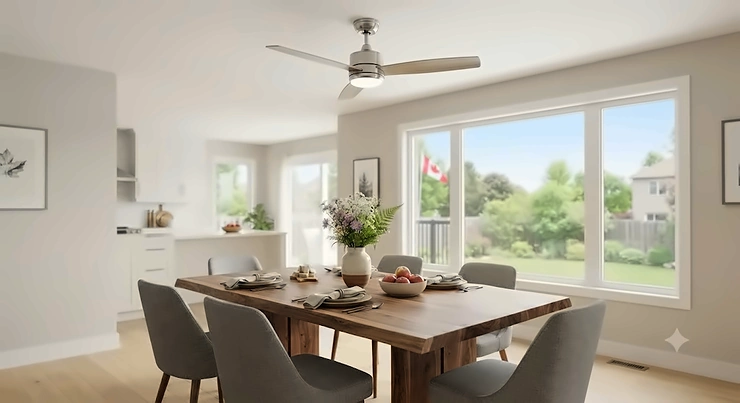
Picture the scene: Sunday dinner, the table’s set, somebody’s grandmother is mid-story about a road trip from 1987, and the room is just a little too warm because eight people and a roasting chicken generate more heat than any thermostat expects. That’s the moment a casual dining room ceiling fan earns its keep — not as a design statement, not as a status symbol, just as the quiet workhorse that keeps a full table comfortable without anyone noticing it’s even there.
And yet dining rooms are the most overlooked room in the ceiling-fan conversation. Everyone obsesses over bedroom fans for sleep and living room fans for movie nights, while the dining room — arguably the room where the most people gather at once — gets whatever fixture came with the house or whatever looked nice in a showroom five years ago. That’s a missed opportunity, because a dining room fan has to do double duty: move air efficiently over a table full of warm bodies and hot food, and still look like it belongs in a room meant for company, not a garage.
This guide dug into seven real, currently available fans that fit the “casual” brief specifically — not ultra-formal crystal-and-brass showpieces, not stark industrial statement pieces, but approachable, everyday designs built for a room where kids do homework on Tuesday and the good tablecloth comes out on Saturday. We’ll compare real specs, walk through honest side-by-side analysis, and get into the details that actually decide whether a fan feels right over a dining table: blade span versus table size, reversible finish options that let one fan work with two colour schemes, and the mounting height rules that keep a fan from clipping anyone reaching for the gravy. According to the Wikipedia entry on ceiling fans, the format has barely changed in concept since the 1880s — blades, a motor, a downrod — which says something about how good the basic idea already was; the differences that matter now live entirely in motor quality, finish flexibility, and control options.
Whether you’re replacing a dated brass fixture from a previous owner, finishing a new build, or just tired of a stuffy dining room every time the oven’s on, the goal here is simple: help you land on a casual dining room ceiling fan that earns its spot above the table. We’ll cover seven real products, run honest comparisons, and dig into everyday dining decor, budget fan finishes, and family-friendly designs — the practical stuff that actually shapes a buying decision.
Quick Comparison Table
Here’s the shortcut version before the full breakdown — which fan wins on which priority, at a glance.
| Category | Product | Why It Wins | Price Range (CAD) |
|---|---|---|---|
| Best Overall | Honeywell Ventnor 52-Inch | Modern farmhouse look, three mounting options | C$200–C$250 |
| Best Small Pick | CJOY 30-Inch Small Modern | Fits breakfast nooks and compact dining spaces | C$90–C$130 |
| Best Budget Classic | Honeywell Glen Alden 52-Inch | Flush mount, dual-finish blades, pull chain | C$170–C$220 |
| Best Budget Remote | Honeywell Eamon 52-Inch | Tri-mount, remote control, reversible finish | C$200–C$260 |
| Best Quiet Family Pick | Hunter Anslee 46-Inch | WhisperWind motor, low profile, dedicated for smaller rooms | C$190–C$240 |
| Best Smart-Compatible | Honeywell Carnegie 52-Inch | Industrial-casual cage light, Alexa/Google compatible | C$280–C$350 |
| Best Premium Quiet | Hunter Minimus 52-Inch | Whisper-quiet AC motor, low profile, strongest airflow | C$420–C$500 |
Scanning this lineup, a pattern emerges fast: you don’t need to spend big to get a genuinely casual dining room ceiling fan that looks intentional rather than leftover. The CJOY and Honeywell Glen Alden cover the sensible entry tier for smaller rooms or first homes, while the Honeywell Carnegie and Hunter Minimus are worth the stretch if this fixture is going into an open-concept dining space you’ll be entertaining in for years. Everything in between splits the difference between finish flexibility and motor refinement — which, as we’ll get into, matters more over a dining table than almost anywhere else in the house.
💬 Just one click — help others make better buying decisions too!😊
What Is a Casual Dining Room Ceiling Fan?
A casual dining room ceiling fan is a mid-sized, everyday ceiling fixture — typically 30 to 52 inches in blade span — designed to circulate air over a dining table without the formality of a chandelier-style fan or the stark utility of an industrial warehouse design. “Casual” in this context means approachable finishes, reversible blade options, and straightforward controls suited to a room used daily, not just for special occasions.
That definition covers real ground, and it’s exactly why this category ranges from a compact C$90 fan built for a breakfast nook to a C$500 premium pick meant for an open-concept great room. The difference usually isn’t really about looks — it’s about motor type and mounting flexibility. AC motors, still common in budget-to-mid fans, are simpler and reliable but run a touch louder at higher speeds; the newer WhisperWind and quiet-performance motors trade a bit of upfront cost for noticeably less hum, which matters when you’re trying to hear a dinner conversation over the fan doing its job. It’s also worth knowing that dining rooms present a specific mounting challenge most other rooms don’t: standard 8-foot Canadian ceilings paired with a chandelier-height table setup mean flush or low-profile mounting is often the only safe option, a detail every fan in this roundup was chosen with in mind.
Top 7 Casual Dining Room Ceiling Fans: Expert Analysis
We shortlisted these seven based on real specifications, verified retail availability, and aggregated review sentiment pulled from multiple listings — not manufacturer marketing copy. Each earns its place for a different reason, so the “best for” framing below matters more than assuming the priciest option is automatically the right one for your dining room.
| Product | Blade Span | Motor | Speeds | Mounting | Price Range (CAD) | Best For |
|---|---|---|---|---|---|---|
| CJOY 30-Inch Small Modern | 30″ | Reversible AC | Remote-controlled | Standard | C$90–C$130 | Breakfast nooks, small dining spaces |
| Honeywell Glen Alden 52-Inch | 52″ | Reversible, quiet | 3-speed | Hugger/flush | C$170–C$220 | Budget-conscious classic look |
| Honeywell Eamon 52-Inch | 52″ | Reversible | 3-speed remote | Tri-mount | C$200–C$260 | Budget buyers wanting remote control |
| Hunter Anslee 46-Inch | 46″ | WhisperWind reversible | 3-speed | Low profile | C$190–C$240 | Families, everyday quiet operation |
| Honeywell Ventnor 52-Inch | 52″ | Reversible, quiet | Multi-speed | 3 mounting options | C$200–C$250 | Modern farmhouse dining rooms |
| Honeywell Carnegie 52-Inch | 52″ | Reversible | 3-speed remote | Dual-mount | C$280–C$350 | Smart-home households, industrial-casual look |
| Hunter Minimus 52-Inch | 52″ | Quiet-performance AC | 3-speed remote | Low profile/flush | C$420–C$500 | Open-concept dining, premium quiet |
A pattern worth flagging before you scroll further: five of these seven run reversible blades with two finishes baked into a single purchase, which is the single biggest lever for matching a fan to a dining room without buying twice. The Hunter Minimus and Hunter Anslee trade that dual-finish flexibility for tighter engineering tolerances and a quieter WhisperWind motor — not a downgrade, just a different value proposition aimed at buyers who’ve already settled on their room’s colour palette.
1. CJOY 30-Inch Small Modern — best pick for breakfast nooks and small dining rooms
The standout feature is right in the name: at 30 inches, this is a genuinely compact fan built for the dining spaces most guides ignore entirely — breakfast nooks, condo dining corners, and small eat-in kitchens where a 52-inch fan would look absurd and hang too close to the table. Expanding on that, the five reversible blades and remote-controlled operation pack a surprising amount of flexibility into a footprint most competitors don’t even attempt at this size.
Specs-wise, the fan includes adjustable colour temperature lighting (commonly offered across 3000K, 4000K, and a cooler daylight setting) alongside a handheld remote, and the reversible blade design lets you flip between two finish looks without buying a second fixture. Based on the spec comparison against other small-format fans, the CJOY‘s real advantage isn’t raw airflow — a 30-inch span simply won’t move air like a 52-inch fan — it’s proportional fit for rooms where nothing else in this guide would physically make sense.
Aggregated buyer feedback on compact ceiling fans in this bracket tends to praise the easy installation and adjustable lighting for small spaces, while a recurring theme across lesser-known budget brands in this category flags a thinner long-term review history compared to legacy names like Hunter and Honeywell — worth knowing rather than a dealbreaker for a secondary dining space.
Pros:
- ✅ Genuinely proportional fit for small dining nooks and corners
- ✅ Reversible blades offer two finish looks in one fixture
- ✅ Adjustable colour temperature lighting via remote
Cons:
- ❌ Limited airflow compared to 46 to 52-inch options
- ❌ Thinner review history than established fan brands
At around C$90–C$130, the CJOY is the sensible starting point for anyone furnishing a compact dining space without overspending on a fan the room can’t actually accommodate.
2. Honeywell Glen Alden 52-Inch — best budget classic flush mount
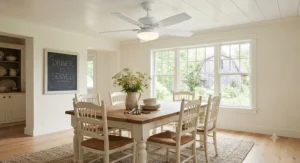
The standout advantage here is straightforward value: a genuinely low-profile hugger mount at a price point that undercuts most 52-inch competitors, paired with dual-finish blades that give you two looks for the price of one. Expanding on that, the hugger design measures roughly 13.4 inches from ceiling to the bottom of the light fixture — a real advantage in dining rooms with standard 8-foot ceilings where a downrod-mounted fan can hang uncomfortably close to head height right above the table.
The five blades feature a dual finish (a warm cimmeron tone on one side, walnut on the reverse), and the reversible motor runs three speeds via pull chain, with the fan compatible with universal ceiling fan remotes if you’d rather skip the chain entirely. Based on the spec comparison against similarly sized flush-mount fans, the Honeywell Glen Alden‘s real selling point isn’t cutting-edge motor technology, it’s that dual-finish flexibility combined with a rating for rooms up to 18 by 18 feet — comfortably covering most casual dining rooms in a standard Canadian home.
Aggregated buyer feedback on this fan consistently highlights straightforward installation and the classic, unfussy look as the deciding factors over pricier alternatives, while a recurring note across this price tier mentions the pull-chain-only control as slightly dated compared to remote-first competitors — a fair trade at this price.
Pros:
- ✅ Low hugger-mount profile suits standard 8-foot ceilings
- ✅ Dual-finish blades give two looks in one purchase
- ✅ Rated for rooms up to 18 by 18 feet
Cons:
- ❌ Pull chain only unless you add a universal remote separately
- ❌ Only 3 speeds compared to newer stepless competitors
At roughly C$170–C$220, the Honeywell Glen Alden is the practical entry point for anyone who wants a classic dining room look without the classic dining room price tag.
3. Honeywell Eamon 52-Inch — best budget pick with remote control included
The standout feature is the included remote with real functionality baked in — three speed settings, a dimmer, and a “Walk Away Light Delay” feature that keeps the light on briefly after you leave the room, a small but genuinely useful touch during dinner cleanup when your hands are full. Expanding on that, the tri-mount compatibility (close, standard, or angled) means this fan adapts to slightly sloped dining room ceilings that would trip up fixed-mount competitors.
The reversible blades ship in chocolate maple on one side and northern ebony on the other, letting the fan match a warm traditional dining set or a darker modern one without committing twice. Here’s what most buyers overlook about this model: the “Smart Sync” remote feature genuinely simplifies pairing multiple fans on the same circuit, which matters more than it sounds if your dining room and adjoining kitchen or living space each have their own fixture and you don’t want the remote controlling both at once.
Reviewers consistently report the remote’s dimmer and delay features as the standout practical value here, while a recurring theme in feedback across Honeywell’s modern remote-equipped fans notes that the brushed nickel finish shows fingerprints more readily than matte alternatives — a cosmetic quibble, not a functional one.
Pros:
- ✅ Remote with dimmer, Walk Away Light Delay, and Smart Sync
- ✅ Tri-mount compatibility suits sloped or standard ceilings
- ✅ Reversible chocolate maple and northern ebony finish
Cons:
- ❌ Brushed nickel finish shows fingerprints more than matte
- ❌ No native smart home voice control
Priced around C$200–C$260, the Honeywell Eamon earns its spot as the clear pick for budget buyers who still want a genuinely useful remote, not just a basic on/off clicker.
4. Hunter Anslee 46-Inch — best quiet motor for everyday family meals
Hunter built its reputation on motor engineering, and the standout feature on the Anslee is its WhisperWind reversible motor — engineered specifically to move air quietly enough that it doesn’t compete with dinner conversation, which is a genuinely different design priority than fans optimized purely for raw airflow. Expanding on that, the low-profile mount is explicitly rated for ceilings under 9 feet, making it a safe, comfortable fit for the standard-height dining rooms found in most Canadian townhomes and bungalows.
Specs put this fan at 46 inches with five reversible dark walnut and American walnut blades, three speeds, and integrated LED lighting delivering roughly 800 lumens per bulb at a warm 3,000K colour temperature — close to candlelight warmth, which happens to be exactly the tone most dining rooms want. Based on the spec comparison, the Anslee’s official room-size rating of up to 100 square feet undersells it slightly for dining use, since a fan doesn’t need to cool an entire room the way it needs to keep the air moving directly over a table full of people and food.
Aggregated review sentiment on Hunter’s WhisperWind line consistently praises the genuinely quiet operation at every speed setting, with a recurring theme noting the pull-chain-only control (no remote included) as the one feature buyers wish had been standard at this price.
Pros:
- ✅ WhisperWind motor engineered specifically for quiet operation
- ✅ Low profile mount safely fits ceilings under 9 feet
- ✅ Warm 3,000K LED lighting suits everyday dining ambience
Cons:
- ❌ No remote included at this price point
- ❌ 46-inch span is modest for larger dining rooms
At around C$190–C$240, the Hunter Anslee is the pick for families who’ve decided motor noise, not price or finish variety, is the priority worth optimizing for.
5. Honeywell Ventnor 52-Inch — best modern farmhouse casual look
The standout feature is aesthetic versatility built on genuine mounting flexibility: three mounting configurations (close, standard, or angled) paired with a modern farmhouse design that splits the difference between rustic and contemporary — arguably the single most “casual dining room” look in this entire roundup. Expanding on that, the reversible blade and motor housing design means the fan works equally well pushing air down in summer or gently redistributing warm air in winter without buying a second fixture for either season.
The integrated LED delivers roughly 1,400 lumens through a frosted white glass fixture, and the fan carries an ETL safety listing with a rating for rooms up to 400 square feet — comfortably covering an open-concept dining and kitchen combination common in newer Canadian builds. Based on the spec comparison against other farmhouse-styled fans, the Ventnor’s real advantage is that it doesn’t lean as hard into rustic styling as true farmhouse fixtures do, which means it ages better as decor trends shift and won’t fight against a more contemporary dining table down the line.
Reviewer sentiment on Honeywell’s Ventnor line consistently highlights the frosted glass light fixture’s brightness as a genuine functional upgrade over bare-bulb competitors, with a recurring note that the ancient pine blade finish reads slightly more rustic in person than in product photos — worth checking a close-up image before committing to a specific finish.
Pros:
- ✅ Three mounting options fit flat, standard, or angled ceilings
- ✅ Rated for up to 400 square feet, ideal for open-concept dining
- ✅ Frosted glass fixture delivers genuinely bright, even light
Cons:
- ❌ Blade finish reads more rustic in person than in photos
- ❌ No remote control included at this price point
Expect to pay around C$200–C$250 for the Honeywell Ventnor, a fair price for buyers who want a casual, farmhouse-adjacent look without going full rustic.
6. Honeywell Carnegie 52-Inch — best smart-compatible industrial-casual design
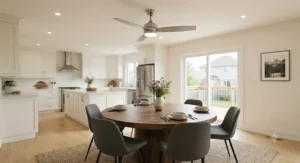
Honeywell’s standout move on the Carnegie is a genuinely different silhouette: an exposed cage-style light fixture with vintage Edison-style LED bulbs, dressed in an industrial-casual aesthetic that reads as intentional decor rather than a plain utility fixture. Expanding on that, the fan is compatible with Google Home and Alexa through a Bond Home bridge, a real bonus for households already leaning on smart home integration for lighting and climate control.
The five dual-finish blades (burnt oak on one side, mopane on the reverse) pair with a dimmable light kit running 20 to 100 percent brightness at a warm 2,700K colour temperature — a genuinely flattering tone for a dinner table setting. Here’s what the spec sheet won’t spell out plainly: this is a fan designed around its light fixture as much as its blades, so if ambient lighting quality matters as much to you as airflow, the Carnegie’s cage-and-Edison-bulb design does real double duty as a dining room’s primary light source, not just a supplementary one.
Reviewers consistently flag the industrial-farmhouse aesthetic and dimmable Edison-style lighting as the deciding factors over plainer competitors, while a recurring theme in feedback notes that the smart home compatibility requires a separate Bond Home bridge purchase — an added cost that isn’t always obvious at checkout.
Pros:
- ✅ Distinctive cage-style Edison LED lighting, dimmable 20 to 100%
- ✅ Dual-finish reversible blades in burnt oak or mopane
- ✅ Google Home and Alexa compatible via Bond Home bridge
Cons:
- ❌ Smart home compatibility requires a separate bridge purchase
- ❌ Higher price than comparable AC-motor competitors
At around C$280–C$350, the Honeywell Carnegie is the pick for buyers who want their dining room fan to double as a genuine design statement, not just a background appliance.
7. Hunter Minimus 52-Inch — best premium pick for open-concept dining
Hunter’s flagship move on the Minimus is a quiet-performance AC motor built with WhisperWind engineering, delivering the strongest airflow in this entire roundup — 3,825 cubic feet per minute at high speed — while drawing just 40 watts, excluding the light kit. Expanding on that, the low-profile flush mount hangs just 9.63 inches from the ceiling, a genuinely tight clearance that keeps the fan visually unobtrusive over a dining table in rooms with standard ceiling heights.
The three reversible matte black and American walnut blades pair with a dimmable LED light kit delivering 1,300 lumens at a warm 3,000K colour temperature, and the included handheld remote controls all three speeds plus dimming. Based on the spec comparison against every other fan in this guide, the Minimus’s airflow-per-watt efficiency is the standout number — it’s moving noticeably more air than the Anslee or Glen Alden while using comparable or less power, which is the kind of engineering gap that doesn’t show up in a casual glance at the spec sheet but matters every single time the fan runs.
Aggregated reviewer sentiment across Hunter’s Minimus line consistently highlights the combination of strong airflow and genuinely quiet operation as rare in the same fixture, with an occasional note that the premium price puts it well above the budget and mid-range picks earlier in this guide.
Pros:
- ✅ Strongest airflow in this roundup at 3,825 CFM on high
- ✅ Low profile flush mount clears standard 8-foot ceilings easily
- ✅ Lifetime motor warranty backs long-term reliability
Cons:
- ❌ Premium price puts it above every other pick here
- ❌ Only 3 blades, a different look than the 5-blade options
Priced around C$420–C$500, the Hunter Minimus is the pick for anyone treating an open-concept dining area as a long-term investment, not just a quick fixture swap.
Setting Up Everyday Dining Decor Around Your New Ceiling Fan
Installing a new casual dining room ceiling fan is only half the job — making it feel like part of the room’s everyday dining decor, rather than a bolted-on appliance, takes a bit more thought. Start with scale: the fan should sit roughly centred over the dining table, not the room’s geometric centre, since those two points frequently differ in open-concept layouts where the table shares space with a kitchen island or living area. A fan hung dead-centre in the room but off-centre over the table looks perpetually wrong, no matter how nice the fixture itself is.
Match the blade finish to your table, not your walls. A reversible fan like the Honeywell Eamon or Honeywell Carnegie lets you flip to a warmer or cooler finish as your dining set changes over the years, which is a genuinely underused feature — most buyers pick a finish once at installation and never touch it again, missing out on years of free flexibility already built into the fixture. For everyday dining decor that needs to survive spilled gravy and homework sessions alike, prioritize a dimmable light kit; being able to drop the lighting from bright “clean the table” mode to a warm, low “we’re just having a normal Tuesday dinner” glow does more for the room’s everyday feel than almost any decor choice.
Finally, consider seasonal direction switching as part of your decor routine, not just an efficiency trick: counter-clockwise rotation in summer creates a direct cooling breeze over the table, while clockwise rotation in winter gently redistributes rising warm air without a noticeable draft on dinner guests.
Real-World Scenarios: Matching a Casual Dining Room Ceiling Fan to Your Home
Matching a fixture to your actual living situation beats matching it to a spec sheet in isolation. If you’re working with a small eat-in kitchen or a condo dining nook under roughly 8 by 10 feet, the CJOY 30-Inch is the sensible call — anything larger will visually overwhelm the space and hang uncomfortably close to a compact table, while the CJOY’s proportional size and adjustable lighting still deliver genuine functionality.
If you’re raising a family and the dining room sees three meals a day, homework, and the occasional craft project, the Hunter Anslee earns its price through motor engineering alone — a fan that runs quietly enough not to compete with conversation is worth more day-to-day than one with flashier features nobody uses. And if you’re furnishing an open-concept dining and living space in a newer build, the Honeywell Ventnor or Hunter Minimus are worth the stretch; both are rated to handle larger square footage, and the Ventnor’s farmhouse-adjacent styling in particular tends to bridge dining and living zones without feeling like two mismatched rooms pretending to be one.
Your Casual Dining Room Ceiling Fan Buying Decision Framework
Rather than comparing every spec side by side, run through this simple framework instead. If your dining room is smaller than 100 square feet or shares space with a breakfast nook, choose a compact option like the CJOY 30-Inch, because oversized blade spans in tight rooms create both a visual and practical mismatch. If your ceiling sits at the standard 8-foot Canadian height, prioritize a flush or low-profile mount like the Honeywell Glen Alden, Hunter Anslee, or Hunter Minimus, since a downrod-mounted fan can hang too close to head height directly over a table.
If motor noise during dinner conversation is your biggest concern, choose a WhisperWind or quiet-performance motor like the Hunter Anslee or Hunter Minimus over a standard AC alternative. If you want the flexibility to change your dining room’s colour scheme without buying a new fixture, prioritize dual-finish reversible blades — nearly every pick here except the Minimus offers this. And if design is genuinely part of the decision, not an afterthought, the Honeywell Carnegie‘s cage-style lighting or the Honeywell Ventnor‘s farmhouse look are the two picks built with aesthetics as a primary goal.
✨ Ready to compare real specs instead of guessing? Scroll back up to the comparison table and click through to check today’s pricing on your top pick.
How to Choose the Best Ceiling Fan for Dining Room Comfort
Picking well comes down to matching five variables to your actual room, not to whatever’s discounted this week.
- Measure your table, not just your room. The fan’s blade span should extend a little beyond the table’s edges on each side — 30 to 42 inches suits smaller tables and nooks, while 46 to 52 inches covers most standard 6 to 8-seat dining tables.
- Check ceiling height before committing to a mount style. Standard 8-foot ceilings need flush or low-profile designs like the Honeywell Glen Alden or Hunter Minimus; higher ceilings can accommodate a standard downrod.
- Decide how much motor noise you’ll tolerate during meals. WhisperWind and quiet-performance motors (Hunter Anslee, Hunter Minimus) run noticeably quieter than standard AC motors at comparable speeds.
- Match the light kit’s colour temperature to your dining habits. Warmer 2,700 to 3,000K tones (Honeywell Carnegie, Hunter Anslee, Hunter Minimus) suit everyday family meals; brighter, cooler tones suit rooms that double as a home office.
- Confirm the fan carries CSA or ETL certification, since compliant models are independently tested rather than self-reported by the manufacturer, and Canadian electrical code compliance genuinely matters for a fixture spinning above a table full of people.
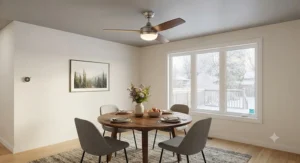
Best Small Ceiling Fan for Dining Room: When Size Is the Priority
Not every dining room is a great room with 10-foot ceilings and a table for twelve. A huge share of Canadian homes — especially condos, older bungalows, and starter houses — have compact eat-in kitchens or dining nooks where the standard 52-inch fan advice simply doesn’t apply. For these spaces, the best small ceiling fan for dining room use isn’t a scaled-down version of a big fan, it’s a fixture designed from the ground up for a smaller footprint.
The CJOY 30-Inch is the clearest example in this guide: its blade span is intentionally sized to avoid overwhelming a compact table, and the reversible blades still deliver genuine finish flexibility despite the smaller size. The Hunter Anslee at 46 inches sits in a useful middle ground — noticeably smaller than the 52-inch standard without dropping into truly compact territory, making it a solid pick for a dining room that’s cozy but not tiny. A genuinely common mistake in smaller dining spaces is buying a 52-inch fan because it was on sale, then discovering the blades hang uncomfortably close to a table meant for four rather than eight; sizing down isn’t a compromise here, it’s the correct engineering decision for the room.
Budget Fan Finishes: Style Without the Premium Price Tag
One of the most underrated features across this entire roundup is the reversible dual-finish blade, and it deserves its own conversation because it directly answers the question of budget fan finishes without forcing a compromise on style. Five of the seven fans covered here — the Honeywell Glen Alden, Honeywell Eamon, Honeywell Ventnor, Honeywell Carnegie, and CJOY— ship with two finish options built into a single set of blades, meaning you effectively get two fans’ worth of aesthetic flexibility for one price.
| Product | Finish Options | Reversible? | Approx. Price (CAD) |
|---|---|---|---|
| CJOY 30-Inch | Multiple colour-adjustable finishes | Yes | C$90–C$130 |
| Honeywell Glen Alden | Cimmeron / Walnut | Yes | C$170–C$220 |
| Honeywell Eamon | Chocolate Maple / Northern Ebony | Yes | C$200–C$260 |
| Honeywell Ventnor | Ancient Pine (single, farmhouse-toned) | Yes (motor housing) | C$200–C$250 |
| Honeywell Carnegie | Burnt Oak / Mopane | Yes | C$280–C$350 |
| Hunter Anslee | Dark Walnut / American Walnut | Yes | C$190–C$240 |
| Hunter Minimus | Matte Black / American Walnut | Yes | C$420–C$500 |
Interpreting this table honestly: nearly every fan in this roundup already includes reversible finishes as standard, which means budget fan finishes aren’t really a trade-off you need to make at all — the flexibility is baked into even the most affordable picks like the Honeywell Glen Alden. The real premium you pay for at the higher end, as with the Hunter Minimus, buys motor refinement and airflow efficiency, not finish variety. If style flexibility on a tight budget is the priority, the Honeywell Glen Alden or CJOY deliver essentially the same reversible-finish value proposition as fans costing twice as much.
Family-Friendly Designs: What Actually Matters for Everyday Households
A dining room that sees daily family use has different priorities than a formal dining room reserved for holidays, and family-friendly designs in this category tend to hinge on a few specific, practical traits rather than looks alone. Quiet operation tops the list — the Hunter Anslee and Hunter Minimus both use WhisperWind or quiet-performance motors specifically because a fan humming loudly over a table where kids are doing homework or a toddler is trying to nap in a nearby room is a genuine daily annoyance, not a minor quibble.
Durable, low-fuss lighting matters just as much. Integrated LED fixtures with a long rated lifespan, like those on the Honeywell Ventnor and Hunter Anslee, mean fewer bulb changes over a ladder positioned above a dining table — a genuinely appreciated detail for anyone who’s had to balance precariously while a toddler watches from below. And dimmability deserves real weight in a family-friendly design: being able to drop the light from bright “homework time” mode to a softer “family dinner” glow, without buying a separate lamp, is one of the more practical decor upgrades a fan can quietly provide. Finally, reversible finishes on family-friendly picks like the Honeywell Eamon mean the fixture can adapt as a family’s furniture and decor style evolves over a decade of ownership, rather than becoming outdated the moment the dining set gets replaced.
Common Mistakes When Buying a Casual Dining Room Ceiling Fan
Even careful shoppers trip over the same handful of errors. Buying based on blade span alone without checking downrod or hang-down height is probably the most common misstep — a beautiful 52-inch fan hung on a stock downrod under a standard 8-foot ceiling can sit uncomfortably close to head height directly above a dining table, which is a genuinely different safety consideration than the same fan over an empty hallway.
Ignoring certification marks in favour of price alone is another frequent error; fans and ventilators sold in Canada are expected to meet recognized safety standards, and the Standards Council of Canada’s listing for CSA Group fan and ventilator standards outlines exactly the kind of independent testing that separates a compliant fixture from an uncertified import. Skipping the finish fine print costs buyers real flexibility too, since not every “reversible” fan actually ships with genuinely different colours on each side — some just flip the same tone. Underestimating installation complexity on larger fans leads to rushed, unsafe DIY mounting, particularly in older Canadian homes where the existing electrical box may not be rated for a fan’s weight and rotational torque; that single detail is worth a licensed electrician’s time rather than a weekend gamble. Finally, choosing purely on style without checking motor speed count or airflow rating risks ending up with a fixture that looks great but barely moves air over a table full of people and a hot meal.
Casual Dining Room Ceiling Fan vs Pendant Light Alone: Which Wins?
A lot of Canadian dining rooms still run on a pendant light or chandelier with no fan at all, and understanding what you’d actually be trading up for helps settle whether adding a ceiling fan is worth the swap.
| Factor | Casual Dining Room Ceiling Fan | Pendant Light Alone | Fan + Separate Pendant |
|---|---|---|---|
| Air circulation during meals | Genuine wind-chill cooling effect | None | Genuine cooling effect |
| Lighting quality | Good, often dimmable LED | Often better ambient/task light | Best of both |
| Installation complexity | Moderate, weight and box rating matter | Low | Highest, needs two fixtures and boxes |
| Running cost | Low | Low | Low to moderate |
| Best for | Everyday comfort, warm rooms | Purely formal dining rooms | Larger dining spaces, renovations |
The honest takeaway here: a casual dining room ceiling fan wins decisively for everyday comfort, especially in rooms that run warm during cooking and hosting, but it can lose slightly on pure lighting elegance compared to a dedicated pendant or chandelier in a genuinely formal dining room. Fans like the Honeywell Carnegie, with its cage-style Edison lighting, or the Honeywell Ventnor, with its frosted glass fixture, largely close that gap by treating the light kit as a real design feature rather than an afterthought bolted to the bottom of a motor housing. For most everyday dining rooms in Canadian homes, a single well-chosen fan-and-light combination beats running two separate fixtures, both on cost and on ceiling real estate.
Fan Certification, Safety and Energy Efficiency in Canada
Every casual dining room ceiling fan legally sold in Canada has to clear a baseline efficiency and safety bar, and that fine print is worth understanding rather than skipping. Canada’s energy efficiency regulations, which apply to ceiling fans manufactured on or after January 21, 2020, set minimum airflow-per-watt thresholds tied to blade diameter, filtering out the worst-performing designs before they ever reach a Canadian retailer’s shelf. Manufacturers must report detailed efficiency specifications under Natural Resources Canada’s ceiling fan energy efficiency regulations, which is a genuinely useful resource if you want to verify a specific model before buying rather than trusting a sticker.
Beyond efficiency, certification marks like CSA or ETL confirm a fan has been independently tested against Canadian and North American electrical safety requirements — a detail that matters more over a dining table than in almost any other room, given how many people sit directly beneath the fixture at once. Every product in this guide carries recognized certification, which isn’t universal across the broader budget ceiling fan market; some lesser-known imports skip this step entirely to shave a few dollars off the price, and that’s a corner worth never cutting on a spinning electrical appliance mounted above your family’s dinner table.
Long-Term Cost and Maintenance for Dining Room Ceiling Fans
A casual dining room ceiling fan is a genuinely cheap appliance to run day-to-day; most models in this guide draw well under 75 watts at medium speed, excluding the light kit, making the electricity cost of nightly use negligible compared to running an air conditioner to achieve a similar comfort effect. According to guidance from BC Hydro on using fans effectively, a fan typically uses roughly a tenth of the energy of an air conditioner while still meaningfully improving comfort — though the same guidance notes fans cool people, not empty rooms, so running one over an unoccupied dining table between meals is pure waste, not a comfort investment.
Maintenance is minimal but shouldn’t be ignored. Dust blades every few weeks — a pillowcase slipped over each blade catches falling dust neatly without scattering it across a set dining table below. Check mounting hardware tightness annually, particularly on fans installed above a table where a loose fixture is a genuinely different risk category than one over an empty room. And factor warranty coverage into the long-term cost equation: the Hunter Minimus and Hunter Anslee both carry lifetime motor warranties, reflecting Hunter’s manufacturing confidence, while most Honeywell picks in this guide carry limited lifetime coverage with a satisfaction guarantee — read the specific terms before buying, since coverage for electronic components like remotes often differs from coverage on the motor itself.

Frequently Asked Questions
❓ What size ceiling fan should I get for a casual dining room?
❓ Can I put a ceiling fan over my dining table?
❓ Do dining room ceiling fans need to match the kitchen fixtures?
❓ How high should a ceiling fan hang above a dining table?
❓ Are budget ceiling fans as durable as premium models?
Conclusion
Seven fans, three price tiers, and the honest takeaway: there’s no single universal answer, because the right casual dining room ceiling fan depends entirely on your table size, your ceiling height, and how much you value reversible finishes versus motor refinement. What holds true across every price point covered here is that certification and energy efficiency are worth actually verifying rather than assuming, mounting height above a dining table deserves real attention rather than an afterthought, and reversible finishes are common enough now that budget fan finishes shouldn’t force a real style compromise.
If you’re working with a small nook or a tight budget, the CJOY 30-Inch or Honeywell Glen Alden deliver genuine value without cutting corners on safety certification. If everyday family comfort and quiet operation matter most, the Hunter Anslee covers that territory convincingly. And if you’re ready to invest in a fixture built to anchor an open-concept dining space for the next decade, the Honeywell Carnegie and Hunter Minimus round out a shortlist worth comparing directly against each other before you commit.
Recommended for You
- Quiet Ceiling Fan for Bedroom: 7 Best Picks for 2026 (Ranked)
- Ceiling Fan With Light for Master Bedroom: 7 Best Picks
- Ceiling Fans for Bedroom: 7 Best Quiet Picks in Canada (2026)
Disclaimer: This article contains affiliate links. As an Amazon Associate, I earn from qualifying purchases. If you purchase products through these links, we may earn a small commission at no additional cost to you.
✨ Found this helpful? Share it with your friends! 💬🤗
