
In This Article
Picture a July evening in a Toronto condo. The oven has been running for forty minutes, the pasta pot is rolling, and the kitchen — all 7 square metres of it — feels like the inside of a toaster. The range hood is roaring, yet somehow the air around your face hasn’t moved an inch. Sound familiar?
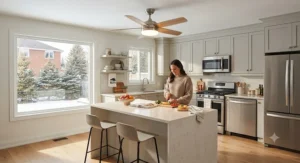
That’s exactly the gap a small kitchen ceiling fan is built to fill. It won’t replace your hood (more on that later), but it does something the hood can’t: it keeps the air around you moving, so the heat from the stove doesn’t pool at head height while you chop onions.
Here’s the catch. Most ceiling fans are designed for living rooms, with 132 cm (52-inch) blades that would clip your upper cabinets and swallow a galley kitchen whole. A good small kitchen ceiling fan flips that script — compact blade spans between 76 cm and 112 cm (30-44 inches), low profiles for 2.4 m (8-foot) ceilings, and fixtures that double as your main light source.
I spent the research phase digging through manufacturer spec sheets, Canadian efficiency regulations, and aggregated review data from large retailers to find seven fans that genuinely suit tight kitchens. No invented test results, no fake testimonials — just specs translated into what they mean at the stove, plus honest reasoning about who each fan suits.
You’ll find a quick comparison table, seven detailed breakdowns, a tight-space installation guide, real-world scenarios, and a hard look at why this is one of the smartest budget kitchen upgrades you can make in 2026. Let’s clear the air.
What Is a Small Kitchen Ceiling Fan?
A small kitchen ceiling fan is a ceiling-mounted fan with a blade span of roughly 76-112 cm (30-44 inches), sized for rooms under about 9-14 m² (100-150 sq ft). It circulates air to cool the cook, often includes an integrated light, and typically uses a flush or short-downrod mount for low ceilings.
That definition matters because size is where most buyers go wrong. According to the general engineering background on the ceiling fan, a fan cools people through the wind-chill effect — moving air across your skin — rather than lowering the room’s actual temperature. In a kitchen, that distinction is everything: you want airflow where you stand, not a hurricane that blows napkins off the counter.
Three traits separate a proper small kitchen ceiling fan from a shrunken living-room fan:
- ✅ Compact blade spans that leave clearance from cabinets, pendants and range hoods
- ✅ Low or adjustable profile for tight-space installation under 2.4-2.7 m (8-9 ft) ceilings
- ✅ Easy-clean surfaces, because kitchen air carries grease that ends up on every blade
Quick Comparison Table: 7 Small Kitchen Ceiling Fan Picks at a Glance
| Fan | Blade Span | Mount / Profile | Airflow (High, Mfr. Listed) | Light | Approx. Price (CAD) | Best For |
|---|---|---|---|---|---|---|
| Westinghouse Petite 7230800 | 76 cm (30″) | Hugger | ~2,146 CFM | LED A19 | C$120-C$180 | Westinghouse Petite for tiny galley kitchens |
| Honeywell Ocean Breeze 50600 | 76 cm (30″) | Dual-mount, 4″ downrod | Not prominently listed | 2 × B10 LED, 450 lm | C$110-C$170 | Honeywell Ocean Breeze for sloped ceilings |
| Hunter Loki 36″ | 91 cm (36″) | Standard / low / angled | ~2,858 CFM | 2 LED, 600 lm each | C$140-C$200 | Hunter Loki for breakfast nooks |
| Prominence Home Alvina 42″ | 107 cm (42″) | Hugger | ~3,767 CFM | 800 lm globe | C$110-C$180 | Prominence Home Alvina for traditional kitchens |
| Hunter Dempsey 44″ Low Profile | 112 cm (44″) | Low profile, 20.5 cm tall | ~3,768 CFM | 2 LED, 800 lm each | C$180-C$280 | Hunter Dempsey for low ceilings with remote |
| Minka-Aire Light Wave F845 | 112 cm (44″) | 6″ downrod | ~3,674 CFM | Integrated dimmable LED | C$350-C$480 | Minka-Aire Light Wave for modern design |
| Minka-Aire Simple F786 | 112 cm (44″) | 6″ downrod, wet-rated | ~5,289 CFM | Optional kit | C$400-C$560 | Minka-Aire Simple for steamy, open kitchens |
Prices are approximate ranges at the time of research — check current price on amazon.ca, as prices may vary.
Looking at the table, the jump in airflow from the 30-inch fans to the 44-inch models is dramatic — the Minka-Aire Simple moves roughly two and a half times the air of the Westinghouse Petite. But raw CFM isn’t the whole story in a small kitchen: the Petite and Honeywell Ocean Breeze exist for rooms where a 44-inch fan simply won’t physically fit. The sweet spot for most Canadian condo and bungalow kitchens sits in the middle, where the Hunter Loki and Hunter Dempsey balance footprint, airflow and price.
💬 Just one click — help others make better buying decisions too! 😊
Top 7 Small Kitchen Ceiling Fan Picks: Expert Analysis
1. Westinghouse Petite 7230800 — smallest footprint for galley kitchens
At just 76 cm (30 inches) across, the Westinghouse Petite is the fan you buy when a bigger one would literally hit the cabinet doors.
Westinghouse lists about 2,146 CFM on high with 41 W of motor draw, which works out to roughly 53 CFM per watt. In practice, that’s a gentle, focused breeze — enough to cut the stuffiness over a single cook’s workspace, not enough to cool an open-concept great room. The six reversible 10.5-inch blades run at an 18-degree pitch, a fairly steep angle that helps a short blade bite more air. It includes a 9.8 W LED A19 bulb (60 W equivalent) and a hugger mount rated for spaces up to about 9.3 m² (100 sq ft).
Here’s what to weigh: six blades means six surfaces to degrease, so this is a better fit for a light-cooking household than someone deep-frying weekly. On the upside, Westinghouse backs the motor with a lifetime warranty and other parts for two years. On Home Depot’s US site at the time of research, the white version carried a 4.7-out-of-5 average across 44 reviews — a small pool, but consistently positive, with shoppers highlighting its fit in compact rooms.
Pros:
- ✅ Genuinely tiny footprint for narrow galley layouts
- ✅ Lifetime motor warranty from a long-standing brand
- ✅ Steep blade pitch squeezes airflow from short blades
Cons:
- ❌ Six blades mean more grease-cleaning time
- ❌ Modest airflow for kitchens over 9 m²
Expect it in the C$120-C$180 range — strong value if clearance, not power, is your constraint.
2. Honeywell Ocean Breeze 50600 — best 30-inch pick for sloped ceilings
The Honeywell Ocean Breeze earns its spot with one practical trick: a dual-mount canopy that handles both flat and angled ceilings.
That matters in older Canadian homes and renovated attic-style kitchens, where the ceiling pitches toward the eaves. It ships with a 4-inch downrod and a 54-inch lead wire for longer options, runs a quiet reversible motor on three speeds, and lights the space with two B10 LEDs behind frosted cylinder glass — about 450 lumens at 2700K. Three dual-finish reversible blades (white or soft maple) let you match cabinets without buying a different model.
On paper, 450 lumens is ambient light, not task light. Think of it as a warm glow for evening tidying, then plan under-cabinet LEDs for the cutting board. Honeywell doesn’t prominently publish a CFM figure on its own store page, so I can’t compare its airflow directly — treat it as a comfort fan for small spaces rather than a heat-blaster.
Review data was thin on Honeywell’s own store at the time of research, so I can’t responsibly summarize a strong sentiment trend. What is verifiable: pull-chain control out of the box, compatibility with a Honeywell remote, and a limited lifetime manufacturer’s warranty.
Pros:
- ✅ Dual-mount handles sloped and flat ceilings
- ✅ Three blades are quick to wipe down
- ✅ Reversible blade finishes suit two décor styles
Cons:
- ❌ CFM figure isn’t prominently published
- ❌ 450 lumens is too dim as sole kitchen light
Typically C$110-C$170 — a sensible buy for awkward ceilings on a tight budget.
3. Hunter Loki 36″ — most flexible mounting in a mid-size span
The Hunter Loki hits the Goldilocks zone: 91 cm (36 inches) is big enough to move real air, small enough to fit most apartment kitchens.
Hunter lists 2,858 CFM on high and rates efficiency at about 64 CFM per watt. That’s a 33% airflow bump over the Westinghouse Petite from only 15 cm more blade span. The real star is mounting flexibility: 29 cm (11.43 inches) tall in standard mode, 24 cm (9.43 inches) in low mode, plus an angled option — three configurations from one box. Two 600-lumen LED bulbs at 3,000K give a combined 1,200 lumens, meaningfully brighter than the 30-inch picks.
Based on the spec comparison, this is the fan for the breakfast-nook kitchen: a table under the fan, 2.4-2.6 m ceilings, and a household that wants the fan to replace an old flush-mount light. The pull-chain control is the compromise — reaching it over a kitchen island isn’t fun, so budget for a separate wall control or remote if the fan will sit above a counter.
I couldn’t access a detailed review breakdown for this specific model, so the “whisper-quiet” description is Hunter’s claim rather than aggregated user data. The limited lifetime motor warranty and ETL listing are verifiable.
Pros:
- ✅ Three mounting modes cover most ceiling heights
- ✅ 1,200 combined lumens replaces a basic ceiling light
- ✅ Strong airflow for its 91 cm span
Cons:
- ❌ Pull chain awkward over counters and islands
- ❌ Four blades need more cleaning than three
Usually around C$140-C$200 — arguably the best all-rounder per dollar here.
4. Prominence Home Alvina 42″ — best traditional look under C$200
The Prominence Home Alvina is the pick for farmhouse, cottage and classic oak-cabinet kitchens that would look odd under a sleek propeller.
It’s a 107 cm (42-inch) hugger with five dual-finish reversible blades, a frosted glass globe, and an 800-lumen dimmable bulb (dimmable 20-100%). Prominence lists airflow at about 3,767 CFM on high — an ambitious number for a flush fan, so I’d treat it as a manufacturer rating rather than a guarantee of room feel, because huggers sit close to the ceiling and typically move air less freely than downrod fans.
Here’s the honest analysis: the Alvina’s value is aesthetic plus clearance. A hugger mount keeps the lowest point high enough for a tall family in a 2.4 m kitchen, and five blades give that classic ceiling-fan silhouette. The trade-off is maintenance — five blades plus a glass globe equals more degreasing, and globes collect cooking film faster than you’d think.
I didn’t find a detailed, verifiable review summary for this exact SKU, so I won’t characterize user sentiment. Prominence does offer a limited lifetime warranty, and the pull chain plus reversible motor cover the basics.
Pros:
- ✅ Classic five-blade look for traditional kitchens
- ✅ Flush hugger mount saves precious headroom
- ✅ Dimmable 800-lumen light for evening ambience
Cons:
- ❌ Glass globe and five blades need frequent cleaning
- ❌ Hugger mounting limits real-world air movement
Often in the C$110-C$180 range — excellent value if style matters as much as breeze.
5. Hunter Dempsey 44″ Low Profile — best for ceilings under 2.7 m
The Hunter Dempsey is what happens when a full-sized fan learns to crouch: 112 cm (44 inches) of blade at just 20.5 cm (8.08 inches) tall.
Hunter designed it for ceilings under 9 feet (about 2.74 m) and lists 3,768 CFM on high with an efficiency rating of roughly 67 CFM per watt — the best airflow-to-profile ratio among the non-DC fans here. Two 800-lumen dimmable LED bulbs (3,000K) put out 1,600 lumens combined, enough to be the room’s main light. The handheld remote solves the pull-chain problem that dogs the Hunter Loki and Prominence Home Alvina.
What most buyers overlook is how rare this combination is: low profile, 44-inch span, remote, and bright light usually means a premium price. For a Canadian bungalow kitchen with 2.4 m ceilings and a small eating area, it’s a near-ideal match. Hunter backs the WhisperWind motor with a limited lifetime warranty and the light kit for three years.
The product documentation and review coverage I could verify emphasize quiet operation and remote convenience; the most cited limitation is that the light fixture is integrated rather than removable, and the fan is rated for indoor use only.
Pros:
- ✅ Ultra-slim 20.5 cm profile for low ceilings
- ✅ Remote control with dimmable 1,600 combined lumens
- ✅ Near-premium airflow at a mid-range price
Cons:
- ❌ Light kit can’t be removed or swapped
- ❌ Not rated for damp, steamy locations
Generally C$180-C$280 — the strongest value-for-performance in this lineup.

6. Minka-Aire Light Wave F845 — best modern design with smart-home hooks
The Minka-Aire Light Wave is the fan that makes guests look up and ask where you got it.
Three sculpted ABS blades span 112 cm (44 inches), paired with a frosted integrated LED and a 6-inch downrod. Minka lists 3,674 CFM on high at about 60.6 W, around 61 CFM per watt, with a variable blade pitch. The 6-inch downrod drops the blades lower than the huggers, which generally lets air circulate more freely — useful over a kitchen table — but it also means you need higher ceilings, ideally 2.6 m or more, to keep safe clearance.
The analytical headline is compatibility with Bond smart-hub technology, which lets you add phone or voice control without swapping the fan. For a renovated kitchen where everything else is on an app, that’s a genuine differentiator. It’s ETL certified and dimmable, but it’s a standard (dry) rated fan, so it isn’t meant to hang directly in the steam column above a stove.
On Home Depot’s US site at the time of research, the white F845-WH averaged 4.3 out of 5 across 332 reviews — a large sample that suggests consistent satisfaction, particularly with its looks and fit in small rooms.
Pros:
- ✅ Standout sculpted design for modern kitchens
- ✅ Bond-compatible for smart-home control
- ✅ Large, positive review pool on major retailers
Cons:
- ❌ Downrod needs taller ceilings for safe clearance
- ❌ Dry-rated only; keep away from direct steam
Typically C$350-C$480 — worth it if design and smart control justify the premium.
7. Minka-Aire Simple F786 — most powerful and wet-rated for steamy kitchens
The Minka-Aire Simple is the performance pick: a DC motor, wet-location rating, and the highest airflow in this guide.
Minka lists 5,289 CFM on high at just over 48 W — about 110 CFM per watt, nearly double the Westinghouse Petite‘s efficiency. On low, it sips around 3.7 W while still moving roughly 1,626 CFM. That’s the DC advantage in plain terms: you can leave it on low all summer and barely notice it on your hydro bill. The wet rating means it tolerates humidity and steam far better than dry-rated fans, which is why it suits open kitchens with heavy cooking.
The trade-offs are clear. There’s no light included (an optional kit is sold separately), so it won’t replace your ceiling light out of the box. And the 6-inch downrod plus slope compatibility up to 18 degrees suits taller or vaulted kitchens better than 2.4 m flat ceilings.
On Home Depot’s US site at the time of research, the coal version averaged 4.4 out of 5 across 228 reviews, with the included remote and compact 44-inch format among the features shoppers point to.
Pros:
- ✅ Highest airflow and efficiency in this lineup
- ✅ Wet-location rating handles steam and humidity
- ✅ DC motor sips power on low settings
Cons:
- ❌ No light included; optional kit adds cost
- ❌ Premium price for a minimalist fan
Usually C$400-C$560 — best long-term value for serious cooks with the ceiling height to fit it.
Top 7 Specs Side by Side
| Fan | Efficiency (CFM/W, Mfr.) | Height / Mount | Control | Damp/Wet Rated | Best For |
|---|---|---|---|---|---|
| Westinghouse Petite | ~53 | Hugger | Pull chain | No | Westinghouse Petite: tiniest kitchens |
| Honeywell Ocean Breeze | Not listed | 4″ downrod, angled OK | Pull chain / optional remote | No | Honeywell Ocean Breeze: sloped ceilings |
| Hunter Loki | ~64 | 24-29 cm, 3 modes | Pull chain | No | Hunter Loki: breakfast nooks |
| Prominence Home Alvina | Not comparable | Hugger | Pull chain | No | Prominence Home Alvina: traditional décor |
| Hunter Dempsey | ~67 | 20.5 cm low profile | Remote | No | Hunter Dempsey: low ceilings |
| Minka-Aire Light Wave | ~61 | 6″ downrod | Remote, Bond-ready | No | Minka-Aire Light Wave: smart modern kitchens |
| Minka-Aire Simple | ~110 | 6″ downrod, slope to 18° | Remote | Yes (wet) | Minka-Aire Simple: heavy cooking |
The efficiency column tells the most interesting story: the Minka-Aire Simple‘s DC motor is in a different league, while the three AC Hunter and Minka fans cluster in the 60s. Notice too that only one fan in the lineup is wet-rated — if your fan will hang near the stove’s steam plume, that single spec can outweigh everything else. For low-ceiling kitchens, the Hunter Dempsey remains the most balanced choice on paper.
✨ Don’t Miss These Top-Rated Picks! 🔍
Take your kitchen comfort to the next level with these carefully selected fans. Click on any highlighted product name to check current pricing and availability on amazon.ca — the right fan turns a sweaty weeknight dinner into a breezy one your whole family will notice! 🍳💨
Compact Blade Spans Explained: Sizing a Fan to Your Kitchen
If there’s one number that decides whether you’ll love or loathe your fan, it’s blade span. Compact blade spans exist because kitchens are cluttered vertical spaces — upper cabinets, range hoods, pendant lights and open shelving all compete for the same airspace.
Here’s a practical sizing rule of thumb based on common industry guidance:
| Kitchen Floor Area | Recommended Span | Matching Picks |
|---|---|---|
| Under 7 m² (75 sq ft) | 76 cm (30″) | Westinghouse Petite, Honeywell Ocean Breeze |
| 7-11 m² (75-120 sq ft) | 91-107 cm (36-42″) | Hunter Loki, Prominence Home Alvina |
| 11-16 m² (120-175 sq ft) | 112 cm (44″) | Hunter Dempsey, Minka-Aire Light Wave, Minka-Aire Simple |
That table is where most shoppers stop. Don’t. Compact blade spans also need to respect clearance. A widely used guideline is to keep blade tips at least 46 cm (18 inches) from walls, cabinets and sloped ceilings, so air can actually circulate instead of bouncing back. In a 2.4 m wide galley, a 91 cm fan centred in the room leaves about 75 cm on each side — comfortable. Swap in a 112 cm fan and you’re down to 64 cm, which still works, but upper cabinets that stick out 33 cm eat into that margin fast.
Measure from the cabinet face, not the wall. That’s the mistake that turns a “perfect” fan into a blade-scraping headache.
One more subtlety: smaller spans usually spin faster to compensate, and faster-spinning short blades can feel choppier on your skin. That’s why the steep 18-degree pitch on the Westinghouse Petite matters — it moves more air per rotation. Compact blade spans are a compromise, and the best ones are engineered to make that compromise invisible.
Tight-Space Installation: A Practical Setup Guide
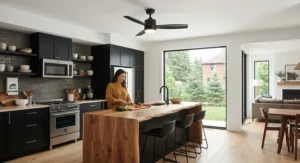
Tight-space installation is where kitchen fans differ most from bedroom fans. You’re working around cabinets, lights and often a range hood duct in the ceiling cavity. Here’s the sequence that avoids headaches.
Before You Buy
- Measure ceiling height and pick a mount. Under 2.5 m, go hugger or low profile (Hunter Dempsey, Westinghouse Petite, Prominence Home Alvina). Over 2.6 m, a short downrod (Minka-Aire Light Wave, Minka-Aire Simple) usually circulates air better.
- Check blade-to-floor clearance. The common safety guideline is at least 2.1 m (7 ft) from floor to blades — and in a kitchen, measure from the top of the island too, because people stand beside it, not on the floor beside it.
- Confirm the ceiling box is fan-rated. A standard light-fixture box isn’t designed to carry a spinning, vibrating load.
Installation Day
- ✅ Kill the breaker, not just the wall switch, and test with a voltage tester.
- ✅ Keep the fan clear of the range hood’s capture zone — a fan blowing across the cooktop can push smoke and grease away from the hood.
- ✅ Use the balancing kit on day one; kitchen wobble gets worse as grease accumulates unevenly.
First 30 Days
- ✅ Run the fan counter-clockwise (viewed from below) in summer for a downdraft; switch to clockwise on low in winter to nudge warm air down from the ceiling.
- ✅ Wipe the blades weekly for the first month to learn how fast your cooking builds film.
- ✅ If it wobbles, tighten blade screws before blaming the motor.
A tight-space installation done right should feel invisible: no rattles, no scraped cabinet doors, and no smoke detours around your hood.
Real-World Scenarios: Matching Kitchens to Fans
Specs are abstract; kitchens aren’t. Here are three realistic profiles and the reasoning behind each match.
Scenario 1: The Vancouver Condo Galley
Profile: 2.1 m × 3.2 m galley (about 6.7 m²), 2.4 m ceiling, electric range, one or two cooks, cooking most nights. Budget: under C$200.
Match: Westinghouse Petite or Hunter Loki. The Petite is the safe choice if upper cabinets sit on both walls, since its 76 cm span leaves generous clearance. If one wall has open shelving instead, the Loki‘s 91 cm span and three mounting modes deliver roughly a third more airflow. Note: condo owners in BC typically need a licensed contractor for the wiring (see the safety section below).
Scenario 2: The Ottawa Bungalow with a Breakfast Nook
Profile: 11 m² kitchen with a small table, 2.4 m ceiling, gas range, family of four, heavy weekend baking.
Budget: C$200-C$300.
Match: Hunter Dempsey. The 20.5 cm profile keeps the fan well above a tall teenager’s head, the remote means nobody climbs on chairs to reach a chain, and 1,600 combined lumens can replace the old flush fixture. Position it over the table, not the gas cooktop, so it doesn’t disturb burner flames or hood capture.
Scenario 3: The Calgary Open-Concept Renovation
Profile: 15 m² kitchen open to a family room, 2.7 m ceiling, induction cooktop, a keen home cook who does lots of boiling and steaming.
Budget: up to C$600.
Match: Minka-Aire Simple. The wet rating handles the steam, the DC motor makes all-day running cheap, and 5,289 CFM can reach across into the adjoining space. If lighting and smart control matter more than steam resistance, the Minka-Aire Light Wave is the design-forward alternative.
Problem → Solution: Fixing Common Small Kitchen Fan Headaches
Problem 1: “The fan makes the kitchen smell like dinner for hours.” Solution: A ceiling fan circulates air; it doesn’t exhaust it. Run the range hood first, and keep the fan on low so it doesn’t fight the hood. The Minka-Aire Simple‘s gentle low speed is ideal for this.
Problem 2: “Grease turns the blades sticky within weeks.” Solution: Choose fewer blades (three-blade Honeywell Ocean Breeze, Minka-Aire Light Wave, Minka-Aire Simple) and wipe weekly with warm water and dish soap. Avoid harsh solvents that can dull finishes.
Problem 3: “It wobbles and clicks.” Solution: Tighten every blade screw, then use the balancing kit. Kitchens build up uneven grease, so recheck balance every few months.
Problem 4: “The light is too dim for chopping.” Solution: Ceiling-fan lights are ambient. Pair a 450-lumen fan like the Honeywell Ocean Breeze with under-cabinet task lighting, or choose the Hunter Dempsey at 1,600 combined lumens.
Problem 5: “My gas burner flames flicker.” Solution: Move the fan away from the cooktop or run it on its lowest setting while cooking. Flame stability and hood capture both suffer in strong crosswinds.
How to Choose a Small Kitchen Ceiling Fan
- Measure the room’s floor area. Floor area drives blade span; a mismatch either wastes power or leaves hot spots.
- Measure ceiling height and cabinet clearance. This decides hugger vs low profile vs downrod — and whether a fan fits at all.
- Check the location rating. Near steam, a damp or wet rating like the Minka-Aire Simple‘s adds years of life.
- Compare CFM per watt, not just CFM. Efficiency tells you what summer-long running actually costs.
- Decide on lighting. If the fan replaces your only ceiling light, aim for 1,000+ lumens.
- Pick your control style. Over an island or counter, a remote beats a pull chain every time.
- Count the blades. Fewer blades means faster cleaning in a greasy kitchen.
Each step narrows the field fast. Most readers will find that steps 2 and 3 alone eliminate half the options — which is exactly the point.
Budget Kitchen Upgrades: Where a Ceiling Fan Fits
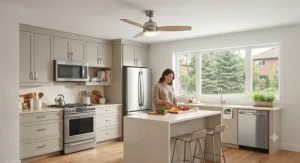
Among budget kitchen upgrades, a ceiling fan punches far above its weight. New cabinets can cost thousands; a quality small kitchen ceiling fan costs roughly C$110-C$560 and changes how the room feels every single day.
Consider the maths on a typical AC fan. The Hunter Dempsey‘s own spec sheet estimates yearly energy cost in the low double digits (in US dollars), and the Minka-Aire Simple draws under 4 W on low. Compare that with a window air conditioner running 500-1,000 W, and a fan becomes the cheapest way to make a hot kitchen tolerable — though, to be fair, it cools people rather than air, so it complements rather than replaces AC during a real heat wave.
Here’s how a fan stacks up against other budget kitchen upgrades:
- ✅ Fan with integrated light: replaces a dated fixture and adds comfort — two upgrades, one ceiling box.
- ✅ Under-cabinet LEDs: pair beautifully with a fan’s ambient light.
- ✅ New cabinet hardware: cosmetic only; no comfort gain.
- ✅ Paint: transformative looks, zero airflow.
The smartest budget kitchen upgrades stack function on function. A fan that also lights the room — like the Hunter Loki or Hunter Dempsey — gives you a visible refresh plus a comfort improvement you’ll feel every summer evening. That’s why I’d rank it near the top of any list of budget kitchen upgrades for 2026.
Small Kitchen Ceiling Fan vs Range Hood vs Portable Fan
These three aren’t really rivals — they do different jobs. But buyers often ask which to prioritize, so here’s the head-to-head.
| Feature | Small Kitchen Ceiling Fan | Range Hood | Portable / Countertop Fan | Best For |
|---|---|---|---|---|
| Removes smoke & odours | No (circulates) | Yes (exhausts or filters) | No | Range hood for air quality |
| Cools the cook | Yes, whole room | Minimal | Yes, one spot | Hunter Dempsey-style ceiling fan for comfort |
| Uses counter/floor space | None | None | Yes | Ceiling fan for tight kitchens |
| Adds light | Often | Task light over stove | No | Ceiling fan for ambient light |
| Install effort | Electrical wiring | Ducting + wiring | Plug in | Portable for renters |
The takeaway is simple: the hood handles air quality, the ceiling fan handles comfort, and a portable fan is a stopgap for renters who can’t wire anything. In a tight kitchen, a ceiling fan wins on space because it uses none of your precious counter. If you can only afford one upgrade and you cook with gas, prioritize a working, ducted hood first — then add the fan.
Features That Actually Matter (And Those That Don’t)
Matters a lot:
- ✅ Location rating. Dry vs damp vs wet determines lifespan in a steamy kitchen.
- ✅ Profile height. A few centimetres decides whether tall family members duck.
- ✅ Blade count. Fewer blades means less degreasing — a real weekly time cost.
- ✅ Control type. Remotes and wall controls beat pull chains over counters.
Matters less than marketing suggests:
- ❌ Maximum CFM alone. A 5,000 CFM fan in a 6 m² galley just blows your mail off the counter. Match CFM to room size.
- ❌ Six-plus speeds. Most people use two: low while cooking, high after.
- ❌ Blade material hype. ABS, MDF and plywood all work indoors; finish and cleanability matter more.
- ❌ “Whisper-quiet” labels. Every brand claims it. Look for DC motors and review data instead.
Smart features sit in the middle. Bond compatibility on the Minka-Aire Light Wave is genuinely useful if your home is already app-controlled — but it’s not worth a C$200 premium if you’ll only ever use the remote.
Long-Term Cost & Maintenance
The purchase price is the smallest cost over a fan’s life. Energy and cleaning time add up.
| Fan | Approx. Price (CAD) | Efficiency | Cleaning Burden | Warranty Highlights | Best For |
|---|---|---|---|---|---|
| Westinghouse Petite | C$120-C$180 | Moderate | High (6 blades) | Lifetime motor | Westinghouse Petite: lowest upfront cost in tiny spaces |
| Hunter Loki | C$140-C$200 | Good | Medium (4 blades) | Limited lifetime motor | Hunter Loki: value all-rounder |
| Hunter Dempsey | C$180-C$280 | Good | Medium (4 blades) | Lifetime motor, 3-yr light | Hunter Dempsey: best value over 10 years |
| Minka-Aire Simple | C$400-C$560 | Excellent (DC) | Low (3 blades) | Register with Minka | Minka-Aire Simple: lowest running cost |
Over a decade of Canadian summers, the efficiency gap between AC and DC fans is real but modest in dollars — the bigger long-term win for the Minka-Aire Simple is its wet rating and three-blade cleaning. For most households, the Hunter Dempsey offers the best blend of upfront price, warranty and running cost.
A simple maintenance schedule:
- ✅ Weekly: wipe blades with a damp microfibre cloth.
- ✅ Monthly: clean the light shade or globe; check for wobble.
- ✅ Twice a year: reverse direction and tighten mounting screws.
- ✅ Yearly: inspect the canopy and wiring connections (breaker off).
Safety, Regulations & Compliance in Canada
Canada takes ceiling fans seriously. Natural Resources Canada sets minimum energy performance standards for ceiling fans and ceiling fan light kits, measured in CFM per watt and varying by fan type and diameter, with the current fan requirements in force since January 21, 2020. Light kits face their own limits on power and efficacy. In practical terms, a fan legally sold in Canada must meet baseline efficiency — but “meets the minimum” and “efficient” aren’t the same thing, which is why comparing CFM per watt still matters.
If efficiency is a priority, check the ENERGY STAR certified ceiling fans list from Natural Resources Canada before buying.
Certification marks: Look for a recognized safety mark such as CSA, cUL or cETL on the product or packaging. Models sold primarily into the US may carry only a US mark, so confirm Canadian certification before you install.
Permits: Rules vary by province. In British Columbia, for example, Technical Safety BC notes that installing or replacing a light fixture or ceiling fan requires a permit, and homeowners in detached homes can pull their own homeowner permit, while strata owners must hire a licensed contractor. Check with your provincial electrical safety authority before a DIY install.
Kitchen-specific safety:
- ✅ Keep blades at least 2.1 m above the floor.
- ✅ Keep strong airflow away from gas burner flames.
- ✅ Use a damp or wet-rated fan near steam.
- ✅ Never mount a fan to a light-only electrical box.
Common Mistakes When Buying a Small Kitchen Ceiling Fan
Mistake 1: Buying for the room, forgetting the cabinets. Floor area says 44 inches; the upper cabinets say 36. Always measure from cabinet faces.
Mistake 2: Ignoring the location rating. A dry-rated fan above a steaming stock pot will age fast. If the fan sits near the cooktop, choose a wet-rated model like the Minka-Aire Simple.
Mistake 3: Treating it as ventilation. A small kitchen ceiling fan moves air around; it doesn’t remove smoke. Buyers who expect it to clear odours end up disappointed.
Mistake 4: Choosing a pull chain over an island. You’ll stop using the fan within a month if you have to lean across a cooktop to change speed.
Mistake 5: Chasing the lowest price. A C$60 no-name fan may skip Canadian certification or rattle within a season. The Prominence Home Alvina and Westinghouse Petite prove you can stay under C$200 and still get a warrantied motor.
Mistake 6: Forgetting light output. Replacing a 1,500-lumen fixture with a 450-lumen fan light makes the kitchen feel dimmer, not better.

FAQ: Small Kitchen Ceiling Fan Questions
❓ What size ceiling fan is best for a small kitchen in Canada?
❓ Can I put a ceiling fan directly over my stove?
❓ Are DC motor ceiling fans worth the extra cost for a kitchen?
❓ Do I need an electrician to install a kitchen ceiling fan in Canada?
❓ Where can I buy a small kitchen ceiling fan with a remote in Canada?
Conclusion: The Right Breeze for Your Kitchen
A small kitchen ceiling fan is one of those upgrades you stop noticing within a week — because the kitchen simply stops feeling like a sauna. The trick is matching the fan to the room’s real constraints: floor area, ceiling height, cabinet clearance and how much steam your cooking throws around.
If you’re squeezed into a galley, the Westinghouse Petite or Honeywell Ocean Breeze will fit where nothing else does. The Hunter Loki is the flexible middle ground, and the Prominence Home Alvina brings classic charm without breaking the bank. For most Canadian households with 2.4 m ceilings, the Hunter Dempsey is the standout all-rounder — slim, bright and remote-controlled. And if design or serious cooking is your priority, the Minka-Aire Light Wave and Minka-Aire Simple justify their premium in style and efficiency respectively.
Measure twice, respect the compact blade spans your cabinets allow, plan your tight-space installation around the hood, and you’ll land one of the most satisfying budget kitchen upgrades of 2026.
✨ Don’t Miss These Exclusive Picks! 🔍
Take your kitchen comfort to the next level with these carefully selected fans. Click on any highlighted product to check current pricing and availability — and enjoy cooler, brighter dinners your family will love! 🍽️💨
Recommended for You
- 7 Best Dining Room Ceiling Fans With Remote (2026 Picks)
- Ceiling Fan For Dining Room With High Ceilings: 7 Best Picks (2026)
- Chandelier Ceiling Fan For Dining Room: 7 Best Picks (2026)
Disclaimer: This article contains affiliate links. As an Amazon Associate, I earn from qualifying purchases. If you purchase products through these links, we may earn a small commission at no additional cost to you.
✨ Found this helpful? Share it with your friends! 💬🤗
