
In This Article
Somewhere between the May long weekend and Labour Day, the patio becomes the most contested square footage in the house — right up until the air goes still and everyone retreats indoors to the air conditioning. That single problem, more than bugs or bad lighting, is usually what sends people searching for the best outdoor ceiling fan they can find. A humid July evening with zero air movement can turn a gorgeous covered deck into a place nobody wants to linger, no matter how nice the furniture is.
So what is an outdoor ceiling fan, exactly? It’s a ceiling-mounted fan engineered with sealed motors, weatherproof blades, and corrosion-resistant hardware so it can survive humidity, temperature swings, and (in wet-rated models) direct rain without the internal components rusting or shorting out — something a standard indoor fan simply isn’t built to handle.
That distinction matters more in Canada than almost anywhere else. Our summers swing from bone-dry heat waves to thunderstorm humidity within the same week, and our winters put fans through freeze-thaw cycles that would finish off a cheap indoor unit within a season. One CBC Life feature on backyard renovations put it well: Canadian summers are short enough that getting outdoor spaces genuinely comfortable, not just decorative, is worth the investment.
This guide breaks down seven real, currently available outdoor ceiling fans — budget, mid-range, and premium — based on published specifications and aggregated owner feedback, not guesswork. You’ll find price ranges in Canadian dollars (never exact figures, since Amazon pricing shifts constantly), a full comparison table, and practical sections on installation, common mistakes, and how an outdoor ceiling fan with light fits into a broader backyard upgrade. No invented reviews, no fabricated hands-on testing — just honest analysis you can actually use.
Quick Comparison: 7 Best Outdoor Ceiling Fans at a Glance
| Fan | Rating | Blade Span | Light Kit | Best For |
|---|---|---|---|---|
| Honeywell Belmar (No Light) | Wet Rated | 52 in (132 cm) | No | Tightest budget |
| Hunter Cassius | Wet Rated | 52 in (132 cm) | No | Minimalist covered patios |
| Honeywell Belmar (With Light) | Damp Rated | 52 in (132 cm) | Yes, LED | Covered porches needing light |
| Prominence Home Teo | Wet Rated | 56 in (142 cm) | Yes, LED | Budget with lighting |
| Westinghouse Oasis | Wet Rated | 48 in (122 cm) | Yes, LED | Tropical-style decor |
| Hunter Builder Elite | Damp/Wet Rated | 52 in (132 cm) | No | Energy Star buyers |
| Minka-Aire Concept III | Wet Rated | 54 in (137 cm) | Yes, LED, Smart | Premium open pergolas |
Looking at the spread above, the pattern is pretty clear: light kits and smart features push prices up fast, while the no-light, wet-rated basics like the Honeywell Belmar and Hunter Cassius stay affordable without sacrificing weatherproofing. If your covered patio already has good lighting, skipping the light kit is one of the easiest ways to trim cost without touching performance. The Minka-Aire Concept III sits in its own category entirely — DC motor efficiency and smart-home control cost real money, but they’re aimed at buyers who want an open, uncovered structure like a pergola to look as intentional as an indoor room.
💬 Just one click — help others make better buying decisions too!😊
Top 7 Best Outdoor Ceiling Fans: Expert Analysis
1. Honeywell Belmar 52-Inch (No Light) — cheapest true wet rating in this lineup
The Honeywell Belmar without a light kit is the fan most people should start with if budget is the deciding factor. It’s ETL wet-rated, meaning it’s certified for direct rain exposure, not just humidity — a meaningful distinction for anyone shopping for an open porch or gazebo rather than a fully covered patio.
The five-blade design and reversible motor mean the same fan doubles as a winter air-circulator, gently redistributing warm air near a patio heater instead of just moving summer breeze. Honeywell rates it for spaces up to roughly 400 sq. ft. (37 m²), which covers most standard Canadian deck footprints. Based on the spec sheet, the tri-mount bracket system (standard, close-mount, or angled) is worth noting: it lets the same fan work on a vaulted cottage-porch ceiling or a flat suburban deck without buying different hardware.
This is squarely a budget-conscious homeowner’s pick — someone who wants proven weatherproofing without paying for lighting or smart features they’ll never use. Owner feedback across major retail listings for the Belmar line consistently points to straightforward installation (most reviewers cite well under an hour) and a pull chain that feels sturdy rather than flimsy, with occasional notes that the motor hums faintly at top speed — worth knowing if your patio doubles as a reading nook.
Pros:
- ✅ True ETL wet rating for uncovered spaces
- ✅ Reversible motor for winter air circulation
- ✅ Tri-mount bracket fits multiple ceiling types
Cons:
- ❌ No light kit option on this specific model
- ❌ Pull-chain only, no included remote
Priced around C$150-C$190 at the time of research, this is one of the better value-per-dollar wet-rated fans on Amazon.ca — check current price, as it fluctuates with seasonal demand.
2. Hunter Cassius 52-Inch — best-known brand at a fair price
Hunter is arguably the most recognized ceiling fan name in North America, and the Cassius is the brand’s answer to buyers who want that reputation without paying premium-tier prices. It’s wet-rated, comes in a low-profile mount for tighter ceiling clearance, and ships with three reversible blades rather than the more common five — a design choice that reduces wobble risk on windy patios since there’s simply less blade surface to catch a gust.
The 13-degree blade pitch is a spec worth translating: a steeper pitch generally means more air moved per rotation, which is why Hunter markets this line for “unparalleled power” relative to its size class. What most buyers overlook here is the three-position mounting system — standard, angled, or low ceiling — which means this single SKU covers cottage porches with sloped roofs just as easily as a flat deck overhang.
Hunter doesn’t publish exact CFM figures for the Cassius, so rather than invent a number, it’s fairer to say its 3-speed direct-drive motor puts it in line with most mid-tier 52-inch outdoor fans — plenty for a 300 sq. ft. (28 m²) covered patio, not quite enough to feel dramatic in a fully open, breezy backyard. Reviewers across retail platforms frequently cite the fan’s quiet operation and matte-black finish holding up well against sun fading, which matters more than people expect in a Prairie summer.
Pros:
- ✅ Trusted brand name with strong parts availability
- ✅ Three-blade design reduces wind wobble
- ✅ Low-profile and angled mount options included
Cons:
- ❌ No CFM airflow figure published by Hunter
- ❌ No light kit compatibility listed
Expect a price in the C$180-C$220 range at the time of research — a fair premium for the brand name and mounting flexibility.
3. Honeywell Belmar 52-Inch (With Light) — the all-rounder for covered porches
This is the lit version of the Belmar above, and the difference goes beyond aesthetics. Where the no-light Belmar is wet-rated, this LED-equipped version is ETL damp-rated instead — a trade-off worth understanding before you buy. Damp-rated means it’s built for humidity and splash exposure but not direct, sustained rainfall, so it belongs under a solid roof, not an open pergola.
Reported airflow for this model lands around 5,070 CFM, which translates in practical terms to a noticeable, steady breeze across a full 280 sq. ft. (26 m²) patio — enough to make a July evening dinner outside genuinely pleasant rather than merely tolerable. The five blades ship in a dual finish (ebony on one side, silver oak on the other), so you effectively get two design options in one purchase depending on which side faces down.
Here’s what the spec sheet won’t tell you, but multiple owner write-ups note: installation runs close to two hours rather than the “45-60 minutes” quoted in Honeywell’s own guide, mostly because wiring in the LED driver takes longer than a simple pull-chain fan. Budget the extra time, or better, budget for an electrician if your patio doesn’t already have a fan-rated junction box.
Pros:
- ✅ Dual-finish blades give two looks in one fan
- ✅ Strong 5,070 CFM airflow for its size class
- ✅ Dimmable LED integrated, no separate bulb kit needed
Cons:
- ❌ Damp-rated only — not for open, uncovered structures
- ❌ Installation runs longer than the quoted estimate
Look for this model in the C$190-C$230 range at the time of research — reasonable for an integrated LED fixture with this airflow output.
4. Prominence Home Teo 56-Inch — largest span for the money
The Prominence Home Teo is the outlier in blade span here — at 56 inches (142 cm), it’s the biggest fan in this roundup, and that extra reach matters more than people assume. A larger blade span moves more air per rotation at the same RPM, which is Prominence’s whole pitch for buyers with larger, fully uncovered patios who don’t want to run the motor at a punishing top speed just to feel a breeze.
It’s genuinely wet-rated (not just damp), with three weather-resistant blades and a reversible airflow switch for year-round use. Prominence Home built its reputation on undercutting premium brands on price while matching core specs, and the Teo is a clean example: wet rating, LED light, reversible motor, dual mounting options, all in one SKU that typically retails well under comparable Hunter or Minka-Aire fans.
Based on the spec comparison with the rest of this list, the trade-off is brand depth — Prominence Home doesn’t have the decades-long service network that Hunter or Westinghouse do, so replacement parts and long-term support are less certain if something fails outside warranty. For a first outdoor fan on a budget, that’s a reasonable risk to accept; for a cottage you visit twice a year and can’t easily service, it’s worth weighing more carefully.
Pros:
- ✅ Largest blade span in this lineup at 56 inches
- ✅ True wet rating, not just damp
- ✅ LED light and reversible motor included
Cons:
- ❌ Smaller brand with thinner long-term parts support
- ❌ Weight of larger blades can amplify wobble if unbalanced
Priced around C$170-C$210 at the time of research, it’s one of the better value picks if square footage is your main constraint.
5. Westinghouse Oasis 48-Inch — the tropical statement piece
If the rest of this list feels a little utilitarian, the Westinghouse Oasis is where personality shows up. Its mahogany-finish, leaf-shaped ABS blades and yellow alabaster glass lantern light kit lean hard into a tropical aesthetic — this is a fan chosen as much for how it looks as how it performs, and that’s a legitimate reason to buy an outdoor fixture.
It’s wet-rated despite the more decorative blade design, which is worth calling out: ornate blades don’t always mean reduced weatherproofing, and Westinghouse has built a long track record specifically in outdoor-rated lighting and fans. The 48-inch span is smaller than most fans on this list, sized for spaces up to roughly 225 sq. ft. (21 m²) — a covered gazebo or mid-size deck rather than a sprawling backyard pavilion.
What most buyers overlook about tropical-style fans generally is that the leaf-shaped blades, while visually distinctive, tend to move slightly less air than straight-bladed designs of the same span, simply due to blade surface geometry. That’s not a flaw so much as a design trade-off — you’re buying ambiance alongside airflow, and the included LED lantern light does double duty as both illumination and decor after dark.
Pros:
- ✅ Distinctive tropical design with weatherproof leaf blades
- ✅ Genuinely wet-rated despite decorative styling
- ✅ Lantern-style LED light doubles as ambiance lighting
Cons:
- ❌ Smaller coverage area than most fans on this list
- ❌ Leaf-blade geometry trades some raw airflow for looks
Expect a price around C$210-C$250 at the time of research — a fair ask for a design-forward, genuinely weatherproof fixture.
6. Hunter Builder Elite 52-Inch — the Energy Star efficiency pick
The Hunter Builder Elite targets a specific buyer: someone who cares about long-term electricity costs as much as upfront price. It’s Energy Star certified, which under Natural Resources Canada’s efficiency guidelines generally means meaningfully lower power draw than a non-certified fan of comparable size, without sacrificing airflow performance.
Five reversible blades and a low-profile mount make this a practical choice for lower ceiling heights common in bungalow-style Canadian homes, where a standard downrod mount can bring the blades uncomfortably close to head height. The pull-chain-only control keeps the price down relative to remote-equipped competitors, which fits Hunter’s positioning of the Builder Elite as a reliable workhorse rather than a showpiece.
Reviewers consistently note that this model runs noticeably quieter than entry-level fans in the same price bracket — a reasonable outcome given Hunter’s investment in motor engineering across its lineup, even at the more affordable end. For anyone weighing the long-term cost and maintenance of an outdoor fan, an Energy Star badge is a legitimate factor: over a decade of seasonal use, the wattage savings genuinely add up, even if the per-month difference feels trivial in isolation.
Pros:
- ✅ Energy Star certified for lower long-term power draw
- ✅ Low-profile mount suits lower ceiling heights
- ✅ Reputation for quieter operation than same-tier rivals
Cons:
- ❌ No light kit or remote control included
- ❌ Fewer finish options than the Cassius or Belmar lines
Look for this fan around C$160-C$200 at the time of research — a smart pick if efficiency matters more to you than features.
7. Minka-Aire Concept III 54-Inch Smart Fan — the premium open-pergola choice
The Minka-Aire Concept III is where this list stops being about basic weatherproofing and starts being about genuine engineering. It runs on a DC motor rather than the AC motors used by every other fan here — a distinction that matters because DC motors typically deliver comparable or better airflow control at meaningfully lower energy draw, with six speed settings instead of the usual three.
It’s wet-rated, includes an integrated 30-watt dimmable LED light, and connects to Minka-Aire’s Bond Home app for smartphone control — genuinely useful for a fan mounted on an open pergola where a wall switch might be a longer walk than you’d like. The three-blade, 14-degree pitch design is built for airflow efficiency over raw blade count, which is a common pattern in premium DC fans: fewer, more aerodynamically shaped blades often outperform a busier five-blade design.
Based on the spec comparison across this entire list, the Concept III is the only fan here genuinely built for a fully exposed pergola or gazebo where design matters as much as function. That positioning explains the price jump — you’re paying for DC motor efficiency, smart integration, and a design pedigree that Minka-Aire has built specifically around outdoor “Concept” series fans for years. It’s not the right choice for a basic covered deck; it’s the right choice for a backyard that’s meant to look intentional.
Pros:
- ✅ DC motor with six speeds for finer airflow control
- ✅ Smart home app integration via Bond Home
- ✅ Integrated dimmable LED, no separate light kit needed
Cons:
- ❌ Significant price premium over AC alternatives
- ❌ Smart features require app setup most buyers skip
Priced around C$480-C$560 at the time of research, this is a considered investment rather than an impulse buy — check current price before committing.
Top 7 Outdoor Ceiling Fans: Full Spec Comparison
| Fan | Motor | Rating | Light | Price Range (CAD) | Best For |
|---|---|---|---|---|---|
| Honeywell Belmar (No Light) | AC, 3-speed | Wet | No | C$150-C$190 | Tightest budgets |
| Hunter Cassius | AC, 3-speed | Wet | No | C$180-C$220 | Brand reliability |
| Honeywell Belmar (With Light) | AC, 3-speed | Damp | LED | C$190-C$230 | Covered porches |
| Prominence Home Teo | AC, 3-speed | Wet | LED | C$170-C$210 | Large open spaces |
| Westinghouse Oasis | AC, 3-speed | Wet | LED lantern | C$210-C$250 | Tropical decor |
| Hunter Builder Elite | AC, 3-speed | Damp/Wet | No | C$160-C$200 | Energy efficiency |
| Minka-Aire Concept III | DC, 6-speed | Wet | LED, dimmable | C$480-C$560 | Smart pergolas |
The clearest takeaway from this table is that motor type, not blade count, is the biggest price driver: every AC fan here clusters between roughly C$150 and C$250, while the single DC model more than doubles that. If you’re outfitting a covered patio on a budget, the Honeywell Belmar or Hunter Builder Elite deliver the core function — weatherproofing and airflow — without paying for features you may not use. Buyers with an open pergola or a genuinely premium backyard build, on the other hand, will find the Minka-Aire Concept III‘s efficiency and control justify its price over a decade of ownership.
Setting Up and Maintaining Your Outdoor Ceiling Fan
Getting an outdoor ceiling fan installed correctly matters more than most first-time buyers expect, and getting it wrong is how a C$200 fan turns into a wobbling, buzzing nuisance within a season.
Start with the electrical box: any outdoor ceiling fan needs a fan-rated outdoor junction box, not a standard light fixture box, because fans generate more torque and vibration over time. If your patio ceiling doesn’t already have one, budget for an electrician rather than attempting a workaround — this is a genuine safety requirement under the Canadian Electrical Code, not just a manufacturer suggestion.
During the first 30 days, run the fan through all its speeds at least once to check for wobble, then tighten the blade brackets if you notice any — new hardware often settles slightly after the first week of use. Most manufacturer manuals recommend a balance kit (usually included) if wobble persists past minor tightening.
For ongoing maintenance, wipe blades down every few weeks during peak season to prevent dust and pollen buildup, which throws off balance over time and adds unnecessary strain to the motor. Before winter, if your fan isn’t rated for snow-load exposure specifically, consider a light cover or seasonal removal for anything mounted in a fully open structure. A quick optimization trick worth knowing: running the fan in reverse (clockwise) during cooler months gently pulls warm air down from the ceiling area, which is especially useful if you’ve added a patio heater to extend your outdoor season.
Real Canadian Backyards: Which Fan Fits Your Space
Picture three different homeowners, each shopping for the same general category of product but landing on very different answers.
The first is a young couple in a Calgary townhouse with a small, fully covered balcony — maybe 120 sq. ft. Budget matters, the ceiling is standard height, and they just want relief from July heat without redoing any wiring. For them, the Honeywell Belmar (No Light) or Hunter Builder Elite covers the need completely; anything bigger would be overkill for the space.
The second is a family outside Halifax with a large, partly open cedar pergola attached to their deck — exposed to salt air and the occasional coastal storm. Wet rating isn’t optional here, and coverage area matters more than design flourishes. The Prominence Home Teo, with its 56-inch span and genuine wet certification, fits the brief, and its lower price relative to Hunter or Minka-Aire leaves room in the budget for the outdoor furniture that actually gets used underneath it.
The third is a retired couple in the Okanagan who’ve spent the last two summers building out a genuinely premium backyard — outdoor kitchen, sectional seating, the works — under an open-air structure they had custom-built. For them, the Minka-Aire Concept III‘s smart control and DC efficiency make sense as part of a considered, long-term investment rather than a quick fix, matching the tier of everything else they’ve already put into the space.
✨ Don’t Miss These Exclusive Deals!
🔍 Take your outdoor living space to the next level with these carefully selected outdoor ceiling fans. Click on any highlighted product to check current pricing and availability. These picks will help you build the comfortable, breeze-filled backyard your family will actually want to spend summer in!
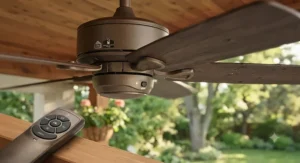
How to Choose the Best Outdoor Ceiling Fan
Picking the right fan comes down to a handful of decisions, in roughly this order of importance:
- Confirm damp vs. wet rating first. If any part of the ceiling is open to the sky, wet-rated is non-negotiable — damp-rated fans installed in exposed locations tend to fail within one or two seasons.
- Measure your space before shopping. A fan under 4,000 CFM suits small covered porches; medium patios need 4,000-6,000 CFM; larger or fully open spaces perform better above 6,000 CFM.
- Match blade span to ceiling height and room size. A 42-44 inch fan suits tight balconies; 52-56 inches fits most standard patios; anything larger belongs in genuinely large, open structures.
- Decide on lighting early. An outdoor ceiling fan with light saves you installing a separate fixture, but damp-rated light kits belong under real roof coverage, not open pergolas.
- Pick AC or DC motor based on priorities. AC motors cost less upfront; DC motors cost more but run quieter and more efficiently over the fan’s lifespan.
- Check control style against your setup. Pull chains are reliable and cheap; remotes and smart app control cost more but matter if the fan is mounted somewhere hard to reach.
- Factor in brand support before finalizing. Established names like Hunter and Westinghouse generally offer better long-term parts availability than newer budget brands — worth weighing if you’re buying for a cottage you can’t easily service.
Outdoor Ceiling Fan vs Standing Patio Fans and Misting Systems
It’s worth stepping back and asking whether a ceiling fan is even the right category of product, because it isn’t always.
Standing or pedestal patio fans cost less upfront and require zero electrical work — plug them in and go. Their obvious downside is floor space: on a smaller patio, a standing fan competes with furniture and foot traffic in a way a ceiling-mounted unit never does. They’re also generally louder at comparable airflow, since the motor sits at ear height rather than overhead.
Misting systems solve a different problem entirely — they lower ambient temperature through evaporation rather than moving air, which works better in genuinely dry heat than in Canada’s more humid summer stretches, where added moisture in the air can feel counterproductive. They also require a water line connection, ongoing nozzle maintenance, and don’t do anything useful once the temperature drops.
An outdoor ceiling fan with light effectively bundles airflow, ambiance, and functional lighting into one fixed installation, with none of the floor-space trade-off of a standing fan and none of the plumbing complexity of a misting system. The catch is the upfront electrical work — if your patio ceiling doesn’t already have wiring in place, that installation cost needs to be weighed honestly against a plug-in standing fan you could have running within the hour.
| Option | Upfront Cost | Airflow Quality | Best For |
|---|---|---|---|
| Outdoor Ceiling Fan | Moderate-high (plus install) | Even, whole-space | Permanent covered/open structures |
| Standing Patio Fan | Low | Directional, floor-level | Renters, temporary setups |
| Misting System | Moderate | Cooling via evaporation | Very dry, hot climates |
The ceiling fan category wins decisively for anyone with a permanent covered patio and existing (or plannable) wiring; the standing fan wins for renters or anyone who wants zero installation commitment; the misting system only really makes sense in dry-heat regions, which describes very little of Canada outside parts of the interior BC valleys.
Common Mistakes When Buying an Outdoor Ceiling Fan
The single most common mistake is buying a damp-rated fan for a location that’s actually exposed to direct rain — it’s an easy error because “outdoor” gets used loosely in product titles even when the rating underneath is only damp, not wet. Always check the actual certification, not just the marketing language.
A close second is underestimating blade span for the space. A 42-inch fan in a 300 sq. ft. patio will run constantly at high speed just to feel adequate, which shortens motor lifespan and defeats the point of buying a quiet fixture in the first place. When in doubt, size up rather than down.
Buyers also frequently skip checking ceiling height compatibility before ordering, only to discover the standard downrod puts the blades at an uncomfortable height for anyone over six feet tall. Low-profile or flush-mount options exist specifically for this — check them before assuming a standard mount will work.
Finally, plenty of people install an outdoor ceiling fan without confirming the junction box is fan-rated, not just a standard light box. This is a genuine safety issue, not a minor technicality — fan-rated boxes are built to handle the torque and vibration a rotating fixture creates, and skipping this step risks the fixture working loose over time.
Outdoor Ceiling Fan Safety and Canadian Electrical Code Basics
Electrical safety around outdoor fixtures isn’t optional in Canada, and it’s worth understanding the basics before you buy, not after.
Under the Canadian Electrical Code, any outdoor ceiling fan needs to be paired with a fan-rated electrical box, and outdoor circuits generally require ground-fault circuit interrupter (GFCI) protection. The CSA Group, Canada’s primary standards and testing body for electrical products, is the organization behind the certification marks you’ll see on legitimately rated outdoor fixtures — always confirm a fan carries a recognized certification mark (CSA, ETL, or UL) rather than taking “outdoor” branding at face value.
Damp-rated versus wet-rated matters here in a genuinely practical sense, not just a technical one: a damp-rated fan installed on an open pergola isn’t just against manufacturer recommendations, it’s a real corrosion and short-circuit risk over time as moisture works into components that weren’t sealed for it. Wet-rated fans use sealed motor housings and rust-resistant hardware specifically to handle that exposure.
If your patio doesn’t already have appropriate wiring in place, hire a licensed electrician rather than attempting a DIY circuit addition — permit and inspection requirements vary by province and municipality, and getting this step wrong risks both safety and any home insurance coverage tied to proper electrical work.
Long-Term Cost and Maintenance: What Ownership Really Costs
The sticker price of an outdoor ceiling fan is only part of the real cost of ownership, and it’s worth running the numbers before assuming the cheapest option is actually the best value.
An AC motor fan running at roughly 60-75 watts on high speed, used for maybe four hours a day across a five-month Canadian outdoor season, adds up to a modest but real amount on your electricity bill each year — figures that compound if you’re running it daily through a hot stretch. A DC motor fan like the Minka-Aire Concept III, by contrast, typically draws meaningfully less power at comparable airflow, which is part of why premium DC fans justify a portion of their higher upfront price over several years of ownership.
| Cost Factor | Budget AC Fan | Premium DC Fan |
|---|---|---|
| Upfront Price (CAD) | C$150-C$220 | C$450-C$600 |
| Typical Wattage (High) | 60-75W | 30-45W |
| Expected Lifespan | 5-8 years | 8-12+ years |
| Replacement Parts | Widely available | Brand-specific, pricier |
The table above makes the trade-off explicit: a budget AC fan wins on upfront cost every time, but a well-built DC fan tends to pay some of that difference back through lower power draw and a longer expected service life. For most Canadian homeowners with a standard covered patio, the AC option remains the more sensible choice; for anyone building a genuinely long-term outdoor living space, the DC premium starts to look more like an investment than an indulgence.
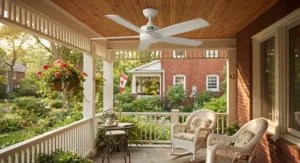
Patio Furniture Accessories That Pair Well With an Outdoor Ceiling Fan
A ceiling fan solves airflow, but it’s rarely the only upgrade a patio needs to feel finished. Weighted outdoor throw pillows and UV-resistant cushions hold up better under a fan running on high than lightweight fabric alternatives, which can shift or flap noticeably in direct airflow. An outdoor rug helps anchor the seating area visually and physically, especially useful under a fan since it reduces the sense of “empty space” that a strong breeze can otherwise create.
For lighting to complement an outdoor ceiling fan without a built-in light kit, low-voltage string lights or solar-powered lanterns add ambiance without adding electrical load to the same circuit. Canadian Tire’s patio accessories selection covers a wide enough range of weather-resistant cushions and decor pieces that most homeowners can round out a patio refresh in a single trip, particularly for cushions rated to handle Canadian humidity swings.
One practical note: avoid loose paper decor, delicate string-light bulbs, or anything easily dislodged directly beneath a fan running on high speed — it’s a small detail people overlook until the first gust sends something flying across the yard mid-dinner party.
Backyard Upgrades: Where an Outdoor Ceiling Fan Fits the Priority List
Backyard renovation budgets rarely cover everything at once, so it’s worth understanding where an outdoor ceiling fan ranks against other common backyard upgrades in terms of cost-to-comfort ratio.
Compared to a full outdoor kitchen build or a permanent pergola structure — both of which can run into the tens of thousands of dollars — an outdoor ceiling fan delivers a disproportionately large comfort improvement for a few hundred dollars plus installation. It’s often the single highest-impact upgrade available for homeowners who already have a covered structure but haven’t addressed airflow.
For homeowners planning upgrades in sequence, a reasonable order looks like: confirm and upgrade outdoor electrical capacity first (since almost every other upgrade depends on it), add the ceiling fan and lighting next, then layer in furniture and larger structural additions like a pergola or outdoor kitchen once the space is actually comfortable to use. Building comfort before building spectacle tends to produce a backyard people actually use daily, rather than one that looks impressive in photos but sits empty on humid evenings.
Four-Season Outdoor Living: Using Your Fan Beyond Summer
The reversible motor found on every fan in this list isn’t a throwaway feature — it’s what turns a summer-only purchase into a genuinely four-season fixture, and it’s worth understanding how to actually use it.
In warmer months, blades should spin counter-clockwise (the default on most fans) to push air straight down, creating the cooling breeze most people buy the fan for in the first place. Once temperatures drop, switching to clockwise rotation at low speed pulls cooler air upward and gently redistributes warm air that naturally rises toward the ceiling — genuinely useful if you’ve paired the patio with an outdoor heater or fireplace to extend the season into fall.
This pattern aligns with a broader shift in how Canadians are treating outdoor spaces. As one recent Canadian Home Trends piece on backyard design notes, backyards increasingly function as year-round extensions of the home rather than seasonal afterthoughts, with fire features and covered structures specifically built to push usable outdoor time well past the traditional summer window. A wet-rated fan with reversible airflow fits neatly into that shift — it’s a fixture that earns its keep across ten months of the year instead of three.
Frequently Asked Questions
❓ What's the difference between a damp-rated and wet-rated outdoor ceiling fan?
❓ Can I install an outdoor ceiling fan myself?
❓ What size outdoor ceiling fan do I need for my patio?
❓ Do outdoor ceiling fans work in Canadian winters?
❓ Is a DC motor outdoor ceiling fan worth the extra cost?
Conclusion
The best outdoor ceiling fan for your backyard depends less on brand prestige and more on three honest questions: how exposed is your space to direct weather, how large is the area you’re trying to cool, and how much are you willing to spend upfront versus over the fan’s lifespan. Budget-focused buyers with a covered patio do well with the Honeywell Belmar or Hunter Builder Elite. Anyone with a larger or more exposed structure should lean toward genuinely wet-rated options like the Prominence Home Teo or Hunter Cassius. And homeowners investing in a premium, fully open backyard build will get real long-term value from something like the Minka-Aire Concept III, DC efficiency and smart control included.
Whichever direction you go, confirm the weather rating matches your actual structure before anything else — it’s the one spec on this entire list that genuinely can’t be compromised on. Get that right, and the rest comes down to matching size, style, and budget to the backyard you’re actually trying to build.
Recommended for You
- Ceiling Fan Without Light Kit: 7 Top Picks for Canada (2026)
- 7 Best Minimalist Ceiling Fan Picks for Canadian Homes in 2026
- Ceiling Fan Chandelier Light: 7 Best Picks for 2026 (Canada)
Disclaimer: This article contains affiliate links. As an Amazon Associate, I earn from qualifying purchases. If you purchase products through these links, we may earn a small commission at no additional cost to you.
✨ Found this helpful? Share it with your friends! 💬🤗
