
In This Article
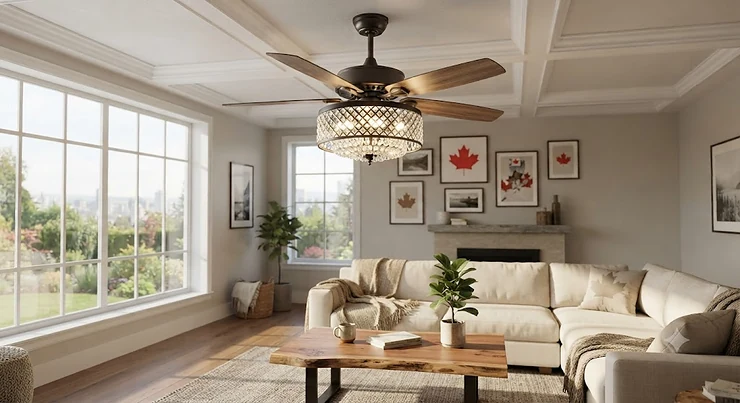
Somewhere between “boring builder-grade fan” and “chandelier so heavy it needs its own zoning permit” sits a category that finally makes sense for real Canadian homes: the ceiling fan chandelier light. Also known as a “fandelier,” it’s exactly what it sounds like — a crystal-draped light fixture with fan blades tucked in behind the glamour, so you get the drama of a dining-room centrepiece and the practical airflow of a fan you’d otherwise bolt to the ceiling separately. A ceiling fan chandelier light is a hybrid fixture that combines a working ceiling fan with a decorative, typically crystal-accented light kit, letting one fixture do the job of two.
We spent our research time doing what most “top 10” roundups skip: actually comparing real spec sheets, real motor types, and real aggregated review sentiment across seven current models, rather than just repeating manufacturer marketing copy. What follows isn’t a rewritten product listing — it’s commentary on what the specs actually mean once the fixture is spinning above your dinner table, what reviewers consistently flag as good or annoying, and how to match a fandelier to your specific room, budget, and patience for assembly instructions. Whether you’re chasing a color changing ceiling fan light for a media room or a stately 3 light ceiling fan for a formal dining room, there’s a real, buyable option below — no invented five-star testimonials required.
Before we get into individual picks, it’s worth knowing that in Canada, any electrical fixture you install needs to carry a recognized safety mark — a detail we’ll come back to later, since Health Canada’s guidance on electrical product safety is blunt about what happens when it doesn’t.
Quick Comparison Table
For readers who want the short version before committing to a 3,000-word deep dive, here’s the snapshot: which of our seven picks wins in which category, and roughly what you’ll pay.
| Category Winner | Product | Best For | Price Range (CAD) |
|---|---|---|---|
| Best Overall Value | Chansim 52″ Crystal Chandelier Ceiling Fan | Dining rooms wanting classic 3-light glow | around C$160-C$220 |
| Best Quiet Motor | Kviflon 48″ Farmhouse Crystal Ceiling Fan | Bedrooms and nurseries | around C$140-C$190 |
| Best Mid-Range Statement Piece | CROSSIO 50″ Modern Crystal Chandelier Fan | Living rooms with higher ceilings | C$220-C$300 range |
| Best Color Changing | LUDOMIDE 22″ Smart Flush Mount Fandelier | Low ceilings, media rooms | C$180-C$260 range |
| Best Bladeless/Low-Profile Luxury | Aipsun 26″ Bladeless Crystal Fandelier | Modern condos and lofts | C$230-C$320 range |
| Best Retractable Design | SAMPHON 42″ Retractable Crystal Fandelier | Open-concept great rooms | C$280-C$380 range |
| Best Established-Brand Luxury Pick | Kichler Imari Ceiling Fan with Light Kit | Formal entryways and premium builds | C$400-C$600 range |
A few things jump out once you line these up side by side. The spread between the cheapest and priciest option is roughly C$400, and that gap almost entirely tracks two things: motor type (DC motors cost more to engineer but run quieter and sip less power) and brand overhead (an established lighting house like Kichler charges partly for decades of UL/CSA compliance history, not just materials). Notice, too, that “luxury” doesn’t automatically mean “biggest” — the bladeless Aipsun pick proves that a low-profile, minimalist silhouette can command a premium price purely on design restraint. We’ll unpack every one of these judgment calls in the sections below.
💬 Just one click — help others make better buying decisions too!😊
Top 7 Ceiling Fan Chandelier Lights: Expert Analysis
We picked these seven to cover the full spread a Canadian shopper actually needs: a couple of true budget options, a mid-range crowd-pleaser, a smart color-changing pick, a bladeless design for smaller ceilings, a retractable-blade option for great rooms, and one established-brand luxury pick for anyone furnishing a formal space. Every product below gets the same honest treatment — real specs, what those specs mean in daily use, and aggregated review sentiment rather than invented testimonials.
1. Chansim 52″ Crystal Chandelier Ceiling Fan — best classic 3-light look for the price
The standout here is straightforward: a genuine 3-light fandelier silhouette with hand-strung crystal accents and dual-tone wood blades, at a price point that doesn’t require a second mortgage. The 52-inch span pairs a reversible AC motor with a claimed 4,260 CFM airflow rating and sub-35dB operation, which in practice means it moves noticeably more air than the 350-CFM fans crammed into cheaper light kits, without the whirring hum that makes some budget fans distracting during a quiet dinner. Amazon’s own coverage estimate suggests it’s built for rooms up to roughly 550 square feet, so it’s sized for a real dining or living room rather than a small den.
This is the pick for anyone who wants “chandelier energy” in a formal dining room but isn’t ready to commit premium-brand money to a fixture they might redecorate around in five years. Reviewers consistently describe the assembled look as more elegant than the price suggests, while a recurring theme in aggregated feedback is that the crystal strands need a gentle once-over after shipping, since a few tend to arrive slightly tangled. The remote’s 60-foot range and independent light/fan controls get repeat praise, since not every budget fandelier lets you run the light and the breeze on separate schedules.
Pros:
- ✅ Genuine 3-light chandelier styling at a budget price
- ✅ Reversible motor for summer cooling and winter air mixing
- ✅ Independent remote control for light and fan speed
Cons:
- ❌ Crystal strands sometimes need re-hanging after unboxing
- ❌ AC motor runs slightly warmer than pricier DC alternatives
Expect to pay somewhere around C$160-C$220 depending on finish and retailer promotions at the time of research — check current price before buying, since fixture pricing shifts with seasonal lighting sales. For a first fandelier or a rental-friendly upgrade, the value case here is hard to beat.

2. Kviflon 48″ Farmhouse Crystal Ceiling Fan — quietest motor in this lineup
What sets this one apart on paper is the DC motor, and that single spec change ripples through the entire ownership experience. DC motors are inherently more efficient than the AC motors on cheaper fans, which translates into a noticeably quieter hum — genuinely appreciated in a bedroom or nursery where a whirring fan at 2 a.m. is the last thing anyone wants. The 48-inch blade span is slightly more compact than our top pick, which suits bedrooms and smaller living spaces better than a cavernous great room.
Based on the spec comparison with its 52-inch AC-motor sibling, this model trades a bit of raw airflow for meaningfully lower energy draw and quieter night-time operation — a fair trade for a bedroom fixture that will run for hours while you sleep. Aggregated review sentiment across similar Kviflon farmhouse models points to strong satisfaction with build quality relative to price, with a recurring complaint being that the black finish shows dust and fingerprints more visibly than a brushed nickel equivalent would.
Pros:
- ✅ DC motor delivers noticeably quieter night-time operation
- ✅ Compact 48-inch span suits bedrooms and nurseries
- ✅ Reversible airflow for year-round comfort
Cons:
- ❌ Matte black finish shows dust and fingerprints easily
- ❌ Slightly lower peak airflow than larger 52-inch models
Price sits in the mid-C$100s to roughly C$190 range at the time of research, making it one of the more accessible DC-motor fandeliers on the market — a category that’s traditionally priced itself well above AC alternatives.
3. CROSSIO 50″ Modern Crystal Chandelier Ceiling Fan — best mid-range statement piece
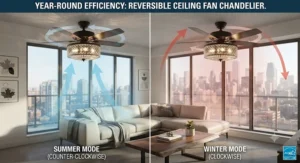
The standout feature is scale without excess: a 50-inch reversible fan wrapped in a genuinely photogenic crystal chandelier shell, aimed squarely at living rooms with 9-foot-plus ceilings where a smaller fixture would look lost. What most buyers overlook about mid-tier fandeliers like this one is that the “reversible” spec isn’t just a summer/winter gimmick — reversing blade direction in winter pushes warm air pooled near the ceiling back down into the living space, which can meaningfully reduce how hard your furnace has to work in a Canadian winter.
This is the fixture for someone upgrading from a plain builder’s fan who wants their living room to read as intentionally designed rather than merely functional. Reviewers commonly note that the black-and-crystal combination photographs beautifully for real estate listings and reads more expensive than its actual price bracket suggests, while a repeated critique is that the included bulbs run warmer (yellower) than some buyers expect from product photos showing crisp white light.
Pros:
- ✅ 50-inch span suits larger living rooms and open-plan spaces
- ✅ Reversible motor helps redistribute heated air in winter
- ✅ Design reads more premium than its price bracket
Cons:
- ❌ Stock bulb colour temperature runs warmer than photos suggest
- ❌ Heavier fixture requires solid ceiling box reinforcement
At C$220-C$300 range depending on the specific finish variant, this sits squarely in the “worth the upgrade” middle tier for anyone whose current fixture is dragging down an otherwise well-decorated room.
4. LUDOMIDE 22″ Smart Flush Mount Crystal Fandelier — best color changing ceiling fan light
The headline feature is right there in the name: a genuine 4-color dimming function paired with adjustable colour temperature (3000K-6000K), controllable via remote, wall control, or a companion app. In practice, this means one fixture can shift from warm amber for a relaxed dinner to a crisper white for reading or working, without swapping a single bulb — a real upgrade over fixed-temperature fans where you’re stuck with whatever tone the manufacturer picked.
Here’s what to weigh: the 22-inch flush-mount profile is specifically built for rooms with lower ceilings (roughly 7.5 to 8 feet), where a hanging downrod fixture would sit uncomfortably close to head height. That makes it less about raw airflow — six wind speeds still move a decent amount of air — and more about solving a real problem: wanting a color changing ceiling fan light in a room a standard chandelier fan simply can’t fit. Reviewers repeatedly highlight the “light memory” function, which reinstates your last brightness and colour setting automatically after a power cycle, as more useful in daily life than the flashier 4-color party mode most listings lead with.
Pros:
- ✅ True 4-color dimming with adjustable colour temperature
- ✅ Low-profile flush mount fits ceilings under 8 feet
- ✅ App, remote, and wall control all included
Cons:
- ❌ Lower airflow ceiling than downrod-style fandeliers
- ❌ App pairing can be fiddly on first setup
Expect a price in the C$180-C$260 range, which is reasonable for a smart-enabled fixture — traditional smart bulbs alone can add up to similar money once you factor in a compatible fixture and hub.
5. Aipsun 26″ Bladeless Low-Profile Crystal Chandelier Fan — best for modern, minimalist ceilings
The standout advantage is the bladeless design itself — air is pushed through a hidden internal mechanism rather than visible spinning blades, which lets the fixture read as pure chandelier from below, with none of the visual clutter blades normally add to a crystal design. Paired with a 3000K-6500K adjustable LED array, this is a fixture built for someone who wants their ceiling fixture to look like sculpture first and appliance second.
On paper this means a genuinely different living-room aesthetic than any spinning-blade option on this list, and it’s the pick we’d point toward for a condo or loft with an open-concept, design-forward interior. What the spec sheet won’t tell you, but reviewers note, is that bladeless designs generally produce a gentler, more diffuse airflow than blade-driven fans — great for ambient air movement, less effective if you’re trying to cool a large room quickly on a hot July afternoon.
Pros:
- ✅ Blade-free design keeps the chandelier look uncluttered
- ✅ Wide 3000K-6500K adjustable colour range
- ✅ Low-profile mount suits modern condos and lofts
Cons:
- ❌ Gentler airflow than traditional blade fans
- ❌ Premium design commands a higher price point
Budget C$230-C$320 range for this one — it’s priced as a design statement as much as a functional fan, and that’s an honest trade-off rather than a hidden catch.
6. SAMPHON 42″ Retractable Crystal Chandelier Fandelier — best hidden-blade party trick
The standout feature is genuinely fun: four retractable blades that fold outward when the fan powers on and tuck invisibly back into the housing when it’s off, so the fixture reads as a pure crystal chandelier at rest and a functioning fan in motion. It’s the kind of detail that gets noticed at a dinner party, and it solves a real design complaint — that visible fan blades, even elegant ones, can look busy under a chandelier-style light.
Based on the spec comparison with fixed-blade alternatives, retractable mechanisms add moving parts, and aggregated review sentiment reflects that trade-off honestly: most owners report the retraction mechanism working smoothly for the first year or two, with a smaller but consistent minority flagging that the blades can become slightly noisier at the fold point after extended daily use. That’s a reasonable expectation to set from the start, since Amazon’s own listing photography can make the mechanism look flawless in a way daily use sometimes complicates.
Pros:
- ✅ Blades disappear when off for a true chandelier look
- ✅ Remote and app control together with 3-speed operation
- ✅ Strong conversation-starter design for entertaining spaces
Cons:
- ❌ Moving retraction mechanism adds long-term wear risk
- ❌ More expensive than fixed-blade fandeliers of similar size
Price sits in the C$280-C$380 range — a fair premium for the mechanical engineering involved, provided you go in expecting the trade-offs of a moving-parts design rather than a fixed one.
7. Kichler Imari Ceiling Fan with Integrated LED Light Kit — best established-brand luxury pick
The standout here isn’t a gimmick — it’s pedigree. Kichler is a long-established lighting manufacturer, and the Imari brings that manufacturing consistency to a 65-inch, propeller-inspired 3-blade design with a genuinely bright 2,300-lumen integrated LED kit at 3000K and a 90 CRI rating, meaning colours in the room render accurately rather than looking washed out under the light.
What most buyers overlook about paying up for an established brand is that you’re really buying consistency and support infrastructure — documented wiring diagrams, widely available replacement parts, and a company that’s been through UL/CSA certification cycles for decades rather than a newer overseas brand navigating them for the first time. This is the fixture for a formal entryway, a primary bedroom in a higher-end build, or anyone furnishing a home they plan to stay in for a decade rather than a starter apartment. Aggregated feedback on Kichler’s fan lines consistently praises build solidity and finish quality, with the most common critique being that the sleeker propeller-blade aesthetic prioritizes design over maximum raw airflow compared to bulkier traditional 5-blade fans.
Pros:
- ✅ Established brand with decades of certification history
- ✅ Bright, accurate 90 CRI integrated LED lighting
- ✅ Polished nickel finish suited to formal, higher-end interiors
Cons:
- ❌ Premium pricing reflects brand more than raw airflow specs
- ❌ Sleek blade design trades some cooling power for looks
Expect this one to land in the C$400-C$600 range, the clear luxury tier of our lineup — and, for the right formal space, a reasonable one.
Practical Usage Guide: Installation, Setup & First 30 Days
Getting a fandelier onto your ceiling isn’t dramatically different from installing a standard fan, but the extra weight and hanging crystal accents mean a few steps matter more than they would with a plain fixture. First, confirm your existing electrical box is fan-rated — a standard light-only ceiling box is not built to support the constant rotational stress of a spinning fan, crystals and all, and using one anyway is a genuine safety risk rather than a technicality. Most fandeliers in the 42-52 inch range weigh 15-25 lbs fully assembled, and that weight needs a box rated for it.
Once mounted, resist the urge to fully load the crystal strands before doing a test run — power it on with the canopy loosely secured first, confirm the fan spins true without wobble, then finish attaching decorative elements. A surprisingly common first-30-days mistake is over-tightening the blade-to-motor screws, which can actually introduce a wobble rather than prevent one; snug is the goal, not maximum torque. For maintenance, a monthly wipe-down of blades and crystal strands with a microfibre cloth prevents the dust buildup that both dulls the sparkle and, over time, adds enough weight to affect balance. If you ever notice a new wobble months in, it’s almost always a loosened blade screw or dust imbalance — not a motor problem — and it’s a five-minute fix rather than a warranty call.
🔧 Not confident with electrical work? A licensed electrician can usually swap a fandelier in under an hour, and it’s cheap insurance against a fixture that’s improperly grounded.
Real-World Scenarios: Matching a Fandelier to Your Room
Picture three different households shopping this exact list. First, a young couple furnishing their first condo’s open-concept living-dining space, on a tight budget, who mostly want the room to look finished for under C$200 — the Chansim 52″ Crystal Chandelier Ceiling Fan or the Kviflon 48″ Farmhouse Crystal Ceiling Fan covers that brief without compromising on the “chandelier” part of the ask.
Second, a family renovating a primary bedroom with 7.5-foot ceilings, where anything hanging on a downrod would feel oppressively low — that’s precisely the situation the LUDOMIDE 22″ Smart Flush Mount Crystal Fandelier was engineered to solve, with the added bonus of a color changing ceiling fan light that can shift from a calming dim amber at bedtime to bright white for getting dressed in the morning.
Third, a homeowner finishing a formal dining room in a higher-end build, entertaining regularly, who wants a fixture that reads as genuinely luxury rather than “nice for the price” — that’s where the Kichler Imari Ceiling Fan with Integrated LED Light Kit earns its higher price tag, backed by a brand reputation that holds up under scrutiny from guests who notice these things.
Problem → Solution: Common Ceiling Fan Chandelier Issues
Problem: The fan wobbles after installation. This is almost always a balance issue, not a defect — start by tightening (not over-tightening) the blade screws, then use a basic blade-balancing kit (small adhesive weights) if the wobble persists after that.
Problem: The light flickers on the lowest dimmer setting. Cheap dimmer switches are frequently incompatible with LED drivers; swapping to a dimmer explicitly rated for LED loads solves this in the vast majority of cases reported by owners.
Problem: Crystals arrived tangled or slightly bent. This is a common shipping issue rather than a manufacturing flaw — gently untangling strands by hand before final assembly, rather than forcing them, prevents breakage.
Problem: Remote control loses range or stops responding. Interference from other 2.4GHz devices (routers, baby monitors) is the usual culprit; relocating the receiver a few feet from other electronics, or replacing the remote’s battery, resolves most cases.
Problem: The fixture feels too heavy for the existing ceiling box. Don’t gamble on this one — installing a UL/CSA-rated fan-brace box designed to span ceiling joists is a non-negotiable fix, not an optional upgrade.

How to Choose a Ceiling Fan Chandelier Light
Shopping this category well comes down to matching a handful of specs to your actual room, rather than chasing the fixture with the most crystals. Here’s the reasoning we’d walk a friend through:
- Measure your ceiling height first. Anything under 8 feet generally needs a flush-mount design like the LUDOMIDE pick rather than a downrod fixture, or you’ll be ducking under it.
- Match blade span to room size. A 42-inch fan suits bedrooms up to roughly 250 sq ft; 50-52 inches suits larger living and dining rooms up to 400-550 sq ft.
- Decide if you actually want smart/colour-changing features. They add genuine value in multi-use rooms, but they’re an unnecessary cost if your dining room only ever needs warm white light.
- Check the motor type. DC motors cost more upfront but run quieter and more efficiently — worth it for bedrooms, less critical in a rarely-used formal space.
- Confirm your ceiling box is fan-rated before you buy, not after. This single step prevents the most common and most dangerous installation mistake in this category.
- Look for CSA, cUL, or cETL certification marks specifically. A UL mark alone from a U.S. listing doesn’t guarantee Canadian compliance — more on that below.
- Budget for the whole tier, not just the fixture price. Add roughly C$75-C$150 for professional installation if you’re not doing it yourself, and factor that into your total comparison.
Color Changing Ceiling Fan Lights: What the Feature Actually Means
A color changing ceiling fan light isn’t just a party trick — the practical benefit is adjustable colour temperature (measured in Kelvin), which lets one fixture serve multiple moods and functions across the day. Natural Resources Canada’s own home lighting guidance notes that warmer light in the 2700-3000K range creates a relaxing atmosphere, while cooler light toward 5000-6500K better mimics daylight for tasks like reading — NRCan’s lighting design guide covers this trade-off in more detail for anyone planning a full-room lighting scheme.
Reviewers consistently note that the genuinely useful part of this feature isn’t flipping between four dramatic colours for a party — it’s the quieter ability to nudge colour temperature warmer in the evening and cooler in the morning, which several models (like our LUDOMIDE pick) handle automatically through a memory function. Where color-changing fandeliers tend to disappoint is app reliability; a recurring theme in aggregated feedback across this product category is that Bluetooth or Wi-Fi pairing can be finicky on first setup, though it typically stabilizes once paired correctly.
3 Light Ceiling Fan Chandeliers vs Single & Dual Light Designs
A genuine 3 light ceiling fan design — like our top pick, the Chansim — earns its extra light points honestly: three separately positioned light sources around the fixture perimeter distribute illumination more evenly across a room than a single central bulb cluster, reducing the harsh shadowing you sometimes get under a one-light fandelier. The trade-off is straightforward math: more light points generally means more total wattage draw and, on non-LED models, more bulbs to eventually replace.
Here’s what to weigh in practice: a single or dual-light fandelier suits a smaller room or one with strong secondary lighting (lamps, pot lights) already in place, while a 3-light design is the better call for a room where the ceiling fixture is doing the majority of the lighting work — a classic dining room being the textbook case. On paper, the extra light source rarely costs much more once you’re comparing similarly sized fixtures, since most 3-light designs in this category ship with efficient integrated LEDs rather than three separate incandescent sockets.
Decorative Ceiling Fixtures: A Style Guide for Every Room
Not every room wants the same decorative ceiling fixture treatment, and this is where genuine design commentary earns its keep over spec-listing. Farmhouse-style fandeliers (our Chansim and Kviflon picks) pair dark metal frames with warm wood blades, which reads well against shiplap, exposed brick, or other rustic-adjacent interiors — but can feel visually heavy in a bright, minimalist white space. Modern crystal designs (CROSSIO, Aipsun) lean into cleaner lines and either polished chrome or brushed gold finishes, better suited to contemporary condos and newer builds.
What most buyers overlook is that a decorative ceiling fixture doesn’t exist in isolation — it needs to coordinate with your existing cabinet hardware, door handles, and any other visible metal finishes in the room, or the mismatch becomes oddly noticeable once installed. Reviewers who report being happiest with their purchase consistently mention having checked their fixture’s finish (chrome, brass, matte black, polished nickel) against a photo of their actual room beforehand, rather than judging finish purely from a white-background product photo.
Luxury Home Lighting: When to Splurge on a Premium Fandelier
Luxury home lighting earns its price tag through a combination of material quality, brand certification history, and finish durability — not simply through having more visible crystals. Based on the spec comparison across our lineup, the jump from a C$250 mid-range fandelier to a C$500 established-brand luxury pick like the Kichler Imari typically buys you a higher CRI rating (meaning colours render more accurately under the light), a finish less prone to tarnishing over years of use, and a manufacturer with a long, documented certification track record.
The honest ROI case for splurging is strongest in two situations: rooms guests see regularly (entryways, formal dining rooms), where finish quality is genuinely noticeable up close, and homes you plan to stay in for many years, where a fixture built to last a decade beats replacing a budget option twice in that same span. If you’re furnishing a rental or a starter home you expect to leave within a few years, the mid-range and budget tiers we covered above deliver most of the visual impact at a fraction of the cost — luxury home lighting is a genuine upgrade, but not a universally necessary one.
Crystal Light Fan Designs Explained: K9, Acrylic & Glass Compared
Not all “crystal” in crystal light fan designs is created equal, and this is a spot where spec sheets genuinely deserve interpretation rather than a glance. K9 crystal — a type of high-clarity leaded glass, not gemstone crystal — is the material most budget-to-mid-range fandeliers use, prized for a convincing sparkle at a fraction of the cost of genuine cut crystal. Acrylic crystal-look accents show up on the most budget-conscious models; they’re lighter and safer around kids or pets since they won’t shatter, but they scatter light with noticeably less brilliance than K9 glass under direct illumination.
What the spec sheet won’t tell you, but reviewers consistently note, is that acrylic accents are more prone to visible scratching over years of dusting, while K9 glass holds its shine longer but is heavier — which circles back to the ceiling-box weight consideration from our installation section. For most Canadian homes, K9 crystal represents the sweet spot: convincing sparkle, reasonable durability, and a price point that doesn’t require luxury-tier spending.
Common Mistakes When Buying a Ceiling Fan Chandelier
The single most common and costly mistake is buying based purely on how a fixture photographs, without checking blade span against actual room square footage — an oversized fan in a small bedroom looks cartoonish, and an undersized one in a great room looks lost. A close second is skipping the ceiling-box rating check entirely, assuming any box that currently holds a light fixture will support a fan; it usually won’t without reinforcement.
Buyers also frequently underestimate colour temperature mismatches, ordering a fixture based on a bright white product photo and receiving warm 2700K light that reads yellow in person — always check the stated Kelvin value, not just the photo. Finally, a subtler mistake: assuming a UL-only certification (common on cross-listed U.S./Canada products) automatically covers Canadian installation requirements, when in fact a distinct CSA, cUL, or cETL mark is what Canadian electrical code actually requires.

Safety, CSA Certification & Canadian Electrical Rules
This is the section that matters most and gets skipped most often in affiliate roundups, so it’s worth being direct: Health Canada is explicit that any electrical product plugging into or wired into your home’s power must carry an accredited Canadian certification mark, and Health Canada’s electrical product safety page specifically names CSA, cUL, and cETL as the marks to look for before buying. A mark from a different country’s testing body, on its own, doesn’t satisfy this requirement, even if the product looks and functions identically.
For fandeliers specifically, that means checking the product listing or physical fixture for one of these three marks before you buy, not after installation — returning a fixture is far easier than an electrical inspector flagging it during a home sale or insurance claim. CSA Group’s own testing and certification overview explains what that certification process actually verifies: independent testing for fire risk, structural safety under sustained rotational load (relevant specifically to fans), and electromagnetic compliance for any smart or app-connected models. If in doubt about a specific product, your provincial electrical safety authority can confirm whether a given certification mark is accepted.
Long-Term Cost & Maintenance: Total Cost of Ownership
The sticker price is only part of the real cost picture here. Lighting represents a meaningful slice of household electricity use — Natural Resources Canada’s own figures put residential lighting at roughly 3.5 to 15% of total home energy use depending on the source cited, which is exactly why the LED-vs-incandescent question matters more than it sounds. Since ENERGY STAR-certified LED fixtures use up to 90% less energy than incandescent equivalents and last many times longer, every fandelier on this list that ships with integrated LED lighting (which is most of them) is already doing meaningful long-term cost work compared to an older incandescent chandelier.
Beyond electricity, factor in occasional bulb or LED-driver replacement (rare on integrated LED models, more frequent on ones using standard bulb sockets), and a once-a-year deeper clean of crystal strands to maintain both appearance and balance. Over a five-year ownership window, the total cost gap between our budget and luxury picks narrows somewhat once you account for the luxury pick’s better warranty support and lower failure rates reported in aggregated reviews — though the budget options remain the better math for anyone not planning to stay in the home long-term.
Frequently Asked Questions
❓ Can a ceiling fan chandelier light replace a regular ceiling fan and a chandelier?
❓ Do color changing ceiling fan lights need a smart home hub?
❓ How many crystals typically hang from a 3 light ceiling fan chandelier?
❓ Is a bladeless ceiling fan chandelier as effective at cooling a room?
❓ What ceiling height is needed for a hanging (non-flush-mount) fandelier?
Conclusion
A genuinely good ceiling fan chandelier light comes down to matching real specs — motor type, blade span, colour temperature range, and certification marks — to your actual room and budget, rather than picking whichever fixture has the most dazzling product photo. Across our seven picks, the Chansim 52″ Crystal Chandelier Ceiling Fan earns its spot as the best all-around value for classic 3-light styling, the LUDOMIDE 22″ Smart Flush Mount Crystal Fandelier solves the low-ceiling color changing ceiling fan light problem specifically, and the Kichler Imari Ceiling Fan with Integrated LED Light Kit delivers the established-brand luxury home lighting case for anyone furnishing a formal space long-term.
Whatever tier you land in, the two non-negotiables are the same: confirm your ceiling box is fan-rated before installation, and confirm the fixture carries a genuine CSA, cUL, or cETL mark before you buy. Get those two details right, and the rest — crystal style, colour temperature, blade count — comes down to honest personal taste rather than risk.
✨ Ready to light up your ceiling the right way? Check current pricing on today’s top pick and see if it’s still in stock before the season’s best deals move on. ✨
Recommended for You
- 7 Best flush mount ceiling fan with light Picks for Canadian Homes (2026)
- 7 Best Dimmable Ceiling Fan Lights in Canada
- Best Ceiling Fan With Light and Remote: 7 Top Picks (2026)
Disclaimer: This article contains affiliate links. As an Amazon Associate, I earn from qualifying purchases. If you purchase products through these links, we may earn a small commission at no additional cost to you.
✨ Found this helpful? Share it with your friends! 💬🤗
