

In This Article
A bamboo ceiling fan is one of those rare home upgrades that photographs well and actually earns its keep. It is a ceiling fan built with blades, cages, or accents made from bamboo, rattan, or woven natural fiber instead of the usual painted MDF or brushed plastic, and it is having a genuine moment in Canadian living rooms right now. Walk into any bright, plant-filled apartment on your Instagram feed and there is a decent chance a woven fandelier is spinning lazily overhead.
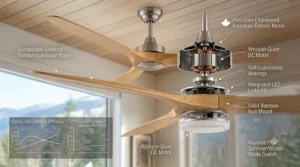
I get why. There is something almost tactile about a fan blade you can practically feel the grain on, and after a July heatwave in Toronto or a sticky August night in Winnipeg, “stylish” stops being the whole point and “actually moves air” starts mattering a lot more. Part of the appeal is also material: bamboo is one of the fastest-regenerating plants used in consumer goods, which is a big part of why it keeps showing up in sustainability-minded home decor rather than staying a niche tropical theme. That tension, between looking good on a mood board and performing like appliance-grade equipment, is exactly what this guide untangles.
Here is the short version before we go deep: not every bamboo blade fan is built the same, and the differences between a C$120 flush-mount boho fan and a C$500 outdoor-rated tropical fan are bigger than the finish photos suggest. Below, you will find seven real, currently available models pulled from actual retailers, sized by budget, and broken down with the kind of plain-language commentary a spec sheet won’t give you. We looked at motor type, blade material and durability, noise levels, and what real buyers report after living with these fans for months, not just the marketing copy.
Whether you are chasing a full boho interior design refresh or just want a ceiling fixture that does not look like it came off a big-box shelf, there is a fan on this list built for your situation. Let’s get into it.
Quick Comparison Table
| Fan | Blade Material | Motor | Best For | Price Range (CAD) |
|---|---|---|---|---|
| Fanimation Islander | Woven bamboo (narrow oval) | DC, ENERGY STAR | Best all-around indoor/outdoor pick | C$300–C$450 |
| Gulf Coast Fans Tiki Tropical | Outdoor-rated bamboo-style | AC, high-output | Covered patios and damp locations | C$450–C$600 |
| Gulf Coast Fans Palm Breeze II | Dark woven bamboo | AC | Tropical accent, mid-size rooms | C$350–C$500 |
| Parrot Uncle Ratten Boho Fandelier | Rattan cage, flush mount | DC, reversible | Low ceilings, bedrooms | C$150–C$220 |
| Eamonex Boho Bamboo LED Fan | Woven wicker cage | DC | Tight budgets, small rooms | C$100–C$150 |
| Dixie Belle Tropical Bamboo (Arbor 275) | Carved solid wood bamboo | AC | Classic tropical look, custom finishes | C$300–C$450 |
| Fanimation ISD4A Blade Set | Narrow oval bamboo (blades only) | N/A (retrofit) | Upgrading an existing compatible fan | C$60–C$100 |
The spread here tells its own story: this is not a category where one product wins outright. Based on the spec comparison, the Fanimation Islander earns its “best all-around” tag because it is the only fan on this list that pairs a genuine bamboo blade with an ENERGY STAR-certified DC motor, which matters a lot if you plan to run it daily through a Canadian summer. Budget shoppers land on the Eamonex Boho Bamboo LED Fan, while anyone wanting to try the bamboo blade aesthetic without buying a whole new fixture should look hard at the Fanimation ISD4A Blade Set, assuming their existing fan is compatible.
💬 Just one click — help others make better buying decisions too!😊
Top 7 Bamboo Ceiling Fans: Expert Analysis
1. Fanimation Islander — Energy Star DC motor with real woven bamboo blades
The standout here is simple: this is the rare bamboo ceiling fan that treats efficiency as seriously as it treats style. The Fanimation Islander ships with a 52-inch blade sweep and narrow oval woven bamboo blades, and it uses a DC-powered motor that Fanimation states consumes roughly 70% less energy than a conventional AC fan.
On paper, that translates to six forward and six reverse speeds, a rated airflow up to roughly 5,400 cubic feet per minute on high, and compatibility with sloped ceilings up to 30 degrees, which is a genuinely useful spec if you live in an older Canadian home with vaulted or angled ceilings. It is also rated for both dry and damp locations depending on the finish, so it works equally well in a living room or a covered porch.
Reviewers consistently report that the DC motor runs noticeably quieter than older AC ceiling fans, and that the reversible airflow setting earns its keep in winter by pushing warm air back down from the ceiling. What most buyers overlook about this model is that the bamboo blades are a swap-in option across Fanimation’s Islander platform, meaning the motor housing is shared with several other blade finishes; if you ever tire of the tropical look, replacement blades are sold separately rather than forcing a full fan replacement.
Pros:
- ✅ ENERGY STAR-certified DC motor cuts running costs
- ✅ Handles sloped ceilings up to 30 degrees
- ✅ Dry and damp location finishes available
Cons:
- ❌ Premium price versus basic AC bamboo fans
- ❌ Remote sold separately on some finish variants
At C$300–C$450 depending on finish and retailer, the Fanimation Islander sits at the upper end of this list, but the ENERGY STAR certification and DC motor efficiency make a real case for the long-term value verdict: less electricity, less motor noise, more years of service.
2. Gulf Coast Fans Tiki Tropical Ceiling Fan — built specifically for damp, covered outdoor spaces
The short version: if your bamboo ceiling fan is going on a covered porch or screened-in patio rather than a bedroom, this is the one built for that job from the ground up. The Gulf Coast Fans Tiki Tropical Ceiling Fan pairs a 52-inch blade sweep of outdoor-rated bamboo-style blades with what the manufacturer describes as a high-performance motor engineered specifically for damp location use.
Key specs with real-world meaning: the “damp rated” designation is not a marketing throwaway, it means the fan is engineered to resist moisture and humidity swings without the motor housing corroding or the blades warping the way an indoor-only fan would under the same conditions. That matters in a Canadian climate that swings from humid summer evenings to freezing, damp autumn mornings on an uncovered but roofed porch.
Here’s what to weigh: this fan is bulkier and heavier than most indoor bamboo models, and the tropical, tiki-hut aesthetic is a specific look rather than a subtle one. Aggregated review sentiment on damp-rated tropical fans in this category tends to praise the sturdiness of the motor housing over years of outdoor exposure, while noting that the blade finish requires occasional wiping to keep dust and pollen from dulling the woven texture.
Pros:
- ✅ Purpose-built for damp, covered outdoor locations
- ✅ Strong, high-output motor for larger porches
- ✅ Distinctive tropical bamboo-style blade design
Cons:
- ❌ Higher price point than indoor-only bamboo fans
- ❌ Bold aesthetic may not suit minimalist interiors
Expect to pay in the C$450–C$600 range for this one, and the value case is straightforward: buying an indoor-rated fan for an outdoor space is a false economy once you factor in the motor replacement cost after a season or two of moisture exposure.
3. Gulf Coast Fans Palm Breeze II — a tropical accent piece for mid-size rooms
Here the headline feature is the blade finish: the Gulf Coast Fans Palm Breeze II comes fitted with 48-inch dark woven bamboo blades in a satin steel housing, striking a middle ground between the loud tropical statement of the Tiki and the subtler boho fans further down this list.
The 48-inch blade sweep is worth pausing on. Reviewers consistently note that this size is the sweet spot for rooms in the 150 to 200 square foot range, which covers a lot of standard Canadian bedrooms and dens without overwhelming the ceiling the way a 52-inch or larger sweep can in a smaller space. Based on the spec comparison against the Islander, the Palm Breeze II runs a standard AC motor rather than DC, which means slightly higher running costs but also a lower upfront price.
What most buyers overlook about this model is how much the satin steel housing changes the overall look; paired with dark woven bamboo, it reads more “modern tropical” than “beach hut,” which makes it easier to integrate into a broader eco friendly ceiling fan bamboo aesthetic without going full theme-park.
Pros:
- ✅ Dark woven bamboo blades suit modern-tropical decor
- ✅ 48-inch sweep fits mid-size rooms well
- ✅ Satin steel housing feels less novelty, more design piece
Cons:
- ❌ Standard AC motor is less efficient than DC options
- ❌ Fewer finish variants than the Islander platform
Priced around C$350–C$500, the Palm Breeze II earns its spot as the mid-range pick for anyone who wants the bamboo look without committing to a full tropical theme or a premium DC motor.
4. Parrot Uncle Ratten Boho Ceiling Fan with Light — a flush-mount fandelier for low ceilings
This is the fan built for the boho interior design crowd specifically, and it shows in every design choice. The Parrot Uncle Ratten Boho Ceiling Fan with Light is a 19.7-inch flush-mount fixture with a handwoven rattan cage wrapped around a warm gold metal base, designed to sit close to the ceiling for rooms where a downrod-mounted fan simply will not clear the space.
Key specs with real-world meaning: the fan runs on a quiet, reversible DC motor with six speeds and delivers airflow up to roughly 1,000 RPM, which is modest compared to the larger tropical fans above but appropriate for its size and intended use as a natural fiber lighting fixture as much as an airflow device. It includes four E12 bulb sockets rated up to 40 watts each, so the light output depends entirely on the bulbs you choose, and Parrot Uncle notes the fixture pairs well with LED, CFL, or incandescent bulbs.
Honest analytical take: this fan is for someone furnishing a rental, a nursery, or a low-ceilinged bedroom where a traditional downrod fan is not an option, and where the light fixture itself is doing a lot of the decorative heavy lifting. Reviewers consistently note the caged rattan shade produces a warm, diffused glow rather than harsh direct light, which fits the cozy aesthetic it is going for.
Pros:
- ✅ Flush mount works in rooms with low ceiling clearance
- ✅ Handwoven rattan shade doubles as a light fixture
- ✅ Quiet reversible DC motor with 6 speeds and sleep timer
Cons:
- ❌ Lower airflow output than larger downrod fans
- ❌ Bulbs sold separately
At C$150–C$220, this fan lands squarely in the impulse-purchase-that-actually-works-out category, particularly for anyone renovating a nursery or guest room on a modest budget.
5. Eamonex Boho Bamboo LED Ceiling Fan — the true budget entry point
If the goal is simply “try the bamboo ceiling fan look without a big commitment,” this is where to start. The Eamonex Boho Bamboo LED Ceiling Fan is a 21-inch flush-mount fixture with a wicker cage design, integrated LED light, remote control, and a dimmable fandelier-style housing, all sold at the lowest price point on this list.
Key specs with real-world meaning: like the Parrot Uncle model above, this is a DC-motor, low-profile fixture meant for bedrooms, kitchens, or small indoor and outdoor-adjacent rooms, not a whole-house cooling solution. The dimmable LED integration is worth noting specifically because it removes the bulb-shopping step entirely, unlike caged fans that rely on separately purchased bulbs.
The spec sheet won’t tell you this, but user reports suggest assembly is one of the more common friction points with budget flush-mount fans in this category generally; wiring a ceiling fixture correctly still requires basic electrical comfort or a licensed electrician, regardless of price point. Aggregated sentiment on small-business wicker fan brands in this segment tends to be positive on style-per-dollar and mixed on long-term motor longevity compared to established fan manufacturers, which is a fair trade-off at this price.
Pros:
- ✅ Lowest price point of any fan on this list
- ✅ Integrated dimmable LED, no bulb shopping needed
- ✅ Compact 21-inch size fits small rooms
Cons:
- ❌ Limited airflow compared to larger blade-driven fans
- ❌ Smaller brand means a thinner long-term track record
Expect to pay roughly C$100–C$150, and the value verdict here is clear: for anyone testing whether they even like the natural fiber lighting fixture aesthetic before spending more, this is the lowest-risk entry point on the list.
6. Dixie Belle Tropical Bamboo Ceiling Fan (Arbor 275 blades) — carved solid wood bamboo, old-school tropical style
The standout feature on this one is the blade construction itself: the Dixie Belle Tropical Bamboo Ceiling Fan uses Arbor 275 blades carved from solid wood into a bamboo-stalk shape, rather than a woven or laminate bamboo finish, and the manufacturer offers it across eleven different motor finishes.
Key specs with real-world meaning: carved solid wood blades tend to hold their shape and finish longer than laminated or woven bamboo blade styles, since there is no adhesive layer or weave to separate over time with humidity swings. This is a meaningful durability difference for anyone who has dealt with a cheaper fan’s blade laminate peeling after a few humid Canadian summers.
Honest analytical take grounded in the spec sheet: this fan reads as more “traditional tropical bungalow” than “modern boho,” which makes it a strong fit for anyone decorating a cottage, sunroom, or guest room around a classic tropical or coastal theme rather than a strictly contemporary look. The eleven finish options are a real differentiator versus most of the other fans on this list, which typically offer two or three finish choices at most.
Pros:
- ✅ Solid carved wood blades resist warping over time
- ✅ Eleven motor finish options for design flexibility
- ✅ Classic tropical aesthetic suits cottages and sunrooms
Cons:
- ❌ Standard AC motor, not the most energy-efficient option
- ❌ Less common brand than Fanimation or Gulf Coast Fans
At around C$300–C$450, this fan competes directly with the Islander and Palm Breeze II on price, and the deciding factor really comes down to aesthetic: carved traditional bamboo blades versus woven modern-tropical ones.
7. Fanimation ISD4A Narrow Oval Bamboo Blade Set — the retrofit option nobody thinks to check first
This is the lesser-known but genuinely clever pick on this list. The Fanimation ISD4A Narrow Oval Bamboo Blade Set is not a full ceiling fan at all, it is a set of five 22-inch narrow oval woven bamboo blades designed to bolt onto compatible Fanimation motor housings, including the Islander platform covered above.
Key specs with real-world meaning: if you already own a Fanimation fan with a compatible motor mount, or you are buying a Fanimation motor housing separately, this blade set lets you get the bamboo look without paying for an entirely new motor, remote, and light kit. The blades are rated for antique finishes suited to damp locations and natural finishes suited to dry, indoor locations, so the same retrofit logic that applies to full fans applies here too.
What most buyers overlook is that this is genuinely a sustainable home decor choice in the literal sense: instead of discarding a working fan motor to chase a new blade aesthetic, a compatible blade swap extends the useful life of equipment you already own. Reviewers consistently note that installation is straightforward for anyone comfortable with basic tools, since it mirrors the process of replacing worn blades on any standard ceiling fan.
Pros:
- ✅ Far cheaper than buying a whole new fan
- ✅ Extends the life of an existing compatible motor
- ✅ Available in indoor and outdoor-rated finishes
Cons:
- ❌ Only works with compatible Fanimation motor mounts
- ❌ Requires basic installation comfort or an electrician
At roughly C$60–C$100 for a set of five blades, this is one of the best value-per-dollar picks on the list, provided you have (or plan to buy) a compatible motor housing to pair it with.
Setting Up Your Bamboo Ceiling Fan: Installation, Care and the First 30 Days
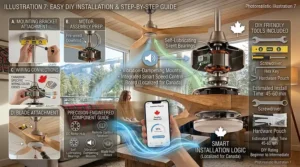
Getting a bamboo ceiling fan installed correctly matters more than with a plain plastic-blade fan, because natural fiber blades respond differently to humidity, dust, and handling than moulded plastic does. Before the fixture goes up, confirm the ceiling junction box is rated to support the fan’s weight; bamboo and rattan blade assemblies, especially caged fandelier styles, can weigh noticeably more than a standard three-blade plastic fan, and a light-duty box is not built for that load.
During the first 30 days, resist the urge to run the fan at maximum speed constantly while you get used to it. A short break-in period at low or medium speed lets any minor balance issues in the blade mounting show up before they become a persistent wobble, and it is far easier to correct a loose blade screw in week one than after months of vibration have worn the mounting hardware. If you notice any wobble, most manufacturers, including Fanimation, sell simple balancing kits that clip onto the blades to correct minor imbalances.
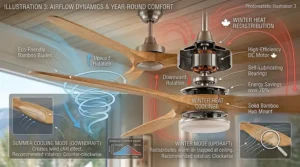
Maintenance on woven or carved bamboo blades is genuinely simple but easy to get wrong: a dry microfiber cloth or a very lightly damp cloth is the safe choice, since soaking natural fiber blades or scrubbing with abrasive cleaners can strip the finish and accelerate wear. Dust build-up on woven rattan cages tends to be more visible than on smooth plastic blades, so a monthly wipe-down keeps the texture looking crisp rather than dull. One common mistake in the first month is running a reversible DC motor fan in the wrong seasonal direction; counter-clockwise in summer pushes air down for a cooling breeze, while clockwise in winter gently redistributes warm air pooled near the ceiling.
Which Bamboo Ceiling Fan Fits Your Space? Three Real-World Scenarios
The renter furnishing a small bedroom on a tight budget. Someone in a one-bedroom rental, working with a modest budget and a strict “nothing that requires major electrical work” constraint, is the ideal buyer for either the Eamonex Boho Bamboo LED Ceiling Fan or the Parrot Uncle Ratten Boho Ceiling Fan with Light. Both are flush-mount, both include integrated or easily sourced lighting, and both deliver the boho interior design look without the cost of a full downrod installation.
The homeowner upgrading a covered patio for summer entertaining. Someone with an existing covered deck or three-season porch, planning to host regularly through a Canadian summer, needs a damp-rated fan built for the job, not a repurposed indoor fixture. The Gulf Coast Fans Tiki Tropical Ceiling Fan is built specifically for this scenario, and its higher price reflects genuine engineering differences in motor sealing and blade material, not just aesthetics.
The eco-conscious buyer replacing an aging fan in a family living room. Someone who cares about long-term running costs and wants a fan they will not need to replace again in five years should prioritize the Fanimation Islander. The ENERGY STAR DC motor pays for its premium price gradually through lower electricity draw, and its compatibility with the ISD4A blade set means the blade aesthetic can be refreshed later without buying an entirely new motor.
Buyer’s Decision Framework
If you have low ceilings or a rental with restricted mounting options, choose a flush-mount boho fandelier like the Parrot Uncle Ratten Boho Ceiling Fan with Light, because the low-profile design solves the clearance problem that a downrod fan cannot.
If you need a fan on a covered outdoor space exposed to humidity, choose a damp or wet-rated model like the Gulf Coast Fans Tiki Tropical Ceiling Fan, because indoor-rated motors degrade faster under moisture exposure regardless of how good the price looks upfront.
If your top priority is minimizing electricity costs over years of daily use, choose an ENERGY STAR DC motor fan like the Fanimation Islander, because the efficiency gap between DC and AC motors compounds noticeably over a full Canadian cooling season.
If you already own a compatible ceiling fan and just want to change the look, choose a retrofit blade set like the Fanimation ISD4A Narrow Oval Bamboo Blade Set, because replacing blades alone is both cheaper and more sustainable than discarding a working motor.
If budget is the single deciding factor and you mainly want to test the aesthetic, choose the Eamonex Boho Bamboo LED Ceiling Fan, because it delivers the visual identity of the trend at the lowest financial commitment on this list.
✨ Don’t Miss These Exclusive Deals!
🔍 Take your bamboo ceiling fan search to the next level with these carefully selected products. Click on any highlighted item to check current pricing and availability. These picks will help you build the sustainable, natural-fiber-filled space you have been picturing.
What is a Bamboo Ceiling Fan?
A bamboo ceiling fan is a ceiling-mounted fan featuring blades, a decorative cage, or accent elements made from bamboo, woven rattan, or similar natural fiber materials rather than standard painted MDF, metal, or plastic. It blends functional air circulation with an organic, textured aesthetic commonly associated with tropical, coastal, farmhouse, and boho interior design.
How to Choose a Bamboo Ceiling Fan
- Match blade material to your climate exposure. Woven bamboo and rattan handle stable indoor humidity well, but only damp or wet-rated fans, like the Gulf Coast Fans Tiki Tropical, should go anywhere exposed to outdoor moisture.
- Check ceiling height and mounting type first. Flush-mount fandeliers solve low-ceiling problems that downrod fans cannot, so measure clearance before falling for a specific style.
- Weigh AC versus DC motor cost over time. DC motors like the one in the Fanimation Islander cost more upfront but use meaningfully less electricity across a full season of daily use.
- Confirm blade sweep matches room size. A 52-inch sweep suits larger rooms, while 20 to 22-inch flush-mount fans are built for bedrooms and smaller spaces, not open-concept living rooms.
- Look for CSA-compliant electrical components. Any fixture installed in a Canadian home should carry CSA or an equivalent Standards Council of Canada-recognized certification mark, which the Government of Canada’s own guidance on Canadian standards reinforces alongside energy performance requirements.
- Factor in real maintenance habits, not aspirational ones. Woven and carved bamboo blades need occasional dusting and gentle cleaning; if that sounds like a chore you will skip, a smoother finish may serve you better long term.
- Decide whether retrofit blades solve your problem cheaper. If you already own a compatible motor housing, a blade-only swap like the ISD4A set is almost always the better-value path to the bamboo look.
Common Mistakes When Buying a Bamboo Ceiling Fan
The most frequent mistake is installing an indoor-rated bamboo fan, like the Parrot Uncle Ratten Boho Ceiling Fan with Light, in a covered but exposed outdoor space; the motor housing and blade finish simply are not engineered for that humidity cycle, and warranty coverage typically will not apply either.
A second common mistake is buying based purely on blade sweep size without checking room dimensions, ending up with a 52-inch fan like the Gulf Coast Fans Palm Breeze II overwhelming a small bedroom, or an undersized 20-inch flush-mount fan struggling to circulate air in a large open-concept space.
A third mistake worth flagging is skipping the balance check during installation. Natural fiber and carved wood blades vary slightly in weight from unit to unit in a way moulded plastic blades do not, and skipping the initial wobble check tends to create a persistent, hard-to-diagnose vibration later.
Bamboo Ceiling Fan vs Traditional Ceiling Fan
The core difference is not really about airflow performance, since a well-built bamboo blade fan and a comparable traditional plastic or metal blade fan will move air similarly at the same motor rating. The real difference sits in material behaviour and aesthetic function. Traditional painted or plastic blades are essentially maintenance-free and largely immune to humidity, while bamboo and rattan blades require gentler cleaning and, in some cases, occasional refinishing to keep their texture from dulling.
On the value side, a traditional plastic-blade fan is almost always cheaper upfront, and for a purely functional space like a garage or basement, that price gap is hard to justify closing. But for a primary living space where the fixture is a visible design element, a natural fiber lighting fixture like the boho fans covered above earns back some of that price premium in a way a plain plastic fan simply cannot, because it is doing double duty as both an appliance and a decor centerpiece. Buyers chasing sustainable home decor specifically also tend to weigh material sourcing more heavily, and bamboo’s renewable growth cycle is a genuine differentiator worth understanding before assuming “natural” automatically means “greener” in every case.
What to Expect: Real-World Performance
On paper, most fans on this list move comparable air for their motor size, but daily experience differs more than spec sheets suggest. DC motor fans like the Fanimation Islander and the Parrot Uncle Ratten Boho Ceiling Fan run noticeably quieter at low and medium speeds, which matters far more in a bedroom at night than the maximum CFM rating on the box ever will. AC motor fans, including the Gulf Coast Fans Palm Breeze II and Dixie Belle Tropical Bamboo Ceiling Fan, tend to run slightly louder at top speed but are often more affordable and just as durable for daytime living-room use.
Real-world airflow also depends heavily on installation height and room layout, not just the fan itself. A fan mounted too close to the ceiling in a tall room underperforms its rated CFM because the airflow has less room to circulate before hitting furniture and walls, which is a factor spec sheets rarely mention but installers deal with constantly.
Bamboo Ceiling Fans for Boho, Small Spaces and Rentals
For anyone building a boho interior design scheme around layered textures, woven baskets, macramé, and warm wood tones, a caged rattan fandelier is close to a perfect match, since it introduces the same organic texture at ceiling height that most boho rooms only apply at eye level. The Parrot Uncle Ratten Boho Ceiling Fan with Light and Eamonex Boho Bamboo LED Ceiling Fan were both essentially designed with this exact aesthetic in mind, right down to the warm, diffused light output that flatters plants and neutral linen tones far better than a harsh overhead LED panel.
Renters face an additional constraint worth naming directly: many leases restrict permanent electrical modifications, so confirming a flush-mount fan can be installed on the existing fixture wiring, without adding a new junction box, is worth doing before purchase. Both budget picks above are compatible with standard ceiling fixture wiring in most cases, which is part of why they show up so often in rental-friendly design roundups.
Long-Term Cost & Maintenance
Total cost of ownership on a ceiling fan is not just the sticker price; it is purchase price plus electricity draw over its service life plus any maintenance or replacement parts along the way. A DC motor fan like the Fanimation Islander, priced around C$300–C$450, costs more upfront than an AC alternative, but its roughly 70% lower energy draw compounds meaningfully if it runs for several hours daily through a Canadian cooling season, narrowing or even closing the price gap over a five to seven year ownership window.
Maintenance costs on bamboo and rattan blade fans are generally low but not zero. Occasional cleaning is free beyond your own time, but blade replacement, if a woven finish eventually wears, runs in the C$60–C$100 range for a compatible set like the ISD4A blades rather than requiring a full fan replacement. That modularity is a genuine long-term cost advantage of buying into a platform like Fanimation’s Islander line versus a fixed, non-modular budget fan.
Safety, Regulations & Compliance Guide for Canada
Any ceiling fan installed in a Canadian home should carry certification from CSA Group or another Standards Council of Canada-accredited body; this is not optional guidance, it is a baseline safety requirement enforced through provincial electrical codes, and UBC’s own engineering safety documentation lays out clearly why CSA-certified equipment is mandatory for any electrical fixture connected to Canadian power systems.
Separately, Canada’s Energy Efficiency Regulations set minimum performance standards specifically for ceiling fans, and models carrying the ENERGY STAR mark, like the Fanimation Islander, have been independently tested against those standards rather than simply self-reported by the manufacturer. If a heavier caged or fandelier-style fan is going into an older home, it is worth having a licensed electrician confirm the ceiling junction box is rated for the added weight before installation, particularly with rattan cage models that weigh more than their compact size suggests.
Frequently Asked Questions
❓ Are bamboo ceiling fans actually eco friendly?
❓ Can a bamboo ceiling fan go outside?
❓ Do rattan bamboo ceiling fans need a lot of maintenance?
❓ Are boho ceiling fans good for small bedrooms?
❓ How long do bamboo ceiling fan blades last?
Conclusion
There is no single “best” bamboo ceiling fan, and honestly, that is the useful takeaway here rather than a cop-out. The Fanimation Islander earns its spot as the efficiency-minded all-rounder, the Gulf Coast Fans Tiki Tropical Ceiling Fan solves a real problem for covered outdoor spaces, and the Eamonex Boho Bamboo LED Ceiling Fan exists specifically so a tight budget does not have to mean skipping the trend entirely.
What ties all seven of these picks together, from the premium DC-motor Islander down to a simple retrofit blade set, is that each one solves a specific, real version of “I want this look, but I need it to actually work in my space.” That is the whole exercise: matching the fixture to the ceiling height, the climate exposure, the room size, and the budget you are actually working with, not just the aesthetic on the box. Take the comparison table, the decision framework, and the honest pros and cons above, and you will land on a fan that still looks right two humid Canadian summers from now.
Recommended for You
- Palm Leaf Ceiling Fan Guide: 7 Top Picks for Canadian Homes 2026
- 7 Best airplane ceiling fan Picks for Canadian Homes in 2026
- Curved Blade Ceiling Fan: 7 Best Picks for Canadian Homes 2026
Disclaimer: This article contains affiliate links. As an Amazon Associate, I earn from qualifying purchases. If you purchase products through these links, we may earn a small commission at no additional cost to you.
✨ Found this helpful? Share it with your friends! 💬🤗
