
In This Article
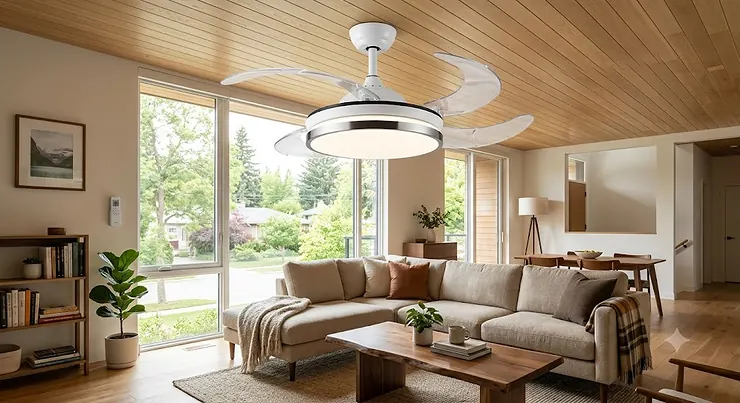
Picture this: your dining room ceiling, bare and elegant, with nothing but a sleek pendant light hanging above the table. Flip a switch, and four blades unfurl like something out of a spy movie, and suddenly you’ve got a genuine breeze moving through the room. That’s the whole appeal of a retractable blade ceiling fan in one sentence, and it’s why this category has quietly become one of the most requested upgrades among homeowners tired of choosing between “looks nice” and “actually cools the room.”
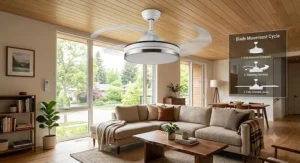
A retractable blade ceiling fan solves an old design headache. Traditional fans, even attractive ones, tend to dominate a ceiling with their spread of blades whether they’re spinning or not. The retractable design flips that logic: blades stay tucked away, invisible, until centrifugal force pulls them open the moment you power up. For anyone furnishing a dining room, a low-ceilinged condo, or a space where the ceiling fixture doubles as a design statement, that difference matters enormously.
This guide walks through seven real, currently available models spanning budget, mid-range, and premium price points, along with the practical details — installation quirks, Canadian electrical rules, maintenance schedules, and honest trade-offs — that most product listings simply skip. All prices below are shown in Canadian dollars as approximate ranges, since exact Amazon.ca pricing shifts constantly; always check current pricing before you buy.
What Is a Retractable Blade Ceiling Fan?
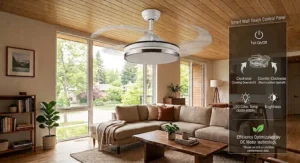
A retractable blade ceiling fan is a ceiling-mounted fan whose blades are hidden or folded flat against the housing when powered off, then extend outward under centrifugal force once the motor spins up — functioning as a pendant light fixture at rest and a functional fan in motion. This hybrid design is often marketed as a “fandelier,” blending chandelier-style lighting with cooling airflow in a single fixture.
The technology isn’t brand new — Australian company Fanaway pioneered the patented retractable-blade mechanism, and it’s since been copied (with varying quality) by dozens of import brands now flooding Amazon.ca listings. What separates a genuinely good retractable ceiling fan light fixture from a flimsy knockoff usually comes down to three things: blade material and thickness, motor quality (DC motors run quieter and more efficiently than older AC units), and whether the product actually holds a real safety certification for the Canadian market.
Quick Comparison: Retractable Blade Ceiling Fans at a Glance
| Product | Blade Span | Motor Type | Standout Feature | Best For |
|---|---|---|---|---|
| Fanaway Classic 48″ | 48″ (4 blades) | AC, 3-speed | Original patented retractable mechanism | Design purists |
| Fanaway Evo1 48″ | 48″ (4 blades) | AC, 3-speed | Colour-shifting LED | Statement lighting |
| AHAWILL 42″ Low Profile | 42″ (retractable) | DC, app + remote | 7.87″ ultra-low housing | Low ceilings |
| GreenEver 44″ Hidden Blade | 44″ (retractable) | DC, remote | Reinforced 3× thicker blades | Durability seekers |
| OUKANING 42″ Crystal Fandelier | 42″/20″ retracted | AC, remote | K9 crystal chandelier shade | Chandelier ceiling fan combo |
| CROSSIO 48″ Rustic Fandelier | 48″ (retractable) | AC, remote | Industrial cage light kit | Farmhouse dining rooms |
| Fanaway Fraser 48″ | 48″ (4 blades) | AC, reversible | Linen drum shade + dimmable LED | Dining room ceiling fixture |
Looking at this table, a clear pattern emerges: the Fanaway-branded models generally command a premium for their patented mechanism and steel hardware, while the newer DC-motor imports like AHAWILL and GreenEver undercut them on price by leaning into slimmer housings and app connectivity instead. If your ceiling sits below the standard 8-foot mark, the low-profile options are worth prioritizing over the taller Fanaway housings, which need a bit more vertical clearance to operate safely.
💬 Just one click — help others make better buying decisions too! 😊
💬 Already have a favourite on this list? Tap through to check today’s price and availability before it changes!
Top 7 Retractable Blade Ceiling Fans: Expert Analysis
1. Fanaway Classic 48″ Retractable 4-Blade Ceiling Fan — the original patented mechanism
This is the fan that essentially invented the category, and it still holds up as the benchmark against which every knockoff gets measured. The Classic’s four antique black or chrome-finished blades snap open the instant the AC motor spins to speed, held apart by centrifugal force alone rather than any spring or motorized arm.
That’s a meaningfully different (and simpler) mechanism than most imports use, which matters for long-term reliability. The 3-speed AC motor won’t win any efficiency awards next to newer DC units, but Fanaway backs the design with over a decade of production history, and the dimmable LED light kit with exposed vintage-style bulbs gives it genuine visual presence rather than the generic “drum shade” look so many competitors default to. Reviewers consistently note that the retract-and-deploy motion is smoother and quieter on the Classic than on cheaper imitators, though a handful mention the assembly instructions could be clearer.
This model suits buyers who want the proven original rather than a budget clone, particularly in living rooms or foyers where the fixture will be a focal point even when it’s switched off.
Pros:
- ✅ Patented mechanism with the longest track record in the category
- ✅ Dimmable LED light kit with distinctive vintage-bulb styling
- ✅ Reversible motor for summer and winter airflow modes
Cons:
- ❌ AC motor draws more power than newer DC alternatives
- ❌ Assembly instructions are a known weak point per reviewer feedback
Expect to pay in the C$450-C$650 range depending on finish, which puts it toward the premium end — a fair trade if you value the original engineering over a cheaper copy.
2. Fanaway Evo1 48″ Retractable Ceiling Fan — colour-adjustable LED lighting
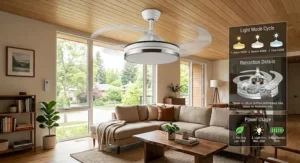
The Evo1 takes the same retractable-blade engine as the Classic and pairs it with a colour-temperature-shifting LED panel, letting you swing from warm 2700K ambiance to cooler daylight tones without swapping bulbs.
That flexibility is the whole pitch here: a single remote adjusts fan speed, light brightness, and colour tone independently, which is genuinely useful in a multi-purpose room that serves as a home office by day and a dining space by night. Based on the spec comparison with the Classic, the Evo1 trades a bit of old-world charm for modern versatility, and reviewers seem to appreciate that trade — aggregated feedback points to praise for the colour-shifting feature, alongside occasional comments that the remote’s button labelling takes some getting used to.
Choose this one if adjustable lighting mood matters as much to you as the fan function itself, particularly in bedrooms or living rooms with mixed lighting needs throughout the day.
Pros:
- ✅ Colour-adjustable LED spans warm to cool white tones
- ✅ Same reliable retractable mechanism as the Fanaway Classic
- ✅ Independent remote control over light and fan functions
Cons:
- ❌ Costs more than base Fanaway models for the added lighting tech
- ❌ Remote learning curve reported by some reviewers
Pricing tends to land in the C$500-C$700 range, positioning it as a premium pick for anyone prioritizing lighting versatility.
3. AHAWILL 42″ Low Profile Retractable Ceiling Fan — built for low ceilings
At just 7.87 inches tall in its housing, the AHAWILL solves a problem the Fanaway lineup doesn’t address well: what do you do if your ceiling is 8 feet or lower and a taller fixture would feel cramped?
The blades retract to a compact 20-inch disc and extend to a full 42 inches in operation, and the DC motor sips power compared to the AC units above — a real advantage if the fan runs for hours daily in a bedroom or condo. App control alongside the included remote lets you schedule on/off times, which is a feature you simply won’t find on the older Fanaway platforms. What most buyers overlook about ultra-thin housings like this one is that the trade-off is usually blade rigidity; aggregated review sentiment does flag occasional wobble at top speed on some units, though most owners report satisfaction with the airflow for rooms up to roughly 150 square feet.
This is the pick for apartment dwellers, condo owners, or anyone renovating a basement with reduced ceiling height who still wants the fandelier look.
Pros:
- ✅ Ultra-low 7.87″ profile fits ceilings under 8 feet comfortably
- ✅ Energy-sipping DC motor with app and remote control
- ✅ Compact 20″ retracted diameter blends in like a flush light
Cons:
- ❌ Some reviewers note mild wobble at maximum fan speed
- ❌ App setup adds an extra step versus remote-only competitors
Look for pricing in the C$180-C$280 range, making it one of the more accessible options here without skimping on smart features.
4. GreenEver 44″ Hidden Blade Ceiling Fan — reinforced blades built to last
GreenEver’s pitch is refreshingly unglamorous: instead of chasing crystal accents or colour-shifting lights, the company built its hidden-blade fan around blades reported to be roughly three times thicker than the industry standard for this category.
That matters more than it sounds. Thin acrylic or ABS blades are the most common failure point on cheaper retractable fans — they warp, wobble, or crack after a season or two of daily use. Here’s what to weigh: GreenEver’s fan carries ETL and cETL safety certification, which at minimum confirms independent third-party testing (worth verifying against Canadian requirements before installing, since ETL and CSA aren’t automatically interchangeable). Reviewers describe the airflow as noticeably stronger than lighter-bladed competitors, and several specifically mention using it in home offices or guest rooms where a bulky traditional fan would clash with the décor.
If longevity and raw air-moving power matter more to you than ornamental crystal or colour-shifting bells and whistles, this is the practical choice in the lineup.
Pros:
- ✅ Reinforced blades roughly 3× thicker than typical competitors
- ✅ ETL/cETL safety certification for dry indoor locations
- ✅ Stronger, more stable airflow per aggregated reviews
Cons:
- ❌ Fewer decorative finish options than the crystal-accented models
- ❌ ETL certification should be double-checked against Canadian CSA requirements before purchase
Expect a price range around C$200-C$320, sitting comfortably in the mid-range tier.
5. OUKANING 42″ Crystal Fandelier Retractable Ceiling Fan — chandelier ceiling fan combo
If you’ve been searching for a genuine chandelier ceiling fan combo rather than a plain drum-shaded fan with a light bulb stuck in it, the OUKANING crystal fandelier is built specifically for that brief. Cascading acrylic crystal strands ring the housing, transforming into what looks like a full chandelier the moment the blades retract.
The 36-watt LED panel shifts across three colour temperatures, and the whole unit compresses down to a 20-inch disc when the fan is off — small enough to read as a ceiling light fixture rather than an obvious fan. On paper, this means you get two furniture purchases (chandelier plus fan) collapsed into one, which is a real space and budget saver for a formal dining room. Aggregated customer feedback is largely positive on the visual impact, with reviewers repeatedly calling out the “beautiful” crystal effect, though a recurring theme in the reviews is that assembling the crystal strands takes patience and the included instructions could be better; some owners report needing to search online video tutorials to finish the install correctly.
Best suited to dining rooms, entryways, or formal living rooms where the fixture needs to double as jewellery for the ceiling, not just a functional appliance.
Pros:
- ✅ Genuine chandelier ceiling fan combo look with cascading crystal accents
- ✅ Three-tone colour-changing LED for flexible ambiance
- ✅ Compact 20″ retracted footprint reads as a light, not a fan
Cons:
- ❌ Crystal-strand assembly is reportedly time-consuming
- ❌ Included instructions are a frequent complaint in reviews
Pricing generally falls in the C$220-C$350 range, a reasonable mid-range ask given it replaces two fixtures at once.
6. CROSSIO 48″ Rustic Industrial Fandelier — farmhouse dining room ceiling fixture
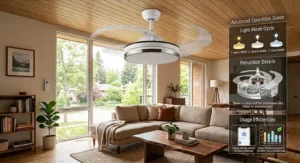
Not every dining room wants crystal and chrome. CROSSIO’s rustic take pairs the same retractable blade mechanism with a blackened metal cage shade that leans hard into industrial-farmhouse styling — the kind of fixture that looks equally at home over a reclaimed wood dining table or in a converted barn-style kitchen.
The retractable blades disappear behind the cage design when off, which is a clever bit of visual engineering: most industrial-style fans look bulky and obvious, but this one hides its mechanical nature until you actually need the airflow. Based on the spec comparison with the crystal-style fandeliers above, this is clearly the pick for anyone whose décor leans rustic rather than glam. Reviewer sentiment frequently praises the aesthetic fit for farmhouse kitchens and dens, with a common complaint centred on the exposed bulb sockets requiring separately purchased bulbs, which some buyers find they discover only after unboxing.
If your dining room ceiling fixture needs to match shiplap and reclaimed wood rather than crystal and gold trim, this is your best-fit option on this list.
Pros:
- ✅ Industrial cage design conceals the fan mechanism convincingly
- ✅ Matches farmhouse and rustic dining room décor specifically
- ✅ Remote-controlled 3-speed operation with dimmable option
Cons:
- ❌ Bulbs are sold separately, a detail some buyers miss
- ❌ Style is narrowly suited to rustic/industrial interiors only
You’ll typically find it priced around C$210-C$330, positioning it as accessible mid-range with a distinctive look.
7. Fanaway Fraser 48″ Retractable Ceiling Fan with Light — best dining room ceiling fixture
The Fraser wraps Fanaway’s proven retractable engine in a PVC linen drum shade with an acrylic diffuser, producing soft, even light that’s genuinely well-suited to the dining room ceiling fixture role rather than the living-room-statement-piece role most of the other entries chase.
Available with either an oil-rubbed bronze motor and amber blades or a white motor with clear blades, it’s designed to blend into a room’s existing palette rather than dominate it — a deliberate design choice for buyers who want function over flash. The reversible AC motor supports both summer cooling and winter heat-circulation modes, and reviewers consistently highlight how evenly the drum shade diffuses light across a table setting compared to exposed-bulb designs. What the spec sheet won’t tell you, but owners report, is that the linen shade can show dust more visibly than acrylic alternatives, so it benefits from the same gentle seasonal cleaning routine you’d give any fabric-shaded fixture.
Choose the Fraser specifically if your dining room needs even, glare-free lighting over the table alongside genuine cooling, rather than a fixture built primarily to be looked at.
Pros:
- ✅ Soft, even light diffusion ideal for dining table illumination
- ✅ Reversible AC motor for year-round comfort
- ✅ Two finish options to match bronze or white colour schemes
Cons:
- ❌ Linen shade shows dust more than acrylic alternatives
- ❌ Less visually dramatic than the crystal-accented options
Expect pricing around C$380-C$500, a mid-to-premium range justified by the dedicated dining-room engineering.
How to Install and Maintain Your Retractable Blade Ceiling Fan
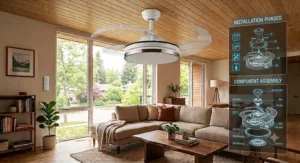
Getting a retractable ceiling fan light fixture installed correctly matters more than with a standard fan, since the retracting mechanism needs unobstructed clearance to swing the blades open without striking the housing, a light shade, or nearby furniture.
Start by confirming your ceiling box is rated for fan support — in Canada, this is a legal requirement, not a suggestion, and it’s covered under the fan-support outlet box rules in the Canadian Electrical Code. A standard light-only box isn’t rated for the vibration and weight load of a spinning fan, so if you’re converting a pendant light location to a fan, you’ll likely need an upgraded box before anything else happens. Most provinces don’t require a permit for a straightforward fan swap in an existing electrical location, but hiring a licensed electrician is strongly recommended given the added mechanical complexity of a retractable design, particularly for anyone not confident working with wiring.
During the first 30 days, run the fan through a handful of full retract-and-deploy cycles at each speed setting before considering the installation “done” — this surfaces any blade alignment issues while you can still adjust mounting screws or balance weights easily. A common early mistake is skipping the reverse-mode test; every model on this list includes a summer/winter switch, and confirming it actually reverses airflow direction now saves a service call in January. For ongoing maintenance, wipe blades with a dry microfibre cloth roughly once a season — the retracting design actually collects less dust than exposed traditional blades since they’re only exposed while spinning, but crystal-accented models like the OUKANING need a bit more frequent attention since dust shows more visibly against reflective surfaces.
Which Fandelier Fits Your Room? Real-World Scenarios
Picture a young couple furnishing their first condo — 850 square feet, 8-foot ceilings, and a dining nook that doubles as a home office two days a week. For them, the AHAWILL 42″ Low Profile is the obvious match: its slim housing won’t feel oppressive in a lower ceiling, and app scheduling means the fan can be running quietly before they even walk in the door on a hot afternoon.
Now imagine a family renovating a century home with a formal dining room, 10-foot ceilings, and a long farmhouse table inherited from a grandparent. The CROSSIO Rustic Fandelier suits that space specifically — its industrial cage aesthetic won’t clash with reclaimed wood and exposed brick, and the taller ceiling gives the fixture room to breathe without crowding anyone’s sightline across the table. Finally, consider a design-forward homeowner staging a house for sale, prioritizing visual wow-factor in the main living space above all else. The OUKANING Crystal Fandelier or the Fanaway Evo1 both deliver strong “showing” appeal, since buyers touring a home respond to visual statement pieces even more than to airflow specs they’ll never ask about.
Each of these scenarios shares one lesson: match the fixture to the room’s actual ceiling height and existing décor language first, then let fan performance be the tie-breaker between finalists.
🔍 Ready to Narrow It Down?
Compare your ceiling height, room size, and décor style against the options above, then click through to check current availability before deciding — stock and pricing shift often on Amazon.ca, so timing matters. ✨
How to Choose a Retractable Blade Ceiling Fan
- Measure your ceiling height first. Anything under 8 feet points you toward low-profile designs like the AHAWILL; taller ceilings can comfortably handle the full-height Fanaway housings.
- Match blade span to room size. A 42-inch fan suits rooms up to roughly 150 square feet, while 48-inch models handle larger dining or living spaces more effectively.
- Check the motor type. DC motors run quieter and use less electricity long-term, which matters if the fan operates for several hours daily.
- Confirm safety certification. Look specifically for CSA, ULc, or ETLc marks rather than assuming a certification from another country automatically applies in Canada.
- Decide on style priority. Crystal fandeliers suit formal dining rooms; industrial cages suit farmhouse aesthetics; drum shades suit anyone prioritizing even table lighting over visual drama.
- Factor in blade thickness and materials. Reinforced blades, as seen on the GreenEver model, tend to hold up better against wobble over years of daily retraction cycles.
- Budget for professional installation. Even simple ceiling fan installation costs vary; adding a retractable mechanism’s added weight and vibration usually makes professional installation the safer call.
Common Mistakes When Buying a Folding Blade Ceiling Fan
The single most common mistake buyers make with a folding blade ceiling fan is assuming any hidden-blade design will suit a low ceiling — plenty of premium Fanaway-style housings actually need more vertical clearance than a standard flush-mount fan, not less, because the retracted disc still needs room to open outward safely.
A second frequent misstep is ignoring certification labelling entirely. It’s tempting to trust a product photo showing a safety symbol, but reviewers and electricians alike report cases of imported fixtures carrying certifications that don’t actually satisfy Canadian requirements, leaving buyers with a fan no licensed electrician will install. A third mistake involves underestimating assembly complexity — several models in this category, especially crystal-accented ones, ship with incomplete or poorly translated instructions, and buyers who don’t budget extra time (or a YouTube tutorial) for assembly often end up frustrated on install day. Finally, many buyers skip checking whether the fixture’s reverse-airflow function actually works before winter arrives, missing out on a genuine year-round efficiency benefit that these fans are specifically designed to provide.
Retractable Ceiling Fan Light Fixture vs Traditional Ceiling Fan
| Factor | Retractable Ceiling Fan Light Fixture | Traditional Ceiling Fan |
|---|---|---|
| Appearance when off | Reads as a pendant light or chandelier | Blades remain visibly exposed |
| Dust accumulation | Lower — blades only exposed while spinning | Higher — blades collect dust continuously |
| Typical price range | C$180-C$700 | C$60-C$400 |
| Mechanical complexity | Higher (moving retraction parts) | Lower (fixed blade arms) |
| Best for | Design-forward dining/living rooms | Budget-first bedrooms, utility spaces |
The core trade-off here is honest: a retractable ceiling fan light fixture asks you to pay more upfront and accept slightly more mechanical complexity, in exchange for a fixture that looks intentional and stylish around the clock rather than only while it’s spinning. Traditional fans remain the more budget-friendly, lower-maintenance option for spaces like basements or laundry rooms where design impact matters less than simple, reliable airflow. If your ceiling fixture doubles as a design centrepiece — which is almost always the case in a dining room — the retractable category earns its premium.
Fandelier & Chandelier Ceiling Fan Combos for the Dining Room
The dining room ceiling fixture decision is where this category shines brightest, because it’s the one room in most homes where lighting design and cooling function genuinely compete for the same real estate above the table. A chandelier ceiling fan combo like the OUKANING model resolves that competition directly, letting a single fixture handle both jobs without forcing a compromise between “elegant” and “functional.”
Sizing matters enormously here. A widely cited guideline from Canadian lighting retailers suggests hanging the fixture roughly 36 inches above the tabletop on a standard 8-foot ceiling, adjusting upward by a few inches for every additional foot of ceiling height — and that a fandelier’s diameter should generally span half to two-thirds of the table’s width to look proportional rather than lost or overwhelming. Ottawa-based lighting retailer Arevco recommends a minimum six-inch gap between the fixture’s edge and the table’s edge as a baseline rule worth following before you drill a single hole. For dining rooms specifically, prioritize even light diffusion (the Fanaway Fraser’s drum shade is purpose-built for this) unless the room is purely for entertaining and visual drama takes priority over practical table lighting.
💬 Found your dining room match? A quick click gets you current pricing before it changes!
Safety, CSA Certification & Electrical Code for Ceiling Fans in Canada
Every fixture on this list eventually connects to your home’s wiring, and that’s where Canadian rules diverge meaningfully from what you’ll read on a US-focused Amazon listing. Electrical products sold for installation in Canada legally require certification from an accredited body — commonly CSA Group, ULc, or Intertek/ETLc — and a certification earned in another country doesn’t automatically transfer, regardless of how the product markets itself.
Natural Resources Canada also enforces federal energy efficiency regulations specifically covering ceiling fans and ceiling fan light kits, meaning manufacturers must report standby power consumption and lighting efficacy data before a model can legally be sold here — worth knowing if you’re comparing an obscure import brand against an established one. On the installation side, provincial electrical codes generally require fan-support-rated ceiling boxes and, in most jurisdictions, recommend or require a licensed electrician for anything beyond a straightforward swap of an existing fixture. This isn’t bureaucratic box-checking for its own sake — a retractable mechanism adds vibration and moving mass that an under-rated ceiling box simply wasn’t designed to handle, and the consequences of skipping this step range from a wobbling fixture to a genuine fire risk.
Long-Term Cost & Maintenance of Hidden Blade Ceiling Fans
The upfront price tag is only part of the ownership story. ENERGY STAR certified ceiling fans use roughly 60% less energy on average than standard models according to Natural Resources Canada, and pairing a fan with your air conditioning to bump the thermostat a couple of degrees can meaningfully cut summer cooling costs — a benefit that applies whether your fan is retractable or traditional, but that’s easy to forget when you’re focused on aesthetics.
Ceiling fan hidden blades designs carry one underappreciated long-term advantage: because blades only extend during operation, they accumulate noticeably less dust and grime over years of use than an exposed traditional fan, which translates to less frequent deep-cleaning and, for allergy-prone households, meaningfully better air quality between cleanings. On the maintenance-cost side of the ledger, DC-motor models like the AHAWILL and GreenEver entries typically outlast and outperform older AC motors on electricity draw over a five-to-ten-year ownership window, even though the upfront sticker price sometimes runs comparable. Factor in bulb replacement costs too — LED-integrated fixtures rarely need bulb swaps for years, while models with separate E12 or E26 sockets (like the CROSSIO) will need occasional bulb purchases, a small but real recurring cost most buyers don’t budget for.
Frequently Asked Questions
❓ Do retractable blade ceiling fans use more electricity than regular fans?
❓ Can I install a retractable ceiling fan light fixture myself?
❓ Are fandelier ceiling fans as powerful as traditional ceiling fans?
❓ What size retractable blade ceiling fan do I need for my dining room?
❓ Do folding blade ceiling fans collect less dust than regular fans?
Conclusion
A retractable blade ceiling fan isn’t just a novelty — it’s a genuinely practical answer to the old tension between wanting a beautiful ceiling fixture and needing real airflow in a room. Whether you land on the original Fanaway Classic, a budget-friendly low-profile AHAWILL for a condo with modest ceilings, or a full chandelier ceiling fan combo like the OUKANING for a formal dining room, the right choice comes down to matching ceiling height, room size, and décor style before chasing the flashiest feature list.
Don’t skip the boring-sounding parts, either: confirming genuine Canadian certification and hiring a licensed electrician for installation will save you far more hassle than any amount of research into blade colour options. Get those fundamentals right, and a retractable blade ceiling fan becomes one of those rare upgrades that looks good in every photo and actually does its job every single day.
✨ Ready to Upgrade Your Ceiling?
Browse today’s top-rated retractable blade ceiling fans and check current pricing before your favourite sells out. Your dining room (and your electricity bill) will thank you! 🌀💡
Recommended for You
- Modern Bladeless Ceiling Fan: 7 Best Picks for Canadians in 2026
- Enclosed Ceiling Fan Guide: 7 Safest Picks for Canadian Homes (2026)
- 6 Blade Ceiling Fan: 7 Honest Picks for Canadian Homes in 2026
Disclaimer: This article contains affiliate links. As an Amazon Associate, I earn from qualifying purchases. If you purchase products through these links, we may earn a small commission at no additional cost to you.
✨ Found this helpful? Share it with your friends! 💬🤗
