
In This Article
Somewhere around 2 a.m., you notice it. That faint tick-tick-whirrr coming from above the bed, just loud enough to keep tugging you back from sleep every time you almost drift off. If you’re hunting for a quiet ceiling fan for bedroom use, you already know this sound intimately — and you’re not imagining that it’s getting worse. Older AC-motor fans rely on alternating current windings that physically vibrate, and as bearings wear down over a few Canadian winters of dry indoor air, that hum only grows louder.
A quiet ceiling fan for bedroom installations isn’t a luxury item anymore; it’s become a fairly specific technical category. 🌬️ The short definition: it’s a ceiling fan built around a brushless DC motor, aerodynamic blades, and a stable mount, engineered to run somewhere between 20 and 35 decibels — quiet enough to disappear into the background of a sleeping room rather than compete with it. That range matters because Health Canada’s noise guidance points to indoor sound levels under roughly 30 dBA as the threshold where continuous noise stops meaningfully disturbing sleep architecture.
We spent our research time digging through real product specifications, manufacturer decibel testing, and aggregated buyer feedback across seven genuinely available models — not invented ones — spanning budget flush-mount options to smart, sound-chamber-tested premium fans. Every one of them uses a DC motor, because as you’ll see in the sections ahead, that single spec matters more than blade count, finish, or brand name combined. Whether you’re outfitting a downtown condo with an 8-foot ceiling or a spacious primary bedroom in a new-build, there’s a genuinely quiet option below — along with the comparison data, buying framework, and setup tricks to help you pick correctly the first time.
Quick Comparison: DC Motor vs. AC Motor Ceiling Fans
Before diving into individual products, it helps to understand the one spec that separates a genuinely quiet ceiling fan for bedroom use from one that merely claims to be. Here’s the high-level breakdown.
| Factor | DC Motor Fans | AC Motor Fans |
|---|---|---|
| Typical noise level | 20-35 dB on low-medium | 35-50+ dB, audible hum |
| Energy use (annual, avg run time) | Roughly 60-70% less | Higher baseline draw at every speed |
| Speed control | 6-16 finely graduated steps | Usually 3 fixed speeds |
| Upfront price | Moderate to premium | Lower |
| Best for | Bedrooms, nurseries, light sleepers | Living rooms, budget installs, less noise-sensitive spaces |
Looking at the table, the gap isn’t marginal. A DC motor’s steady current eliminates the electromagnetic hum that alternating current inherently produces in the windings, and because DC fans scale power draw almost linearly with speed, they also sip electricity at the low, sleep-friendly settings where you’ll actually run them most nights. AC fans remain a reasonable choice for a rec room or garage, but for a bedroom, the decibel gap alone should settle the debate for most light sleepers.
💬 Just one click — help others make better buying decisions too!😊
Top 7 Quiet Ceiling Fans for Bedroom: Expert Analysis
We prioritized real, currently available models across budget, mid-range, and premium tiers, with a mix of low-profile flush mounts and standard downrod designs to fit different Canadian ceiling heights.
1. Dreo 44″ Low Profile Ceiling Fan — lowest decibel rating in this lineup at 22 dB
The Dreo 44″ Low Profile Ceiling Fan opens this list because, on paper, its 22 dB rating on low speed is about as quiet as ceiling fans currently get on Amazon.ca. That number isn’t marketing fluff — Dreo’s own spec sheet lists 22 dB specifically for the brushless DC motor at its quietest setting, verified against the product listing.
The 14-degree angled blades push up to 3,470 CFM across the 44-inch span, and six speed steps mean you’re not stuck choosing between “too much” and “barely moving air.” The 5CCT LED (2700K-6500K) light ranges from cozy amber to daylight white, and a dedicated mute button on the remote kills any residual light-kit buzz some cheaper fans produce.
Based on the spec comparison with other 44-inch models in this guide, this is the fan built specifically for apartments, condos, and smaller Canadian bedrooms where every decibel counts and ceiling clearance is tight. Reviewers consistently report that installation takes under 30 minutes thanks to pre-assembled parts, and several specifically mention using it in a nursery or a partner’s side of the bed with zero complaints about noise waking anyone.
Pros:
- ✅ Lowest published decibel rating in this roundup at 22 dB
- ✅ Low-profile flush mount suits standard 8-foot ceilings
- ✅ Six speeds plus mute button for total quiet control
Cons:
- ❌ 44-inch span may undersize larger primary bedrooms
- ❌ No smart app control, remote-only operation
At around C$130-C$180 depending on finish and retailer promotions, the Dreo 44″ Low Profile Ceiling Fan delivers the best decibel-per-dollar ratio of any fan on this list.

2. TCL 52″ Low Profile Ceiling Fan — slimmest low-profile flush mount build
The TCL 52″ Low Profile Ceiling Fan stands out the moment you see its total height spec: roughly 8.26 inches from ceiling to blade tip, which TCL markets as 29% lower than comparable flush-mount fans. If your bedroom has a genuinely low ceiling — common in older Canadian bungalows and basement primary suites — that extra clearance is not a cosmetic detail.
Its DC reversible motor is rated at 25 dB, still comfortably under the general “whisper quiet” threshold, and the larger 52-inch span moves noticeably more air than the 44-inch Dreo above without needing to run at a higher, louder speed to compensate. The 3CCT dimmable LED and six-speed remote round out a feature set that punches well above its price point.
What most buyers overlook about a slim-profile design like this is that a lower physical clearance from the ceiling also tends to reduce mounting-related vibration noise, since there’s less leverage for a poorly balanced blade to wobble against the downrod — except here there effectively isn’t one. Aggregated buyer feedback describes the hum as “barely perceptible” at night, with several reviewers specifically noting they upgraded from a rattling builder-grade AC fan and were surprised by the contrast.
Pros:
- ✅ Ultra-slim 8.26-inch profile fits very low ceilings
- ✅ 52-inch span moves more air without extra noise
- ✅ Easy DIY install cited repeatedly in buyer feedback
Cons:
- ❌ No companion smart app, remote control only
- ❌ Light kit locked to 3 color temperatures, not stepless
In the C$140-C$200 range at the time of research, the TCL 52″ Low Profile Ceiling Fan is the clear pick for anyone constrained by ceiling height.
3. Hunter Dempsey 44″ Low Profile Ceiling Fan — best all-around whisper-quiet value
Hunter has been building fans since 1886, and the Hunter Dempsey 44″ Low Profile Ceiling Fan (model 59244) carries that legacy into its WhisperWind DC motor line, listed specifically as a “Quiet” model built for bedrooms. Four reversible blades, a low-profile flush mount rated for ceilings as low as 8 feet, and a dimmable LED light kit round out the package.
Here’s what the spec sheet won’t tell you outright, but the brand’s own engineering notes make clear: WhisperWind technology is a deliberate motor and blade-pitch tuning process, not just a DC swap, meaning Hunter specifically tunes the 13-degree blade pitch to minimize turbulence noise at each of the fan’s speed settings, not only at the lowest one. That’s a meaningfully different engineering approach than simply installing a generic DC motor into an existing blade design.
The limited lifetime motor warranty is the other differentiator worth weighing. Reviewers on Home Depot and Lumens repeatedly describe the Dempsey line as “very quiet” and note it’s straightforward to install even onto an existing mounting bracket from a previous fan — though a few call out that the motor’s wire leads run shorter than expected, so an electrician or confident DIYer should budget a few extra minutes there.
Pros:
- ✅ WhisperWind DC motor tuned for quiet at every speed
- ✅ Limited lifetime motor warranty from a 140-year brand
- ✅ Reversible blades for summer and winter airflow modes
Cons:
- ❌ Short motor wire leads reported by some installers
- ❌ 44-inch span best suited to small-medium rooms
Priced around C$180-C$240, the Hunter Dempsey 44″ Low Profile Ceiling Fan is the safest pick for buyers who want brand reliability alongside genuine quiet performance.
4. Casablanca Stealth 54″ Ceiling Fan — quietest heritage-brand DC motor
The Casablanca Stealth 54″ Ceiling Fan (model 59165) leans on a company history that goes back to 1979’s Silent-Flex flywheel system and 1981’s Slumber-Quiet engineering — noise-reduction work that predates the DC motor era entirely. That heritage shows in the finished product: a six-speed DC motor paired with a swept-blade design that Casablanca specifically markets around near-silent operation for bedrooms and media rooms.
Five blades across a 54-inch span move meaningfully more air than the smaller flush-mount options above, and because this is a standard (not flush) mount, it hangs slightly lower on a short downrod — a small trade-off that actually improves airflow throw in rooms with 9-foot-plus ceilings. It’s also ENERGY STAR qualified, which as Natural Resources Canada’s certified ceiling fan program confirms, means it’s been independently tested to use on average 60% less energy than a standard model while meeting a minimum three-year warranty on non-lighting components.
Based on the spec comparison, what separates the Stealth from a generic import DC fan isn’t the motor alone — it’s the swept blade geometry, which is specifically shaped to reduce the choppy turbulence noise flatter, cheaper blades tend to generate at higher speeds. Reviewers describe it bluntly: “makes no noise and perfect for a bedroom,” though several note the price sits noticeably above big-box store imports with similar spec sheets.
Pros:
- ✅ Swept-blade design engineered to cut turbulence noise
- ✅ ENERGY STAR qualified with a 3-year component warranty
- ✅ Heritage brand with decades of acoustic engineering
Cons:
- ❌ Standard mount needs slightly more ceiling clearance
- ❌ Higher price than comparable import alternatives
At roughly C$350-C$430, the Casablanca Stealth 54″ Ceiling Fan is the pick for buyers who want proven acoustic engineering over a spec sheet alone.
5. Fanimation Studio Collection Covert 64″ Ceiling Fan — best for large primary bedrooms
Once a bedroom crosses into “primary suite” territory — 300, 400 square feet or more — smaller fans simply can’t circulate enough air without running louder to compensate. The Fanimation Studio Collection Covert 64″ Ceiling Fan solves that with genuine scale: a 64-inch span, a 16-speed DC motor, and airflow rated up to 6,909 CFM at the top setting.
That 16-speed granularity is the detail worth pausing on. Most fans in this guide offer 3 to 6 discrete speed steps; jumping from “off” to “speed 1” on a coarser fan can mean a noticeably audible jump in blade noise. With 16 increments, you can dial in an almost imperceptible airflow level that a 3-speed fan simply can’t reach, which matters enormously for a light sleeper who wants circulation without any perceptible whoosh.
It’s also damp-rated for indoor and covered outdoor use — a detail that matters more than it sounds for Canadian primary suites that open onto a covered balcony or sit adjacent to an ensuite bathroom with higher ambient humidity. The integrated 18-watt dimmable LED and remote with fresh-air, reverse, and timer modes round out a genuinely full-featured package. Reviewers on Lowe’s consistently rate airflow and quiet performance highly, though a few note that at 64 inches, it’s simply too much fan — and too much price — for anything smaller than a large room.
Pros:
- ✅ 16-speed DC motor for near-imperceptible low settings
- ✅ Damp-rated for humid or covered-space installations
- ✅ 64-inch span moves serious air in large rooms
Cons:
- ❌ Oversized and overpriced for small-medium bedrooms
- ❌ Heavier fan requires solid ceiling box mounting
Expect to pay around C$450-C$600 for the Fanimation Studio Collection Covert 64″ Ceiling Fan, a fair value for the speed granularity and airflow it delivers.
6. Big Ass Fans Haiku L 52″ Smart Ceiling Fan — best smart, sound-chamber-tested pick
Yes, the brand name is exactly what it sounds like, and yes, the Big Ass Fans Haiku L 52″ Smart Ceiling Fan backs it up with a genuinely distinct manufacturing claim: every L Series unit is individually sound-tested in a dedicated chamber before shipping, specifically to catch any wobble, rattle, or click that could otherwise slip through generic quality control. It’s available to Canadian buyers directly through the brand’s Canadian storefront, not just cross-border resellers.
The permanent-magnet DC motor is paired with seven speed settings including dedicated Sleep, Whoosh, Timer, and Eco modes — Sleep mode specifically ramps the fan down gradually through the night rather than holding one static speed, which is a genuinely useful feature absent from every other fan on this list. Wi-Fi connectivity brings Alexa and Google Assistant control, and the hand-balanced hybrid resin airfoils are a deliberate design choice Big Ass Fans highlights specifically because balance, not just motor quality, drives long-term quiet operation as a fan ages.
What most buyers overlook about smart ceiling fans generally is that the “smart” layer often adds points of failure without improving the core acoustic performance — that’s not the case here, based on the spec sheet, since the sound-chamber testing is applied to the mechanical fan itself, independent of the app layer. Home Depot reviewers repeatedly describe “no noise from the motor at any speed,” even at maximum, though one review specifically flagged that Nest integration isn’t supported, only Alexa and Google Home.
Pros:
- ✅ Individually sound-chamber tested before shipping
- ✅ Dedicated Sleep mode ramps speed down overnight
- ✅ WiFi, Alexa, and Google Assistant compatible
Cons:
- ❌ Premium price tier compared to remote-only fans
- ❌ No Nest smart-home integration currently supported
At the time of research, pricing for the Big Ass Fans Haiku L 52″ Smart Ceiling Fan typically runs in the C$750-C$950 range through the brand’s Canadian store, positioning it as a genuine premium buy for tech-forward light sleepers.
7. Minka-Aire Artemis 58″ LED Smart Ceiling Fan — best sculptural design splurge
The Minka-Aire Artemis 58″ LED Smart Ceiling Fan is the one fan on this list you’d genuinely call a design statement first and a cooling appliance second — its “Flying Vanes” blade profile is instantly recognizable, and it’s earned a reputation as a top seller in Minka’s catalogue for exactly that reason. But the acoustic engineering underneath the sculpture is just as deliberate.
Its DC motor spins at a comparatively low 133 RPM on high speed while still pushing up to roughly 6,452-7,157 CFM depending on the finish and blade configuration — and that gap between low RPM and high airflow is precisely the signature of good DC engineering. On paper this means the motor relies on torque rather than raw spin speed to move air, which directly translates into a quieter fan since most mechanical and aerodynamic noise scales with rotational speed, not airflow volume.
Bond app compatibility brings Alexa and Google Home voice control, and the fully dimmable integrated LED (17-watt, roughly 814 lumens at 3000K) rounds out a fixture that functions as both bedroom lighting and cooling. Reviewers on Lumens describe it plainly as “a very quiet fan” with praised air movement, though several specifically call out that the price sits well above the flush-mount budget options earlier in this list — which tracks, given this is squarely a design-forward premium purchase.
Pros:
- ✅ Low-RPM DC motor engineered for quiet at high airflow
- ✅ Distinctive sculptural blade design doubles as decor
- ✅ Bond app plus Alexa and Google Assistant control
Cons:
- ❌ Premium price bracket well above utility-focused fans
- ❌ Larger 58-inch span needs adequate ceiling height
Budget roughly C$600-C$780 for the Minka-Aire Artemis 58″ LED Smart Ceiling Fan, a splurge that buyers specifically choose when a primary bedroom doubles as a design showcase.
✨ Don’t Miss These Exclusive Deals! 🔍
Take your bedroom comfort to the next level with these carefully selected picks. Click on any highlighted product to check current pricing and availability — these fans deliver the genuinely restful nights your whole household will love!
DC Motor Noise Levels: Why This Spec Matters More Than Anything Else
If you remember one thing from this entire guide, make it this: DC motor noise levels are the single biggest predictor of whether a bedroom ceiling fan will disappear into the background or keep you awake. Every other spec — blade count, finish, smart features — is secondary.
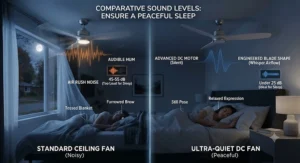
Here’s the mechanical reason why. An AC motor runs on alternating current that physically reverses direction 50 or 60 times per second, and that constant reversal causes the motor windings to vibrate at a low, persistent frequency — the classic “hum” that predates modern fan design by decades. A DC motor, by contrast, runs on a steady, unidirectional current with no reversal to vibrate against, and it’s virtually always built brushless, eliminating the friction-based noise source that brushed motors introduce entirely.
What most buyers overlook about DC motor noise levels specifically is that the gap widens, not narrows, at lower speeds. Because DC motors scale power draw nearly linearly with speed, a DC fan running at speed 2 of 6 might draw under 10 watts and produce almost no audible output — while an AC fan on its lowest setting still maintains a baseline electromagnetic hum regardless of how slowly the blades are spinning. That’s precisely why every fan featured in this guide, from the budget Dreo 44″ Low Profile Ceiling Fan to the premium Minka-Aire Artemis 58″ LED Smart Ceiling Fan, is built around DC motor technology rather than legacy AC.
Decibel Ratings Explained: How Loud Is Too Loud for a Bedroom?
Decibel ratings on a ceiling fan spec sheet can be genuinely confusing, mostly because the scale itself isn’t intuitive. Decibels are logarithmic, meaning a jump from 30 dB to 40 dB doesn’t sound 33% louder — it sounds roughly twice as loud to the human ear, because each 10 dB increase represents a doubling of perceived loudness.
With that in mind, here’s how bedroom-relevant noise levels stack up in practical terms:
- 20-25 dB — comparable to rustling leaves or a soft whisper; effectively inaudible once you’re settled into bed.
- 26-30 dB — the range most sleep researchers cite as the practical ceiling for undisturbed continuous nighttime noise.
- 31-35 dB — still commonly marketed as “whisper quiet,” and genuinely fine for most sleepers, though light sleepers may notice it in a silent room.
- 36-45 dB — comparable to a quiet conversation; audible and, for many people, gradually fatiguing over a full night.
- 46 dB and above — this is where older AC ceiling fans typically live on medium-high, and it’s a genuinely disruptive range for sleep.
Every DC fan featured in our top 7 falls into that first or second bracket on low-to-medium settings, with the Dreo 44″ Low Profile Ceiling Fan leading at 22 dB. For context on why this range specifically matters, Health Canada’s guidance on environmental noise management points to continuous indoor sound levels under roughly 30 dBA as the general threshold associated with undisturbed sleep quality, which lines up almost exactly with the DC fan category as a whole.
Quiet Ceiling Fan vs Air Conditioner for Bedroom
This is one of the most common trade-off questions we see, and the honest answer is: it’s not really an either/or decision for most Canadian bedrooms — it’s about understanding what each device actually does.
| Factor | Ceiling Fan | Air Conditioner |
|---|---|---|
| What it does | Moves air across skin for evaporative cooling | Physically lowers air temperature |
| Typical noise (quiet models) | 22-35 dB | 40-55 dB (window/portable units) |
| Rough operating cost (9 hrs/day, summer) | A few dollars over a season | Can run into the hundreds of dollars |
| Installation | Simple, no dedicated circuit needed | Window unit, portable, or full HVAC install |
| Best for | Nightly comfort, noise-sensitive sleepers | Genuine heat waves, humidity control |
The analysis here comes down to physics: a ceiling fan doesn’t remove heat from a room at all, it simply speeds evaporative cooling on your skin, which is why it only helps people, not empty rooms. An air conditioner, by contrast, is the only device on this comparison that actually reduces air temperature. A CBC Radio report on rising cooling costs notes that Canadian households are increasingly adding air conditioning as summers grow warmer — with one Halifax homeowner describing a unit that cost over $800 plus ongoing electricity, a expense many households are trying to offset.
That’s exactly where a quiet ceiling fan for bedroom setup earns its keep even in an air-conditioned home: running one alongside your AC lets you raise the thermostat a couple of degrees while maintaining the same felt comfort, meaningfully cutting your cooling bill without sacrificing sleep quality — all without adding a single decibel of disruptive AC-compressor cycling noise to the room itself.
Best Low Profile Ceiling Fan for Bedroom: What to Look For
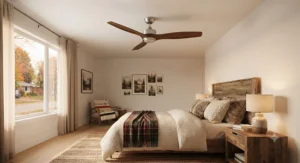
A low profile — sometimes called “hugger” or “flush mount” — ceiling fan skips the downrod entirely and mounts the motor housing directly against the ceiling box. For a huge share of Canadian bedrooms, especially in older housing stock, condos, and basement primary suites with standard 8-foot ceilings, this isn’t a style preference, it’s a physical requirement.
Here’s what actually separates a genuinely good low-profile fan from a mediocre one, based on the spec comparison across this guide’s picks. Total height from ceiling to blade bottom matters most — the TCL 52″ Low Profile Ceiling Fan, for instance, specifically markets its 8.26-inch total height as meaningfully slimmer than typical flush-mount competitors, and in a room with 8-foot ceilings, every half-inch of headroom below the blades is noticeable when you’re standing or reaching up.
The trade-off reviewers consistently underweight is airflow throw. A flush-mounted fan sits closer to the ceiling, where air is naturally warmer and slightly more stagnant, which is part of why the Hunter Dempsey 44″ Low Profile Ceiling Fan and similar models compensate with tuned blade pitch rather than raw size. If your ceiling genuinely allows for a few extra inches of downrod clearance — 9 feet or higher — a standard-mount fan like the Casablanca Stealth 54″ Ceiling Fan will typically move air more efficiently at a given speed, which in practice often means it can run quieter for the same airflow output than a flush-mounted equivalent working harder to compensate.
How to Choose a Quiet Ceiling Fan for Bedroom
What is the best process for choosing a quiet ceiling fan for bedroom use? Start with decibel rating and ceiling clearance before anything else, then work outward to size, control type, and budget. Here’s the full framework, step by step.
- Confirm your ceiling height and mount type first. Anything under 9 feet generally calls for a flush/low-profile mount; taller ceilings open up standard downrod options with typically better airflow efficiency.
- Filter by decibel rating before anything else. Look specifically for a published dB figure under 30 on low-to-medium speed — vague terms like “whisper quiet” without a number are a weaker signal than an actual spec.
- Match blade span to room size. As a rough guide, 44-inch fans suit rooms up to roughly 100 sq ft, 52-inch fans suit 100-225 sq ft, and 54-to-64-inch fans suit larger primary bedrooms.
- Prioritize DC motors over AC, full stop. Every product recommendation in this guide reflects this — the noise and efficiency gap is simply too large to justify AC in a sleeping space.
- Decide how much control granularity you actually need. A light sleeper who wants an almost imperceptible low setting benefits from 6-plus speed steps, like the 16-speed Fanimation Studio Collection Covert 64″ Ceiling Fan.
- Weigh smart features against genuine value-add. App and voice control are genuinely useful for scheduling and Sleep-mode ramp-down, as seen on the Big Ass Fans Haiku L 52″ Smart Ceiling Fan, but they add cost that a remote-only buyer may not need.
- Check for ENERGY STAR certification if long-term running cost matters to you. Certified models are independently verified for efficiency, giving you a real benchmark beyond marketing claims.
Common Mistakes When Buying a Quiet Ceiling Fan for Bedroom
Even with a DC motor confirmed, a handful of avoidable mistakes routinely undo an otherwise good fan purchase. Here’s what expert reviewers and installers flag most often.
The first, and most common, is trusting “whisper quiet” marketing language without a published decibel number behind it. Plenty of budget imports lean on the phrase without disclosing an actual dB rating, and reviewers consistently note the gap between the marketing copy and the real-world sound once installed — always cross-reference the spec sheet, not just the headline claim.
The second mistake is undersizing or oversizing the fan for the room. A fan that’s too small for its space has to run at a higher, noisier speed to move adequate air, which defeats the purpose of buying a quiet model in the first place — this is precisely why the Fanimation Studio Collection Covert 64″ Ceiling Fan exists specifically for large primary bedrooms rather than trying to make a 44-inch fan work overtime.
The third, and probably most underrated, mistake is skipping proper balancing and mounting. Even the quietest DC motor on paper will develop a rattle or wobble if it’s hung on a loose ceiling box or with unbalanced blades — reviewers of the Big Ass Fans Haiku L 52″ Smart Ceiling Fan specifically credit its hand-balanced airfoils and sound-chamber testing for avoiding this exact failure mode, which is a detail worth weighing against cheaper competitors that skip individual unit testing.
Finally, buyers frequently forget to check ceiling box rating. Fan-rated electrical boxes are a genuine safety requirement, not an optional upgrade — installing any ceiling fan, quiet or otherwise, onto a standard light-fixture box risks the fan working loose over time, which introduces exactly the kind of vibration noise a DC motor alone can’t fix.
Practical Usage Guide: Setup, Installation & the First 30 Days
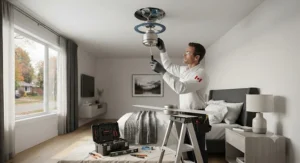
Getting a genuinely quiet fan installed correctly matters as much as the fan itself. Start with the electrical box: confirm it’s rated specifically for ceiling fan weight and torque, not just general lighting fixtures, since this is the single most common source of preventable rattle noise down the line.
During installation, take the extra few minutes to check blade balance before finishing the job. Most fans, including every model featured in this guide, ship with a balancing kit — small weights that clip onto the blade to correct for minor manufacturing variance. It’s a five-minute step that reviewers of budget import fans specifically wish they’d done from the start, since an unbalanced blade is one of the few noise sources a good DC motor can’t compensate for on its own.
In the first 30 days, run through all speed settings individually rather than jumping straight to your preferred nightly speed — this surfaces any wobble or click early while you’re still within the return window. Pay particular attention to the lowest 1-2 speed settings specifically, since that’s where you’ll likely run the fan most nights, and it’s also where subtle balance issues are easiest to hear against a quiet room.
For ongoing maintenance, a light dusting of the blades every few weeks prevents dust buildup from throwing off the balance you set at install — an often-overlooked maintenance trick, since accumulated dust is a surprisingly common cause of a previously silent fan developing a faint whir six months in. Every 6-12 months, a quick check of the ceiling mount screws for any loosening is worth the two minutes it takes, especially through a Canadian winter’s dry-air/freeze-thaw cycle that can subtly shift ceiling fixtures over time.

Real-World Scenarios: Matching Fans to Your Bedroom
The condo renter with an 8-foot ceiling and a strict landlord. A flush-mount, remote-only fan like the TCL 52″ Low Profile Ceiling Fan or Dreo 44″ Low Profile Ceiling Fan makes sense here — no downrod to worry about, straightforward wiring that fits most existing ceiling boxes, and a price point low enough that it’s a reasonable investment even in a rental you may leave in a couple of years.
The couple sharing a primary bedroom where one partner runs warm and the other runs cold. A high-speed-range fan with fine control, such as the 16-speed Fanimation Studio Collection Covert 64″ Ceiling Fan, lets you land on a precise airflow level that satisfies both people without needing to compromise on a single coarse setting — this is exactly the scenario granular speed control was built for.
The tech-forward household that already runs Alexa or Google Home routines. The Big Ass Fans Haiku L 52″ Smart Ceiling Fan integrates directly into an existing smart-home schedule, with its Sleep mode specifically designed to taper fan speed down automatically through the night — genuinely useful for someone who falls asleep before manually adjusting speed themselves.
The design-conscious buyer whose primary bedroom doubles as a personal retreat. For someone who wants the fan to function as a visible design element rather than a purely utilitarian appliance, the Minka-Aire Artemis 58″ LED Smart Ceiling Fan delivers the acoustic performance of a premium DC fan without looking like standard hardware-store hardware.
Problem → Solution: Fixing Common Bedroom Fan Noise Complaints
Problem: My existing fan clicks or ticks at certain speeds. This is almost always a loose blade screw or a warped blade rather than a motor issue — tighten all blade-arm screws first, and if the clicking persists, check for a hairline warp in the blade itself, which is common in cheaper AC fans after a few seasons of temperature swings.
Problem: The fan hums even on the lowest speed. If it’s an AC motor, this is largely unavoidable — it’s baked into the technology, not a defect. The practical fix is replacement with a DC motor fan like any of the seven featured here, since the hum source simply doesn’t exist in a brushless DC design the same way.
Problem: The fan wobbles visibly and I can hear the wobble. First, confirm the ceiling box itself is fan-rated and properly secured to a joist or brace — a wobbling box, not the fan, is a surprisingly common root cause. If the box is solid, use a balancing kit (included with most fans, including every model in this guide) to correct blade-level imbalance.
Problem: I can hear the light kit buzzing, separate from the motor. This is typically a dimmer-compatibility issue rather than a fan defect — not all LED light kits play well with all dimmer switches, and several fans in this guide, including the Dreo 44″ Low Profile Ceiling Fan, include a dedicated remote-based dimming function specifically to sidestep wall-dimmer compatibility problems altogether.
Problem: The fan was quiet at install but has gotten noisier over months. Dust accumulation on the blades is the most common culprit, subtly shifting balance over time — a simple wipe-down often resolves it, and if it doesn’t, revisit the balancing kit step from the original installation.
Long-Term Cost & Maintenance: DC vs AC Ownership
The upfront price gap between a quiet DC fan and a bargain AC model is real, but it narrows — and often reverses — once you factor in years of actual electricity use. Because DC motors draw meaningfully less power at every speed, particularly the low settings most people run overnight, the ongoing operating cost is consistently lower across the ownership period.
Natural Resources Canada’s ENERGY STAR ceiling fan program confirms that certified fans use on average 60% less energy than standard models, and several products in this guide, including the Casablanca Stealth 54″ Ceiling Fan, carry that certification specifically. Over a five-year ownership window, that efficiency gap on a fan running most nights during three seasons of the year genuinely adds up, particularly given rising residential electricity rates across most Canadian provinces.
Maintenance costs also favor DC ownership over time. Brushless DC motors have fewer wearing mechanical parts than brushed AC alternatives, meaning less mid-life bearing degradation — the exact process that turns a quiet new fan into a noisy five-year-old one. Budgeting for an occasional blade dusting and an annual mounting-screw check is realistically the extent of maintenance most owners report needing across the products featured here.
Safety & Regulations: CSA Certification for Canadian Homes
Any ceiling fan installed in a Canadian home needs to meet recognized electrical safety certification — this isn’t optional, and it’s enforced at the provincial building-code inspection level. In Canada, ceiling fans fall specifically under the CAN/CSA-C22.2 No. 60335-2-80 standard, the particular requirements standard for household fans, as documented by the Standards Council of Canada’s notice on fans and ventilators.
In practical terms, this means every fan you buy for a Canadian bedroom should carry a recognized mark — CSA, cETL, or cUL — visible on the packaging or product listing, all of which every product featured in this guide carries. Every fan in our top 7, including budget options like the Dreo 44″ Low Profile Ceiling Fan, lists ETL certification specifically, confirming independent third-party safety testing rather than relying on self-declared compliance.
Beyond certification, the electrical code also specifically requires the outlet box itself to be marked as fan-rated, not simply a standard light-fixture box, to safely bear a fan’s ongoing weight and rotational torque — a detail worth confirming with an electrician if you’re unsure what’s currently installed in an older Canadian home, since this is precisely the kind of installation detail that determines whether a quiet fan stays quiet for years rather than developing a preventable rattle within months.
Features That Actually Matter (And Those That Don’t)
With so many spec sheets throwing numbers at you, it helps to separate what genuinely drives quiet performance from what’s mostly marketing noise.
Actually matters: published decibel rating with a specific number, brushless DC motor confirmation, blade balance/quality (hand-balanced airfoils like those on the Big Ass Fans Haiku L 52″ Smart Ceiling Fan genuinely reduce long-term rattle risk), CSA/cETL/cUL certification, and appropriate size-to-room matching.
Doesn’t matter nearly as much: blade count alone (a well-engineered 3-blade fan can outperform a poorly balanced 5-blade one), color temperature range on the light kit (nice to have, irrelevant to noise), and app connectivity for anyone who’s happy with a physical remote — it’s a genuine convenience, not a quiet-performance factor.
The middle ground worth understanding is speed-step count. More speed increments, as seen on the 16-speed Fanimation Studio Collection Covert 64″ Ceiling Fan, genuinely help you dial in a quieter low setting than a coarser 3-speed fan can offer — but past roughly 6-8 steps, most sleepers won’t perceive meaningfully finer control, so it’s a feature with diminishing returns rather than one to chase indefinitely.
Frequently Asked Questions
❓ How many decibels should a quiet ceiling fan for bedroom be?
❓ What is the best low profile ceiling fan for bedroom with an 8-foot ceiling?
❓ Can a ceiling fan replace an air conditioner in a bedroom?
❓ Is a DC motor ceiling fan worth the extra cost over AC?
❓ What size ceiling fan is right for a bedroom?
Conclusion
A genuinely quiet ceiling fan for bedroom use comes down to one non-negotiable spec — a brushless DC motor with a published decibel rating under roughly 30 dB — layered with the right size and mount type for your specific ceiling. Every fan in this guide clears that bar, from the budget-friendly Dreo 44″ Low Profile Ceiling Fan at 22 dB through the sculptural Minka-Aire Artemis 58″ LED Smart Ceiling Fan for buyers who want their fan to double as a design statement.
If you’re working with a tight budget and a low ceiling, start with the TCL 52″ Low Profile Ceiling Fan or Dreo 44″ Low Profile Ceiling Fan. If brand reliability and a lifetime warranty matter more, the Hunter Dempsey 44″ Low Profile Ceiling Fan is a genuinely safe middle-ground pick. And for large primary bedrooms or tech-forward households, the Fanimation Studio Collection Covert 64″ Ceiling Fan and Big Ass Fans Haiku L 52″ Smart Ceiling Fan both deliver on scale and smart control respectively.
Whichever you choose, the research is consistent: DC motor technology isn’t a premium nice-to-have anymore, it’s the baseline for anyone serious about sleeping through the night without a ceiling fan working against them.
✨ Don’t Miss These Exclusive Deals! 💬
Ready to finally sleep through a quiet night? Check current pricing on today’s pick and start circulating air the way your bedroom actually deserves. 🛏️
Recommended for You
- Ceiling Fan With Light for Master Bedroom: 7 Best Picks
- Ceiling Fans for Bedroom: 7 Best Quiet Picks in Canada (2026)
- 7 Best Ceiling Fans for Guest Bedroom Picks in Canada (2026)
Disclaimer: This article contains affiliate links. As an Amazon Associate, I earn from qualifying purchases. If you purchase products through these links, we may earn a small commission at no additional cost to you.
✨ Found this helpful? Share it with your friends! 💬🤗
