
In This Article
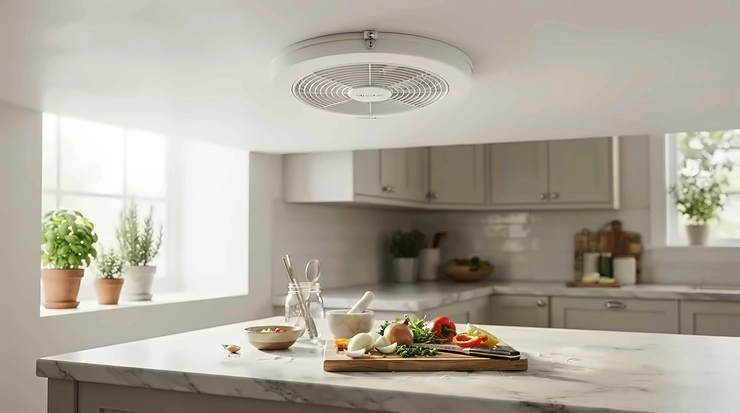
Your kitchen island is the busiest square metre in the house. Homework, hot pans, charcuterie, a dog auditioning for crumbs. When summer heat settles over that spot, the question isn’t whether you want airflow. It’s how to get it without a fan that looks like it escaped from a roadside motel. Picking a ceiling fan for kitchen island use is trickier than picking one for a bedroom, because steam, grease, pendant lights and sightlines all fight for the same patch of ceiling.

Here is what this guide does. It compares seven real fans, using published specs and the review themes that keep showing up across retailer listings and roundups. I haven’t personally tested any of them, and I won’t pretend otherwise. Where I couldn’t verify something, I’ll say so plainly.
The energy case is also stronger than most people expect. Natural Resources Canada notes that an ENERGY STAR certified ceiling fan uses about 60% less energy on average than a standard model. It also says that raising your thermostat two degrees and using fans to move cool air can trim air conditioning costs by about 14%. Not bad for a spinning accessory.
Along the way we’ll cover four things that decide whether a fan works above an island:
- island lighting placement
- downdraft airflow
- open-plan kitchen design
- which of the top rated kitchen ceiling fans with remote controls actually suit a working kitchen
Let’s start with the cheat sheet.
Quick Comparison: Top Rated Kitchen Ceiling Fans With Remote
| Fan | Blade span | Remote/smart control | Best For |
|---|---|---|---|
| Hunter Dempsey | 132 cm (52 in) | Handheld remote, 3 speeds + light | Low 2.4 m (8 ft) ceilings |
| Dreo 52-inch Smart Fan | 132 cm (52 in) | Remote, app, Alexa/Google | Smart-home households |
| Honeywell Carnegie | 132 cm (52 in) | Remote, 3 speeds + dimming | Industrial-style kitchens |
| Honeywell Carmel | 122 cm (48 in) | Remote with light delay | Mid-sized islands, 2.7 m ceilings |
| LEDIARY 20-inch Fandelier | 50 cm (20 in) | Remote + app | Small kitchens, galley layouts |
| Amico 52-inch Smart Fan | 132 cm (52 in) | Remote, app, voice | Value-minded smart control |
| addlon 52-inch | 132 cm (52 in) | Dual remotes (per roundup) | Budget open-plan spaces |
Look at the pattern. Only the Hunter Dempsey and the LEDIARY 20-inch Fandelier are genuinely built for low ceilings, while the Dreo 52-inch Smart Fan and Amico 52-inch Smart Fan earn their keep through control and efficiency rather than a slim profile. If your ceiling is a standard 2.4 m (8 ft), height is your first filter and features come second. Everyone else should let airflow and lighting decide.
💬 Just one click — help others make better buying decisions too!😊
Top 7 Ceiling Fan for Kitchen Island Picks: Expert Analysis
Price note: every range below is an estimate in Canadian dollars from the retail and listing data I could find. Prices move constantly, so check current price on amazon.ca, and expect variation by finish, seller and variant.
1. Hunter Dempsey — slimmest profile for 8 ft kitchen ceilings
The Dempsey’s hugger housing is the whole story. Published dimensions put the blades roughly 20.5 cm (8 in) below the ceiling and the light kit about 31 cm (12.3 in) down, so there’s still clearance above an island on a standard ceiling.
Specs, translated: a 132 cm (52 in) span with four reversible blades at a 13° pitch, plus a handheld remote for speed and light. One retailer lists an average of about 3,441 CFM. That’s lower than the DC-motor fans below, but sensible for a fan that only has a short air path to work with. Hunter rates it for rooms up to 37 m² (400 sq ft) and lists kitchens among suitable rooms.
Here’s the honest trade-off. Efficiency guides suggest fans move air best with 25-30 cm (10-12 in) of space above the blades, and a hugger gives that up. Expect a gentler, more even breeze rather than a gust. For most islands that’s a feature, because it won’t scatter napkins.
I couldn’t verify a large pool of reviews for this exact variant, so I’m leaning on brand-level evidence instead, namely Hunter’s limited lifetime motor warranty.
Pros:
- ✅ Hugger design suits standard 2.4 m ceilings
- ✅ Limited lifetime motor warranty
- ✅ Three-speed remote controls fan and light
Cons:
- ❌ Lower listed airflow than DC-motor rivals
- ❌ Fewer smart features than newer fans
Price range: roughly C$300-C$450. The value verdict is that it earns its premium on low ceilings and is harder to justify on high ones.

2. Dreo 52-inch Smart Fan — 12 speeds with app and voice control
The headline feature is control. Listings describe a brushless DC motor, 12 speeds, three wind modes (Natural, Normal, Sleep) and dimmable LED lighting with adjustable colour temperature, all drivable by remote, app, Alexa or Google Home.
What that means in practice: a DC motor typically draws 15-30 W versus 50-100 W for older AC designs, so the running-cost gap is real. Colour tuning also matters over an island. Cool white works for chopping, and warm white makes the same space feel like a dinner party.
The caution is that specs vary by variant. Airflow claims range from roughly 4,200 to 5,700 CFM across the listings I found, and noise claims run from the low 20s to the mid-30s in dB. Treat “quiet” as the takeaway, not the decibel figure. Verify the exact model number before buying (one listing cites CLF521S). Overall height is also listed near 34.7 cm (13.7 in), so it suits 2.7 m (9 ft) ceilings better than 2.4 m.
On reviews, roundups consistently single out quiet operation and customization. I couldn’t verify individual owner reviews on amazon.ca, so weigh that accordingly.
Pros:
- ✅ Remote, app and voice control in one fan
- ✅ Efficient DC motor with many speeds
- ✅ Tunable brightness and colour temperature
Cons:
- ❌ Specs differ noticeably between variants
- ❌ Taller body demands higher ceilings
Price range: roughly C$180-C$300. The verdict is strong value if you’ll actually use the app and scheduling.
3. Honeywell Carnegie — industrial cage that doubles as island statement lighting
Think steel mesh drum, three exposed filament-style bulbs, and five reversible blades in rough pine and dark chestnut finishes. In an industrial or farmhouse kitchen, it does the job of a pendant and a fan at once.
Lowe’s lists 3,376 CFM, a three-speed reversible motor, a 4-inch downrod, and three dimmable E26 bulbs at 450 lumens each in 2700K. That’s about 1,350 lumens total. It’s a warm ambient glow, nowhere near enough task light for chopping, so pair it with under-cabinet or recessed lighting. Overall height is about 36 cm (14.1 in), so it prefers 2.7 m ceilings.
Reviewers frequently praise the look, quiet running and a responsive remote. Common complaints include a finicky remote and lights, some wobble on high, and a fiddly remote-receiver fit inside the canopy during installation. A few reviewers also warn that using the wrong bulbs melted the socket, so stick to the supplied bulb type and wattage.
Pros:
- ✅ Cage light matches industrial island pendants
- ✅ Warm dimmable filament-style bulbs included
- ✅ Dual-mount design with included downrod
Cons:
- ❌ Remote and receiver reported finicky
- ❌ Some owners note wobble at high speed
Price range: roughly C$200-C$280. The verdict is good value for style, provided you’re patient with installation.
4. Honeywell Carmel — frosted globe light for a softer island glow
The Carmel trades industrial edge for a lightly frosted dome and a five-blade, dual-finish design. It’s the quieter-looking sibling.
Listings quote a 122 cm (48 in) span, a 4-inch downrod, and about 1,600 lumens at 3000K. Honeywell rates it for rooms up to 37 m² (400 sq ft), with a remote that has three speeds, a dimmer and “Walk Away Light Delay.” One retailer lists 5,202 CFM, but listings differ by variant, so treat that figure as a ceiling, not a promise.
The 48-inch span is a smart size for a one-island kitchen. It’s smaller than the 52-inch fans but easier to keep inside the 45 cm (18 in) wall and obstruction clearance that manufacturers specify. Overall height is about 32.5 cm (12.8 in), so check blade-to-floor clearance carefully on 2.4 m ceilings.
Reviewers mention quiet running, strong airflow and a convenient remote. The recurring complaints are remote or receiver quality and an installation with plenty of parts to sort through.
Pros:
- ✅ Soft frosted light flatters stone counters
- ✅ Smaller span fits mid-sized islands
- ✅ Remote includes light dimmer and delay
Cons:
- ❌ Remote quality draws repeated complaints
- ❌ Installation involves many small parts
Price range: roughly C$200-C$250. The verdict is solid if you replace the remote with a universal one if needed.
5. LEDIARY 20-inch Fandelier — compact fan-light hybrid for small kitchens
A fandelier is a light fixture that happens to move air. At 50 cm (20 in) wide and about 14.5 cm (5.7 in) tall, it’s the one option here that doesn’t need a downrod conversation.
Listed features include seven blades, up to 2,500 lumens, colour temperatures from 3000K to 6000K, 10-100% dimming, six speeds, a reversible motor, and remote plus app control. The caveat is physics. Compact 50 cm fans advertise far less airflow than 132 cm (52 in) models, since a comparable 20-inch caged fan at Lowe’s lists 1,580 CFM. Think personal breeze at the island, not whole-room circulation.
Reviewers commonly say it’s smaller than expected yet surprisingly forceful, and several use it in kitchens. Some note it blows straight down rather than sweeping outward, a few dislike the clear plastic blades, and one flagged confusion between the remote’s “off” and the wall switch.
Pros:
- ✅ Flush-mount height suits any ceiling
- ✅ Bright, dimmable, colour-adjustable light
- ✅ Remote and app control included
Cons:
- ❌ Limited whole-room air movement
- ❌ Downward-focused airflow pattern
Price range: roughly C$55-C$110. The verdict is excellent for galley kitchens, weak for big open plans.

6. Amico 52-inch Smart Fan — value-priced smart control
Amico’s pitch is smart features without a premium price. Listings describe five blades, six speeds, a reversible DC motor, dimmable three-colour-temperature light, and control via remote, app, Alexa or Google Home.
Airflow figures appear as roughly 4,454 CFM on one listing and 4,749 CFM on another, and height ranges from about 28 cm (11 in) to 40 cm (15.7 in) depending on variant. Warranty claims also vary, with one listing citing two years on the product and ten on the motor. Confirm both against the listing you actually buy from.
What that spread tells you is that this is a family of similar models, not a single product. Match the model number, mounting type and height to your ceiling, and ask the seller which variant ships.
On reviews, owners frequently mention easy installation and complete hardware. One reviewer reported a clicking noise from imbalance, traced it to the mounting fit, and eventually received a replacement motor from the seller. That’s a useful reminder to keep your order paperwork handy.
Pros:
- ✅ Smart control at a modest price point
- ✅ Efficient DC motor with six speeds
- ✅ Installation often described as straightforward
Cons:
- ❌ Variants and specs differ across listings
- ❌ Occasional clicking or balance issues reported
Price range: roughly C$100-C$250. The verdict is best value for smart features if you buy carefully.
7. addlon 52-inch — budget workhorse with dual remotes
A roundup lists this black 132 cm (52 in) fan at about 4,952 CFM with six speeds, a reversible DC motor and two remotes. That’s competitive airflow for the class.
The dual remotes are more useful than they sound. In an open plan, one can live by the island and the other by the sofa, or a spare can stay in a drawer for when the first one vanishes under couch cushions. Check, though, whether both remotes control the light as well as the fan, because listing language is vague.
The same roundup notes consistent praise for quiet DC-motor operation. I couldn’t verify individual owner reviews on amazon.ca, so confirm the current review count and recent comments yourself before buying, since this is a lesser-known brand.
Pros:
- ✅ High listed airflow for the price
- ✅ Dual remotes suit open-plan living
- ✅ Quiet reversible DC motor reported
Cons:
- ❌ Lesser-known brand, thinner verification
- ❌ Limited detail on light output
Price range: roughly C$120-C$200. The verdict is a smart budget gamble that pays off if reviews hold up.
Top 7 at a Glance
| Fan | Listed airflow | Typical height | Est. price (CAD) | Best For |
|---|---|---|---|---|
| Hunter Dempsey | ~3,441 CFM | ~28 cm (11 in) | C$300-C$450 | Hunter Dempsey for 8 ft ceilings |
| Dreo 52-inch Smart Fan | ~4,200-5,700 CFM | ~35 cm (13.7 in) | C$180-C$300 | Dreo 52-inch Smart Fan for smart homes |
| Honeywell Carnegie | ~3,376 CFM | ~36 cm (14.1 in) | C$200-C$280 | Honeywell Carnegie for industrial style |
| Honeywell Carmel | ~5,202 CFM (variant) | ~32.5 cm (12.8 in) | C$200-C$250 | Honeywell Carmel for mid-sized islands |
| LEDIARY 20-inch Fandelier | Not stated | ~14.5 cm (5.7 in) | C$55-C$110 | LEDIARY 20-inch Fandelier for galley kitchens |
| Amico 52-inch Smart Fan | ~4,454-4,749 CFM | ~28-40 cm | C$100-C$250 | Amico 52-inch Smart Fan for value smart control |
| addlon 52-inch | ~4,952 CFM | Not verified | C$120-C$200 | addlon 52-inch for budget open plans |
Read this table sideways, not just down. The Honeywell Carmel‘s big airflow figure looks great until you notice it comes from a variant-dependent listing, while the Hunter Dempsey‘s lower number comes with a slimmer body and a stronger warranty. Airflow numbers are not comparable across brands unless you know how each was measured, so use them to rank within a tier, not across tiers.
What Is a Ceiling Fan for Kitchen Island?
A ceiling fan for kitchen island use is a quiet, ideally low-profile fan, usually with an integrated LED light, positioned above or beside an island to circulate air through the kitchen and any connected living space. It balances airflow, clearance above cooking and prep areas, and light output so it doesn’t clash with pendants or range ventilation.
That definition hides a few real constraints. Kitchens collect grease, so surfaces and light fixtures need to be wipeable. Islands are social, so noise matters more than in a hallway. And because fans cool people rather than rooms, as Natural Resources Canada puts it, the best position is where people actually stand and sit. Over an island, that’s usually the sweet spot.
There’s also a lighting dimension most guides skip. A fan with a built-in light kit can become your main island lighting, a supplement to pendants, or an obstacle to them. We’ll untangle that in the island lighting placement section below.
Practical Usage Guide: Setting Up Your Fan in the First 30 Days
Week one: install and balance. Mount only to a box marked for fan support, and tighten every blade bracket screw before the first spin. Canarm’s manual specifically tells owners to check bracket screws and blade seating. If you hear clicking or see wobble, check mounting-plate fit before you blame the motor. One owner of a fan in this price class reported fixing clicking by firming up the plate connection.
Week two: pair and label. Set the remote code or pairing so it controls only your fan. In open-plan homes with several fans, a shared signal can cause a “ghost” response in another room. Stick the wall cradle somewhere sensible and put spare batteries in a drawer.
Week three: set the season. Use summer mode (typically counterclockwise) and test the speeds. Pick the one you’d actually leave on during dinner. Most households settle on low or medium.
Week four: first clean. Wipe the blades with a barely damp cloth. Don’t use water or detergents on the motor housing, a warning that appears in some manuals.
Maintenance rhythm: a quick wipe monthly, a screw check quarterly, and a deeper degrease after any heavy frying season.
Real-World Scenarios: Which Fan Fits Which Kitchen?
The condo cook, 2.4 m ceiling, 1.8 m island. Frequent weeknight cooking, minimal space above the counter. The Hunter Dempsey is the safe pick because its hugger body keeps blades near the ceiling. If the floor plan is tight and a 52-inch blade span would crowd the walls, the LEDIARY 20-inch Fandelier steps in as a personal-breeze option.
The family open plan, 2.7 m ceiling, 2.4 m island. Kids, homework and constant traffic. A smart fan like the Dreo 52-inch Smart Fan or Amico 52-inch Smart Fan makes sense because scheduling and voice control mean nobody is hunting for a remote with sticky fingers. Budget around C$180-C$300 for the Dreo, less for the Amico.
The budget renovator, mixed-use space. Money is going to cabinetry. The addlon 52-inch gives high listed airflow and dual remotes for a modest outlay, with the caveat that you’ll need to check recent reviews.
The industrial-style entertainer. If your island already has dark metal and filament bulbs, the Honeywell Carnegie doubles as a statement piece. Add under-cabinet lighting so the cage light isn’t doing all the work.
Problem → Solution Guide for Island Fans
Problem: wobble or clicking. Re-tighten blade brackets, check blade alignment, and confirm the mounting plate sits flush. If it persists, contact the seller with your order number. Replacement motors do happen.
Problem: remote lag or dead receiver. Replace batteries first, then re-pair. Several Honeywell Carmel owners report buying a universal remote kit as a fix, so that’s a sensible backup.
Problem: grease film on blades and light. Kitchens do this. Wipe monthly with a barely damp cloth, and run your range hood on high during cooking so less residue reaches the ceiling.
Problem: glare on stone counters. Drop dimmer settings and choose warmer colour temperatures. Smart models like the Dreo 52-inch Smart Fan and Amico 52-inch Smart Fan let you tune this precisely. Fixed-temperature fans like the Honeywell Carnegie need softer bulbs or a dimmer.
Problem: papers fluttering on the island. Drop to a lower speed or choose a fan with a natural-wind mode. Gentle beats gusty above food prep.
How to Choose a Ceiling Fan for Kitchen Island
- Check ceiling height first. For 2.4 m (8 ft) ceilings, Hunter recommends low-profile or ultra-low-profile fans. For 2.7 m (9 ft) and above, a downrod fan is fine.
- Match blade span to the island, not just the room. A 132 cm (52 in) fan overhangs a 1.8 m island more than you’d think. Measure the island and the walls before you fall in love with any model.
- Prefer a DC motor. DC motors tend to draw 15-30 W versus 50-100 W for older AC designs, and they’re typically quieter.
- Decide how much light you need. A fan’s built-in light is usually ambient, so plan separate task lighting for chopping.
- Choose control you’ll actually use. Handheld remotes work for most people. Smart fans pay off if you like scheduling or voice commands.
- Look for certification and efficiency. ETL or CSA marks and ENERGY STAR certification are good signals. NRCan notes ENERGY STAR fans use about 60% less energy on average.
- Verify the exact model number. Listings for popular fans often cover multiple variants with different heights, CFM claims and warranties.
Island Lighting Placement: Where Pendants, Light Kits and Fans Coexist
Standard guidance puts pendants 76-91 cm (30-36 in) above the island counter, adding about 7.5 cm (3 in) per extra 30 cm (1 ft) of ceiling height beyond 2.4 m. Centre-to-centre spacing runs 61-76 cm (24-30 in), with outer fixtures 15-30 cm (6-12 in) in from the island’s edge.
Now add a fan. Manufacturers typically want blades at least 45 cm (18 in) from walls or obstructions, and a pendant is an obstruction. A 132 cm (52 in) fan centred over a 2.1 m (7 ft) island leaves roughly 40 cm on each side of the blade tips, which puts pendants squarely in the sweep zone. That’s a no-go.
You’ve got three workable options:
- Fan beside the island. Mount it between the island and the living area, and let the pendants hang over the counter.
- Fan as the island’s main light. Choose a fan with a strong integrated kit, such as the Honeywell Carnegie or the Honeywell Carmel, and drop the pendants.
- Compact fan plus pendants. A LEDIARY 20-inch Fandelier centred between two pendants avoids blade conflict entirely.
Whatever you choose, treat island lighting placement as a layered plan. Ambient light comes from the fan, task light from under-cabinets or pendants, and accent light from dimmer scenes.
Downdraft Airflow: What It Is and Why It Matters Above Cooking Zones
“Downdraft” gets used two ways. In fan talk, it describes forward summer mode, where blades push air straight down so you feel a breeze on your skin. Hunter describes it as running the reversible motor in downdraft mode for summer and updraft in winter. Separately, “downdraft” can refer to cooktop vents that pull air down. This article means the fan kind.
Direction matters. NRCan advises counterclockwise in summer and clockwise in winter, and a fan in the wrong mode feels useless. In winter, updraft gently circulates warm air trapped near the ceiling without a direct blast.
Here’s where kitchens get complicated. Health Canada’s cooking and indoor air quality factsheet says running a range hood on high, around 300 cubic feet per minute, can cut exposure to cooking pollutants by more than 80% compared with slower speeds. It also recommends hoods that fully extend over the burners.
My inference, based on how airflow behaves and not on a tested figure, is that strong downdraft airflow near a range can push cooking plumes away from the hood. Run the island fan on low or off while searing, then boost it afterwards to clear the room.

Open-Plan Kitchen Design: Sizing, Zoning and Remote Control Sanity
Open-plan kitchen design is where one fan stops being enough. Manufacturers rate a typical 132 cm (52 in) fan for rooms up to about 37 m² (400 sq ft). Many open-plan kitchen and living spaces run larger, and the airflow doesn’t magically carry across furniture and sightlines.
Think in zones. One fan over the island handles cooking and eating, and a second serves the lounge. Match finishes and blade styles so the two fans read as one design, rather than competing statements.
Control is the sneaky problem. Two fans on the same remote frequency can both respond to one button press, so choose models that support pairing codes. Smart fans like the Dreo 52-inch Smart Fan and Amico 52-inch Smart Fan sidestep this through app control, while the addlon 52-inch gives you dual remotes that can be assigned to different spots.
Finally, sightlines. A matte black fan with a cage light changes how a room reads from across the open plan. Squint from the sofa before you commit.
Ceiling Fan vs Alternatives: Which Option Cools Your Island Best?
| Option | Strength | Weakness | Best For |
|---|---|---|---|
| Ceiling fan (e.g., Hunter Dempsey) | Always-on circulation, no floor space | Needs ceiling clearance | Everyday kitchens |
| Pedestal or tower fan | Portable, no wiring | Clutter and cords | Renters |
| Range hood alone | Removes cooking pollutants | Not designed for comfort | Heavy cooking |
| Air conditioning | Real temperature drop | Higher running cost | Heat waves |
Notice that these aren’t strict rivals. A ceiling fan won’t cool a room’s air, it cools people, but it lets you run the thermostat warmer, which is where NRCan’s 14% air conditioning savings estimate comes from. A range hood handles pollutants, which a ceiling fan shouldn’t be asked to do.
For background on how ceiling fans work and why blade design matters, Wikipedia’s ceiling fan entry is a decent starting point. The practical takeaway is simple: use the fan for comfort, the hood for cooking exhaust, and AC for the worst days.
Common Mistakes When Buying a Ceiling Fan for Kitchen Island Spaces
Ignoring total height. A fan labelled “low profile” may still hang lower than you expect once the light kit is attached. The Hunter Dempsey‘s published dimensions are helpful because they separate blade height from light height.
Putting pendants in the blade sweep. Always check the 45 cm (18 in) clearance rule against every fixture.
Using the wrong bulbs. Some Honeywell Carnegie owners reported melted sockets after fitting unsuitable bulbs. Always match wattage and base to the fan’s specification.
Buying on CFM alone. CFM claims differ between variants and measurement methods, as the Dreo 52-inch Smart Fan and Amico 52-inch Smart Fan listings show.
Skipping model-number checks. Listings often bundle variants. Confirm the exact one you’re ordering.
Running full blast while cooking at the range. Gentle airflow beats gusts near open flames and hoods.
Over-sizing for a small galley. A LEDIARY 20-inch Fandelier can be a smarter fit than a 132 cm (52 in) fan that crowds the room.
Safety and Regulations: What Canadian Homeowners Should Know
Manufacturers’ manuals consistently call for at least 2.13 m (7 ft) between the floor and blade tips, and at least 45 cm (18 in) from walls or obstructions. Canarm’s Calibre manual also specifies a CSA-approved box for Canada marked “for fan support,” plus secure mounting that can handle the fan’s weight and motion.
Look for recognized certification marks like CSA or ETL, and remember that fans are covered by Canada’s Energy Efficiency Regulations, which set minimum performance standards. NRCan explains the framework on its cooling and ventilating equipment page, where you’ll also find the EnerGuide label that helps you compare models.
Electrical work rules vary by province and territory. In most places, replacing a fixture with a fan involves a licensed electrician, and the electrician will confirm your box rating and wire gauge. Over an island, there’s an extra practical point. If your island includes a cooktop, check the manufacturer’s clearance guidance for the fan and light kit, since heat and grease are in play.
Long-Term Cost and Maintenance: Is a Better Fan Worth It?
Let’s run an illustrative sum. Assume 4 hours a day for 120 days at C$0.15 per kWh (your province will differ). A 30 W DC fan uses about 14.4 kWh a season, roughly C$2.16. A 75 W AC fan uses about 36 kWh, roughly C$5.40. Not dramatic by itself, but the bigger payoff comes from nudging your thermostat up, which NRCan says can trim air conditioning costs by around 14%.
| Tier | Example | Est. price (CAD) | Best For |
|---|---|---|---|
| Budget | LEDIARY 20-inch Fandelier, addlon 52-inch | C$55-C$200 | Small or cost-driven kitchens |
| Mid | Honeywell Carnegie, Honeywell Carmel, Amico 52-inch Smart Fan | C$100-C$280 | Style plus value |
| Premium | Hunter Dempsey, Dreo 52-inch Smart Fan | C$180-C$450 | Warranty, smart control, low profile |
Value rarely tracks price perfectly here. The Amico 52-inch Smart Fan undercuts the Dreo 52-inch Smart Fan on cost while offering similar control types, though its listings vary more. The Hunter Dempsey costs more, but its lifetime motor warranty and exact dimensions give you something concrete for the premium.
Maintenance is cheap: wipe monthly, check screws quarterly, and replace remote batteries yearly. Do that and the fan outlasts the paint.

FAQ
❓ How big should a ceiling fan for kitchen island open-plan layouts be?
❓ Can I use pendants and a fan together above an island?
❓ Are remote-controlled kitchen fans better than wall-switch models?
❓ Is it safe to run a fan above a cooktop island?
❓ Do I need an electrician to install a kitchen ceiling fan in Canada?
Conclusion
Choosing a ceiling fan for kitchen island use comes down to a few honest questions. How high is your ceiling? Where do your pendants hang? How much of your open-plan space does the fan need to cover? Answer those, and the shortlist narrows fast.
For low ceilings, the Hunter Dempsey and the LEDIARY 20-inch Fandelier are the natural fits. For smart control, the Dreo 52-inch Smart Fan and Amico 52-inch Smart Fan make a strong pair. For statement lighting, the Honeywell Carnegie and Honeywell Carmel bring style, though both draw occasional remote complaints. On a tight budget, the addlon 52-inch is worth checking against current reviews.
Whatever you pick, remember the basics: 2.13 m (7 ft) to blade tips, 45 cm (18 in) from obstructions, a fan-rated box, and a plan for island lighting placement that doesn’t put pendants in the blades’ path. Use downdraft airflow thoughtfully around the range, and treat open-plan kitchen design as a zoning exercise rather than a one-fan-fits-all job.
Check current prices and availability on amazon.ca, confirm the exact model number, and pick the fan that matches your ceiling, not just your Pinterest board.
Recommended for You
- Kitchen Ceiling Fan With Light: 7 Proven Picks, Canada 2026
- 7 Best Small Kitchen Ceiling Fan Picks For 2026
- 7 Best Dining Room Ceiling Fans With Remote (2026 Picks)
Disclaimer: This article contains affiliate links. As an Amazon Associate, I earn from qualifying purchases. If you purchase products through these links, we may earn a small commission at no additional cost to you.
✨ Found this helpful? Share it with your friends! 💬🤗
