
In This Article
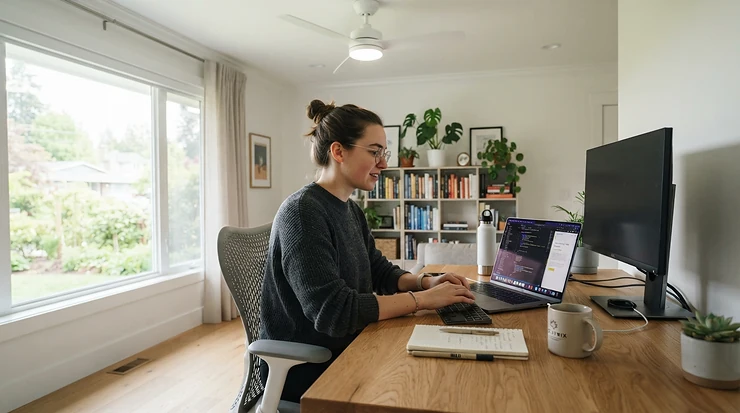
A quiet ceiling fan for home office use is a ceiling-mounted fan that pairs a brushless DC motor with balanced blades and a rigid mount. That keeps its noise around 20–35 dB, soft enough that your microphone, your clients and your concentration barely notice it. That’s the whole job: cool the room, then vanish from the soundtrack.
Most fans pass the first half and flunk the second. Home offices are unforgiving. The Canadian Centre for Occupational Health and Safety notes that office noise is mainly a stress and concentration problem, not a hearing-damage one. It also puts background noise in a quiet office at roughly 40–45 dB. So your target is a fan that sits comfortably under that floor. A steady 20–30 dB whisper disappears into the room. A 45 dB rattle ruins your afternoon.
Here’s what you’ll get. Seven real fans from budget to premium. A plain-English guide to the decibel (dB) rating on the box. A straight look at why a DC motor ceiling fan for home office use usually wins. What a ceiling fan with reversible motor for Canadian winters can and can’t do. How to keep video call background noise off your mic. And how blade balancing kits rescue a wobbly install.
One honesty note before we start. I haven’t hung any of these fans in my own ceiling. Everything below comes from spec sheets, retailer listings and published reviews. Noise figures are manufacturer or listing claims, not lab results. Prices are approximate CAD ranges, so check the current price on Amazon.ca before you buy.
Quick Comparison: Quiet Ceiling Fan for Home Office Options at a Glance
| Fan | Motor | Claimed noise | Max airflow | Approx. price (CAD) | Best For |
|---|---|---|---|---|---|
| DREO Smart Ceiling Fan 52-Inch | DC | 22 dB claim (spec page: under 35 dB) | 5,673 CFM | C$200–C$300 | Smart-home control |
| Ohniyou 52-Inch Low Profile Ceiling Fan | DC, reversible | 20 dB claim | 4,580 CFM | C$100–C$180 | Tight budgets |
| DREO 44-Inch Low Profile Ceiling Fan | DC, reversible | 22 dB claim | Not confirmed | C$140–C$220 | Small rooms |
| TCL 52-Inch Modern Flush Mount Ceiling Fan | DC | 25 dB claim | Not confirmed | C$130–C$220 | 8-foot ceilings |
| Sofucor 52-Inch Wood Blade Ceiling Fan | DC | Under 30 dB claim | Not confirmed | C$140–C$240 | Warm, natural style |
| Hunter Builder Elite 52-Inch | AC (WhisperWind) | None published | About 5,049 CFM | C$200–C$300 | Pull-chain simplicity |
| Minka-Aire Barn 65-Inch Smart Ceiling Fan | DC | None published | 9,155 CFM | C$900–C$1,200 | Large, high-ceiling rooms |
The Ohniyou 52-Inch Low Profile Ceiling Fan is the cheapest and claims the lowest noise, but a claim is not a measurement. The DREO Smart Ceiling Fan 52-Inch costs more and buys you real control, with 12 speeds and a Sleep mode. The Hunter Builder Elite 52-Inch is the only AC motor here and publishes no noise figure at all, so you’d be buying it on brand trust rather than a number.
💬 Just one click — help others make better buying decisions too!😊
Top 7 Picks for a Quiet Ceiling Fan for Home Office: Expert Analysis
1. DREO Smart Ceiling Fan 52-Inch — best smart-home pick, 12 speeds
The DREO Smart Ceiling Fan 52-Inch (the 521S line) earns the top slot for control. You get 12 speeds, three wind modes (Natural, Normal and Sleep), and remote, app, Alexa or Google Home operation. For a quiet ceiling fan for home office work, that granularity is the point. You can sit at a near-silent speed during calls and push it up between them.
The 52-inch (132 cm) span moves up to about 5,673 CFM. One roundup suggests that suits rooms of roughly 13–21 m² (144–225 sq ft). The light runs 2,400 lumens with 2,700–6,500K tuning, plus a 1–8 hour timer. On noise, listings advertise 22 dB, but DREO’s own spec page says “lower than 35 dB”. Read that gap as low speed versus high speed. Treat the decibel (dB) rating as a range, not a promise.
Based on the specs, this suits medium offices where video call background noise matters and you want fine speed steps. Published reviews mention minor wobble at certain speeds on some units. That is exactly what blade balancing kits are for.
Pros:
- ✅ 12 speeds plus Sleep mode for fine control
- ✅ Strong 5,673 CFM airflow for its size
- ✅ App, remote and voice control built in
Cons:
- ❌ Wobble reported at certain speeds on some units
- ❌ Noise claim varies between listings (22 vs 35 dB)
Expect roughly C$200–C$300. Good value if you’ll use the smart features; overkill if you won’t.

2. Ohniyou 52-Inch Low Profile Ceiling Fan — lowest claimed noise on a budget
The Ohniyou 52-Inch Low Profile Ceiling Fan is the bargain-bin headline grabber, with a 20 dB claim that undercuts everything else in this list. It’s a flush-mount, reversible DC fan, so it hugs the ceiling and keeps your headroom intact.
The numbers: up to 4,580 CFM, six speeds, an 18W LED with 3000K, 4500K and 6000K options, and 5%–100% dimming. The double-sided five-blade set is black on one face and wood-grey on the other. Flush mounts can trade some air movement for height, but 4,580 CFM is plenty for a 14–23 m² room. The reversible motor also makes it a workable ceiling fan with reversible motor for Canadian winters, which we’ll unpack below.
Honest take: it’s the “lowest on paper” pick, and that matters only if the claim holds. Early reviews I found were strongly positive but came from a small pool. Deal-forum commenters were more sceptical about long-term durability at this price. For a spare-room office where money is tight, it’s a smart gamble.
Pros:
- ✅ Lowest noise claim in this round-up (20 dB)
- ✅ Flush mount suits low ceilings
- ✅ Reversible DC motor with app and remote
Cons:
- ❌ Small review pool, so long-term durability is unproven
- ❌ Lighter build than premium brands
Roughly C$100–C$180. Excellent value if it lasts; verify the warranty terms on the listing.
3. DREO 44-Inch Low Profile Ceiling Fan — best for small, low-ceiling rooms
The DREO 44-Inch Low Profile Ceiling Fan shrinks the formula for compact rooms. Think spare-bedroom or basement offices where a 52-inch fan would feel like a helicopter parked indoors.
It’s a flush-mount, reversible, six-speed fan with a 22 dB claim, a 1–8 hour timer, 5CCT lighting and six-level dimming. The 44-inch (112 cm) span is a sensible match for rooms up to roughly 12 m² (130 sq ft), going by the usual sizing rule of thumb. I couldn’t confirm an airflow figure, which is worth knowing: you can’t compare its CFM against the others. That reversible motor makes it a handy ceiling fan with reversible motor for Canadian winters in a basement that runs cold.
The spec sheet won’t tell you this, but roundups praise the polished remote and flexible lighting, and one says it feels pricier than it is. I couldn’t verify a deep pool of Canadian customer reviews, so weigh that honestly.
Pros:
- ✅ Compact 112 cm span for small rooms
- ✅ 5CCT lighting with six-level dimming
- ✅ Reversible motor with timer
Cons:
- ❌ Airflow figure not confirmed in sources
- ❌ Too small for rooms over about 14 m²
Roughly C$140–C$220. Solid value for small spaces.
4. TCL 52-Inch Modern Flush Mount Ceiling Fan — slim 28 cm drop, 25 dB claim
The TCL 52-Inch Modern Flush Mount Ceiling Fan is the one to check if your ceiling is a standard 2.4 m (8 ft). Its drop from ceiling is about 28 cm (11.2 in). Do the maths: 244 cm minus 28 cm leaves roughly 216 cm to the bottom of the fan. That clears the commonly recommended 2.1 m floor clearance with a hair to spare.
It carries a 25 dB claim and comes with a remote, in black or white. One roundup calls its noise floor industry-leading for bedrooms. Another says it’s the flush mount to beat for build quality at the price. The decibel (dB) rating is again a claim, so treat it as a strong hint rather than proof.
The catch is thin published data. I couldn’t confirm airflow, and I couldn’t verify an aggregated Amazon.ca rating. That makes it a good pick for height-challenged rooms, but not one to buy blind on specs alone.
Pros:
- ✅ 28 cm drop fits 8-foot ceilings
- ✅ 25 dB claim praised in roundups
- ✅ Strong build quality for the money
Cons:
- ❌ Airflow data not confirmed
- ❌ Flush mounts move less air than downrod models
Roughly C$130–C$220. Good value for basements and 8-foot offices.
5. Sofucor 52-Inch Wood Blade Ceiling Fan — warmest look, solid wood blades
The Sofucor 52-Inch Wood Blade Ceiling Fan is the one that looks like furniture. Solid wood blades bring warmth to a room full of grey screens, and it’s another flush-mount DC fan with remote control and a claim of under 30 dB.
One reviewer said that figure was quiet enough for sleeping, which is the right yardstick for an office too. A flush mount on a 2.4 m ceiling is the same sensible geometry as the TCL. Wood blades are heavier than plastic and can respond to humidity swings. That’s worth considering for a damp basement. In a dry upstairs room, it’s a non-issue.
Verified customer-review sentiment on Amazon.ca wasn’t something I could confirm, so lean on the spec and editorial praise. If you want a quiet ceiling fan for home office use that doubles as décor, this is the pick.
Pros:
- ✅ Solid wood blades with real visual warmth
- ✅ Under 30 dB claim on a DC motor
- ✅ Flush mount saves headroom
Cons:
- ❌ Wood may react to humidity swings
- ❌ Airflow figure not confirmed
Roughly C$140–C$240. Good value if style matters to you.
6. Hunter Builder Elite 52-Inch — trusted brand, AC motor veteran
The Hunter Builder Elite 52-Inch is the traditionalist: a three-speed WhisperWind AC motor, five reversible blades in two finishes, and pull-chain control. It weighs about 19 lb (8.6 kg) and has a 13° blade pitch. Listings quote 1,930, 3,252 and 5,049 CFM at low, medium and high, though another lists 4,516 CFM, so specs vary by variant.
It publishes no noise figure. That matters, because buying guides note that motor hum at low speed is the test most ceiling fans in this class fail. DC designs generally vibrate less than AC ones. So I’d pitch this as the “I trust the brand” pick, with a limited lifetime motor warranty and compatibility with Hunter’s universal remote.
One retailer listing mentions a six-speed DC version of the Builder Elite, so confirm the motor type before you buy. It’s reversible, which helps in winter.
Pros:
- ✅ Limited lifetime motor warranty
- ✅ Hugger, standard or angled mounting options
- ✅ Hunter remote and wall controls compatible
Cons:
- ❌ AC motor and no published noise figure
- ❌ No light kit included
Roughly C$200–C$300. Fair value for a no-frills workhorse; weaker for call-heavy offices.
7. Minka-Aire Barn 65-Inch Smart Ceiling Fan — premium DC fan for big rooms
The Minka-Aire Barn 65-Inch Smart Ceiling Fan is the grown-up option for open lofts and big rooms. It’s a ten-blade windmill design with a six-speed DC motor, a 16° blade pitch and up to 9,155 CFM at only about 125 rpm. Big, slow blades are the opposite of the frantic little fan that whines.
It also posts about 183 CFM per watt, runs from an app, and works with Alexa, Google Home, Nest and Ecobee. The catch is geometry: it needs a ceiling of at least 2.7 m (9 ft) with the 10-inch downrod, and it weighs about 14.7 kg. It publishes no noise figure either, so I can’t call it “quiet” on a number.
Bob Vila’s quiet-fans roundup named it the best ceiling pick, which is editorial recognition rather than customer sentiment. It’s a lovely ceiling fan with reversible motor for Canadian winters in a high-ceilinged space, since reversing pushes trapped warm air back down.
Pros:
- ✅ Up to 9,155 CFM at slow blade speed
- ✅ Smart control across major platforms
- ✅ Lifetime motor warranty
Cons:
- ❌ Needs a 2.7 m ceiling minimum
- ❌ No published dB figure at a premium price
Roughly C$900–C$1,200. Great value for a large room, poor value for a small one.
✨ Don’t Miss These Exclusive Deals!
🔍 Take your home office to the next level with these carefully selected fans. Click any highlighted product name to check current pricing and availability. A quiet ceiling fan for home office work could be the cheapest productivity upgrade on your desk this year!
How to Choose a Quiet Ceiling Fan for Home Office
Choosing well comes down to six checks. Do them in this order and you’ll dodge most regrets.
- Pick the motor first. Prioritize DC. It runs smoother and draws less power, which is why a DC motor ceiling fan for home office use is the default recommendation.
- Read the decibel (dB) rating critically. Look for a figure, a speed it applies to, and ideally more than one number. No figure means you’re buying on faith.
- Match the mount to your ceiling. On 2.4 m ceilings choose flush mount. Above 2.7 m, a downrod improves airflow.
- Size the blades to the room. Roughly 44-inch for compact rooms, 52-inch for medium ones, 60-inch or larger for big spaces.
- Insist on a real remote. Don’t run a fan through a wall dimmer, which can cause hum.
- Check the warranty. Lifetime motor coverage is a good sign; a short component warranty is worth noticing.
Decibel (dB) Rating: What the Number Really Means
The decibel scale is logarithmic, as Wikipedia’s explanation of the decibel lays out. Every 10 dB step is a tenfold jump in sound power, and listeners usually judge it about twice as loud. So the gap between a 20 dB claim and a 35 dB claim is bigger than it looks.
Two cautions. First, a decibel (dB) rating without a stated speed is half a number. Buying guides report that “whisper-quiet” appears on many fans with no independently verified figure behind it. Second, a lab reading is taken directly beneath the fan, while your microphone sits somewhere else.
| What you hear | Approx. dB | What it means for your office | Best For |
|---|---|---|---|
| Fan with 20–25 dB claim | 20–25 | Below typical room background | Recording, calls |
| Whisper or very quiet bedroom | About 30 | Comfortable baseline | Focus work |
| Fan with 35 dB claim | About 35 | Faintly audible in silence | General work |
| Quiet office background (CCOHS) | 40–45 | Where noise starts to compete with you | Reference floor |
| Normal conversation | About 60 | Clearly intrusive | Reference only |
Read the table as a ladder. Anything at or below 30 dB is comfortable, 35 dB is acceptable, and above 40 dB you’re approaching ordinary office background.
DC Motor Ceiling Fan for Home Office vs Traditional AC Motor
A DC motor ceiling fan for home office use usually beats an AC fan for three reasons: smoother torque, less vibration, and lower power draw. Natural Resources Canada says an ENERGY STAR certified ceiling fan uses about 60% less energy than a standard model, and that fans fall under Canada’s Energy Efficiency Regulations.
| Factor | DC motor | AC motor | Best For |
|---|---|---|---|
| Noise at low speed | Typically lower | Often more hum | DC for calls |
| Speeds | Often 6–12 | Often 3 | DC for fine control |
| Power draw | About 30–35W claims | Higher | DC for running costs |
| Control | Remote or app | Pull chain or remote | AC for simplicity |
| Upfront price | Higher | Lower | AC for budgets |
Treat marketing claims such as “75% less power than AC” as upper-end claims; the Natural Resources Canada average of 60% is the safer number. The takeaway: pay the modest premium for DC, unless your office sits at the back of the house and calls are rare.
Ceiling Fan With Reversible Motor for Canadian Winters: Does It Really Help?
Yes, with limits. Natural Resources Canada advice is to run your fan counterclockwise in summer and clockwise in winter. A ceiling fan with reversible motor for Canadian winters gently pulls air upward and lets warm air drift down along the walls instead of pooling at the ceiling.
How to do it well. Switch direction with the remote while the blades are stopped; the Minka-Aire listing makes this point. Then run on the lowest speed. A winter breeze straight down is a draft, and drafts feel like wind chill.
This matters most with high ceilings, where heat stratifies. On an 8-foot ceiling the gain is modest, so don’t expect a ceiling fan with reversible motor for Canadian winters to replace your furnace. It’s a comfort tweak, not a heating system. Among our picks, the Ohniyou 52-Inch Low Profile Ceiling Fan, DREO 44-Inch Low Profile Ceiling Fan, Hunter Builder Elite 52-Inch and Minka-Aire Barn 65-Inch Smart Ceiling Fan all list reversible operation. That makes the Minka-Aire Barn 65-Inch Smart Ceiling Fan the standout in a tall loft office.
Video Call Background Noise: What Mics Actually Pick Up
Your laptop mic is a gossip. It hears everything, especially low steady hums and rhythmic ticks. That’s why video call background noise from a fan is often more noticeable to colleagues than to you.
Three culprits. Motor hum, which DC designs reduce. Blade wobble, which shows up as a periodic thump or tick. And light-kit buzz, which appears when a dimmer or cheap driver is involved.
A practical test costs nothing. Record 30 seconds of silence on your phone with the fan on low and another with it off, then compare. If you can hear the difference on headphones, your colleagues can too. Use the remote to drop to Sleep mode or a low speed during calls. Noise-suppression software can help with video call background noise, but it can also clip your voice, so it’s a backup, not a fix. And position your desk away from directly beneath the fan.
Features That Actually Matter (And Those That Don’t)
Matter: a DC motor, a stated decibel (dB) rating with a speed attached, a mount that fits your ceiling height, and a proper remote.
Nice but not essential: a 1–8 hour timer, tunable colour temperature, and app control. They’re pleasant, not decisive.
Mostly marketing: speed counts above six, RGB lighting, and extra blades. One buying guide notes extra blades produce slightly more blade-cutting noise than a three-blade fan at the same speed. For a quiet ceiling fan for home office use, spend your money on build quality and motor type, not on feature lists.
Long-Term Cost & Maintenance
Running costs are tiny, which is the good news. A 30W DC fan running 8 hours on 250 workdays uses about 60 kWh a year. At C$0.15 per kWh, that’s roughly C$9 annually, though your province’s rate will move it.
| Tier | Fan | Approx. range (CAD) | Value verdict | Best For |
|---|---|---|---|---|
| Budget | Ohniyou 52-Inch Low Profile Ceiling Fan | C$100–C$180 | Great if durable | Tight budgets |
| Mid | DREO 44-Inch Low Profile Ceiling Fan | C$140–C$220 | Strong for small rooms | Compact offices |
| Mid | DREO Smart Ceiling Fan 52-Inch | C$200–C$300 | Best all-rounder | Smart control |
| Premium | Minka-Aire Barn 65-Inch Smart Ceiling Fan | C$900–C$1,200 | Worth it only for big rooms | Lofts |
The real cost is maintenance. Wipe blades and re-tighten screws every six months, and use blade balancing kits at the first sign of a wobble. Warranty length varies, so a lifetime motor warranty like the Hunter Builder Elite 52-Inch and Minka-Aire Barn 65-Inch Smart Ceiling Fan offer is a real long-term asset.
Practical Usage Guide: Installing Your Fan for Silence
Install quality decides how quiet your quiet ceiling fan for home office really is. A loose mount turns a good motor into a noisemaker.
Start by cutting power at the breaker. Check that the box is rated for a ceiling fan and anchored to a joist, not just the drywall. Tighten every screw in the blade irons. Measure blade-to-ceiling distances, then check floor clearance. Aim for about 2.1 m (7 ft) or more to the blades.
For anything electrical, follow your local code and hire a licensed electrician where required. The CSA C814 standard covers energy performance and marking requirements for ceiling fans in Canada, so check that products carry proper certification marks.
In the first 30 days, re-check screws after a week, run each speed for a minute and listen. Label the remote’s settings. Note any new ticks early; they’re far easier to fix before they settle in.
Blade Balancing Kits: How to Silence a Wobbling Fan
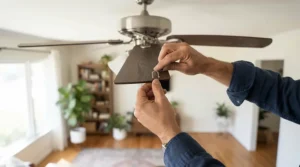
A wobble is the number-one reason a good fan sounds bad. Blade balancing kits fix most of them for the price of a coffee. Typical kits run only a few dollars at hardware stores and include a clip and adhesive weights.
The method, from standard how-to guides:
- Switch off the fan and tighten the blade screws. Clean the blades, since uneven dust causes wobble.
- Measure the distance from each blade tip to the ceiling and gently correct any outlier.
- Clip the kit’s clip on the trailing edge of one blade, about halfway out, and run the fan.
- Repeat blade by blade until you find the one that calms the wobble most.
- Slide the clip in small steps, then stick the adhesive weight on top of that blade, in line with the clip.
Problem to solution, quickly. A hum that persists after balancing isn’t a balance issue. Check the light-kit screws and any dimmer. A moving canopy is structural: stop the fan and call an electrician. Always balance at the speed where the wobble shows. On models like the DREO Smart Ceiling Fan 52-Inch, where some units wobble at certain speeds, blade balancing kits are a smart ten-minute fix.
Real-World Scenarios: Matching Fans to Three Home Office Types
The basement budget office. A 3 m by 3.5 m room, 2.4 m ceiling, used 6 hours daily. The TCL 52-Inch Modern Flush Mount Ceiling Fan or the Ohniyou 52-Inch Low Profile Ceiling Fan fits. The ceiling fan with reversible motor for Canadian winters feature helps move heat in a cool basement, so be sure to run it low in winter.
The call-heavy consultant. A 3.5 m by 4 m spare bedroom, six hours of video calls a week, with video call background noise being the top worry. The DREO Smart Ceiling Fan 52-Inch with Sleep mode is the pick. Use the app to drop to a whisper mode before you join a call.
The open-loft remote worker. A 6 m by 6 m open space with a 2.7 m or higher ceiling. The Minka-Aire Barn 65-Inch Smart Ceiling Fan handles that volume at slow blade speed. If budget rules, the Hunter Builder Elite 52-Inch is a reasonable fallback, as long as you run it off during calls. For anyone in between, any DC motor ceiling fan for home office use from this list beats a bargain AC fan.

FAQ
❓ How many decibels is a silent ceiling fan?
❓ Will a flush-mount fan fit my 8-foot basement ceiling?
❓ Why does my new DC fan hum on low speed?
❓ Do I need an electrician to install a ceiling fan in Canada?
❓ Are blade balancing kits worth buying?
Conclusion
The best quiet ceiling fan for home office use is the one that disappears: a DC motor, a firm mount, balanced blades and a remote you actually use. The DREO Smart Ceiling Fan 52-Inch is the strongest all-rounder, the Ohniyou 52-Inch Low Profile Ceiling Fan is the budget gamble, and the DREO 44-Inch Low Profile Ceiling Fan suits compact rooms. For 8-foot ceilings, the TCL 52-Inch Modern Flush Mount Ceiling Fan and Sofucor 52-Inch Wood Blade Ceiling Fan make sense, while the Hunter Builder Elite 52-Inch is the traditional choice and the Minka-Aire Barn 65-Inch Smart Ceiling Fan is the premium choice for big rooms.
Remember the three habits that matter: read each decibel (dB) rating critically, fix wobbles with blade balancing kits, and use the remote to dial down before calls. Do that and a ceiling fan with reversible motor for Canadian winters will earn its place all year, without taking your video call background noise hostage.
✨ Ready to upgrade your workspace?
🔍 Click your favourite pick above to check current pricing and availability on Amazon.ca, and give your home office the quiet, comfortable air it deserves! 🚀
Recommended for You
- Ceiling Fan For Breakfast Nook: 7 Best Picks For 2026
- Flush Mount Ceiling Fan For Kitchen: 7 Best Picks (2026)
- Ceiling Fan For Kitchen Island: 7 Top Picks For 2026 (Ultimate Guide)
Disclaimer: This article contains affiliate links. As an Amazon Associate, I earn from qualifying purchases. If you purchase products through these links, we may earn a small commission at no additional cost to you.
✨ Found this helpful? Share it with your friends! 💬🤗
