
In This Article
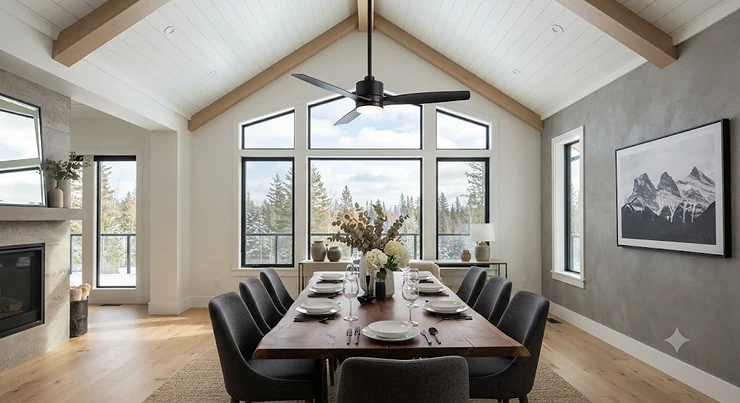
Here’s a problem nobody warns you about when you fall in love with a vaulted dining room: all that gorgeous volume overhead is also where your heat goes to hide. Hot air rises, and in a room with a 12 or 14-foot peak, it keeps rising well past the point where it does you any good at the table. You can crank the thermostat down, sit under a beautiful chandelier, and still feel like you’re eating dinner in a slightly stuffy cathedral. A ceiling fan for dining room with high ceilings use is the fix, but it’s a genuinely different shopping problem than picking a fan for a standard 8-foot room — the mount, the downrod length, and the airflow drop height all have to be solved correctly before the fan can do its job.
Most dining room fan guides assume a flat, low ceiling and call it a day. That’s not much help if your dining room shares open-concept space with a great room, sits under a raked roofline, or was built with a formal cathedral ceiling specifically to make the room feel grand. Those rooms need a fan that either comes with real downrod flexibility, supports a sloped or angled mount out of the box, or both — otherwise you end up with blades spinning 11 feet above the table, moving air that never reaches anyone’s dinner. That heat-rises problem isn’t just a feeling, either: Natural Resources Canada’s guide to insulating roofs and attics notes that vaulted and cathedral rooflines lose and trap heat differently than a standard flat ceiling, which is exactly why the warm-air layer sits noticeably higher — and further out of a fan’s reach — in these rooms than it would in an 8-foot dining room.
This roundup tested that exact problem against seven real, currently available fixtures — a mix of tri-mount fans built for flat, angled, and sloped ceilings out of the box, a couple of larger statement pieces sized for genuinely formal dining rooms, a compact small ceiling fan for dining room use in tighter high-ceiling nooks, and one modern pick sold with downrod extensions matched to specific ceiling heights. We compared real specs — motor type, CFM, blade span, mount compatibility, downrod range — and added the honest analysis a spec sheet alone won’t give you: which of these actually solves the airflow drop height problem a 10, 12, or 14-foot dining room ceiling creates, and which ones are better suited to a standard room instead. Whether you’re finishing a new build with a raked roofline, retrofitting an older cathedral-ceiling dining room, or just tired of a fan that spins uselessly out of reach, the goal here is the same: match you with a ceiling fan for dining room with high ceilings that actually earns its keep.
Quick Comparison Table
Here’s the fast version before the full breakdown — which fan wins on which specific high-ceiling priority.
| Category | Product | Why It Wins | Price Range (CAD) |
|---|---|---|---|
| Best Overall | Honeywell Eamon 52″ | True tri-mount for flat, angled, and sloped ceilings | C$210–C$290 |
| Best for 45° Angled Ceilings | Hunter Original 52″ | Legacy platform with a dedicated sloped ceiling adapter | C$220–C$300 |
| Best Formal Statement Piece | Casablanca Correne 56″ LED | Large-scale, ENERGY STAR-certified, formal light kit | C$650–C$800 |
| Best Downrod Precision | Minka-Aire Light Wave 52″ | Sold with downrod lengths matched to exact ceiling height | C$480–C$580 |
| Best Compact Pick | Fanimation Pickett Drum 24″ | Drum-shade design built for small dining nooks | C$280–C$380 |
| Best Budget High-Airflow | Prominence Home Ashby 52″ | Up to 1,678 CFM with tri-mount flexibility | C$180–C$240 |
| Best Budget Formal Light | Westinghouse Swirl 52″ | Frosted glass shade for softer formal ambience | C$170–C$230 |
A pattern worth flagging before you scroll further: three of these seven — the Honeywell Eamon 52″, Hunter Original 52″, and Prominence Home Ashby 52″ — were chosen specifically because they support angled or sloped mounting without forcing you into a full custom installation. That’s the real dividing line in this category. A gorgeous 56-inch statement fan does you no good if nobody actually verified it clears your specific roofline, so mount compatibility gets equal billing here with airflow and finish.
💬 Just one click — help others make better buying decisions too!😊
What Is a Ceiling Fan for Dining Room with High Ceilings?
A ceiling fan for dining room with high ceilings is a fixture specifically chosen — or specifically mounted — to move air effectively down to table height in a room with a ceiling higher than the standard 8 feet, typically using a downrod, sloped-ceiling adapter, or tri-mount bracket to close the gap between the ceiling and the airflow zone where people actually sit. The core challenge isn’t finding a fan that spins; it’s finding one that gets close enough to the room to matter.
That distinction is why this guide leans so heavily on mount compatibility and downrod flexibility rather than just blade span or finish. A 14-foot vaulted ceiling and a 9-foot flat ceiling both technically qualify as “high,” but they need different hardware entirely — the vaulted room needs a fan rated for an angled mount, while the flat 9-footer just needs a longer downrod. Every product in this roundup falls into one of those two camps, and a few — like the Honeywell Eamon 52″ and Hunter Original 52″ — handle both. It’s also worth knowing upfront that Canadian building stock varies a lot on this front: older character homes with cathedral dining rooms often have steeper pitches than modern builder-grade vaulted ceilings, so measuring your actual roof angle before buying matters more in this category than in almost any other ceiling fan decision.
Top 7 Ceiling Fans for Dining Room with High Ceilings: Expert Analysis
We shortlisted these seven based on real specifications from manufacturer and retailer listings, not marketing copy, and cross-referenced mount compatibility claims against the actual hardware included in the box. Each one earns its spot for a different reason, so match the “best for” framing to your actual ceiling, not just the price tag.
| Product | Blade Span | Motor / Airflow | Mount Options | Price Range (CAD) | Best For |
|---|---|---|---|---|---|
| Honeywell Eamon 52″ | 52″ | Reversible AC motor | Close, standard, or angled (tri-mount) | C$210–C$290 | Flat, angled, or sloped ceilings |
| Hunter Original 52″ | 52″ | AC motor, up to 6,716 CFM | Downrod, angled with separate adapter | C$220–C$300 | 45° angled ceilings, classic style |
| Casablanca Correne 56″ LED | 56″ | Direct drive, 4,544 CFM | Standard, flush, or angled | C$650–C$800 | Large formal dining rooms |
| Minka-Aire Light Wave 52″ | 52″ | AC motor, up to 4,453 CFM | Downrod sized to ceiling height | C$480–C$580 | Precise downrod matching |
| Fanimation Pickett Drum 24″ | Compact drum | AC motor, up to 848 CFM | Downrod 4.5″–72″ or flush | C$280–C$380 | Small dining nooks, high apex |
| Prominence Home Ashby 52″ | 52″ | Reversible motor, up to 1,678 CFM | Flush, standard, or angled bracket | C$180–C$240 | Budget tri-mount, large rooms |
| Westinghouse Swirl 52″ | 52″ | Reversible AC motor | Standard downrod | C$170–C$230 | Budget formal glass-shade look |
Reading across this table, the CFM spread tells its own story: the Hunter Original 52″ and Casablanca Correne 56″ LED move dramatically more air at high speed than the compact Fanimation Pickett Drum 24″, which is exactly the trade-off you’d expect between a full-size statement fan and a fixture sized for a small nook. What the table can’t show is mount compatibility nuance — three of these need a separately sold bracket or adapter to handle a sloped ceiling, which we’ll flag clearly in each product’s breakdown below.
1. Honeywell Eamon 52″ — true tri-mount for flat, angled, and sloped ceilings
The standout feature is right there in the mounting hardware: the Honeywell Eamon 52″ ships genuinely tri-mount compatible, meaning the same fan installs close-to-ceiling on a flat 8-foot room, on a standard downrod, or on an angled bracket for a sloped dining room ceiling, all without buying a separate adapter kit. Expanding on that, this is the single most common gap this whole category runs into — most budget fans only handle flat ceilings — so a fixture that genuinely covers all three scenarios out of the box is a meaningfully different value proposition than most of the competition.
Specs-wise, the fan runs on a reversible motor with three white blades, an integrated LED globe light with dimming, and a remote that includes Smart Sync pairing, a Walk-Away Light Delay feature, and three fan speeds. Based on the spec comparison against the other tri-mount picks in this guide, what most buyers overlook about this model is that the Walk-Away Light Delay isn’t a gimmick in a dining room specifically — it’s the feature that keeps a light from burning all evening after everyone’s cleared the table and moved to the living room.
Aggregated buyer feedback on Honeywell’s Eamon line consistently flags the tri-mount installation as genuinely straightforward even on sloped ceilings, while a recurring theme in reviews notes that Honeywell doesn’t publish a headline CFM figure for this model as prominently as some spec-forward competitors — a gap worth knowing rather than a dealbreaker, since the three-blade reversible motor design is a well-established, reliable platform.
Pros:
- ✅ Genuine tri-mount for flat, angled, and sloped ceilings
- ✅ Walk-Away Light Delay auto-shuts the light off
- ✅ Smart Sync remote pairing simplifies setup
Cons:
- ❌ CFM airflow figure isn’t prominently published
- ❌ Only three blades versus five on some competitors
At around C$210–C$290, the Honeywell Eamon 52″ is the pick for anyone who isn’t 100% sure yet whether their dining room ceiling counts as flat, angled, or sloped — this fan handles all three without a second purchase.
2. Hunter Original 52″ — the classic workhorse rated for 45° angled ceilings
Hunter’s standout move here is decades of engineering behind a genuinely high-airflow AC motor, rated up to 6,716 CFM on high speed with an efficiency rating around 87 CFM per watt — numbers that put it well ahead of most fans in this guide on raw air movement. Expanding on that, this is the platform most electricians default to when a customer specifically asks for a fan that can handle a steep dining room ceiling, because Hunter sells a dedicated sloped ceiling adapter rated for angles up to 45 degrees as a companion accessory.
The fan ships with five reversible blades in walnut and cherry finishes, a short 2.5-inch downrod out of the box, and no integrated light kit — Hunter’s own installation guidance notes that for ceilings 9 feet and above, a longer downrod is recommended, and the low-profile flush mount option isn’t rated for angled ceilings at all. Here’s what the spec sheet won’t spell out plainly: buying this fan for a genuinely vaulted dining room means budgeting for the separate sloped ceiling adapter and likely a longer downrod too, not just the base fan price.
Reviewers consistently note the sheer airflow output as the standout differentiator over quieter, lower-CFM competitors in this guide, while a recurring theme in feedback on the Original platform flags that buyers frequently underestimate the extra accessory cost needed to actually mount it on an angled ceiling correctly.
Pros:
- ✅ Up to 6,716 CFM, among the highest airflow here
- ✅ Dedicated sloped ceiling adapter rated to 45°
- ✅ Reversible walnut/cherry blades suit multiple decor styles
Cons:
- ❌ No integrated light kit included
- ❌ Sloped adapter and longer downrod are separate purchases
Priced around C$220–C$300 for the base fan, the Hunter Original 52″ is the pick for buyers who want proven, high-airflow performance and don’t mind budgeting a little extra for the angled-ceiling hardware.
3. Casablanca Correne 56″ LED — the formal statement pick for grand, high-ceiling dining rooms
The standout feature is scale paired with genuine light output: a full 56-inch blade span driven by a direct-drive motor rated at 4,544 CFM, married to a 17-watt dimmable LED light kit with cased white glass designed to serve as a formal dining room’s primary light source, not an afterthought. Expanding on that, ENERGY STAR certification on this model means the efficiency claims are independently verified rather than self-reported, which matters more on a premium purchase like this one.
Specs include five champagne-finish blades set at a 12-degree pitch, standard, flush, or angled mounting options, and a four-speed remote with full-range dimming and reverse. Based on the spec comparison against the smaller picks in this guide, the Casablanca Correne 56″ LED‘s real advantage isn’t just size — it’s that Casablanca rates the fixture for rooms from 150 to 300 square feet, which is precisely the footprint of a genuinely formal, high-ceiling dining room that a 42 or 48-inch fan would look undersized in.
Aggregated review sentiment on Casablanca’s Correne line consistently praises the fixture’s presence as a true dining room centrepiece and the light quality as strong enough to skip a separate chandelier entirely, while a recurring theme notes that the direct-drive motor, though quiet, commands a meaningfully higher price than the AC-motor competitors elsewhere in this guide.
Pros:
- ✅ Full 56-inch span rated for large, formal rooms
- ✅ ENERGY STAR-certified 4,544 CFM direct-drive motor
- ✅ 17-watt dimmable LED strong enough as sole light source
Cons:
- ❌ Meaningfully higher price than AC-motor alternatives
- ❌ Overkill for dining rooms under roughly 150 sq ft
At around C$650–C$800, the Casablanca Correne 56″ LED is the pick for anyone treating their high-ceiling dining room fixture as a genuine architectural statement, not just a comfort appliance.
4. Minka-Aire Light Wave 52″ — downrod length matched to your exact ceiling height
Minka-Aire’s standout move on this model is refreshingly literal: the Minka-Aire Light Wave 52″ is sold in variants with an 18-inch downrod specifically sized for 11-foot ceilings and a 24-inch downrod sized for 12-foot ceilings, taking the guesswork most buyers face out of the airflow drop height equation entirely. Expanding on that, a separately sold sloped ceiling fan adapter extends that same precision to angled dining room ceilings, rounding out one of the more thoughtfully engineered mounting systems in this category.
The fan runs a variable-pitch three-blade design in ABS plastic, delivering up to 4,453 CFM at 170 RPM on high speed and 1,497 CFM at a whisper-quiet 55 RPM on low — a genuinely wide range for fine-tuning airflow at a dinner table where a low, steady breeze usually beats a gust. Here’s what most buyers overlook about this model: the integrated 20-watt LED light isn’t reversible in colour temperature or direction the way the fan itself is, so it’s worth confirming the fixed light output suits your dining room before buying rather than after installation.
Reviewers consistently note the ceiling-height-matched downrod system as a genuine time-saver during installation compared to guessing at a universal-length downrod, while a recurring theme in feedback points out that Minka-Aire’s sloped ceiling adapter is a separate line item that some buyers don’t discover until checkout.
Pros:
- ✅ Downrod lengths pre-matched to 11 or 12-foot ceilings
- ✅ Wide 1,497–4,453 CFM range across three speeds
- ✅ Variable-pitch blades for genuinely fine airflow control
Cons:
- ❌ Integrated LED light isn’t reversible or adjustable
- ❌ Sloped ceiling adapter sold separately
Expect to pay around C$480–C$580 for the Minka-Aire Light Wave 52″, a fair price for buyers who’d rather match hardware to a measured ceiling height than eyeball a downrod length.
5. Fanimation Pickett Drum 24″ — the compact drum-shade pick for small dining nooks
The standout feature is genuine mounting range packed into a small footprint: the Fanimation Pickett Drum 24″ is available with downrod lengths spanning 4.5 inches all the way to 72 inches, plus a flush-mount option, which makes it one of the few fans in this guide equally suited to a low ceiling nook and a surprisingly tall, narrow dining alcove under a raked roofline. Expanding on that, the drum-shade silhouette reads as a genuine light fixture first and a fan second, which matters in a small dining space where a large exposed-blade fan would visually overwhelm the room.
Specs include a compact AC motor delivering up to 848 CFM on high speed at 41 watts, a 23-watt integrated LED rated at 2,200 lumens with a 90 CRI rating and a warm 3000K colour temperature, and a handheld remote with three speeds, dimming, and a built-in timer. Based on the spec comparison against the full-size 52 and 56-inch picks in this guide, the Fanimation Pickett Drum 24″‘s real advantage isn’t raw airflow — 848 CFM won’t move air like a 52-inch fan — it’s genuine proportional fit for a small ceiling fan for dining room use in a breakfast nook, condo dining corner, or secondary eating area under a high apex.
Aggregated buyer feedback on Fanimation’s Pickett Drum line consistently highlights the mounting flexibility and warm light quality as standout practical features, with a recurring note that exact blade span isn’t as prominently published as CFM and lumen figures — worth knowing if raw blade size is your top comparison metric.
Pros:
- ✅ Downrod range from 4.5″ to 72″ plus flush mount
- ✅ Warm 2,200-lumen LED with 90 CRI colour accuracy
- ✅ Rated for both dry and damp locations
Cons:
- ❌ Lower CFM than full-size 52-inch alternatives
- ❌ Exact blade span less prominently published than other specs
At around C$280–C$380, the Fanimation Pickett Drum 24″ is the sensible pick for a compact high-ceiling dining nook where a full 52-inch fan simply wouldn’t fit the room’s proportions.
6. Prominence Home Ashby 52″ — budget tri-mount with the highest CFM per dollar in this lineup
Prominence Home’s standout feature is value math that’s hard to beat elsewhere in this guide: up to 1,678 CFM from a reversible three-speed motor, paired with genuine flush, standard-downrod, or angled-ceiling mounting, all at the most accessible price point among the full-size fans here. Expanding on that, the fan ships with a 4-inch downrod included and rates for rooms up to 400 square feet, which is a lot of dining room coverage for the price.
The fixture includes five reversible blades in white and grey oak finishes, a frosted globe light kit with two dimmable LED bulbs, and a remote controlling both speed and light output. Here’s what the spec sheet won’t spell out plainly: the angled-ceiling bracket needed for a sloped dining room roofline is sold separately, so budget for that add-on before assuming this is a complete out-of-box solution for a steeply pitched ceiling the way the tri-mount Honeywell Eamon 52″ is.
Reviewers consistently note the reversible blade finishes and genuinely strong airflow for the price as standout value, while a recurring theme across Prominence Home’s budget tri-mount fans flags that the included frosted globe light reads as more functional than formal — a fair trade at this price tier for buyers prioritizing airflow over dining room glamour.
Pros:
- ✅ Up to 1,678 CFM, strong output for the price tier
- ✅ Flush, downrod, or angled mounting versatility
- ✅ Rated for rooms up to 400 sq ft
Cons:
- ❌ Angled-ceiling bracket sold separately
- ❌ Light kit is functional rather than formal in styling
At around C$180–C$240, the Prominence Home Ashby 52″ is the pick for buyers who want real airflow and mounting flexibility without paying premium-tier prices.
7. Westinghouse Swirl 52″ — the accessible glass-shade pick for softer formal lighting
The standout feature on the Westinghouse Swirl 52″ is the frosted swirl glass shade itself — a genuinely more decorative light treatment than the plain globes found on most budget fans in this guide, giving it a softer, slightly formal look without the price jump of a full crystal fixture. Expanding on that, the reversible rosewood and light maple blade finish means the same fan can lean warmer or lighter depending on which side faces down, a small but useful flexibility at this price point.
Specs include five reversible blades, a dimmable LED light fixture, brushed nickel hardware, and wall control operation rather than a handheld remote on the base configuration. Based on the spec comparison against the other budget picks in this guide, what most buyers overlook about this model is that Westinghouse doesn’t headline a CFM figure for the Swirl the way spec-forward brands like Hunter and Prominence Home do — a gap worth flagging honestly rather than guessing at a number, though as a five-blade AC fan in this size class, expect performance broadly in line with similarly built alternatives.
Aggregated buyer feedback on Westinghouse’s Swirl line consistently praises the glass shade’s light quality and the brushed nickel finish’s fit with more traditional formal dining decor, while a recurring theme notes that wall-control-only operation on the base model is less convenient day to day than the handheld remotes bundled with most of this guide’s other picks.
Pros:
- ✅ Frosted swirl glass shade for softer formal light
- ✅ Reversible rosewood/light maple blade finish
- ✅ Brushed nickel hardware suits traditional dining rooms
Cons:
- ❌ CFM airflow figure not prominently published
- ❌ Base configuration uses wall control, not a remote
At around C$170–C$230, the Westinghouse Swirl 52″ is the sensible entry point for a formal-leaning dining room light-fan combo on a tighter budget.
Downrod Extensions and Vaulted Ceiling Mounts: Getting the Drop Height Right
The single most common mistake in this entire category is treating downrod length as a cosmetic choice instead of the actual mechanism that determines whether your fan works. Every ceiling fan is rated to move a certain volume of air, but that air only reaches the dinner table if the blades hang at the right airflow drop height — generally understood as somewhere between roughly 2.4 and 2.7 metres (8 to 9 feet) above the floor for effective circulation. On a standard 8-foot ceiling, that’s basically flush-mount territory. On a 12 or 14-foot vaulted dining room ceiling, it means adding real downrod length, not just accepting whatever short rod ships in the box.
This is exactly the gap downrod extensions exist to close. Most manufacturers, including several brands featured in this guide, sell downrods in a range of lengths as accessories precisely because a single included rod can’t serve every ceiling height. The Minka-Aire Light Wave 52″ takes the most direct approach by selling ceiling-height-specific variants outright — an 18-inch downrod for an 11-foot ceiling, a 24-inch rod for 12 feet — while the Hunter Original 52″ and Prominence Home Ashby 52″ expect buyers to select a compatible downrod length separately based on a measured ceiling height. A rough rule of thumb worth remembering: for every additional foot of ceiling height above 8 feet, add roughly 6 to 12 inches of downrod to keep the blades in that same 8-to-9-foot airflow zone.
Vaulted ceiling mounts solve a related but distinct problem: the fan’s mounting bracket needs to physically accommodate an angled ceiling surface, not just a longer drop. A standard flush mount simply won’t sit flat against a sloped ceiling, which is why the Honeywell Eamon 52″ ships tri-mount capable out of the box, while the Hunter Original 52″ and Minka-Aire Light Wave 52″ both require a separately purchased sloped ceiling adapter rated for a specific maximum angle — typically up to 45 degrees on the Hunter platform. Measuring your actual roof pitch with a simple angle finder before ordering avoids the frustrating situation of a fan that arrives correctly sized but can’t physically mount to the ceiling it was bought for.
Matching a Fan to Your Actual High-Ceiling Dining Room
Matching a fixture to your real dining room beats matching it to a spec sheet in isolation. If you’re working with a genuinely grand, formal dining room — 150 square feet or more, a 12-foot-plus ceiling, the kind of room that hosts holiday dinners — the Casablanca Correne 56″ LED earns its price through scale and light output that a smaller fan simply can’t match in a room that size. If your dining room sits under a steeply pitched cathedral ceiling closer to 45 degrees than a gentle vault, the Hunter Original 52″ paired with its dedicated sloped adapter, or the tri-mount Honeywell Eamon 52″, are the safer bets over fans that only claim generic “angled ceiling” compatibility without a stated maximum pitch.
If you’re furnishing a smaller eat-in nook or condo dining corner that happens to sit under a taller-than-usual ceiling — a common layout in converted lofts and open-concept builds — the Fanimation Pickett Drum 24″ solves a problem the full-size 52-inch fans in this guide don’t: its 4.5-to-72-inch downrod range means it can drop a genuinely long way from a tall, narrow ceiling void without looking like an oversized fixture crammed into a small footprint. And if budget is the deciding factor and your ceiling is a moderate 9 to 10 feet rather than a dramatic vault, the Prominence Home Ashby 52″ or Westinghouse Swirl 52″ deliver real airflow and reasonable mounting flexibility without the premium price tag of the direct-drive and precision-downrod picks.
✨ Ready to compare real specs instead of guessing? Scroll back up to the comparison table and click through to check today’s pricing on your top pick.
How to Choose a Ceiling Fan for Dining Room with High Ceilings
Picking correctly comes down to measuring first and shopping second, not the other way around.
- Measure your actual ceiling height and pitch, not an estimate. A tape measure and a simple angle finder tell you whether you’re dealing with a tall flat ceiling, a gentle vault, or a steep cathedral pitch — and that answer decides everything else on this list.
- Calculate the downrod length you actually need. Aim to keep the blades roughly 8 to 9 feet above the floor; add downrod length accordingly rather than accepting whatever ships in the box on a ceiling taller than 9 feet.
- Confirm sloped-ceiling compatibility and its maximum angle, not just the word “angled” on the listing. The Hunter Original 52″‘s adapter is rated to 45 degrees specifically — a generic “works on angled ceilings” claim without a stated maximum is worth double-checking before you buy.
- Size the blade span to the room, not just the ceiling height. A 24-to-36-inch compact fan like the Fanimation Pickett Drum 24″ suits a small nook; 52 to 56 inches covers most standard-to-large dining tables.
- Decide whether you need the fan to double as your primary light source. If so, prioritize fixtures like the Casablanca Correne 56″ LED with genuinely strong lumen output, not a fan with a token light kit bolted on.
- Check for independent efficiency certification. Natural Resources Canada’s ceiling fan energy efficiency regulations require manufacturers to report verified airflow-per-watt data, and ENERGY STAR-certified models like the Casablanca Correne 56″ LED have that data independently confirmed rather than self-reported.
- Budget for accessories separately from the base fan price. Sloped ceiling adapters, extended downrods, and angled brackets are frequently sold apart from the fan itself — factor that into your total cost before comparing sticker prices across brands.
Small Ceiling Fan for Dining Room vs Large Statement Fan: Which Wins Under High Ceilings
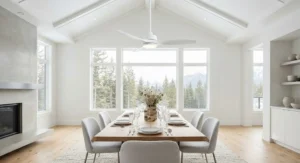
It’s tempting to assume a high ceiling automatically calls for the biggest fan available, but that’s not always true — room footprint matters just as much as ceiling height, and a small ceiling fan for dining room use is frequently the correct call even under a tall ceiling, provided the room itself is compact.
| Factor | Small Fan (24″–36″) | Large Statement Fan (52″–56″) |
|---|---|---|
| Best room size | Nooks, alcoves, condo dining corners | Formal rooms, open-concept great rooms |
| Airflow output | Lower CFM, sufficient for small spaces | Higher CFM, needed for larger footprints |
| Downrod flexibility | Often wider range (see Pickett Drum) | Matched more precisely to standard heights |
| Visual proportion | Reads correctly in tight spaces | Overwhelms small rooms, anchors large ones |
| Typical price range | C$150–C$400 | C$200–C$800+ |
Interpreting this table honestly: the deciding factor isn’t ceiling height at all, it’s floor-area footprint under that ceiling. A tall, narrow dining alcove under a raked roofline is still a small room, and a 52-inch fan crammed into it will look — and feel — disproportionate no matter how tall the ceiling runs. The Fanimation Pickett Drum 24″ exists precisely for that scenario, while the Casablanca Correne 56″ LED and Hunter Original 52″ are built for rooms where both the ceiling and the floor plan are genuinely large.
Ceiling Fan with Light for Formal Dining Room: What Actually Matters
A ceiling fan with light for formal dining room use has to clear a slightly different bar than a purely functional fan — it needs to look intentional as a lighting fixture first, with the fan function as a genuine bonus rather than the headline feature. That distinction shapes which specs actually matter for this specific use case.
Light output and quality matter more here than in a purely utilitarian dining space. The Casablanca Correne 56″ LED‘s 17-watt dimmable LED with cased white glass is rated to serve as a room’s sole overhead light source, which is a meaningfully different design brief than a fan with a basic bulb kit bolted underneath. Colour rendering matters too — the Fanimation Pickett Drum 24″‘s 90 CRI rating means food and table settings render with genuinely accurate colour under the light, a detail that matters more at a dinner table than almost anywhere else in the house. Finish and shade style carry real weight in a formal room as well: the frosted swirl glass on the Westinghouse Swirl 52″ reads noticeably softer and more traditional than a plain integrated LED panel, even though both are technically “a light on a fan.”
Dimming range is worth checking closely, too, since a formal dining room typically wants a wider brightness spread than a kitchen or hallway — bright enough for cleanup, low enough for a candlelit dinner. Every fixture in this guide’s top three price tiers includes a dimmable remote, but the depth of that dimming range varies more than manufacturers advertise upfront, so reading verified buyer feedback on actual low-end brightness is worth the extra five minutes before committing to a formal dining room’s primary light source.
Downrod Length vs Airflow Drop Height: What the Numbers Actually Mean
These two terms get used almost interchangeably in product listings, but they describe different things, and mixing them up is a common reason buyers end up with a fan that technically fits their ceiling but still performs poorly.
Downrod length is simply the physical measurement of the rod connecting the fan to the ceiling mount — a fixed number stated in inches on the product listing. Airflow drop height is the practical outcome of that measurement: how far below the ceiling the blades actually end up sitting, and by extension, how effectively the fan’s rated CFM translates into air movement people can actually feel at table height.
| Ceiling Height | Recommended Downrod Length | Resulting Airflow Drop Height |
|---|---|---|
| 8 ft (standard) | None / flush mount | Blades ~8–9 ft from floor |
| 9 ft | 6 inches | Blades ~8.5 ft from floor |
| 10 ft | 12 inches | Blades ~9 ft from floor |
| 12 ft | 24 inches | Blades ~10 ft from floor |
| 14 ft (vaulted) | 36–48 inches | Blades ~10–11 ft from floor |
Reading this table honestly, the goal isn’t to hang the fan as low as physically possible — it’s to land the blades in that roughly 8-to-9-foot sweet spot regardless of how tall the ceiling itself runs. Go past a reasonable drop height on a very tall vaulted ceiling and airflow starts dispersing before it reaches table level again; the Minka-Aire Light Wave 52″‘s ceiling-height-matched downrod variants exist specifically to hit that sweet spot without buyers doing this math themselves.
💬 Measured your ceiling yet? Check the comparison table above and match your numbers to the right pick.
Vaulted Ceiling Mounts Explained: Angle Brackets, Sloped Adapters, and Ball-and-Socket Mounts
Not every “angled ceiling compatible” claim on a product listing means the same thing, and understanding the actual hardware categories helps avoid buying a fan that arrives unable to physically mount to your dining room’s roofline.
A sloped ceiling adapter, like the one Hunter sells specifically for the Hunter Original 52″ platform, is typically a separate bracket that bolts to the existing electrical box and provides an angled mounting surface, usually rated to a specific maximum pitch — 45 degrees in Hunter’s case. A tri-mount system, like the one built into the Honeywell Eamon 52″ and Prominence Home Ashby 52″, integrates flat, standard, and angled mounting options into the fan’s own included hardware, which is why those two didn’t need a separate accessory purchase in this guide’s price comparison. A ball-and-socket downrod coupling, common on premium fans including the Minka-Aire Light Wave 52″‘s optional adapter, allows the downrod itself to pivot at the ceiling connection point, accommodating a range of angles rather than one fixed pitch.
The Canadian Electrical Code, administered provincially and enforced through bodies like Ontario’s Electrical Safety Authority, sets the baseline requirement that any ceiling-suspended fixture — fan or otherwise — connect to an outlet box specifically rated for the weight and rotational torque involved, a requirement that applies regardless of which mounting hardware style you choose. On an older cathedral-ceiling dining room, verifying that the existing box meets this rating, rather than assuming it does because a previous light fixture hung there safely, is worth a licensed electrician’s five-minute check before installation day.
Common Mistakes When Buying a Ceiling Fan for High Ceilings
Even careful shoppers trip over the same handful of errors in this category. Buying based on blade span or finish alone without checking the maximum rated mounting angle is probably the most common misstep — a beautiful 52-inch fan that only supports a 15-degree slope will not work on a genuinely steep cathedral ceiling no matter how much CFM it claims on paper.
Assuming the included downrod is adequate for a tall ceiling is a second frequent error; as covered above, most fans ship with a short standard rod meant for an 8-foot room, and a 12 or 14-foot vaulted dining room ceiling needs that rod upgraded separately in most cases. Underestimating total project cost by pricing only the base fan is a third recurring mistake — sloped ceiling adapters, extended downrods, and angled brackets routinely add C$30 to C$80 on top of the fan’s own price, and skipping that math leads to sticker shock at checkout. Ignoring electrical box rating in favour of focusing purely on the fixture itself is a fourth genuinely risky error, particularly relevant on older homes where a box rated for a static light fixture may not be rated for a heavier, rotating fan assembly. And finally, buying a full-size 52-inch fan purely because the ceiling is tall, without checking whether the room’s actual floor footprint can proportionally support that size, leads to a fixture that looks — and often performs — worse than a correctly sized small ceiling fan for dining room use would have.
Long-Term Cost and Maintenance for High-Ceiling Dining Room Fans
A ceiling fan is a genuinely cheap appliance to run day to day; most models in this guide draw well under 75 watts at medium speed excluding the light kit, making nightly use inexpensive compared to running air conditioning to achieve a comparable comfort effect in a large, high-ceiling room. According to BC Hydro’s guidance on using fans effectively, a fan typically uses roughly a tenth of the energy an air conditioner does while still meaningfully improving comfort — though the same guidance notes fans cool people, not empty rooms, so running one over an unoccupied dining table between meals wastes electricity rather than banking comfort for later.
Maintenance in a high-ceiling dining room carries one extra wrinkle standard-height rooms don’t: the fan itself is harder to reach for routine dusting and bulb changes. A telescoping duster handles the blades without a ladder in most cases, but bulb replacement on a fixture like the Casablanca Correne 56″ LED or Fanimation Pickett Drum 24″ mounted 10 or more feet up genuinely may require a proper ladder or a professional visit — worth factoring into the long-term convenience calculation before buying, not after the first bulb burns out. Check the downrod’s mounting hardware and any sloped ceiling adapter’s bolts for tightness annually, a step that matters more on angled mounts than flat ones, since gravity and vibration work at a mechanical disadvantage on a pivoted or angled connection point over time. And confirm warranty terms before buying — coverage duration and what’s actually included vary meaningfully between the AC-motor budget picks and the direct-drive premium options in this guide.
Frequently Asked Questions
❓ What downrod length do I need for a ceiling fan for dining room with high ceilings?
❓ Can any ceiling fan be mounted on a vaulted or sloped ceiling?
❓ Is a small ceiling fan for dining room use enough for a high-ceiling room?
❓ Do I need a licensed electrician to install a ceiling fan on a high or vaulted ceiling?
❓ How much airflow drop height do I actually need for a dining table?
Conclusion
Seven fixtures, three price tiers, and one consistent takeaway: choosing a ceiling fan for dining room with high ceilings comes down to solving a mounting and drop-height problem first, and a style problem second — reverse that order and you end up with a beautiful fan that either can’t physically install on your roofline or spins uselessly out of reach of your table. What holds true across every price point covered here is that downrod extensions and vaulted ceiling mounts are worth verifying in detail rather than assuming, and that room footprint matters just as much as ceiling height when sizing a fixture.
If you’re working with a steep cathedral pitch or want mounting flexibility without a second accessory purchase, the Honeywell Eamon 52″ and Hunter Original 52″ cover that territory convincingly. If your dining room is genuinely large and formal, the Casablanca Correne 56″ LED earns its premium price through scale and light quality. And if you’re furnishing a smaller nook under a tall ceiling or working with a tighter budget, the Fanimation Pickett Drum 24″, Prominence Home Ashby 52″, and Westinghouse Swirl 52″ round out a shortlist worth comparing directly against your measured ceiling height before you commit.
Recommended for You
- Chandelier Ceiling Fan For Dining Room: 7 Best Picks (2026)
- 7 Elegant Ceiling Fans for Dining Room That Wow Guests (2026)
- Casual Dining Room Ceiling Fan: 7 Best Picks for Canada (2026)
Disclaimer: This article contains affiliate links. As an Amazon Associate, I earn from qualifying purchases. If you purchase products through these links, we may earn a small commission at no additional cost to you.
✨ Found this helpful? Share it with your friends! 💬🤗
