
In This Article
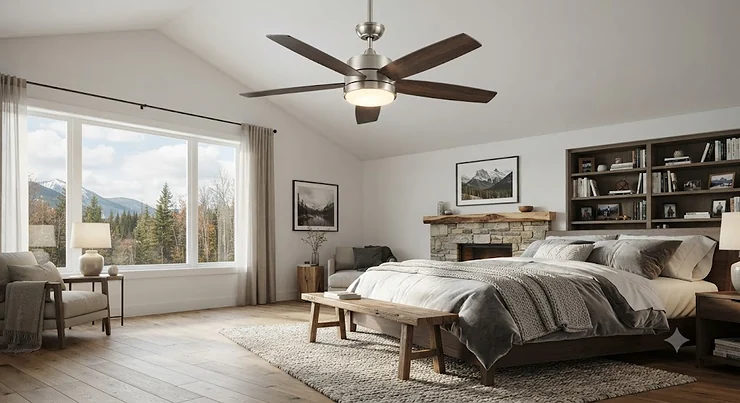
There’s a specific kind of misery reserved for hot, still bedrooms — the kind where you flip your pillow to the “cool side” three times before midnight and still end up staring at the ceiling. A flush-mount light fixture up there isn’t helping you sleep, and a box fan on the dresser is loud, ugly, and hogging an outlet. A ceiling fan with light for master bedroom use solves both problems from one spot on the ceiling, which is honestly the whole appeal.

So what is a ceiling fan with light for master bedroom, exactly? It’s a single ceiling-mounted fixture that pairs a multi-speed fan motor with an integrated or attachable LED light source, built to cool and illuminate a primary bedroom without the clutter of separate pendant and fan installations.
We dug through real product listings, manufacturer spec sheets, and aggregated review sentiment from actual buyers to find seven fans worth your ceiling joist. This isn’t a rewritten spec sheet — every pick below comes with an honest read on who it actually suits, because a fan that’s perfect for a nine-foot great room can be dead wrong for a cozy 10×12 master. Canadian homes also fight a specific battle: forced-air heating dries winter air while summer humidity does the opposite, and both extremes affect how comfortable your bedroom actually feels, something Health Canada’s own guidance on indoor air quality and ventilation touches on directly. A well-chosen fan won’t fix humidity on its own, but moving air makes a room feel several degrees cooler than the thermostat says, which matters when you’re trying to fall asleep in July.
We’ll walk through seven real, currently available models, then get into sizing, remote versus app control, dimmable lighting, and the regulatory details that actually apply north of the border.
Quick Comparison: Ceiling Fan With Light for Master Bedroom at a Glance
Before the deep dive, here’s the shortlist. Every model below includes an integrated or included LED light kit and a remote.
| Fan | Best For | Noise Level | Price Range (CAD)* |
|---|---|---|---|
| DREO 52 Inch Smart Ceiling Fan | Smart home / app control | ~22dB | C$190-C$240 |
| Hunter Warrant 60 Inch Ceiling Fan | Large master suites | Low-medium | C$230-C$290 |
| Amico 42 Inch Low Profile Ceiling Fan | Tight budgets | Low | C$70-C$100 |
| LEDIARY 24 Inch Low Profile Ceiling Fan | Low ceilings, small rooms | Very low | C$95-C$135 |
| Sofucor 52 Inch Ceiling Fan | Balanced all-rounder | Low | C$95-C$140 |
*Prices fluctuate constantly on Amazon.ca — treat these as ballpark ranges at the time of research, not quotes, and always check current pricing before buying.
Looking at the spread, the pattern is pretty clear: bigger blade spans and app/voice integration push you toward the top of the range, while flush-mount and low profile ceiling fan for bedroom designs tend to sit in the budget-to-mid tier because they skip the downrod hardware and extra mounting complexity. The Hunter Warrant 60 Inch Ceiling Fan justifies its position at the top mainly through sheer airflow volume for larger rooms, not gimmicks. If your master bedroom is a standard 10×12 to 12×14 footprint, you likely don’t need to spend at the top of this table at all.
Just one click — help others make better buying decisions too!😊
Top 7 Ceiling Fans With Light for Master Bedroom: Expert Analysis
We picked seven real, currently listed models spanning budget flush-mount options to premium smart fans, because “best” depends entirely on your ceiling height, room size, and whether you actually want to talk to your fan through a phone app.
| # | Fan | Blade Span | Motor / Noise | Light | Best For |
|---|---|---|---|---|---|
| 1 | DREO 52 Inch Smart Ceiling Fan | 52″ | DC, ~22dB | Dimmable LED, app-controlled | Smart bedrooms |
| 2 | Hunter Warrant 60 Inch Ceiling Fan | 60″ | AC, low-medium | 16W dimmable LED | Large suites |
| 3 | Amico 42 Inch Low Profile Ceiling Fan | 42″ | DC, low | Dimmable 3CCT LED | Budget shoppers |
| 4 | LEDIARY 24 Inch Low Profile Ceiling Fan | 24″ | DC, very low | Stepless dimmable 3CCT | Low ceilings |
| 5 | ZMISHIBO 52 Inch Ceiling Fan | 52″ | DC, low | 20W dimmable LED | Flush-mount value |
| 6 | Hunter Brookside 30 Inch Fandelier | 30″ | AC (WhisperWind), low | Two 4.5W dimmable bulbs | Decorative statement |
| 7 | Sofucor 52 Inch Ceiling Fan | 52″ | DC, low | Dimmable LED | Balanced all-rounder |
The table above is a snapshot, not a decision — notice that blade span alone doesn’t predict which fan suits your room, since the LEDIARY 24 Inch Low Profile Ceiling Fan at only 24 inches is designed for a completely different job (low ceilings, smaller rooms) than the Hunter Warrant 60 Inch Ceiling Fan. DC-motor fans dominate this list for good reason: forum consensus and manufacturer spec sheets agree that DC motors run quieter and cooler than older AC motors, which matters enormously in a room where the whole point is falling asleep.
1. DREO 52 Inch Smart Ceiling Fan — best smart pick with app and voice control
The standout here isn’t the size, it’s the control scheme: this fan runs on 12 speeds spread across 3 fan modes, adjustable from a phone app, a physical remote, or voice assistants. That’s a genuinely different experience from flipping a wall switch at 1am. The reversible DC motor is rated at roughly 22dB, and manufacturer airflow figures put it near 5,600+ CFM on its highest setting — high enough to matter in rooms up to about 400 square feet, which covers most Canadian primary bedrooms with room to spare. The dimmable LED light kit is stepless rather than stepped, so you’re not stuck choosing between “too bright” and “pitch black.” Based on the spec comparison, this is the pick for anyone who already has a smart-home ecosystem and wants one more device folded into it, rather than one more app cluttering their phone. Reviewers consistently report that the app connection is more reliable than typical budget smart-fan apps, though a handful mention occasional Wi-Fi dropouts requiring a re-pair — a known friction point with app-controlled fans generally, not unique to this model.
Pros:
- ✅ Whisper-quiet DC motor rated near 22dB
- ✅ App, remote, and voice control in one fan
- ✅ Stepless dimmable LED avoids harsh brightness jumps
Cons:
- ❌ Smart features add setup complexity for non-tech users
- ❌ Premium pricing versus basic remote-only fans
At the time of research, this fan sits in the C$190-C$240 range on amazon.ca. For the control flexibility alone, it’s solid value if you’ll actually use the app — if you won’t, you’re paying for features that’ll sit unused.

2. Hunter Warrant 60 Inch Ceiling Fan — best for large master suites
At 60 inches, the standout feature is raw airflow: this fan is rated at up to 6,785 CFM on high, which is a meaningfully bigger number than most 52-inch competitors and matters once your master suite pushes past 300 square feet. The integrated 16W dimmable LED kit is ENERGY STAR certified and rated for roughly 60,000 hours of use, and Hunter’s own materials claim it’s about 64% more efficient than conventional fixtures. The 13-degree blade pitch is worth noting because it’s steeper than most budget fans, which typically sit closer to 10 degrees — a steeper pitch physically moves more air per rotation, so the fan doesn’t need to spin as fast to feel effective, which in turn keeps it quieter at everyday speeds. Here’s what the spec sheet won’t tell you outright: a fan this large needs at least 8 to 9 feet of ceiling height with the included downrod to hang at the recommended 8 to 9 feet above the floor, so measure before you fall in love with the CFM number. Aggregated buyer sentiment on large ENERGY STAR fans in this category tends to praise the noticeable drop in cooling bills during summer months, consistent with independent claims that fans can meaningfully cut air conditioning costs.
Pros:
- ✅ Massive 6,785 CFM airflow for big rooms
- ✅ ENERGY STAR certified, roughly 64% more efficient
- ✅ 60,000-hour rated LED life reduces bulb changes
Cons:
- ❌ Requires higher ceilings for proper downrod clearance
- ❌ Wall control only, no app or voice option
Expect a price in the C$230-C$290 range at the time of research. For a genuinely large master suite, the airflow-per-dollar math works out in this fan’s favour over smaller alternatives.
3. Amico 42 Inch Low Profile Ceiling Fan — best budget low-profile pick
The standout advantage is the flush-mount design paired with a genuinely low price point — this is a low profile ceiling fan for bedroom setups where every other option felt like overkill for a modest room. At 42 inches, it’s sized for bedrooms in the 100 to 175 square foot range rather than sprawling master suites, and the dimmable 3CCT LED light kit lets you shift between warm, neutral, and daylight-ish colour temperatures with the included remote. Based on the spec comparison, the appeal here isn’t performance ceiling, it’s that you get a working DC motor, dimmable light, and remote control bundled together for less than most standalone flush-mount light fixtures cost on their own. It’s genuinely one of the best-selling fans in its category, which suggests broad satisfaction rather than a lucky one-off review cluster, though as with most budget electronics, the plastic housing and blade material feel noticeably less premium than mid-range picks once you handle it directly.
Pros:
- ✅ True low-profile flush mount for low ceilings
- ✅ Dimmable 3CCT LED covers warm to daylight tones
- ✅ Genuinely affordable without skipping a remote
Cons:
- ❌ Plastic build feels budget compared to pricier fans
- ❌ Smaller blade span limits coverage in larger rooms
Pricing sits under C$100 in most listings, often in the C$70-C$100 range at the time of research. For a secondary bedroom or a modest master, it’s hard to beat the value here.
4. LEDIARY 24 Inch Low Profile Ceiling Fan — best pick for low ceilings and small rooms
The standout feature is right in the name: at just 24 inches, this is a genuinely compact low profile ceiling fan for bedroom spaces with 7 to 8-foot ceilings, where a standard downrod fan would hang uncomfortably close to your head. Despite the small blade span, the manufacturer claims wider airflow coverage than the size suggests, thanks to blade geometry rather than sheer diameter. The stepless dimmable LED with 3 colour temperature settings and the quiet reversible DC motor across 6 speeds make it a legitimate bedroom fan, not just a compromise for tight spaces. What most buyers overlook about compact fans like this is that a smaller blade span isn’t automatically a downgrade for a smaller room — a 52-inch fan in a cramped 10×10 bedroom actually creates uncomfortable turbulence near the walls, so matching size to room dimensions matters more than chasing the biggest CFM number available.
Pros:
- ✅ True flush mount fits ceilings under 8 feet comfortably
- ✅ 6 speeds and 3CCT dimmable LED in a compact footprint
- ✅ Built-in timer for automatic shutoff overnight
Cons:
- ❌ Limited airflow coverage for rooms over roughly 150 sq ft
- ❌ Less brand history than Hunter or Amico in this category
At the time of research, pricing lands around C$95-C$135. If your master bedroom has a lower ceiling or a smaller footprint, this is a genuinely purpose-built option rather than a scaled-down compromise.
5. ZMISHIBO 52 Inch Ceiling Fan — best flush-mount value pick
The standout feature is combining a full 52-inch blade span with a true flush-mount, low-profile body — most fans this large use a downrod, which pushes the fixture lower into the room. The 20W dimmable LED light kit is on the brighter side for this category, and the app-plus-remote control combo mirrors pricier smart fans at a noticeably lower price point. Here’s what the spec sheet alone won’t tell you: pairing a large blade span with a flush mount typically means a bit more mounting complexity during installation, since the fan sits closer to the ceiling box and there’s less clearance to work with your hands. Reviewers consistently note the airflow feels stronger than the price point suggests, though a few flag that the app occasionally lags behind the physical remote by a second or two — a minor annoyance rather than a dealbreaker.
Pros:
- ✅ Full 52-inch coverage in a true flush-mount body
- ✅ Bright 20W dimmable LED, stronger than typical for its price
- ✅ Both app and remote control included
Cons:
- ❌ Slightly trickier installation due to tight flush clearance
- ❌ Occasional lag reported between app and physical remote
At the time of research, this fan runs roughly C$110-C$150. It’s a strong middle-ground pick if you want a low profile ceiling fan for bedroom use without sacrificing the airflow of a full-size blade span.

6. Hunter Brookside 30 Inch Fandelier — best decorative statement piece
The standout feature is style: this compact fandelier is designed to double as master suite decor, with enclosed blades and a chandelier-adjacent silhouette that reads more like a light fixture than a fan at first glance. Hunter’s WhisperWind reversible motor is rated up to roughly 2,604 CFM on high, which is modest compared to full-size fans but entirely appropriate for its 30-inch scale and intended role in smaller bedrooms or as a secondary fixture. It ships with two 4.5W dimmable LED bulbs on a standard socket rather than an integrated LED panel — worth noting because forum consensus consistently favours standard bulb sockets over sealed LED panels for long-term serviceability, since a burnt-out standard bulb costs a few dollars to replace while an integrated panel failure can mean replacing the whole light kit. Based on the spec comparison, this is less a cooling workhorse and more a design centrepiece for a master suite that wants personality on the ceiling, not just function.
Pros:
- ✅ Genuine design statement, not just a utilitarian fan
- ✅ Standard-socket LED bulbs are cheap and easy to replace
- ✅ Whisper-quiet reversible motor for year-round use
Cons:
- ❌ Lower CFM output than full-size 52-inch and 60-inch fans
- ❌ Downrod-only mounting, unsuitable for very low ceilings
Expect a price around C$140-C$190 at the time of research. If your master bedroom decor leans traditional or transitional, this is the pick that looks intentional rather than purely functional.
7. Sofucor 52 Inch Ceiling Fan — best all-around quiet performer
The standout feature is balance — this 52-inch fan doesn’t lead with any single flashy spec, but it combines quiet operation, a modern silhouette, remote control, and reversible blades into one genuinely well-rounded package. The DC motor keeps noise low enough for light sleepers, and the reversible blade direction means it earns its keep in winter too, gently pushing warm air back down from the ceiling rather than sitting idle from October through April. Based on aggregated review sentiment, this model has emerged as something of a default recommendation among independent review sites precisely because it doesn’t force a compromise between quiet, style, and price — it’s the fan you buy when you don’t want to overthink the decision. What most buyers overlook is that reversible motors aren’t just a marketing checkbox; running the fan clockwise on low in winter genuinely reduces heating costs by redistributing warm air that naturally rises and pools near the ceiling.
Pros:
- ✅ Quiet DC motor suitable for light sleepers
- ✅ Reversible blades add genuine winter utility
- ✅ Modern look that fits most master bedroom styles
Cons:
- ❌ No smart/app control, remote only
- ❌ Light output is adequate but not class-leading
At the time of research, pricing sits around C$95-C$140. For buyers who just want a dependable, quiet, good-looking fan without decision fatigue, this is the safest bet on the list.
🔧 Ready to narrow it down? Bookmark your top two picks and re-check current pricing before you buy — ceiling fan prices on Amazon.ca shift more than you’d expect.
Setting It Up Right: Installation, First 30 Days, and Maintenance
Buying the right ceiling fan with light for master bedroom use is only half the job — a poorly installed fan wobbles, hums, or worse, pulls loose from the ceiling box over time. Start with the electrical box itself: standard light-fixture boxes aren’t rated to support a fan’s weight and vibration, so you need a fan-rated outlet box before anything else goes up. If you’re unsure what’s currently in your ceiling, this is genuinely one job worth calling an electrician for rather than guessing.
Once mounted, run the fan through all speeds before installing the blades — a surprising number of “defective” fan complaints trace back to a wobble that was present in the motor housing itself, not the blades. Balance kits (usually included) fix 90% of post-installation wobble by adding small weights to the lighter blade. In the first 30 days, the most common mistake is leaving the fan running on high constantly; most DC motors are engineered for years of low-to-medium speed use, and constant high-speed operation accelerates bearing wear faster than the specs sheet implies.
For ongoing maintenance, dust the blades monthly with a microfibre cloth or a pillowcase slipped over each blade — this catches falling dust rather than scattering it across your bedding. Check the mounting screws for tightness every six months, since vibration gradually loosens hardware over years of operation. If your fan uses standard-socket LED bulbs rather than an integrated panel, keep a spare bulb or two on hand; it’s a five-minute fix instead of a fixture replacement.
Real Bedrooms, Real Picks: Three Buyer Scenarios
The renovator on a deadline: You’re finishing a spare-room-to-master conversion with an 8-foot ceiling and a C$100 budget line item for lighting and cooling combined. The Amico 42 Inch Low Profile Ceiling Fan or LEDIARY 24 Inch Low Profile Ceiling Fan both clear this bar, with the LEDIARY better suited if the room runs under 150 square feet.
The tech-comfortable couple: You already run smart bulbs and a smart thermostat, and you want the bedroom fan folded into the same app or voice routine. The DREO 52 Inch Smart Ceiling Fan is the obvious fit here — 12 speeds across 3 modes gives enough granularity that “just a bit more airflow” is actually achievable, not a guess between two settings.
The design-first homeowner: Your master suite decor leans traditional, with warm wood tones and a chandelier in the ensuite, and a purely functional fan would look out of place. The Hunter Brookside 30 Inch Fandelier was built for exactly this brief — it reads as a light fixture first and a fan second, without disappearing into the ceiling the way flush-mount options do.
How to Choose a Ceiling Fan With Light for Master Bedroom
Picking the right fan comes down to a handful of decisions, in roughly this order of importance:
- Measure ceiling height first. Anything under 8 feet 6 inches generally calls for a low profile ceiling fan for bedroom installation rather than a downrod-mounted model, simply for headroom safety.
- Match blade span to square footage. As a rough guide, 42-inch fans suit rooms up to about 175 square feet, 52-inch fans handle 175 to 350 square feet, and 60-inch-plus fans are for larger master suites beyond that.
- Decide on control type early. A ceiling fan with remote for bedroom use covers most people’s needs; only add app or voice control if you’ll genuinely use it.
- Check the light’s colour temperature range. Dimmable, adjustable-CCT lights let you shift from warm evening tones to brighter daytime light from the same fixture.
- Confirm motor type. DC motors run quieter and use less power than older AC motors — worth prioritizing in a room where quiet matters more than almost anywhere else in the house.
- Factor in your actual ceiling box. Confirm it’s fan-rated before you fall in love with a heavier premium model.
- Set a realistic price range, and treat any listed price as a moving target rather than a fixed number, since Amazon pricing shifts constantly.

Low Profile Ceiling Fan for Bedroom: When Ceiling Height Rules Everything
Not every master bedroom has soaring nine-foot ceilings, and that’s exactly where a low profile ceiling fan for bedroom installation earns its keep. These flush-mount designs skip the downrod entirely, hanging the fan body just inches from the ceiling surface instead of a foot or more below it. The tradeoff, honestly, is airflow: mounting a fan closer to the ceiling reduces the vertical drop of moving air before it reaches you, which is why manufacturers typically compensate with steeper blade pitch or slightly higher motor speeds on their low-profile lines. Both the Amico 42 Inch Low Profile Ceiling Fan and LEDIARY 24 Inch Low Profile Ceiling Fan from our list above fall into this category, and the ZMISHIBO 52 Inch Ceiling Fan manages to combine flush mounting with a larger blade span, which is the harder engineering trick to pull off. If your builder-grade ceiling sits at exactly 8 feet — extremely common in Canadian homes built after the 1990s — a low profile ceiling fan for bedroom use isn’t a compromise, it’s genuinely the correct spec.
Ceiling Fan With Remote for Bedroom: Remote, App, or Voice?
Every fan on this list ships with a remote, and for most bedrooms, that’s genuinely all you need — a ceiling fan with remote for bedroom use means you can adjust speed and light brightness without getting out of bed, full stop. Where it gets more interesting is the step beyond: app control (like the DREO 52 Inch Smart Ceiling Fan and ZMISHIBO 52 Inch Ceiling Fan offer) adds scheduling, so the fan can automatically slow down at 2am when bedroom temperature typically drops, or switch the light to a warmer tone after sunset. Voice control layers on top of that for hands-free adjustment, useful if you’re already lying down with a phone charging across the room. Here’s the honest tradeoff: every additional control layer is one more thing that can lose Wi-Fi connection or need a firmware update, so a plain ceiling fan with remote for bedroom setup remains the more reliable baseline. Reviewers of remote-only fans consistently report fewer connectivity complaints than smart-enabled models, which tracks — there’s simply less to go wrong.
Dimmable Fan Lights and Master Suite Decor
Dimmable fan lights solve a problem that fixed-brightness bulbs never really address: a bedroom needs bright, even light for getting dressed and a much softer glow for winding down before sleep, and toggling between “on” and “off” doesn’t cover that range. Most of the fans above pair dimming with adjustable colour temperature (often called 3CCT), letting you shift from a cooler daylight tone in the morning to a warmer amber tone at night — and warmer light in the evening is generally considered less disruptive to the body’s wind-down process than cooler, bluer light. Beyond function, the fixture itself is now doing double duty as master suite decor, which is a real shift from a decade ago when “ceiling fan” and “stylish bedroom centrepiece” rarely appeared in the same sentence. The Hunter Brookside 30 Inch Fandelier leans hardest into this, but even the flush-mount options on this list come in finishes — matte black, brushed nickel, walnut wood tones — chosen specifically to read as intentional master suite decor rather than a purely utilitarian afterthought bolted to the ceiling.
Common Mistakes When Buying a Ceiling Fan With Light for Master Bedroom
The single most common mistake is buying based on blade span alone without checking CFM or motor type — a large fan with a weak motor can move less air than a smaller fan with a strong one, and spec sheets don’t always make that obvious at a glance. A close second is ignoring ceiling height entirely and defaulting to a downrod fan when the room genuinely called for a low profile ceiling fan for bedroom use instead, resulting in a fixture that hangs uncomfortably low or, worse, within reach of an outstretched hand.
Buyers also frequently underestimate light output, assuming “LED” automatically means “bright enough,” when integrated light kits vary enormously in actual lumen output between models. Another recurring issue: skipping the fan-rated electrical box check, which leads to returns or, in worse cases, a fixture that develops a wobble or hum within months because the mounting hardware was never designed to handle a rotating load. Finally, plenty of shoppers chase smart features they’ll never actually use, paying a real premium for app and voice control on a fan that ends up controlled by the same wall switch for its entire lifespan — know your own habits before you pay for connectivity.

Ceiling Fan With Light vs Separate Fixture and Portable Fan
| Factor | Ceiling Fan With Light | Separate Light + Portable Fan |
|---|---|---|
| Installation | One fixture, one electrical box | Two separate installs/purchases |
| Floor/outlet space | None used | Portable fan occupies floor or dresser space |
| Noise | Generally lower (DC motor options) | Varies widely, often louder |
| Style cohesion | Single design decision | Two mismatched aesthetics possible |
| Best For | Most master bedrooms | Renters barred from ceiling modifications |
The comparison above makes the case pretty plainly: a combined fixture wins on space, noise (especially with a DC motor fan), and design cohesion, since you’re making one style decision instead of coordinating a light fixture and a fan that were never designed together. The one scenario where separate fixtures genuinely win is rental housing where ceiling modifications aren’t permitted — in that case, a portable or window fan paired with your existing light remains the only legal option. For anyone who owns their home or has landlord approval, though, the ceiling fan with light for master bedroom combo consistently comes out ahead on both practicality and long-term value.
Long-Term Cost and Maintenance: What You’ll Actually Spend
| Price Tier | Typical Range (CAD) | What You Get | Est. Annual Energy Cost** |
|---|---|---|---|
| Budget | C$70-C$100 | DC motor, basic dimmable LED, remote | Low |
| Mid-range | C$95-C$150 | Larger blade span, brighter LED, app option | Low-moderate |
| Premium | C$190-C$290 | Smart control, ENERGY STAR, highest CFM | Moderate |
**Estimates only, based on typical LED wattage and moderate seasonal usage; actual costs depend on local electricity rates and usage patterns.
The value story here isn’t as simple as “spend more, save more.” DC motors across every price tier already use meaningfully less electricity than older AC designs, so the biggest energy-cost differentiator is actually whether the fan carries ENERGY STAR certification, like the Hunter Warrant 60 Inch Ceiling Fan does, rather than price alone. Where premium pricing does pay off long-term is bulb and bearing longevity — the 60,000-hour LED rating on that Hunter model, for instance, likely outlasts the fixture’s mounting hardware, meaning you may never replace a bulb in that fan’s lifetime. Budget fans aren’t a false economy, though; they simply shift the cost from purchase price to a slightly higher chance of needing bulb or remote-battery replacements sooner.
Safety, Regulations, and CSA Compliance in Canada
Ceiling fans sold in Canada fall under CAN/CSA-C22.2 No. 60335-2-80, the household appliance safety standard that specifically covers ceiling fans alongside table and pedestal fans, and any fan you buy for permanent installation should carry a certification mark from an SCC-accredited body confirming it meets this CSA safety standard. Beyond basic electrical safety, Natural Resources Canada also regulates the energy efficiency of ceiling fans and their integrated light kits, with minimum performance standards tied to blade span and CFM output that manufacturers must report and label accordingly.
Practically, this means two things for a Canadian buyer: first, confirm the listing mentions CSA certification (most reputable Amazon.ca listings for the brands above do); second, remember that the outlet box supporting the fan must be rated for fan support under the Canadian Electrical Code, not a generic light-fixture box — this is a distinct requirement from the fan’s own certification and is almost always the point where DIY installations go wrong. If you’re at all unsure whether your existing ceiling box meets this standard, a licensed electrician’s inspection is inexpensive insurance against a fixture that eventually works loose.
Frequently Asked Questions
❓ What size ceiling fan do I need for a master bedroom?
❓ Is a ceiling fan with light better than a separate fan and light fixture?
❓ How much does a ceiling fan with light for master bedroom cost in Canada?
❓ Can I install a low profile ceiling fan for bedroom on a standard 8-foot ceiling?
❓ Do dimmable fan lights work with any light switch?
Conclusion
Choosing a ceiling fan with light for master bedroom use really comes down to three honest questions: how big is the room, how high is the ceiling, and how much control do you actually want over speed and brightness. Budget shoppers land well with the Amico 42 Inch Low Profile Ceiling Fan, tech-comfortable households get real value from the DREO 52 Inch Smart Ceiling Fan, and anyone furnishing a design-forward master suite should take a serious look at the Hunter Brookside 30 Inch Fandelier. Low ceilings point toward the LEDIARY 24 Inch Low Profile Ceiling Fan, larger suites toward the Hunter Warrant 60 Inch Ceiling Fan, and anyone who just wants a dependable, no-fuss option can stop second-guessing and go with the Sofucor 52 Inch Ceiling Fan or the ZMISHIBO 52 Inch Ceiling Fan.
Whichever you land on, confirm CSA certification, check that your ceiling box is fan-rated, and remember that price ranges shift constantly on Amazon.ca — the “best” fan on paper today might be a different value proposition next month. Measure your room, match the fan to it, and you’ll get years of quiet, comfortable nights out of a fixture that costs less than most people spend on a single mattress topper.
✨ Still deciding between two finalists? Re-check today’s prices before you buy — ceiling fan listings shift often, and the better deal might have changed since we last checked.
Recommended for You
- Ceiling Fans for Bedroom: 7 Best Quiet Picks in Canada (2026)
- 7 Best Ceiling Fans for Guest Bedroom Picks in Canada (2026)
- Ceiling Fan With Remote For Living Room: 7 Best Picks 2026
Disclaimer: This article contains affiliate links. As an Amazon Associate, I earn from qualifying purchases. If you purchase products through these links, we may earn a small commission at no additional cost to you.
✨ Found this helpful? Share it with someone furnishing their master bedroom! 💬🤗
