
In This Article
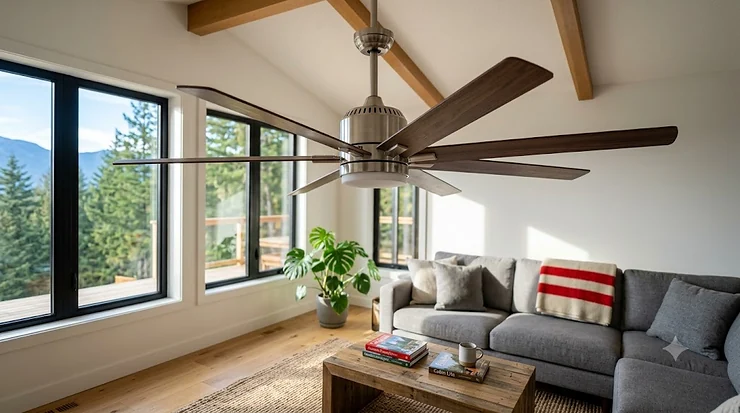
There’s a particular kind of misery that comes with a Canadian summer in a room with no air movement — the kind where your ceiling light fixture just sits there, doing absolutely nothing for you, while you lie on top of the covers at 1 a.m. wondering why you didn’t fix this years ago. A 6 blade ceiling fan is one of the simplest, cheapest fixes for that problem, and it’s also one of the most misunderstood purchases in the whole home-comfort category. People assume more blades automatically means more breeze. It doesn’t, and we’ll get into exactly why that assumption is wrong further down.
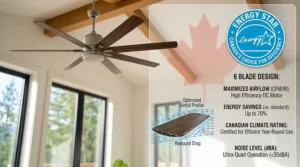
What is a 6 blade ceiling fan? It’s a ceiling-mounted fan with six blades instead of the more common three, four, or five, designed to circulate air through hub-mounted rotating blades. The extra blades typically trade a bit of raw airflow for quieter, smoother operation and a fuller, more substantial look — a trade-off that matters more in some rooms than others.
This guide pulls together real product specifications, genuine aggregated review sentiment, and honest comparative analysis on seven actual fans you can find through Amazon.ca and other Canadian retailers — from compact 76 cm (30-inch) models built for laundry rooms to 244 cm (96-inch) commercial-grade units that move enough air to cool a small gymnasium. Whether you’re outfitting a single bedroom, a vaulted great room, or a multi blade ceiling fan setup across a commercial space, you’ll find a grounded, no-fluff comparison below — plus the practical detail that most product listings skip entirely. For more on how ceiling fans actually work and where the design originated, see Wikipedia’s overview of the ceiling fan, which traces the concept all the way back to hand-pulled punkah fans in India.
Quick Comparison Table: 6 Blade Ceiling Fan Options at a Glance
| Fan | Blade Span | Best For | Price Range (CAD) |
|---|---|---|---|
| Fanimation Brawn | 163 cm (64″) | Large rooms, smart control | C$700–C$950 |
| Hykolity 60-Inch DC | 152 cm (60″) | Budget large-room buyers | C$220–C$300 |
| Big Ass Fans i6 | 244 cm (96″) | Commercial and industrial spaces | C$2,200–C$2,800 |
| Hunter Lakeway SureSpeed | 152 cm (60″) | Vaulted ceilings, covered patios | C$280–C$380 |
| Westinghouse Turbo Swirl | 76 cm (30″) | Small rooms, closets, laundry | C$90–C$140 |
| Casablanca Wailea | 79 cm (31″) | Compact spaces with style | C$180–C$260 |
| Canarm CP56D10N | 142 cm (56″) | Industrial/commercial, Canadian-built | C$650–C$900 |
A glance at this table tells most of the story: blade span, not blade count, is what predicts whether a fan can handle a great room or a den. Notice the spread, too — a 30-inch six-blade fan and a 96-inch six-blade fan share a blade count but live in completely different worlds of airflow and price. Buyers chasing a 6 blade ceiling fan large room solution should anchor their decision on span and CFM first, then layer in finish, smart features, and price range second.
💬 Just one click — help others make better buying decisions too! 😊
✨ Compare Your Options Before You Decide!
💬 Found a fan that fits your space? Check current pricing on amazon.ca before it changes!😊
Top 7 6 Blade Ceiling Fans: Expert Analysis
1. Fanimation Brawn — strongest airflow-to-size ratio in this lineup
The Brawn earns its name honestly: this is the fan to reach for when you need serious circulation without scaling all the way up to a commercial unit. Its DC motor produces a real spread between speeds, which matters more than most listings let on. On low it produces 1,576 CFM, jumping to 4,749 CFM on medium and 7,443 CFM on high — that kind of range means you can run it as near-silent background circulation overnight and then crank it for a hot afternoon without buying a second fan. Based on the spec comparison with other six-blade DC models in this price bracket, the Brawn’s damp rating and six 11-degree pitched blades make it one of the few fans here genuinely suited to a covered porch as well as an indoor great room. Reviewers consistently flag the WiFi smart control as a pleasant surprise at this price point, since fanSync-enabled scheduling is usually reserved for premium lines; a recurring complaint, however, is that the app setup process can be fussier than the box copy suggests. This is the fan for buyers who want one six-blade unit to handle both a large living space and an adjoining outdoor area.
✅ Wide speed range gives genuine quiet-to-powerful flexibility
✅ Damp rating extends use to covered outdoor spaces
✅ WiFi smart control included at a mid-range price
❌ App pairing reported as finicky by some owners
❌ 64-inch span needs a fairly large room to look proportional
At around C$700–C$950 depending on finish, the Brawn lands as strong value for anyone who would otherwise need two separate fans for indoor and covered-outdoor zones.
2. Hykolity 60-Inch DC — best value for a budget 6 blade ceiling fan large room
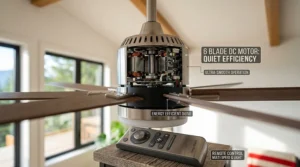
If your priority is moving real air through a sizeable room without spending Fanimation or Big Ass Fans money, this is the pick reviewers keep recommending to friends. It pushes up to 6,276 CFM on its high setting, which is genuinely competitive with fans costing two or three times as much. What most buyers overlook about budget DC fans like this one is that the motor technology, not the brand name, is doing most of the work — a quiet, efficient DC motor at C$250 can outperform an older AC-motor fan at C$400. The integrated LED light module offers five colour temperatures, a feature that’s becoming standard but is still worth checking before you buy, since older listings in this price tier often skip it entirely. Aggregated review sentiment is largely positive on noise level and remote responsiveness, though a handful of buyers mention the supplied downrod options feel limited for ceilings above roughly 3 metres (10 feet).
✅ Exceptional CFM-per-dollar in the 60-inch class
✅ Five colour temperature settings on the light kit
✅ Quiet operation reported across most reviews
❌ Limited downrod length for unusually tall ceilings
❌ Build materials feel lighter-duty than premium brands
Priced in the low-to-mid C$200s to around C$300, this is the fan to recommend to anyone asking how to cool a 28 square metre (300 sq ft) living room without overspending.
3. Big Ass Fans i6 — the industrial 6 blade ceiling fan built for genuinely huge spaces
This is not a fan for a bedroom, and Big Ass Fans doesn’t pretend otherwise. Energy Star and Title 24 certified, with energy use as low as 35 watts and a high-end output around 9,676 CFM, the i6 was engineered for the same commercial and industrial settings the company built its reputation on before it ever sold a residential model. Here’s what to weigh: that CFM figure is roughly four to six times what a typical 52-inch residential fan produces, which is exactly why this model shows up in warehouses, gymnasiums, and open-concept commercial lofts rather than condos. The patented EC motor is engineered for continuous-duty operation, a detail that matters enormously if the fan will run eight-plus hours a day in a retail or office setting. SenseME technology — occupancy, temperature, and humidity sensing — automates speed adjustments, which reviewers in commercial settings note saves real labour versus manually adjusting dozens of units. The trade-off is obvious from the price tag: this is a serious investment, and its 244 cm (96-inch) span needs a correspondingly large, open ceiling to make sense.
✅ Commercial-duty motor built for continuous operation
✅ Energy Star certified despite enormous airflow output
✅ Smart sensing automates speed for occupancy and climate
❌ Price puts it well outside typical residential budgets
❌ Requires a genuinely large, open space to suit its scale
Expect a price range in the low-to-mid C$2,000s to roughly C$2,800 — steep, but proportionate for a commercial ceiling fan rated for spaces that would otherwise need two or three smaller units.
4. Hunter Lakeway SureSpeed — purpose-built ceiling fan for vaulted ceiling installs
Vaulted and cathedral ceilings punish poorly chosen fans, because the extra vertical space swallows airflow that would otherwise reach the people in the room. The Lakeway addresses this directly: its 6-blade, 152 cm (60-inch) design with a long-downrod option is engineered to be hung well below the peak of a sloped ceiling, which is the single biggest factor in whether a vaulted-ceiling fan actually does its job. SureSpeed-branded Hunter fans are tested in-house, and the brand claims a meaningful air-velocity advantage over comparable competitor models, though as with any manufacturer-reported figure it’s worth treating as a starting point for comparison rather than gospel. The reversible WhisperWind motor handles the clockwise winter setting well, which is especially useful in a great room with a vaulted ceiling where heat stratification — warm air pooling near the peak — is a common complaint. Reviewers in outdoor and covered-patio installs report smooth, wobble-free operation, with the most common critique being that assembly takes a bit longer than Hunter’s other lines due to the extra blade.
✅ Long-downrod compatibility purpose-built for vaulted spaces
✅ Reversible motor helps with winter heat stratification
✅ Outdoor-rated for covered patios and three-season rooms
❌ Assembly reported as more time-consuming than 4-blade Hunter models
❌ Six-blade design slightly limits maximum tip speed versus 3-blade options
Pricing typically falls between C$280 and C$380, putting it squarely in mid-range territory for a fan engineered around a specific architectural challenge.
5. Westinghouse Turbo Swirl — the honest budget pick for small rooms
Not every room needs a large-room fan, and pretending otherwise does readers a disservice. The Turbo Swirl is a compact, 76 cm (30-inch), six-blade fan engineered for spaces under roughly 9 square metres (100 sq ft) — closets, laundry rooms, nurseries, small home offices. It moves 2,541 CFM at a high-speed RPM of 260, and on high speed delivers 2,267 CFM at 45 watts, for an airflow efficiency around 51 CFM per watt, which is a genuinely strong efficiency figure for an AC-motor fan at this price. The spec sheet won’t tell you this, but user reports suggest the asymmetrical curved-blade design is more about aesthetic flair than maximum air movement — the steep 18-degree blade pitch does the real work. This is a fan to recommend specifically when someone is shopping for a 6 blade ceiling fan and assumes bigger room performance is guaranteed; here, the honest answer is that it’s the wrong tool for anything larger than a small bedroom.
✅ Strong efficiency rating for an entry-level AC motor fan
✅ Dimmable LED light kit included at this price point
✅ Compact size fits low-clearance closets and small rooms
❌ Underpowered for anything beyond a small room
❌ AC motor is noticeably louder than the DC options on this list
At roughly C$90 to C$140, this is one of the most affordable entries here, and the right choice only when room size genuinely matches its rating.
6. Casablanca Wailea — premium small-space fan with genuine motor pedigree
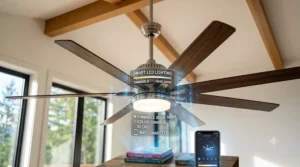
Casablanca built its reputation on motor quality, and the Wailea brings that pedigree to a compact footprint. This 79 cm (31-inch), six-blade fan runs on a reversible, four-speed Direct Drive motor and is damp-rated, making it a strong choice for a covered porch, sunroom, or bathroom where moisture resistance actually matters. Its 25-degree blade pitch is specifically optimized for maximum air movement despite the compact size, which is the kind of engineering detail that separates a premium small fan from a budget one running the same blade count. Based on the spec comparison with the Westinghouse Turbo Swirl above, the Wailea trades some affordability for a more robust motor warranty and damp-rating, which matters if the install location sees any humidity at all. Reviewers describe the stainless-steel hardware as noticeably more durable than typical small-fan hardware, though several note the styling — described as hibiscus-petal-inspired curved blades — reads more traditional than the brand’s modern lines.
✅ Damp-rated motor suits humid or semi-outdoor installs
✅ Steep blade pitch compensates well for compact size
✅ Stainless steel hardware built for moisture exposure
❌ Traditional styling won’t suit every modern interior
❌ Limited to small spaces given its 31-inch span
Expect to pay in the C$180 to C$260 range, a premium over the Westinghouse for buyers who specifically need damp-rated reliability in a small footprint.
7. Canarm CP56D10N — Canadian-built industrial and commercial 6 blade ceiling fan
For Canadian buyers specifically, this one deserves extra attention: Canarm is a Canadian-headquartered manufacturer, and the CP56D10N is purpose-built for the commercial ceiling fan category rather than adapted from a residential line. This 142 cm (56-inch) reversible DC unit is rated at 8,449 CFM and carries a 10-year warranty, a warranty term that’s unusually long for this category and signals genuine confidence in the motor’s continuous-duty rating. What most buyers overlook about industrial 6 blade ceiling fan options is that the warranty length often tells you more about expected service life than the spec sheet does — a 10-year warranty implies a motor designed to run far longer than the typical 2-to-3-year residential standard. This fan shows up in warehouses, gyms, agricultural buildings, and large retail floors across Canada, and its single-phase 120V configuration means it doesn’t require the specialized electrical work that some industrial equipment demands. The trade-off is aesthetic: this is a utilitarian, function-first design, not a decorative statement piece.
✅ Ten-year warranty signals genuine continuous-duty engineering
✅ Canadian manufacturer with established industrial track record
✅ Standard 120V single-phase power simplifies installation
❌ Utilitarian design prioritizes function over style
❌ 56-inch span still requires multiple units for very large floors
Pricing generally runs C$650 to C$900, positioning it as a serious mid-tier commercial option for facilities that need reliability over decades, not just years.
Setting Up and Maintaining Your 6 Blade Ceiling Fan
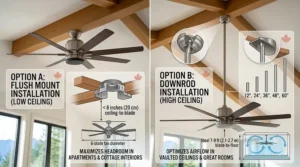
A six-blade fan is not meaningfully harder to install than a four-blade one, but the extra blades do change a few details worth knowing before you start. First, balance: more blades mean more opportunities for a tiny weight mismatch to cause wobble, so use the balancing kit included with most fans rather than skipping that step. During the first 30 days, the most common mistake is mounting the fan too close to a vaulted or sloped ceiling — aim for the blades to sit roughly 2.1 to 2.7 metres (7 to 9 feet) above the floor regardless of how high the ceiling itself runs, which usually means a longer downrod than the one in the box for genuinely tall spaces. Clean the blades monthly with a dry microfiber cloth or a vacuum brush attachment; dust accumulation on six blades adds up faster than on three or four, and an unbalanced, dusty fan is a leading cause of premature motor wear. Twice a year, check that the downrod coupling and blade screws haven’t loosened from normal vibration — Honeywell’s own installation literature recommends this exact interval for its similar large fans. Finally, set the seasonal reverse switch: counterclockwise rotation in summer pushes air down for a cooling effect, while clockwise rotation in winter gently redistributes warm air that’s pooled near the ceiling, a detail that becomes especially valuable with the vaulted-ceiling installs discussed above.
Real-World Scenarios: Matching a 6 Blade Ceiling Fan to Your Space
Picture three different Canadian households shopping for the same general product category and arriving at completely different answers. A condo owner in a one-bedroom unit with a 9-square-metre den needs the Westinghouse Turbo Swirl — anything larger is wasted money and an oversized visual in a small room. A family that just finished a great-room addition with a 4.3-metre (14-foot) vaulted ceiling and large south-facing windows is the textbook case for the Hunter Lakeway, where the long downrod and reversible motor directly solve the heat-stratification problem that vaulted spaces create. A small business owner outfitting a 460-square-metre (5,000 sq ft) warehouse or open-concept gym, on the other hand, isn’t shopping in the same category at all in practical terms — the Big Ass Fans i6 or the Canarm CP56D10N exist specifically because a handful of large commercial units outperform dozens of small residential ones, both on upfront cost and on long-term energy use per square metre. The throughline across all three: room size and ceiling geometry should drive the decision before finish, brand, or even price enter the conversation.
Common 6 Blade Ceiling Fan Problems, Solved
A handful of complaints show up again and again in review data across this category, and most have straightforward fixes. Wobbling after installation is almost always a balance issue, not a defect — use the included balance kit, and if one wasn’t included, most brands sell a universal one for under C$15. A fan that feels underpowered for the room usually means the blade span, not the blade count, was mismatched to square footage; a six-blade 30-inch fan and a six-blade 60-inch fan are not interchangeable despite sharing a category name. Excessive noise on higher speeds is frequently a sign of a worn-out remote-control receiver or a loose mounting bracket rather than the motor itself — check the bracket screws before assuming the fan needs replacing. Light flicker on dimmable LED kits is commonly caused by an incompatible wall dimmer switch; swapping to a fan-rated dimmer usually resolves it instantly. Finally, for anyone installing on a vaulted or sloped ceiling and finding the fan still doesn’t seem to move enough air to the floor, the fix is almost never a different fan — it’s a longer downrod positioned correctly within that 2.1 to 2.7 metre range from the floor.
How to Choose a 6 Blade Ceiling Fan
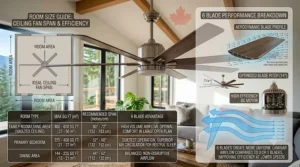
- Measure your room first. A fan with a 60-inch-plus span suits rooms over roughly 28 square metres (300 sq ft); smaller rooms do better with a 30-to-44-inch fan to avoid an oversized, overpowering look.
- Check CFM, not just blade count. Two fans with six blades can have wildly different airflow output; the CFM rating on high speed is the actual performance number that matters.
- Match the motor to your usage pattern. A DC motor costs more upfront but uses meaningfully less electricity if the fan runs daily for long stretches, which matters most in commercial or near-constant-use settings.
- Confirm the damp or wet rating for covered outdoor spaces. A fan rated only for dry indoor use will corrode quickly on a covered porch exposed to humidity.
- Plan your downrod length around ceiling height, not the box default. Vaulted and tall-ceiling rooms almost always need a longer downrod than what ships standard.
- Decide if smart control is worth the premium. App and voice control add convenience but also add a layer of potential connectivity headaches — weigh that honestly against your actual habits.
- Read the warranty term as a proxy for build quality. A 10-year motor warranty, like Canarm’s, signals a different engineering standard than a typical 2-to-3-year residential warranty.
Common Mistakes When Buying a 6 Blade Ceiling Fan
The single most common mistake is assuming six blades automatically out-performs a four- or five-blade fan of the same span — in most controlled comparisons, fewer blades with a more aggressive pitch can move comparable or even slightly more air, while six blades typically trade a small amount of raw output for quieter, smoother rotation. A second frequent error is buying based on finish and styling photos without checking the CFM rating at all, which is how buyers end up with a beautiful fan that barely stirs the air in a 30-square-metre living room. Third, many buyers skip checking the damp or wet rating before installing on a covered patio, leading to premature motor failure within a year or two. Fourth, underestimating downrod needs for vaulted ceilings is extremely common, since most retail listings ship a fan with a downrod sized for a standard 2.4 to 2.7 metre (8 to 9 foot) flat ceiling. Finally, buyers frequently overlook that a commercial-grade fan and a residential fan marketed as “large” are not the same product category — a 60-inch residential six-blade fan and a 96-inch commercial six-blade fan serve fundamentally different square footages.
6 Blade vs Multi Blade Ceiling Fan: What the Blade Count Actually Changes
The phrase multi blade ceiling fan often gets used loosely to describe anything with five or more blades, which muddies a comparison that actually has a clear technical answer. Fans with six to ten blades are versatile and are usually found in larger fans, though small fans for tiny areas sometimes also use six or more blades — blade count alone doesn’t predict room size, which is exactly the misconception this guide opened with. What changes meaningfully between a 3-blade and a 6-blade fan of the same span is balance and noise: more blades distribute weight more evenly around the hub, which tends to produce smoother, quieter rotation, while fewer, wider blades with a steeper pitch can sometimes move more air per rotation. In rooms over roughly 37 square metres (400 sq ft), the longer blade spans typical of 6-blade fans help push air circulation to every corner of the space — so the real performance variable circling back to span, not blade count, again. For buyers comparing a 6 blade ceiling fan against an 8-or-10-blade “multi blade” alternative, the honest takeaway is that motor quality and CFM rating should outrank blade count on every shopping checklist.
Industrial and Commercial 6 Blade Ceiling Fans: What’s Actually Different
The line between a residential 6 blade ceiling fan and an industrial 6 blade ceiling fan isn’t really about blade count at all — it’s about duty cycle, motor construction, and certification. Industrial ceiling fans are built for large indoor or outdoor areas such as warehouses, offices, large stores, garages, and storage areas, and differ from residential fans through larger blade diameter, more powerful motors, and more durable materials like steel and aluminum built to withstand harsher environments. A commercial ceiling fan is also typically rated for continuous multi-hour daily operation, which residential motors aren’t always engineered to handle without premature wear. For a restaurant, gym, or warehouse application, this is also where the warranty term becomes a genuinely useful proxy — a fan rated for 10 years of continuous duty, like the Canarm model above, has a fundamentally different motor inside it than a fan rated for occasional residential use, even if both happen to have six blades and a similar diameter. Buyers furnishing a commercial space should also confirm local electrical code compliance before installation, since commercial-grade fixtures often require a qualified electrician familiar with provincial commercial wiring standards rather than a standard residential install.
6 Blade Ceiling Fans for Vaulted Ceilings and Large Rooms
Vaulted ceilings and large rooms create two related but distinct challenges, and it’s worth separating them. In a large but flat-ceilinged room, the priority is simply blade span and CFM — a wider sweep moves air across more floor area per rotation. In a vaulted or cathedral-ceiling room, the challenge is vertical distance: experts recommend extending the downrod so the fan hangs roughly 2.1 to 2.4 metres (7 to 8 feet) above the floor, since hanging it any higher significantly reduces the airflow that actually reaches the people in the room. This is precisely why a fan marketed simply as a 6 blade ceiling fan large room solution can still underperform badly in a vaulted space if the downrod isn’t sized correctly — the fan might be perfectly matched to the square footage while being mounted too far from the floor to do its job. A useful rule of thumb when sizing the sweep itself is matching blade span to room width, where roughly a 4.3-metre (14-foot) room pairs well with a 132-to-142 cm (52-to-56-inch) fan. Combine that span guidance with correct downrod length, and a six-blade fan becomes one of the more reliable solutions for genuinely difficult architectural spaces.
🔍 Ready to Upgrade Your Comfort?
✨ These carefully researched picks can transform a stuffy room into the most comfortable spot in your home — check current pricing on amazon.ca and find the model that fits your space! 🍃
Long-Term Cost and Maintenance: What a 6 Blade Ceiling Fan Really Costs to Own
The sticker price is only part of the real cost picture, and this is one area where commentary genuinely changes the buying decision. According to Natural Resources Canada’s ENERGY STAR ceiling fan certification page, an ENERGY STAR certified ceiling fan uses 60% less energy on average than a standard model, which compounds meaningfully over a fan that might run six or more hours a day for a decade. Comparing the Hykolity DC fan against an older-style AC-motor equivalent, the wattage difference alone can translate into a noticeably lower electricity line item over several summers, even before counting the convenience of a longer-lasting LED light kit versus replaceable incandescent bulbs. Pairing a ceiling fan with air conditioning and setting the thermostat two degrees higher can cut air conditioning costs by roughly 14%, which is a meaningful, repeatable saving for households in hotter regions of the country. It’s worth noting that fans have real physical limits during genuine heat emergencies — a Montreal Heart Institute heat physiologist interviewed by CBC News found that fans generally help lower body temperature and ease strain on the heart only up to about 38°C, beyond which they can push warm air around without providing real relief, so a ceiling fan should be treated as a comfort and cost-saving tool for normal summer days rather than a substitute for air conditioning or a cooling centre during an extreme heat warning. On the commercial side, the Big Ass Fans i6 and Canarm units carry a much higher upfront cost, but their long warranty terms and lower watts-per-CFM efficiency mean the total cost of ownership over a 10-year horizon often compares favourably against running multiple smaller, less efficient units to cover the same floor area. The practical takeaway: when comparing a 6 blade ceiling fan against a similar option, always weigh wattage and warranty term alongside the upfront price range.
Safety, Regulations and Compliance Guide for Canadian Homes
Electrical safety isn’t optional when it comes to ceiling-mounted fixtures supporting a rotating motor overhead, so a few Canadian-specific points are worth flagging. Ceiling fans sold in Canada are subject to federal energy efficiency regulations, and fan luminaires specifically must meet CSA C22.2 No. 250.0-08 standards for luminaires, which is the certification mark worth checking for on the box before purchase — CSA Group’s own product listings confirm ceiling fans now fall under the related CAN/CSA-C22.2 No. 60335-2-80 fan safety standard as well, so look for either mark on the packaging. Always confirm the existing electrical box is rated for ceiling-fan support rather than a standard light-fixture box — fan-rated boxes are built to handle the additional weight and vibration load, and this is a detail that’s easy to overlook when replacing an old light fixture with a fan. For outdoor or covered-patio installs, confirm the damp or wet rating matches the actual exposure level of the install location, since a damp-rated fan isn’t engineered for direct rain exposure the way a wet-rated one is. If you’re not entirely confident in your home’s existing wiring or box rating, this is genuinely one of the situations where hiring a licensed electrician is worth the cost — both for safety and because most manufacturer warranties require professional installation to remain valid for ceiling-mounted, motorized fixtures.
Features That Actually Matter (And Those That Don’t)
After comparing seven real products across this price range, a clear pattern emerges in what’s genuinely worth paying for versus what’s marketing polish. DC motors matter — the efficiency and noise difference versus AC motors is real and measurable, not just a spec-sheet talking point. Damp or wet ratings matter enormously for any semi-outdoor install and are worth double-checking every time. Warranty length matters as a proxy for build quality, particularly in the commercial category. On the other hand, blade count alone is mostly aesthetic once you control for span and CFM — the marketing emphasis on “six blades” in product names often overstates how much that single number predicts performance. Smart app control is a genuine convenience for some households but adds little for buyers who’ll only ever use the wall switch. And decorative details like curved versus straight blades affect style far more than they affect actual air movement, despite how often product copy implies otherwise.
Frequently Asked Questions
❓ Does a 6 blade ceiling fan move more air than a 3 or 4 blade fan?
❓ What size 6 blade ceiling fan do I need for a large room?
❓ Are 6 blade ceiling fans good for vaulted ceilings?
❓ How much does a commercial-grade 6 blade ceiling fan cost in Canada?
❓ Do 6 blade ceiling fans cost more to run than fewer-blade models?
Conclusion
The honest answer to “which 6 blade ceiling fan should I buy” was never going to be a single product — it depends entirely on your room’s square footage, ceiling height and pitch, and whether the install is indoor, covered-outdoor, or genuinely commercial. What the spec comparisons above make clear is that blade count is one of the least predictive numbers on the box, while CFM rating, motor type, and warranty term tell you almost everything you actually need to know. A condo bedroom and a vaulted great room and a 460-square-metre warehouse all technically fall under the same product category, yet they call for three completely different fans from this list. Whatever you land on, pairing it correctly with your air conditioning schedule and the seasonal reverse switch can meaningfully cut cooling costs through the warmer months — a small habit change that compounds over years of ownership. Measure your space, match the span and CFM to that number, confirm the damp rating fits your install location, and the rest of the decision becomes considerably more straightforward.
✨ Don’t Miss These Exclusive Deals!
🔍 Take your home comfort to the next level with these carefully selected fans. Click on any highlighted model above to check current pricing and availability on amazon.ca. The right pick will keep your space comfortable through every Canadian season! 🍃
Recommended for You
- Best 4 Blade Ceiling Fan in Canada 2026: Top 7 Picks Reviewed
- Best 3 Blade Ceiling Fan in Canada 2026 – Top 7 Picks
- 7 Best Traditional Ceiling Fans in Canada 2026 (Honest Picks)
Disclaimer: This article contains affiliate links. As an Amazon Associate, I earn from qualifying purchases. If you purchase products through these links, we may earn a small commission at no additional cost to you.
✨ Found this helpful? Share it with your friends! 💬🤗
