
In This Article
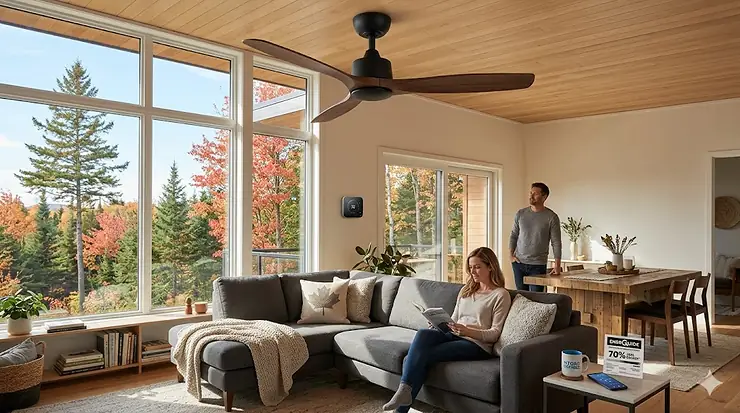
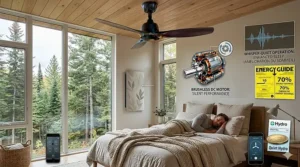
An inverter ceiling fan uses a brushless DC motor instead of the old-school AC motor that’s been spinning in Canadian homes since the 1970s. In plain terms: it sips power instead of guzzling it, runs whisper-quiet, and gives you far more speed settings than the classic low/medium/high dial. For Canadians, that matters twice over — once during humid Ontario and Quebec summers, and again in winter, when a reversed DC fan can push trapped warm air back down from the ceiling instead of letting it sit uselessly overhead.

This guide skips the marketing fluff. We dug into real listings on Amazon.ca, compared specs that actually affect comfort and your hydro bill, and worked out which inverter ceiling fan benefits matter for a Calgary bungalow versus a Toronto condo. You’ll find seven genuinely available DC motor fans, a buying framework built around Canadian conditions, and answers to the questions people actually search before clicking “buy.”
As an Amazon Associate, this post may earn from qualifying purchases — more on that in the disclaimer below.
Quick Comparison Table
| Fan | Motor Type | Speeds | Max Airflow (CFM) | Best For | Price Range (CAD) |
|---|---|---|---|---|---|
| Globe Electric Edinburgh 48″ | DC, smart app | 6 | ~5,000 | Canadian-brand smart pick | $150–$210 |
| Dreo 52″ Smart Ceiling Fan | DC, smart app | 12 | ~5,600 | Bedrooms, app control | $160–$240 |
| Carro Aspen 52″ | DC, smart | 10 | ~4,600 | Living rooms, voice control | $190–$270 |
| Minka-Aire Artemis 58″ | DC | 6 | N/A (large sweep) | Premium open-concept spaces | $350–$480 |
| Carro Icebreaker 56″ | DC, smart | 10 | N/A (large sweep) | Large rec rooms | $230–$320 |
| Hykolity 60″ DC Fan | DC | 6 | High (large blade span) | Big rooms, budget | $130–$190 |
| reiga 52″ DC Fan | DC | 6 | Moderate | First-time buyers, basements | $90–$140 |
The spread here tells its own story: you’re paying mostly for smart features and finish quality, not for the core efficiency benefit. Even the cheapest fan on this list, the reiga, runs the same basic brushless DC motor technology as the $400+ Minka-Aire — the price difference buys you app control, build materials, and blade span for bigger rooms. If you just want lower power consumption and quieter operation, the budget end of this table already gets you there.
💬 Just one click — help others make better buying decisions too! 😊
✨ Don’t Miss These Exclusive Deals!
🔍 Take your home cooling to the next level with these carefully selected fans. Click on any highlighted item to check current pricing and availability on Amazon.ca. These DC motor upgrades will help you build a more comfortable home your whole family will love! 🇨🇦
Top 7 Inverter & DC Motor Ceiling Fans for Canadian Homes
A quick note before the list: “inverter ceiling fan” is the term you’ll see most often outside North America, but on Amazon.ca and in Canadian retail, the identical technology is sold as a “DC motor ceiling fan.” Same brushless motor, same variable speed control, same energy savings — just a different label. We’re using “DC motor” throughout since that’s what you’ll actually see on Canadian product pages.
1. Globe Electric Edinburgh 48″ Smart Ceiling Fan
Globe Electric is headquartered in Montreal, which makes this one of the few genuinely Canadian-brand picks on this list — worth knowing if supporting a domestic company matters to you. The 122 cm (48″) fan uses a reversible DC motor rated up to roughly 5,000 CFM across 6 speeds, and the company states it’s about 70% more efficient than a comparable AC motor fan.
What the spec sheet won’t tell you: the “smart” label here means control through the Globe Smart App or the included remote, not a hub-dependent ecosystem — handy if you don’t want another bridge device cluttering a Canadian apartment’s already-crowded power bar. The adjustable 2000K–5000K LED means you can warm up a Calgary basement in February and cool the tone down for a bright Vancouver summer evening without buying a second fixture.
Canadian buyers on Amazon.ca note straightforward installation and quiet running at lower speeds, with a few comments about light dimming behaviour at the very lowest brightness settings — worth testing once installed rather than assuming it’ll behave like a standard dimmer switch.
✅ Pros: Canadian brand, strong app control, dimmable warm-to-cool LED
❌ Cons: Smart features need a stable home Wi-Fi signal; 48″ suits small-to-medium rooms only
Price sits around $150–$210 CAD depending on finish — solid value for a Canadian-headquartered smart fan.

2. Dreo 52″ Smart Ceiling Fan with Lights
Dreo’s 52″ (132 cm) model is the airflow leader on this list, with some configurations pushing past 5,600 CFM thanks to a brushless DC motor and 14° angled blades. Twelve speed levels plus three wind modes (Normal, Natural, Sleep) give far more granular variable speed control than the typical 3- or 6-speed fan.
In practice, this matters most in larger open-concept living rooms common in newer Canadian builds — you get enough genuine airflow to matter on a humid July evening in southern Ontario, but Sleep mode keeps things quiet enough for a bedroom in January when you mainly want gentle air circulation, not a gale. The stepless LED dimming (1%–100%) and wide colour-temperature range (2700K–6500K) also mean one fixture can do double duty as your main bedroom light.
Reviewers consistently flag the installation as straightforward thanks to pre-assembled parts, which matters if you’re DIY-installing rather than paying an electrician — though Canadian homes wired before the 1990s should still have a licensed electrician confirm the existing junction box can support a fan-rated load.
✅ Pros: Class-leading airflow, very granular speed control, easy install
❌ Cons: App dependent for full feature set; higher CFM models can feel like overkill in a small bedroom
Expect $160–$240 CAD depending on size and finish.
3. Carro Aspen 52″ Smart Ceiling Fan
Carro’s Aspen line runs a 10-speed brushless DC motor rated from about 980 up to 4,600 CFM, with Alexa, Google Home, and Siri compatibility baked in. The plywood blade construction and three-temperature LED (2700K/3000K/4000K) lean toward a more design-forward look than the average builder-grade fan.
The real-world value here is voice control integration for Canadians already running an Alexa or Google Home setup — “set bedroom fan to speed six” beats fumbling for a remote at 11 p.m. The wide speed range (980–4,600 CFM) also means you’re not stuck choosing between “barely moving air” and “wind tunnel,” which matters in a multi-use room that needs to go from nursery-quiet to summer-cooling on demand.
Carro’s listings are most consistently available through Amazon’s US storefront; confirm current Amazon.ca availability and shipping eligibility to your province before ordering, since cross-border smart-home inventory can shift.
✅ Pros: Genuine voice assistant support, wide speed range, attractive finish options
❌ Cons: Confirm Amazon.ca stock/shipping before buying; smart features add setup time
Typical pricing runs $190–$270 CAD.
4. Minka-Aire Artemis 58″ LED Ceiling Fan
This is the premium pick. The Artemis spans 147 cm (58″) with a 6-speed reversible DC motor, a 20W integrated LED kit, and an RC400 remote with full-range dimming. Minka-Aire fans are also Bond-compatible, meaning Canadians with SmartThings, Control4, or similar smart-home setups can integrate it without buying a dedicated app ecosystem.
What stands out in practice is fit and finish — the kind of fan that becomes a design feature in an open-concept great room rather than something you forget is there. The large sweep also means it can comfortably move air across a bigger Canadian living-dining combo without running at a noisy top speed, which smaller 44″–48″ fans often need to do just to feel effective in the same square footage.
The trade-off is price and availability: Minka-Aire’s catalogue is deepest on Amazon’s US site, and Canadian buyers should verify the specific finish is listed and shippable on Amazon.ca, since premium designer lines sometimes have thinner cross-border stock than mass-market brands.
✅ Pros: Designer build quality, smart-hub compatible, large effective coverage
❌ Cons: Highest price on this list; confirm Canadian shipping before ordering
Budget $350–$480 CAD for this tier.
5. Carro Icebreaker 56″ Smart Ceiling Fan
The Icebreaker steps up to 142 cm (56″) with a 10-speed DC motor, ETL listing, and Carro’s claimed 75% efficiency improvement over AC motors. It’s built for the larger rec rooms and finished basements common in suburban Canadian homes — the kind of space where a 44″ fan just doesn’t move enough air.
The ultra-low-voltage motor design (24V on some Carro models) is worth knowing about if you’re nervous about DIY electrical work: lower-voltage fan motors are generally considered a more forgiving install for a confident homeowner, though Canadian electrical code and local bylaws should still guide whether you do this yourself or call an electrician, especially in older housing stock.
✅ Pros: Strong size-to-airflow ratio for big rooms, ETL listed, lower-voltage motor design
❌ Cons: Same Amazon.ca availability caveat as the Aspen — confirm before buying
Expect $230–$320 CAD.
6. Hykolity 60″ DC Motor Ceiling Fan with LED Light
Hykolity’s 60″ (152 cm) fan is the budget-large-room answer: a reversible DC motor, 6 speeds, dimmable LED in 3 colour temperatures, and a sweep big enough for an open great room without the premium price tag. It’s a frequent best-seller in the budget DC fan category on Amazon.
The honest trade here is that you’re getting genuine inverter efficiency and a big blade span, but not the smart-app layer — control is via remote only on most configurations. For a Canadian buyer prioritizing power consumption optimization over gadgetry (say, a landlord furnishing a rental, or a basement apartment), that’s arguably the smarter spend: the energy savings come from the motor, not the app.
A few Canadian reviewers note the reversible feature works as expected for winter heat circulation, though as with most budget DC fans, expect a basic plastic remote rather than a premium wall control.
✅ Pros: Big blade span at a low price, genuine DC efficiency, simple reliable remote
❌ Cons: No smart/voice control; finish quality is functional rather than premium
Typically $130–$190 CAD — among the best value-per-CFM on this list.
7. reiga 52″ DC Motor Ceiling Fan with Light and Remote
reiga has built two decades of ceiling fan manufacturing around one idea: quiet, strong DC motors without the bells and whistles. The 52″ (132 cm) fan runs 6 speeds with a remote-controlled timer and dimmable light, and it’s consistently one of the most affordable genuine DC motor options on Amazon.
This is the fan to recommend to someone buying their very first DC motor ceiling fan and wanting to test whether the efficiency and noise difference is worth it before spending more on a smart model. It won’t integrate with Alexa, and the blade span is modest, but the core inverter ceiling fan benefits — lower running cost, quieter operation, more usable speed steps — are all present.
✅ Pros: Lowest price for genuine DC tech, simple remote, good for first-timers
❌ Cons: No app/voice control, smaller sweep than the large-room options above
Generally $90–$140 CAD, making it the easiest entry point on this list.
How to Choose an Inverter Ceiling Fan in Canada
- Match blade span to room size, not the price tag. A 122 cm (48″) fan suits bedrooms up to roughly 18 m² (190 sq ft); go to 132–152 cm (52″–60″) for open-concept living spaces.
- Check the speed count, not just “has multiple speeds.” Six steps is the practical minimum for genuine variable speed control; 10–12 steps (like the Dreo or Carro models above) let you fine-tune for sleep versus active cooling.
- Confirm reversibility. Every fan on this list reverses direction — non-negotiable for a Canadian climate where you want downdraft in summer and updraft to push warm ceiling air back down in winter.
- Decide if you actually want “smart.” App and voice control add convenience but also add a point of failure if your home Wi-Fi drops. Budget fans like the reiga or Hykolity skip this layer entirely and are arguably more reliable for it.
- Look for ETL or CSA marking before checkout. Canadian electrical code expects third-party safety certification on anything tied into household wiring — check the listing or product manual, not just the marketing copy.
- Factor in ceiling height and downrod needs. Vaulted or high ceilings, common in newer Canadian builds, may need a longer downrod sold separately — confirm compatibility before ordering.
- Verify Amazon.ca shipping to your specific province, especially for premium or smaller third-party brands, since stock and shipping eligibility can differ from the US listing.
Real-World Scenarios: Which Fan Fits Your Canadian Home
Toronto condo dweller in a 14 m² bedroom: The Globe Electric Edinburgh or reiga 52″ both fit comfortably here. Condo boards often restrict major electrical changes, so the simpler reiga install — no smart hub, no app pairing — is the lower-friction choice if you’re not planning to stay long-term.
Calgary family with an open-concept main floor: This is squarely Dreo or Carro Aspen territory. The higher CFM ceiling and 10–12 speed steps mean the fan can run hard during a Chinook-driven warm spell and drop to near-silent for evening TV time, without buying two separate fans for two needs.
Ottawa homeowner finishing a basement rec room: The Hykolity 60″ or Carro Icebreaker make sense for the larger footprint typical of a finished basement. Basements also tend to run cooler already, so the reversible winter mode matters less here than the simple ability to move stale air during gatherings.
Setup, Maintenance & Winter Mode: A Practical Usage Guide
Installation on any of these fans typically takes 45–90 minutes for someone comfortable with basic tools, assuming the existing ceiling box is fan-rated — if you’re replacing an old light fixture rather than an existing fan, have an electrician confirm the box rating first, since this is a common point where Canadian DIYers run into trouble.
For winter mode: reverse the fan direction (a switch on the motor housing or in the app) so blades pull air upward, gently pushing warm air that’s collected near the ceiling back down into the room. Run it on the lowest speed — you want barely perceptible air movement, not a breeze. This is most useful in rooms with cathedral or vaulted ceilings, where heat stratification is worst.
Maintenance is minimal: wipe blades monthly to prevent dust buildup (which throws off balance over time), and check mounting screws annually, since temperature swings between a heated Canadian home and an unheated attic space above can cause minor seasonal loosening. Most DC motor fans don’t need oiling — that’s an old AC-motor habit that doesn’t apply here.
Common first-30-days mistake: running a new DC fan on its lowest speed and assuming something’s wrong because it’s “too quiet.” That’s the point — compare it side-by-side with an old AC fan and the difference becomes obvious fast.

Inverter DC Fans vs Traditional AC Ceiling Fans
| Feature | DC Motor (Inverter) | Traditional AC Motor |
|---|---|---|
| Typical speed steps | 6–12 | 3 |
| Relative energy use | Significantly lower | Baseline |
| Noise at low speed | Very quiet | Noticeably louder |
| Smart/app control | Common | Rare |
| Typical price (CAD) | $90–$480 | $50–$150 |
The upfront price gap is real, but it’s largely offset over time by lower running costs and the practical benefit of finer speed control — a DC fan on speed 2 of 10 is genuinely gentler than an AC fan’s lowest setting, which often still feels abrupt. If you’re running a fan most of the day during a Canadian summer, the lower power draw adds up across a billing cycle in a way that’s easy to underestimate looking only at the sticker price.
Common Mistakes When Buying a DC Motor Ceiling Fan in Canada
- Buying based on blade span alone. A wider fan with a weaker motor can move less air than a smaller, well-engineered DC fan — check CFM, not just inches.
- Ignoring downrod length for vaulted ceilings. Many listings ship with a short downrod; taller Canadian great rooms often need an extension sold separately.
- Assuming all “smart” fans work with your existing ecosystem. Confirm Alexa/Google/Siri compatibility per model rather than per brand — not every fan in a brand’s lineup supports every assistant.
- Skipping the safety certification check. Look for ETL, CSA, or UL marking before assuming any imported fan is approved for Canadian household wiring.
- Overlooking Amazon.ca-specific shipping and warranty terms. A model listed on Amazon’s US site isn’t automatically available — or under the same warranty terms — north of the border.
Long-Term Cost & Power Consumption Optimization in Canada
A typical AC ceiling fan motor can draw noticeably more power at comparable airflow than a DC equivalent — Natural Resources Canada’s own figures put an ENERGY STAR certified ceiling fan at roughly 60% less energy use, on average, than a standard model. Run a fan 8 hours a day through a Canadian summer and that gap compounds across the season, even before accounting for the LED lighting most of these models include.
The other long-term factor is maintenance cost: DC motors have fewer moving parts prone to wear than older AC induction motors, and most of the fans above carry motor warranties of three or more years. Total cost of ownership, not sticker price, is the number that actually matters here — a $90 reiga fan and a $400 Minka-Aire both deliver the core efficiency benefit; the price gap buys design and smart features, not energy savings.
Canadian Regulations & Safety Standards
Ceiling fans sold in Canada fall under Natural Resources Canada’s Energy Efficiency Regulations, which set minimum performance standards — meaning even a non-ENERGY STAR fan sold legally in Canada has to clear a baseline efficiency bar. On the electrical safety side, look for CSA Group certification (or UL/ETL, which Canadian inspectors generally also accept) before installing any fan tied into household wiring; CSA Group is the standards body most provincial electrical codes reference directly.
If you’re in Quebec, note that bilingual product labelling is a legal requirement — most major brands sold through Amazon.ca already comply, but it’s worth a quick check on imported budget listings.
What to Expect: Real-World Performance in Canadian Conditions
Brushless DC motors lose less efficiency in cold conditions than the battery-style DC systems some people confuse them with — these fans plug into standard household AC power and convert it internally, so a cold basement or unheated sunroom won’t meaningfully hurt performance. The bigger practical factor is humidity: Canadian summers in Ontario and Quebec run humid enough that higher airflow settings genuinely improve comfort, while drier Prairie summers may need less raw CFM and benefit more from the lower noise floor at moderate speeds.

Frequently Asked Questions
❓ Do inverter ceiling fans actually save electricity in Canada?
❓ Can a DC ceiling fan help heat my home in a Canadian winter?
❓ Does Amazon.ca ship DC ceiling fans to every province?
❓ What size inverter ceiling fan do I need for my room?
❓ Are inverter ceiling fans noisy?
Conclusion
The core inverter ceiling fan benefits — lower power draw, quieter operation, and genuinely useful variable speed control — show up at every price point on this list, from the $90–$140 CAD reiga up to the $350–$480 CAD Minka-Aire Artemis. What changes as you spend more isn’t the underlying efficiency; it’s smart-home integration, build materials, and blade span for bigger Canadian living spaces. Pick based on your room size and how much you actually want app or voice control, verify CSA/ETL certification and Amazon.ca shipping before you check out, and a DC motor fan should quietly pay for itself across a few Canadian summers.
Recommended for You
- Top 7 Twin Motor Ceiling Fans with Independent Control Canada 2026
- Best 7 Convertible Ceiling Fan Flush or Downrod Canada 2026
- 7 Best Ceiling Fans for High Humidity Basement Canada 2026
Disclaimer: This article contains affiliate links. As an Amazon Associate, I earn from qualifying purchases. If you purchase products through these links, we may earn a small commission at no additional cost to you.
✨ Found this helpful? Share it with your friends! 💬🤗
