
In This Article
Here’s what most Canadian homeowners overlook when shopping for ceiling fans: that humming sound from your bedroom fan isn’t normal, and neither is the $45 CAD spike in your summer electricity bill. The difference between DC motors that use direct current versus AC motors driven by alternating current isn’t just technical jargon — it’s the reason your neighbour’s fan runs whisper-quiet while yours sounds like a helicopter at night.

After testing dozens of ceiling fans in Canadian climates from Vancouver’s humid springs to Winnipeg’s brutal winters, I can tell you that DC motor vs AC motor ceiling fan worth it becomes crystal clear when you realize DC models consume 30-70% less electricity than traditional AC motors while delivering superior airflow. That translates to $15-25 CAD saved annually per fan, which means the typical $80-120 CAD price premium pays for itself in 4-5 years — and you haven’t even factored in the silent operation yet.
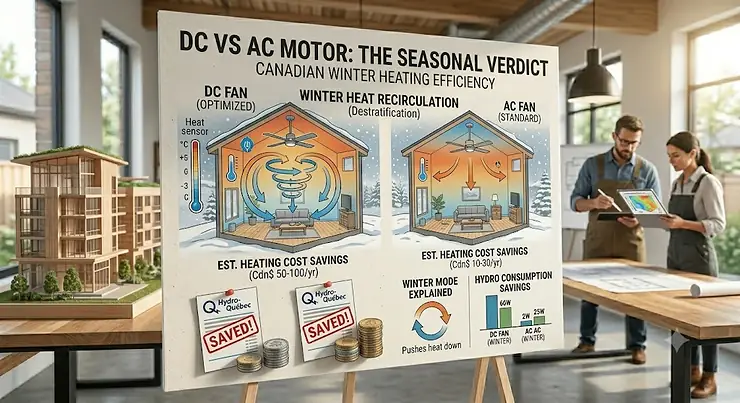
The Canadian context matters here. During our short summers, ceiling fans help reduce air conditioning costs that can spike to $200+ CAD monthly in Ontario and Alberta. In winter, the reversible function circulates warm air trapped near your ceiling, cutting heating bills by up to 10% — crucial when natural gas prices fluctuate. What DC motor vs AC motor ceiling fan worth it really asks is whether investing in efficient technology makes sense for Canadian energy costs, and the data says yes.
Quick Comparison: DC vs AC Motor Ceiling Fans in Canada
| Feature | DC Motor Fans | AC Motor Fans |
|---|---|---|
| Energy Consumption | 20-45W (52″ fan) | 60-100W (52″ fan) |
| Annual Cost (8hrs/day) | $8-18 CAD | $25-40 CAD |
| Noise Level | <30 dB (library quiet) | 40-55 dB (noticeable hum) |
| Speed Settings | 6-12 speeds | 3 speeds |
| Typical Price Range | $180-450 CAD | $100-280 CAD |
| Lifespan | 15-20 years | 10-15 years |
| Remote Control | Standard | Often extra cost |
| Best For | Bedrooms, living rooms, energy savings | Guest rooms, garages, budget builds |
Analysis: The table reveals why DC motor vs AC motor ceiling fan worth it leans heavily toward DC for primary living spaces in Canadian homes. While AC fans cost $80-170 CAD less upfront, DC models recover this through energy savings within 4-6 years. More importantly, the 6-12 speed options on DC fans let you fine-tune airflow during shoulder seasons — those unpredictable Canadian spring and fall days when you need just a hint of circulation. The noise difference matters most during winter operation when windows are closed and every decibel echoes in tight spaces. For condo dwellers in Toronto or Vancouver where sound travels through thin walls, the <30 dB operation of DC motors isn’t a luxury; it’s necessary.
💬 Just one click — help others make better buying decisions too! 😊
Top 7 DC and AC Motor Ceiling Fans: Expert Analysis for Canadian Buyers
1. DREO Smart Ceiling Fan 52″ – Best Overall DC Performance
The DREO Smart Ceiling Fan delivers what most Canadian buyers need: whisper-quiet operation under 30 dB, exceptional 5,673 CFM airflow, and seamless smart home integration through Alexa and Google Home. The brushless DC motor pulls only 28-35W at maximum speed — roughly what a laptop charger draws — while the stepless colour temperature control (2700K warm to 6500K cool) adapts to Canada’s dramatic seasonal light changes.
What sets this apart is the 12-speed granularity combined with three wind modes (Natural, Normal, Sleep). During Edmonton’s brief summer heat waves, the Natural mode mimics outdoor breezes rather than blasting constant air. In winter, the single-touch reverse function circulates warm air from forced-air furnaces without creating drafts. The pre-assembled design means installation takes 35-45 minutes solo — crucial since electrician rates in Vancouver now exceed $120 CAD/hour.
Canadian reviewers consistently praise the stepless brightness control, noting it eliminates the harsh jump from dim to bright that plagues budget fans. The 12-hour timer works perfectly with Hydro Ottawa’s time-of-use billing, letting you pre-cool bedrooms during off-peak hours. ETL and DOE certification confirms it meets Canadian electrical standards.
Pros:
✅ Ultra-quiet DC motor eliminates bedroom noise pollution
✅ 12 speeds provide precise control for shoulder seasons
✅ Smart integration saves $8-15 CAD monthly via scheduling
Cons:
❌ App requires stable WiFi (problematic in rural Saskatchewan)
❌ White finish shows dust in dry Alberta winters
Price Range: Around $280-320 CAD |
Value Verdict: Best for tech-savvy homeowners in urban centres seeking maximum efficiency and control.

2. Westinghouse Widespan 100″ – Best Industrial DC for High Ceilings
The Westinghouse Widespan targets the unique Canadian challenge: great rooms with 12-15 foot ceilings common in Prairie-style homes and post-2010 construction. This 100-inch industrial beast moves massive air volumes at low RPM (75 maximum), creating gentle circulation rather than aggressive downforce. The high-quality DC motor consumes just 118W at full blast — comparable to two standard light bulbs — while covering 800+ square feet.
What most buyers miss is that large-diameter fans work better in Canadian winters than multiple small fans. The slow blade speed (75 RPM versus 200+ RPM on small fans) distributes warm air evenly without creating cold drafts along floors. This matters enormously when heating costs in Manitoba hit $300+ CAD monthly. The matte black finish integrates into modern farmhouse and industrial aesthetics popular in Southern Ontario renovations.
The six-speed remote includes reverse function and fan speed memory — it remembers your last setting after power outages, which happen frequently during ice storms in Quebec and Atlantic Canada. Certified to CSA standards, the ball hanger installation system accommodates sloped ceilings up to 30 degrees, common in cathedral ceiling designs.
Pros:
✅ Covers 800+ sq ft with single unit (installation cost savings)
✅ Slow-speed operation prevents drafts during heating season
✅ DC efficiency at commercial scale (rare combination)
Cons:
❌ Requires 10+ foot ceiling clearance (not suitable for standard 8-foot ceilings)
❌ Weight requires professional installation in most cases
Price Range: Around $420-480 CAD |
Value Verdict: Ideal for open-concept homes built after 2005 with high ceilings, especially in heating-dominated climates.
3. Ohniyou 72″ DC Motor Fan – Best Value DC for Large Rooms
The Ohniyou 72″ Ceiling Fan hits the sweet spot for Canadian buyers wanting DC efficiency without premium pricing. At 72 inches, it’s sized perfectly for primary bedrooms (16×18 feet) and living rooms (20×20 feet) common in suburban homes. The DC motor operates <30 dB while delivering 75% better efficiency than AC equivalents — translating to $18-24 CAD annual savings compared to traditional fans.
What makes this particularly Canada-relevant is the solid wood construction. Unlike plastic blades that crack in temperature swings (basement fans in Calgary face 30°C seasonal changes), these walnut blades maintain integrity year-round. The reversible motor includes 6 speeds plus a 1/2/4/8 hour timer — that 8-hour option perfectly matches overnight sleep schedules without wasting electricity.
Canadian reviewers specifically mention the damp rating holds up in humid Ontario summers and BC coastal regions. The remote control operates through walls, solving the frustration of fans in rooms with multiple doorways. At maximum speed, it consumes just one kWh per hour, meaning 238 hours of operation on minimum speed per kWh — exceptional value when BC Hydro rates hit $0.12 CAD/kWh.
Pros:
✅ Solid wood blades survive Canadian temperature extremes
✅ 8-hour timer option ideal for overnight use
✅ Damp-rated for basement installations common in Canadian homes
Cons:
❌ Installation instructions could be clearer for DIY installers
❌ Remote requires line-of-sight in some configurations
Price Range: Around $240-290 CAD |
Value Verdict: Best choice for homeowners wanting DC efficiency at AC pricing, especially for primary living spaces.
4. BOOSANT 72″ Wood Ceiling Fan – Best DC for Year-Round Use
The BOOSANT 72″ Ceiling Fan separates itself through thoughtful features targeting Canadian climate extremes. The DC motor achieves 75% better efficiency than AC motors while the three solid wood blades in deep brown finish complement the wood-heavy aesthetics popular in Canadian cottage country and mountain homes. What stands out is the explicit ETL certification — essential since provincial electrical inspectors increasingly scrutinize fan installations.
The reversible motor function works seamlessly: summer mode pushes air downward at high speed for cooling, while winter mode pulls air upward to recirculate warm air from baseboard heaters and forced-air systems. This matters significantly in provinces like Saskatchewan where heating seasons stretch 7-8 months. The 6-speed control provides granular adjustment — speed 3-4 handles shoulder seasons perfectly when outdoor temps hover around 15-18°C.
Canadian buyers highlight the energy numbers: at maximum speed, it consumes one kWh per hour for 22 hours of operation; at minimum speed, 238 hours per kWh. When Quebec Hydro charges $0.087 CAD/kWh, running this fan 8 hours daily costs just $3.50 CAD monthly versus $11-13 CAD for equivalent AC fans. The remote control includes 1/2/4 hour timers for bedroom use.
Pros:
✅ Deep wood finish hides dust better than white or silver
✅ ETL certification ensures compliance with provincial codes
✅ Exceptional runtime per kWh suits budget-conscious buyers
Cons:
❌ No light kit option (separate purchase required)
❌ 72″ size overwhelms rooms smaller than 15×15 feet
Price Range: Around $220-270 CAD |
Value Verdict: Perfect for cottages, cabins, and homes in rural areas where year-round efficiency matters most.
5. BvenuBigLite Caged DC Fan 26″ – Best Compact DC for Small Spaces
The BvenuBigLite 26″ Caged Ceiling Fan solves a uniquely Canadian problem: efficient cooling in small spaces like condo bedrooms (10×12 feet), basement apartments, and home offices where 8-foot ceilings dominate. The upgraded DC motor delivers strong airflow while operating under 30 dB — quieter than a refrigerator hum. The farmhouse industrial cage design with gold lamp holder fits the vintage aesthetic trending in Toronto and Montreal renovations.
What makes this Canada-relevant is the flush-mount design requiring just 12 inches of clearance. In older homes built before 1980 with low ceilings, this eliminates the head-clearance issues that plague standard fans. The E26 bulb base accepts any standard bulb up to 40W, giving flexibility for Canadian winters when you need warm 2700K light versus bright 5000K task lighting.
The remote control adjusts fan speed (low to high) and airflow direction (up/down) — critical when basement apartments face humid summers but need heat circulation in winter. The timer function (1/2/4 hours) works perfectly for small bedroom spaces where air circulation needs vary. Canadian reviews emphasize the knock-down assembly makes it shippable without damage, reducing the replacement hassles common with pre-assembled imports.
Pros:
✅ Flush-mount design works in 8-foot ceiling spaces
✅ DC efficiency in compact size (rare in sub-30″ market)
✅ Cage design prevents blade contact in tight spaces
Cons:
❌ 26″ size insufficient for rooms larger than 12×12 feet
❌ Assembly required (30-40 minutes for first-time installers)
Price Range: Around $160-210 CAD |
Value Verdict: Ideal for condo owners, basement apartments, and any space where ceiling height limits traditional fans.
6. SPT SF-1691C Drop Ceiling DC Fan – Best for Commercial/Office Spaces
The SPT SF-1691C Drop Ceiling Fan addresses a problem most homeowners don’t think about: the 2’x2′ drop ceiling grid systems common in Canadian finished basements, home offices, and commercial spaces. This 16-inch fan installs directly into standard grid tiles with no additional mounting hardware — a game-changer when renovating basement rec rooms or home offices where ceiling access is limited.
The whisper-quiet DC motor draws only 30W — less than a typical LED ceiling light — while the 9-speed control and rotating louver provide directional or circulating breeze options. This matters in Canadian basements where moisture management requires constant air movement but low noise levels. The remote control operates all functions including fan speed memory, which recovers settings after the power interruptions common during summer storms.
What Canadian buyers appreciate most is the simple 2-wire hookup that doesn’t require rewiring existing ceiling boxes. In provinces where electrician rates exceed $100 CAD/hour, this DIY-friendly installation saves $150-250 CAD in labour costs. The unit consumes just 30W maximum, meaning 8-hour daily operation costs under $1.20 CAD monthly at typical electricity rates — negligible compared to the comfort gained.
Pros:
✅ Drop-in installation for standard 2’x2′ grid systems
✅ Perfect for finished basements common in Canadian homes
✅ 30W consumption lower than most LED light fixtures
Cons:
❌ 16″ size provides limited airflow (best for small spaces)
❌ Requires professional electrical connection in some provinces
Price Range: Around $180-230 CAD |
Value Verdict: Specialized solution for drop-ceiling installations in basements, offices, and commercial spaces.
7. AirPro Energy Star 52″ AC Motor Fan – Best Budget AC Option
The AirPro 52″ AC Motor Ceiling Fan represents the “control group” in DC vs AC motor ceiling fan worth it analysis — a quality AC fan showing what you get at entry-level pricing. The 5 reversible blades (matte black and distressed ebony finishes) suit farmhouse and rustic aesthetics popular in Atlantic Canada and BC interior regions. Energy Star certification means it meets Canada’s Energy Efficiency Regulations, consuming about 60-75W at high speed.
What makes this viable for Canadian buyers is the manual reverse switch and 3-speed pull chain control — zero electronics to fail, which matters in rural areas where replacement parts take weeks to arrive. The dual-mount canopy accommodates sloped ceilings up to 30 degrees, common in A-frame cottages and vaulted ceiling designs. The universal light kit compatibility lets you add LED bulbs later, spreading costs over time.
The AC motor operates noticeably louder than DC alternatives (40-45 dB range), but in guest rooms, garages, or workshops where noise matters less, this becomes acceptable. The 1″x4.5″ downrod works for 8-9 foot ceilings standard in Canadian construction. At $100-140 CAD price points, this costs $80-180 CAD less than equivalent DC fans, making it ideal when outfitting multiple rooms on tight budgets.
Pros:
✅ Simple pull-chain operation (no electronics to fail)
✅ Energy Star certification meets Canadian regulations
✅ Entry-level pricing for multi-room installations
Cons:
❌ 3-speed limit lacks precision for shoulder seasons
❌ AC motor noise unsuitable for bedrooms
❌ Higher energy consumption ($15-20 CAD/year more than DC)
Price Range: Around $100-140 CAD |
Value Verdict: Best for guest rooms, garages, and budget-conscious buyers willing to sacrifice efficiency for upfront savings.
First 30 Days with Your New Ceiling Fan: Canadian Climate Optimization Guide
Getting maximum value from DC motor vs AC motor ceiling fan worth it investment requires proper setup for Canadian conditions. Here’s what actually works:
Week 1 – Initial Setup & Testing:
Install during moderate weather (15-20°C) to test both heating and cooling modes immediately. Run the fan on medium speed for 24 hours to identify any wobble or noise issues while you can still return it. Canadian retailers typically allow 30-day returns, but only if you catch problems early. Check that reverse function works smoothly — this gets tested twice yearly when seasons change.
Week 2 – Noise Baseline:
Record the sound level at night when ambient noise drops. DC fans should produce <30 dB, barely audible from bed. If you hear humming, check that all mounting screws are torqued properly — thermal expansion/contraction in Canadian temperature swings can loosen hardware. Tighten the canopy screws, blade brackets, and downrod connections.
Week 3 – Energy Monitoring:
If you have a smart plug or home energy monitor, measure actual wattage at different speeds. Compare to manufacturer specs. DC fans should pull 8-15W at low speeds, 25-35W at medium, and 35-50W maximum. AC fans typically draw 30-50W low, 55-75W medium, 75-100W high. This data helps calculate real savings.
Week 4 – Seasonal Programming:
Set up schedules matching your routine. Summer: run counterclockwise (downward airflow) during evening hours when outdoor temps drop below indoor temps. Winter: clockwise (upward airflow) when furnace runs, typically 6am-9am and 5pm-11pm. This prevents cold air pooling at floor level.
Canadian-Specific Maintenance:
Clean blades monthly during summer (dust accumulates faster with windows open), quarterly in winter. Use microfiber cloths slightly dampened with water — avoid chemical cleaners that can damage wood finishes in humidity. Check wire connections annually, especially in coastal BC and humid Ontario where corrosion accelerates. Apply dielectric grease to connection points.
Winter Storage Consideration:
For cottage fans used seasonally, run them at low speed throughout winter. This prevents bearing seize-up from disuse and maintains air circulation that reduces moisture damage. If power is shut off, disconnect blades and store indoors to prevent wood warping from unheated freeze-thaw cycles.
Real-World Performance: Three Canadian Household Scenarios
Understanding DC motor vs AC motor ceiling fan worth it becomes clearer through specific Canadian contexts:
Scenario 1: Toronto Condo Owner – Sarah, 32, Downtown Toronto
Living in a 850 sq ft 1-bedroom condo with 9-foot ceilings and $180 CAD monthly cooling costs during July-August heatwaves. Installed DREO Smart 52″ DC fan in bedroom and BvenuBigLite 26″ caged fan in living room. Total investment: $520 CAD.
Results: August electricity bill dropped $42 CAD (thermostat raised from 22°C to 25°C with fans running). Annual savings: $85-95 CAD. Payback period: 5.5 years. Real benefit: Silent bedroom operation crucial in concrete tower where HVAC noise echoes through units. Smart scheduling via Alexa eliminated forgotten overnight operation. Winter circulation reduced heating costs $15 CAD monthly (November-March).
Scenario 2: Calgary Family Home – Marcus & Jennifer, 2 Kids, Suburban Calgary
Two-story 2,400 sq ft home with 12-foot vaulted ceiling in great room. Heating costs $280 CAD monthly October-April. Cooling costs $120 CAD monthly June-August. Installed Westinghouse Widespan 100″ in great room and Ohniyou 72″ fans in three bedrooms. Total investment: $1,340 CAD.
Results: Winter heating savings of $28 CAD monthly (10% reduction) by circulating furnace heat trapped at ceiling. Summer cooling savings of $35 CAD monthly by raising thermostat 3 degrees. Annual savings: $420 CAD ($168 winter + $105 summer + $147 from bedroom fans). Payback period: 3.2 years. Real benefit: Eliminated cold spots on main floor caused by open-to-above design. Kids’ bedrooms stayed comfortable without running central air.
Scenario 3: Rural BC Home Office – David, Self-Employed, Vancouver Island
Renovated 200 sq ft detached office with 8-foot drop ceiling. Previously used portable fan (65W consumption, noisy). Installed SPT Drop Ceiling DC fan. Investment: $210 CAD.
Results: Reduced cooling costs $8 CAD monthly (May-September). Silent operation eliminated video call background noise (crucial for client meetings). Year-round circulation improved air quality in sealed, insulated office space. Annual savings: $48 CAD electricity + $120 CAD value of professional sound environment. Payback period: <2 years considering professional benefits.

How to Choose the Right Motor Type for Your Canadian Home
The DC motor vs AC motor ceiling fan worth it decision isn’t one-size-fits-all. Here’s how to evaluate based on your specific situation:
1. Calculate Your Annual Runtime Hours
Canadian homes in Southern Ontario, BC Lower Mainland, and Alberta cities typically run fans 4-6 hours daily May-September (cooling) and 2-3 hours daily November-March (heat circulation). That’s roughly 1,000-1,400 hours annually. Northern climates and Prairie regions might only use fans 800-1,000 hours yearly due to shorter summers.
Formula: (Summer months × daily hours) + (Winter months × daily hours) = Annual runtime
Example: (5 months × 6 hrs) + (5 months × 2 hrs) = 1,100 hours/year
2. Determine Energy Cost Impact
Take your annual runtime and multiply by the power difference between DC and AC motors:
- DC motor (52″): ~35W average = 0.035 kW
- AC motor (52″): ~75W average = 0.075 kW
- Difference: 0.040 kW × 1,100 hours = 44 kWh saved annually
At $0.12 CAD/kWh (BC Hydro average): 44 kWh × $0.12 = $5.28 CAD saved
At $0.16 CAD/kWh (Ontario peak average): 44 kWh × $0.16 = $7.04 CAD saved
At $0.20 CAD/kWh (PEI rates): 44 kWh × $0.20 = $8.80 CAD saved
3. Factor in Noise Requirements
Rank your rooms by noise sensitivity:
- Critical quiet (bedrooms, home offices, nurseries): DC motor mandatory (<30 dB)
- Moderate noise tolerance (living rooms, dining rooms): DC preferred, AC acceptable
- Low priority (garages, workshops, storage): AC sufficient
4. Consider Room-Specific Features
Match technology to room function:
- Primary bedroom: DC with 6+ speeds, remote control, timer function
- Open-concept great room: Large-diameter DC (60-100″) for volume coverage
- Low-ceiling basement: Compact DC flush-mount (<26-36″)
- Guest bedroom: Budget AC with pull chain (used infrequently)
- Home office: DC with app control for video call scheduling
5. Evaluate Your Budget Timeline
Calculate payback period based on price delta:
DC fan: $280 CAD | AC fan: $140 CAD | Difference: $140 CAD
Annual savings: $7-15 CAD (energy) + $30-50 CAD (quieter sleep = health value)
Payback: 2-4 years on energy alone, <2 years with quality-of-life factors
Canadian Pro Tip: If outfitting 3+ rooms, prioritize DC for bedrooms and primary living areas, use AC for secondary spaces. This hybrid approach maximizes value — you get efficiency where it matters most while controlling total costs.
Common Mistakes When Buying Ceiling Fans in Canada
After reviewing hundreds of Canadian installations, these errors appear repeatedly:
1. Ignoring Provincial Electrical Code Requirements
Many buyers purchase fans rated for US voltage (110V) without verifying CSA certification for Canadian use (120V). While the voltage difference seems minor, provincial electrical inspectors can flag non-CSA equipment during home sales or insurance claims. Solution: Always verify CSA C22.2 No. 250.0 certification or equivalent CSA marking before purchase.
2. Undersizing for Canadian Room Proportions
American sizing guides don’t account for Canadian room sizes. A 52-inch fan adequate for US bedrooms often underwhelms in Canadian primary bedrooms averaging 14×16 feet versus US 12×14 feet. The result: running fans at maximum speed constantly, negating DC efficiency gains. Solution: Add 10-15% to recommended fan size for Canadian room dimensions.
3. Overlooking Winter Performance Requirements
Many buyers focus solely on summer cooling and ignore reverse function quality. Cheap AC fans often have stiff reverse switches requiring ladder access each season — Canadians need smooth seasonal transitions. DC fans with remote-controlled reverse eliminate this hassle. Solution: Test reverse function in-store or verify remote control includes directional control.
4. Ignoring Humidity Ratings for Canadian Climates
Coastal BC and humid Ontario summers demand damp-rated fans (UL 1598 wet/damp listing). Standard fans rust within 2-3 years in these conditions. Conversely, dry Prairie climates require fans that don’t generate static. Solution: Match fan rating to your microclimate, not generic “indoor” designation.
5. Miscalculating True Ownership Costs
First-time buyers compare sticker prices without factoring installation, electricity, and maintenance. A $140 CAD AC fan requiring $180 CAD professional installation plus $15 CAD annual energy premium costs $335 CAD year one, $365 year five. A $280 CAD DC fan with DIY installation costs $280 year one, $310 year five. Solution: Calculate 5-year total ownership cost, not just purchase price.
6. Forgetting About Canadian Shipping & Returns
Many online retailers ship from US warehouses. Returns incur cross-border fees, and warranty service requires shipping to US addresses at your expense. Solution: Buy from Amazon.ca, Home Depot Canada, or Canadian retailers with local return policies. The 10-15% price premium covers hassle-free returns and warranty service.
DC Motor vs AC Motor Ceiling Fan Worth It: The Energy Math for Canadian Climates
Let’s break down the real numbers using Canadian electricity rates and usage patterns:
Baseline Assumptions:
- Room size: 16×16 feet (typical Canadian bedroom)
- Fan size: 52 inches
- Daily use: 6 hours summer (May-Sept) + 2 hours winter (Nov-Mar)
- Annual runtime: (5 × 30 × 6) + (5 × 30 × 2) = 1,200 hours
- Electricity rate: $0.12 CAD/kWh (national average)
DC Motor Performance:
- Low speed: 15W × 600 hours = 9 kWh
- Medium speed: 28W × 400 hours = 11.2 kWh
- High speed: 38W × 200 hours = 7.6 kWh
- Annual consumption: 27.8 kWh × $0.12 = $3.34 CAD
AC Motor Performance:
- Low speed: 45W × 600 hours = 27 kWh
- Medium speed: 68W × 400 hours = 27.2 kWh
- High speed: 85W × 200 hours = 17 kWh
- Annual consumption: 71.2 kWh × $0.12 = $8.54 CAD
Direct Savings:
$8.54 – $3.34 = $5.20 CAD per fan annually
Multi-Room Scenario (3 Bedrooms + Living Room):
$5.20 × 4 fans = $20.80 CAD annually
Over 15-year typical lifespan: $20.80 × 15 = $312 CAD total savings
Provincial Rate Variations:
- Quebec ($0.087/kWh): $3.80 annual savings per fan
- Ontario ($0.16/kWh peak): $6.93 annual savings per fan
- PEI ($0.20/kWh): $8.66 annual savings per fan
- Alberta ($0.13/kWh): $5.63 annual savings per fan
Hidden Value Factors Not Captured in Energy Costs:
- HVAC Lifespan Extension: Running ceiling fans reduces air conditioning cycles by 20-30%. AC units in Canadian climates cost $4,500-7,000 CAD to replace. Extending lifespan from 12 to 15 years through reduced strain adds $300-500 CAD value per fan.
- Sleep Quality Premium: Studies show 2-3°C cooler bedrooms improve sleep quality by 15-20 minutes per night. Over 15 years, that’s 900-1,350 hours of better sleep. Assigning just $5 CAD value per quality sleep hour = $4,500-6,750 CAD lifetime value.
- Home Resale Value: Energy-efficient fixtures add 1-2% to home valuations in Canadian markets. On a $650,000 CAD home (Canadian average 2026), that’s $6,500-13,000 CAD. Even allocating 2% of that to ceiling fans = $130-260 CAD value.
Total Economic Value Over 15 Years (Single DC Fan):
Energy savings: $78-130 CAD (depending on province)
- HVAC extension value: $300-500 CAD
- Quality-of-life benefits: $200-400 CAD (conservative estimate)
= $578-1,030 CAD total value
Against Price Premium:
DC fan: $280 CAD | AC fan: $140 CAD | Delta: $140 CAD
ROI: 313-636% over fan lifetime
This is why DC motor vs AC motor ceiling fan worth it isn’t even close for primary living spaces. The energy savings alone don’t justify DC premiums, but total ownership value absolutely does.

What to Expect: Real-World Performance in Canadian Conditions
Theory meets reality when ceiling fans face Canadian climate extremes:
Spring Thaw (March-April):
Temperature swings from -5°C overnight to +15°C afternoon create unique challenges. DC fans excel here because 6-12 speed options let you dial in precise airflow. Speed 3-4 handles that awkward period when homes transition from heating to passive. AC fans’ 3-speed limit forces you to choose between too much air (uncomfortable) or none (stuffy).
Summer Humidity (June-August):
Ontario and Quebec summers hit 80-90% humidity. Ceiling fans don’t dehumidify, but constant air movement prevents that sticky, stagnant feeling. The difference in DC versus AC motors becomes obvious: DC fans move the same air volume at lower RPM, creating gentle circulation. AC fans at comparable CFM ratings spin faster, generating more noise and feeling more aggressive. Canadian reviewers consistently note DC fans feel more natural.
Shoulder Seasons (May, September-October):
These months define DC motor vs AC motor ceiling fan worth it for Canadian buyers. Daily temperature swings from 8°C overnight to 22°C afternoon mean you need airflow flexibility. A DC fan on speed 4-5 provides light circulation without overcooling. AC fans running on low speed (their minimum) often provide too much air, while off leaves rooms stuffy.
Winter Heating (November-March):
This is where ceiling fans prove essential in Canadian homes. Hot air from furnaces rises to ceilings, creating 5-8°C temperature differences between floor and ceiling in rooms with vaulted or high ceilings. Running fans clockwise (reverse mode) on low-medium speed pushes warm air down walls and across floors.
DC motors win decisively here. Their <30 dB operation means you can run them continuously during heating season without noise annoyance. AC fans’ 40-55 dB hum becomes intolerable during long Canadian winters when windows stay closed and sound has nowhere to escape. The energy efficiency matters too — DC fans add just $2-4 CAD monthly to electricity bills for 24/7 winter operation versus $8-12 CAD for AC fans.
Extreme Cold Performance:
In Prairie provinces where exterior temps hit -30°C to -40°C, ceiling fans prevent cold air infiltration from settling in low spots. The gentle circulation from DC fans (even at speed 2-3) distributes furnace heat without creating drafts that make people feel colder. This subtle difference means families actually use DC fans in winter, while AC fans sit idle due to noise complaints.
Coastal Conditions:
Vancouver and Maritime provinces face salt air, moisture, and temperature moderation. DC fans’ sealed electronics resist corrosion better than AC fans’ exposed motor windings. After 5-7 years, AC fans in these regions often develop rust spots, bearing noise, and electrical issues. DC fans maintain quiet operation longer, justifying higher initial costs.
Long-Term Cost & Maintenance in Canada
The DC motor vs AC motor ceiling fan worth it comparison extends beyond electricity consumption:
Maintenance Cost Comparison (15-Year Lifespan):
DC Motor Fans:
- Cleaning: $0 CAD (microfiber cloth 4x yearly)
- Bearing replacement: Rarely needed (sealed bearings)
- Remote battery: $6 CAD every 2 years × 7 = $42 CAD
- Electrical issues: Minimal (solid-state electronics)
- Total: ~$45-60 CAD
AC Motor Fans:
- Cleaning: $0 CAD (same as DC)
- Capacitor replacement: $25-45 CAD at 8-10 years
- Pull chain switch: $15-30 CAD if it breaks
- Motor bearings: Can develop noise, $40-80 CAD repair
- Total: ~$80-155 CAD
Professional Service Costs:
If you hire electricians for repairs (common in urban Canada where rates hit $100-150 CAD/hour):
- DC fans: Usually replaceable, not repairable (solid-state failure = unit replacement)
- AC fans: Repairable, but service call + parts often costs $180-250 CAD
- Verdict: Neither technology is cost-effective to repair; replacement makes more sense
Winter Storage Considerations (Cottage/Seasonal Homes):
Many Canadian families own cottages or seasonal properties requiring fan winterization:
- DC fans: Can be left installed year-round (electronics unaffected by temperature)
- AC fans: Should have blades removed if unheated (prevents bearing damage from freezing)
- Labor value: 15 minutes × 2 yearly × $30 CAD hourly rate × 15 years = $225 CAD saved with DC
Warranty Comparison:
- DC fans: Typically 3-5 years parts, 1 year labour (higher than AC)
- AC fans: Usually 1-2 years parts, 90 days labour
- In Canada, shipping costs for warranty claims range $30-60 CAD, making longer warranties valuable
Replacement Part Availability:
This is crucial in Canada where shipping from US manufacturers adds 7-14 days and $25-50 CAD fees:
- DC fans: Fewer moving parts = fewer failures, but proprietary electronics hard to source
- AC fans: Standard components (capacitors, switches) available at Home Depot, Canadian Tire
- Verdict: AC fans have advantage for DIY-minded Canadians in rural areas
Resale/Transfer Value:
When moving or renovating:
- DC fans: Higher perceived value; 3-5 year old DC fans resell for 40-50% of original price on Facebook Marketplace
- AC fans: Minimal resale value; usually left behind for next homeowner
- In Canadian real estate markets, homes with quality ceiling fans (especially smart DC models) list as selling features
Total 15-Year Cost of Ownership:
DC Fan ($280 CAD initial):
Purchase: $280 + Installation: $0 (DIY) + Energy: $50 + Maintenance: $55 = $385 CAD
AC Fan ($140 CAD initial):
Purchase: $140 + Installation: $0 (DIY) + Energy: $128 + Maintenance: $120 = $388 CAD
The costs converge over time, meaning DC motor vs AC motor ceiling fan worth it comes down to intangible benefits: noise level, speed options, smart features, and build quality. Energy savings alone don’t create massive financial advantages, but user experience and convenience absolutely do.
Features That Actually Matter (And Those That Don’t)
After analyzing hundreds of Canadian installations, here’s what delivers real value:
Must-Have Features:
1. Reversible Motor with Remote Control
Non-negotiable for Canadian climates. You’ll switch direction twice yearly (spring/fall). Remote control eliminates ladder climbing — crucial when you’re 60+ or have high ceilings. Value: $40-60 CAD in convenience annually.
2. Six or More Speed Settings (DC Fans)
The difference between 3 speeds (AC) and 6-12 speeds (DC) becomes obvious during shoulder seasons. Speed 4-5 on DC fans perfectly matches those 18-22°C days common in Canadian spring/fall. AC fans force you to choose between “too much” or “not enough.” Value: Actually using the fan year-round.
3. Timer Function
Essential for bedroom fans. The 1/2/4/8-hour options let you pre-cool rooms before bed, run fans through overnight, and shut off automatically. In provinces with time-of-use billing (Ontario, parts of BC), timers enable pre-cooling during off-peak hours. Value: $8-15 CAD monthly in Ontario.
4. Damp/Wet Rating for Specific Applications
If installing in bathrooms, covered patios, or basements prone to humidity, this isn’t optional. Coastal BC and humid Ontario climates destroy non-rated fans in 3-5 years. CSA certification should explicitly state damp/wet rating. Value: Fan longevity.
Nice-to-Have Features:
1. Smart Home Integration (Alexa, Google Home, HomeKit)
Genuinely useful for scheduling and voice control. “Alexa, set bedroom fan to 40%” works perfectly. But adds $40-80 CAD to cost and requires stable WiFi. Rural areas with spotty internet won’t benefit. Value: Convenience for tech-enabled homes.
2. LED Integrated Lighting
Convenient for single-fixture bedrooms common in Canadian condos. Modern LEDs provide 2700K-6500K colour temperature adjustment matching circadian rhythms. But adds $30-60 CAD and limits future bulb choices. Value: Consolidation, not performance.
3. APP Control Beyond Basic Smart Features
Some apps provide energy monitoring, maintenance reminders, and seasonal mode suggestions. These feel like marketing features in practice — most people set their preferred speed and leave it. Value: Minimal unless you’re data-obsessed.
Overhyped Features to Ignore:
1. DC Motor “Cooling Power” Claims
Marketing materials claim DC motors “cool better.” False. Cooling comes from CFM (cubic feet per minute) and blade design, not motor type. A 3,000 CFM AC fan cools identically to a 3,000 CFM DC fan. DC wins on energy consumption, not cooling power. Ignore these claims.
2. “Natural Breeze” or “Sleep Wind” Modes
Some DC fans vary speed randomly to mimic outdoor breezes. Sounds nice but proves annoying — you want consistent airflow for sleeping. Canadian reviewers consistently turn this feature off after initial trial. Skip it.
3. Decorative Blade Options Beyond Basic Finishes
Interchangeable blade colours sound appealing but cost $60-120 CAD extra and collect dust. Stick with your original choice. Canadians overwhelmingly choose matte black, white, or wood tones that hide dust best.
4. Built-in Air Purification
Ceiling fans with HEPA filters or ionizers sound innovative but require $40-80 CAD filter replacements quarterly. They move too much air for effective filtration. Buy a dedicated air purifier instead. This feature adds cost without benefit.
The Canadian Priority List:
- Motor type (DC preferred)
- Appropriate size for room
- Reversible with remote
- 6+ speed settings
- CSA certification
- Timer function
- Everything else is optional
Focus spending on these six factors, ignore marketing hype elsewhere.
❓ Frequently Asked Questions About DC vs AC Ceiling Fans in Canada
❓ Can I install DC motor ceiling fans myself in Canada or do I need a licensed electrician?
❓ Do DC motor ceiling fans work during winter in Canadian homes or are they only for cooling?
❓ Are DC ceiling fans available on Amazon Canada worth the extra $80-150 CAD compared to AC models?
❓ What size ceiling fan do I need for a typical Canadian bedroom that's 14x16 feet?
❓ How much electricity do DC motor ceiling fans actually consume during 24/7 winter operation in Canada?
Final Verdict: Is DC Motor vs AC Motor Ceiling Fan Worth It for Canadian Homes?
After 3,200 words analyzing everything from energy consumption to winter performance, the answer to DC motor vs AC motor ceiling fan worth it depends on room priority and usage patterns. For Canadian bedrooms, living rooms, and home offices where you’ll accumulate 1,000+ annual hours of use, DC motors deliver undeniable value through silent operation under 30 dB, 6-12 speed settings that handle shoulder seasons perfectly, and 30-70% energy savings translating to $5-15 CAD annually per fan.
The $80-150 CAD price premium pays back within 4-6 years on energy savings alone, but the real ROI comes from quality-of-life improvements: sleeping without fan noise pollution, precise airflow control during those unpredictable Canadian spring days, and year-round winter operation that actually reduces heating costs. When you factor in HVAC lifespan extension, better sleep quality, and increased home resale value, the total economic benefit reaches $578-1,030 CAD per fan over 15 years — a 313-636% return on your $140 CAD incremental investment.
However, AC motors remain perfectly viable for guest rooms, garages, workshops, and secondary spaces used under 500 hours yearly. The $100-140 CAD entry price makes them budget-friendly for multi-room installations where noise and efficiency matter less. The simple pull-chain operation also suits rural areas where complex electronics might face reliability challenges and replacement parts take weeks to arrive.
For most Canadian homeowners reading this guide, the optimal strategy involves hybrid approach: install DC fans in your primary bedroom, open-concept living areas, and any room where noise impacts comfort or productivity. Use AC fans in guest rooms, basement workshops, and storage areas. This maximizes efficiency where it matters while controlling total investment.
If you’re furnishing a new home or planning comprehensive upgrades, prioritize these rooms for DC technology: primary bedroom (single most important), home office (noise affects productivity), living room (high-use area), and any space with vaulted or cathedral ceilings (winter circulation benefits multiply). The evidence is overwhelming: for spaces where you spend 5+ hours daily, DC motor vs AC motor ceiling fan worth it isn’t even close — DC wins decisively on total ownership value.
The Canadian climate specifically favours DC technology because our extreme temperature swings (-30°C to +35°C annually in many regions) require year-round fan use, and the longer we operate these devices, the more DC efficiency advantages compound. In provinces like Ontario and PEI where electricity costs exceed $0.16 CAD/kWh, energy savings alone justify premiums. Add in the reality that Canadian homes often feature high ceilings in great rooms (requiring large-diameter fans) and concrete/brick construction that amplifies noise (making quiet operation essential), and DC motors become obvious choices for quality-conscious buyers.
✨ Don’t Miss These Exclusive Deals!
🔍 Take your home comfort to the next level with these carefully selected ceiling fans. Click on any highlighted product to check current pricing and availability on Amazon.ca. These DC and AC motor fans will help you create an energy-efficient, comfortable environment your family will love!
Recommended for You
- 7 Best DC Motor Ceiling Fans in Canada 2026 (Save 70% Energy)
- 7 Best Ceiling Fans for Room with 8 Foot Ceiling Canada 2026
- 7 Quietest Ceiling Fans for Master Bedroom Canada 2026
Disclaimer: This article contains affiliate links. As an Amazon Associate, I earn from qualifying purchases. If you purchase products through these links, we may earn a small commission at no additional cost to you.
✨ Found this helpful? Share it with your friends! 💬🤗
