
In This Article
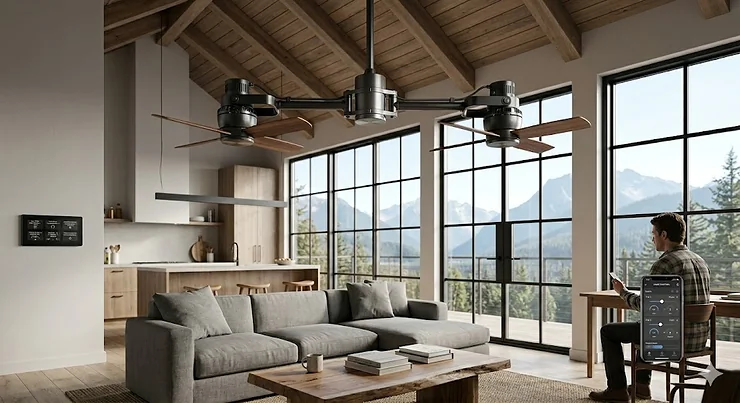
Here’s a confession: the first time I stood under a twin motor ceiling fan with independent control watching both heads glide in slow, hypnotic arcs — one aimed at the dining table, the other directed at the living room sofa — I genuinely wondered why we’d ever settled for a single paddle fan spinning aimlessly in the middle of the room. It felt like discovering stereo sound after years of mono.
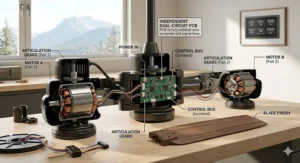
A twin motor ceiling fan with independent control is exactly what it sounds like. Two separate motor heads, each driving its own set of blades, mounted on a single ceiling fixture — and critically, each one adjustable or operable on its own terms. Think of it as having two precision tools where you once had one blunt instrument. You’re not just moving air; you’re directing it, sculpting comfort to fit the actual shape of your room rather than hoping for the best.
For Canadians, this matters more than you might think. Our homes are rarely built for simple airflow. Open-concept great rooms run from kitchen islands to sectional sofas spanning 9 metres (30 feet). Cottage sunrooms face every direction. Finished basements in cities like Winnipeg, Calgary, and Ottawa need winter heat recirculation just as urgently as summer cooling. A twin motor ceiling fan with independent control, with its customizable airflow and dual-zone reach, is frankly the more logical choice for these spaces.
According to Natural Resources Canada’s ENERGY STAR programme, ceiling fans are subject to Canada’s Energy Efficiency Regulations — and ENERGY STAR–certified fans use 60% less energy than standard models on average. Pair one of these dual-motor units with your central air and you’re not just cooling a room; you’re running a smarter, leaner home.
In this guide, I’ve researched and ranked 7 real models available to Canadian buyers through Amazon.ca, covering everything from budget-accessible rotational fans to premium gyro-driven showpieces. Prices are in CAD (Canadian dollars), and I’ll tell you exactly what each feature means in the real world — not just what the spec sheet says.
Quick Comparison Table: Top 7 Twin Motor Ceiling Fans with Independent Control
| Model | Diameter | Motor Type | Control | Damp Rated | Best For | Price Range (CAD) |
|---|---|---|---|---|---|---|
| Matthews AQ-TB-MTL Acqua | 37″ | AC | Remote + Wall | ✅ Yes | Indoor/Outdoor, Modern | $450–$650 |
| Matthews AQ-TB-WD Acqua | 39″ | AC | Remote + Wall | ✅ Yes | Natural-aesthetic homes | $450–$650 |
| Minka-Aire F802-ORB Vintage Gyro | 42″ | AC | Wall Control | ❌ No | Premium indoor statement | $1,100–$1,400 |
| Minka-Aire F602L-BN/CH Gyro | 42″ | AC | Remote | ❌ No | Modern-industrial blend | $700–$950 |
| Matthews DG-TB-MTL Dagny | 39″ | AC | Remote (3-speed) | ✅ Yes | Industrial, covered outdoor | $550–$750 |
| Minka-Aire F502-BCW Traditional Gyro | 42″ | AC | Wall Control | ❌ No | Classic traditional decor | $650–$900 |
| TroposAir Duet Oscillating | 30″ | AC | Remote | ❌ No | Smaller rooms, budget entry | $500–$700 |
The table above makes one pattern crystal clear: Matthews Fan Company dominates the damp-rated segment, making their Acqua and Dagny lines particularly smart choices for Canadian buyers who want to use a double motor oscillating ceiling fan on a covered porch, a three-season room, or a cottage deck. Damp ratings matter in a country where humidity swings between a humid Ontario July and a dry Alberta January. The Minka-Aire Gyro family leads in sheer visual drama and CFM output, but it’s strictly an indoor game.
💬 Just one click — help others make better buying decisions too! 😊
✨ Don’t Miss These Exclusive Deals!
🔍 Take your comfort to the next level with these carefully selected dual-motor ceiling fans. Click on any highlighted product name to check current pricing and availability on Amazon.ca. These fans will transform the airflow — and the look — of any room in your home!
Top 7 Twin Motor Ceiling Fans with Independent Control: Expert Analysis
1. Matthews AQ-TB-MTL Acqua 37″ Dual Rotational Ceiling Fan
The Acqua is the fan that makes engineers and interior designers simultaneously raise an eyebrow and nod in approval. Matthews designed it to resemble the molecular structure of water — which sounds like marketing poetry until you see it rotating, and then it genuinely looks like something out of a science museum.
The AQ-TB-MTL features dual metal fan heads enclosed in decorative metal blade guards, positioned on a 37-cm (approximately 15-inch) horizontal crossbar in textured bronze. Those fan heads can be adjusted infinitely within a 180-degree arc, and here’s what the spec sheet won’t tell you: the greater the angle of the motor heads relative to the support arms, the faster the entire fixture’s axial rotation. You’re not just setting a speed; you’re tuning the physics of the airflow. The AC motor moves air quietly and efficiently enough for bedroom use, and the included remote offers three speeds plus reverse — which is exactly what you want for Canadian winters, when running the fan clockwise at low speed can push heated air back down from vaulted ceilings.
This is the fan I’d recommend to a Montréal condo owner with an open-plan kitchen-living area who wants something that looks like contemporary art and actually works. It’s cUL approved for damp locations, so a covered balcony in Vancouver rain is no problem at all. Canadian buyers will find it available on Amazon.ca, typically eligible for Prime shipping, and while pricing runs slightly higher than the US equivalent due to exchange rates and import logistics, you avoid customs headaches and warranty complications.
Customer reviews consistently highlight how quiet the motor is — no one wants a ceiling fan that sounds like a helicopter during a dinner party — and the build quality of the cast aluminum housing draws regular praise.
✅ Quiet AC motor suited for bedroom or dining room
✅ cUL damp-rated for covered outdoor Canadian use
✅ Infinitely adjustable 180° fan head positioning
❌ Light kit sold separately (plan for extra cost)
❌ At 37″, may underwhelm in rooms larger than 40 m² (430 sq ft)
Price range: $450–$650 CAD — solid mid-range value for the engineering and aesthetics on offer.
2. Matthews AQ-TB-WD Acqua 39″ Dual Rotational Ceiling Fan — Wood Blades
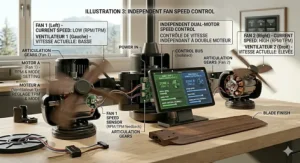
Same elegant Acqua platform, meaningfully different character. The AQ-TB-WD swaps the industrial metal cage look for six solid mahogany wood blades, which transforms the visual language entirely. Where the MTL reads as contemporary-industrial, the wood variant feels warmer — better suited for a Muskoka cottage great room, a finished basement with reclaimed wood accents, or a West Coast–inspired open-plan home.
The 39″ sweep (roughly 99 cm) gives this variant slightly more reach than the metal-cage model, and the solid mahogany blades are hand-balanced at the factory, which translates to near-silent operation even at high speed. The same 180-degree arc positioning system applies here, and the textured bronze finish on the motor housing pairs genuinely well with darker wood-toned interiors. One important note: “all-weather blade system” on this model means the blades resist humidity, but it’s not intended for saltwater or chlorine environments — keep that in mind if you’re near the BC coast or have a pool enclosure.
For Canadian buyers, this is perhaps the most versatile model in the Matthews dual-motor lineup. Confirmed available on Amazon.ca, it ships to most provinces without issue. The included three-speed hand-held remote with full-range light dimming rounds out a package that delivers a premium experience without crossing into four-figure territory.
What most Canadian buyers overlook about this model: the reverse function on the remote is genuinely useful in winter. Running the blades backward (clockwise) at low speed redistributes the warm air that pools near cathedral ceilings without creating a cold draught — a subtle but real energy-saving trick.
✅ Solid mahogany blades for warm, natural aesthetic
✅ Reverse function ideal for Canadian winter heat redistribution
✅ Hand-balanced from factory; whisper-quiet operation
❌ Not saltwater or chlorine compatible — limit outdoor placement accordingly
❌ Halogen bulb included; consider upgrading to LED for energy savings
Price range: $450–$650 CAD — nearly identical value proposition to the MTL, but choose based on your room’s aesthetic.
3. Minka-Aire F802-ORB Vintage Gyro 42″ Dual Ceiling Fan
The Vintage Gyro is the fan that started it all. Minka-Aire pioneered the dual-motor ceiling fan category, and the F802-ORB remains the gold standard for a reason. Two three-bladed 17-inch (43 cm) turbofan heads, adjustable up and down, mounted on a rotating central axis that gyrates the entire assembly at approximately 3 RPM. The result is volumetric air displacement across rooms up to 37 m² (400 sq ft) — genuinely impressive for a single fixture.
The oil-rubbed bronze finish is the kind of warm, aged patina that feels at home in everything from a Victorian semi-detached in Toronto’s Annex neighbourhood to a craftsman bungalow in Victoria, BC. Technically, at high speed it generates around 3,255 CFM while consuming under 85 watts — which means you could run this fan continuously for roughly 12 hours and use less electricity than a single load of laundry. That’s the kind of efficiency argument that makes sense in provinces with higher electricity rates like Ontario or BC.
The WCS212 wall control — included — offers three fan speeds, full-range light dimming, and reverse. What the spec sheet won’t tell you is that the gyroscopic rotation dramatically changes the distribution of the airflow, sending air laterally across the room rather than straight down. This makes the Vintage Gyro uniquely effective in rooms with L-shaped layouts or open stairwells — spaces where a standard fan creates a dead pocket.
Available via Amazon.ca, though as a premium-tier product, delivery timelines can vary for remote northern addresses. Worth verifying your postal code at checkout.
✅ Legendary CFM-to-watt efficiency at ~3,255 CFM / 85W
✅ True 360° gyro rotation covers irregular room shapes
✅ WCS212 wall control with full dimming and reverse included
❌ Indoor use only — no damp rating
❌ Premium price point; budget for professional installation
Price range: $1,100–$1,400 CAD — an investment, but one that pays dividends in both performance and visual impact for years.
4. Minka-Aire F602L-BN/CH Gyro 42″ LED Dual Ceiling Fan with Cages
Think of the F602L-BN/CH as the Vintage Gyro’s younger, more urban sibling. The brushed nickel finish with chrome accents trades old-world warmth for industrial-modern edge, and the caged turbofan heads give it a steampunk-adjacent visual that reads unexpectedly well in contemporary kitchen-living spaces, home offices with high ceilings, and loft-style apartments.
The integrated LED light kit is genuinely superior to the halogen bulbs found in older Gyro models — longer life expectancy, lower heat output, and that cool-white illumination that’s become the default choice in modern Canadian homes. At 42″ with twin turbofan heads, coverage is identical to the F802-ORB, but the cage design means the blades are enclosed, which matters if you have curious pets or children in an open great room. The opal glass shade softens the light beautifully.
From a practical standpoint, the brushed nickel finish is significantly easier to keep clean than the oil-rubbed bronze — finger smudges, cooking residue, and the general grime of Canadian winter when everyone’s tracking in salt and damp coats somehow always finds ceiling fans. A damp cloth and five minutes monthly keeps this model looking showroom-fresh.
Available on Amazon.ca. Minka-Aire’s quality control is consistently strong, and the Canadian market benefits from the fact that Minka products are engineered for North American electrical standards from the ground up — no voltage adapter gymnastics required.
✅ Integrated LED kit — energy-efficient and long-lasting
✅ Caged blades for added safety in family homes
✅ Brushed nickel easy to maintain in high-traffic homes
❌ No damp rating — indoor use only
❌ Chrome accents can read as cold in warmer-toned interiors
Price range: $700–$950 CAD — the sweet spot between the Vintage Gyro’s premium cost and the entry-level rotational fan market.
5. Matthews DG-TB-MTL Dagny 39″ Damp Rated Dual Rotational Ceiling Fan
If the Acqua is the fan for someone who appreciates molecular design theory, the Dagny is for someone who appreciates brutalist architecture. Cylindrical central housing, straight parallel arms, no flourishes — pure industrial geometry with textured bronze finish. It’s striking. And underneath the visual confidence is serious engineering: a 39″ double-headed AC motor delivering up to 4,168 CFM at high speed, which places it among the most powerful fans in the dual-motor category. A room that a single-motor 52″ fan would struggle to cool properly? The Dagny handles it in stride.
The cUL damp-location rating means this model is fully qualified for covered patios and three-season sunrooms — important for Canadians who squeeze every last week out of warm weather between spring thaw and first frost. The fan heads can be positioned in 180-degree arcs, and at steeper angles, the entire fixture rotates faster axialy. The included 3-speed RF remote has a reverse function, which in Canadian winter terms means you can push that warm air down off the ceiling without creating the cold draught that makes people reflexively reach for the thermostat.
One detail worth noting for Canadian buyers: the 2Modern product page for Dagny specifically notes cage options can be used “in Canada at ceiling heights as low as 2.5 m (8.2 ft)” — which aligns with Canadian residential ceiling height standards and gives added flexibility for lower-ceilinged older homes.
✅ Highest CFM in this roundup at 4,168 — powerhouse for large rooms
✅ cUL damp-rated for covered porches and sunrooms
✅ Bold industrial design; works in commercial or residential spaces
❌ No integrated light; optional light kit adds cost
❌ Aesthetic is divisive — a deliberate choice for modern/industrial interiors
Price range: $550–$750 CAD — exceptional airflow-per-dollar value for buyers willing to invest in industrial style.
6. Minka-Aire F502-BCW Traditional Gyro 42″ Twin Turbofan Ceiling Fan
The Traditional Gyro occupies a fascinating position in the dual-motor ceiling fan landscape: it’s the original Gyro design reimagined for rooms that would reject anything resembling industrial chic. The belcaro walnut body and matching blades with aged champagne glass make this feel more like heirloom furniture than a mechanical appliance.
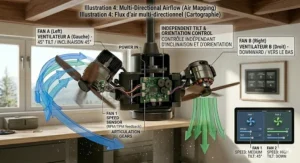
At its core, this is the same twin turbofan platform that made the Minka-Aire Gyro famous — dual three-bladed 17″ heads with 20-degree blade pitch, adjustable up and down, mounted on a central axis that rotates the whole assembly. The included WCS212 wall control delivers three fan speeds with full-range dimming and reverse. For homes with traditional, transitional, or colonial decor — think older Toronto neighbourhoods like Rosedale or Kerrisdale in Vancouver — this is the twin motor ceiling fan with independent control that doesn’t ask you to compromise on aesthetics.
The 100W T4 halogen bulb is included, though I’d recommend budgeting to replace it with an LED equivalent fairly quickly. It runs warm (literally — the halogen bulb adds noticeable heat below the fixture in summer, which rather defeats the purpose). The 4.5″ downrod is included, with a 12″ extension available if you’re working with higher ceilings — a practical consideration for the Victorian and Edwardian homes common across southern Ontario and BC.
✅ Classic belcaro walnut aesthetic suits traditional Canadian home styles
✅ Same proven Gyro twin-turbofan performance as premium F802
✅ WCS212 wall control with full dimming included
❌ Halogen bulb; plan to upgrade to LED for efficiency
❌ Indoor only — no damp or wet rating
Price range: $650–$900 CAD — premium aesthetics and proven mechanics justify the mid-tier price for traditional home buyers.
7. TroposAir Duet Oscillating Dual Ceiling Fan
The TroposAir Duet earns its spot on this list by doing something none of the Matthews or Minka-Aire models do: it oscillates the entire assembly continuously around a central light dome, while the two caged 15-inch fan heads counter-rotate. The effect — which you genuinely have to see in person to appreciate — is air being dispersed in full 360-degree sweeps rather than directed arcs. For smaller rooms where you want uniform airflow coverage rather than targeted streams, it’s the most democratic approach to cooling in this category.
The two caged fans enclosed in 18-inch (46 cm) diameter cages give the Duet a classic industrial character — this reads like a prop from a 1920s airship hangar, and that’s a compliment. The remote control handles speed and rotation independently, and the central light dome provides functional illumination without the awkward add-on aesthetic of an aftermarket light kit.
A note for Canadian buyers: TroposAir’s Duet is available on Amazon.com and ships to Canada with additional freight charges. It’s not always listed on Amazon.ca directly, so check availability and calculate the total landed cost — including applicable duties and provincial taxes — before ordering. That said, the Duet genuinely fills a niche none of the Canadian-stocked models cover as elegantly, and for the right buyer in the right room, the extra effort is worth it.
✅ Continuous 360° oscillation covers room uniformly — no dead spots
✅ Dual caged fans for a bold industrial aesthetic
✅ Remote independently controls rotation and fan speed
❌ May need to order via Amazon.com with extra shipping to Canada
❌ Smaller 15″ fan heads mean less raw CFM than Gyro or Dagny
Price range: $500–$700 CAD (including estimated shipping to Canada) — budget-accessible entry into dual-motor ceiling fan territory.
How to Use Your Twin Motor Ceiling Fan with Independent Control Year-Round in Canada
This is where the dual-motor advantage really earns its keep in Canadian homes specifically. Most fan guides stop at “spin counterclockwise in summer.” But with a twin motor ceiling fan with independent control, you have layered options that single-motor fans simply can’t match.
Summer (May through September): Set both fan heads counterclockwise to create the wind-chill effect that allows you to raise your thermostat by roughly 2–4°C without noticing a difference in comfort — a real benefit in Ontario or BC where air conditioning runs significant hydro bills. According to Save on Energy Ontario, a ceiling fan uses approximately 50 watts compared to a central air conditioner’s 3,500 watts. With two motor heads, you’re still well under 150 watts while covering significantly more room area than any single fan.
Here’s the twin-motor trick most people miss in summer: aim one head at the main seating area for comfort cooling, and angle the second head toward a window or hallway to assist passive air movement through the house. You’re engineering cross-ventilation without opening expensive ducts.
Winter (October through April): Switch both heads to clockwise rotation at low speed. Warm air rises and pools near the ceiling — particularly in homes with 2.7+ metre (9 ft+) ceilings, a common feature in Alberta and Ontario new builds. Running both heads clockwise slowly destratifies that ceiling-trapped warmth and pushes it back into the living zone without the cold draught that makes people dive for the thermostat. In a Calgary bungalow with vaulted ceilings and forced-air heating, this can meaningfully reduce how often your furnace cycles on during a -20°C evening.
Maintenance tip: Dust accumulation on blade guards and motor housings is heavier in Canadian winter because of static electricity and dry indoor air. A monthly wipe-down of both fan head casings keeps airflow efficiency high and extends motor life. Use a damp cloth — never spray cleaner directly onto the motor housing.
Canadian Buyer Profiles: Which Fan Is Right for You?
Let’s be direct: not every Canadian buyer needs the same fan, and the wrong choice is expensive to fix once you’ve already wired it into the ceiling.
Profile 1 — The Toronto Condo Owner, Open-Concept 65 m² Unit. You have 9-foot ceilings, a kitchen that flows into a dining area and living room, and your south-facing windows mean July is genuinely brutal. You need targeted airflow rather than uniform diffusion — one motor head over the kitchen island, the other toward the seating area. Best match: Matthews AQ-TB-MTL Acqua. It covers the space elegantly, runs quietly enough for the neighbour downstairs, and the contemporary metal aesthetic matches the typical Toronto condo palette. Budget: $450–$650 CAD. Prime-eligible on Amazon.ca means weekend delivery is realistic.
Profile 2 — The Ottawa Homeowner with a Cottage-Style Great Room. You’ve got a 14 x 7 metre (46 x 23 ft) main floor with cathedral ceilings, radiant flooring, and an aesthetic that leans toward reclaimed wood and natural materials. Summer cooling matters, but winter heat redistribution from those tall ceilings is equally important. Best match: Minka-Aire F502-BCW Traditional Gyro. The belcaro walnut body disappears into the room’s natural tones, the WCS212 wall control handles your winter clockwise setting without you fishing for a remote, and the Gyro platform’s proven reliability means you’re not thinking about this fan for the next decade. Budget: $650–$900 CAD.
Profile 3 — The Calgary Basement Renovation Crew. You’ve finished a 90 m² basement with a media area, a bar, and a gym corner. Industrial concrete floors, exposed ductwork, matte black aesthetic throughout. You want serious airflow and a fan that looks like it belongs. Best match: Matthews DG-TB-MTL Dagny. At 4,168 CFM, it’s the strongest performer in this roundup and the industrial design language is exactly what you’re building toward. The damp rating is a bonus for the bar area where humidity from glassware can accumulate. Budget: $550–$750 CAD — outstanding value for a basement space where the fan is doing heavy lifting.
Profile 4 — The Vancouver Island Retiree with a Covered Deck Room. You use your screened outdoor room eight months of the year. You want a fan that handles Pacific coastal humidity, provides serious airflow across a 20 m² (215 sq ft) space, and looks like it belongs in the natural surroundings. Best match: Matthews AQ-TB-WD Acqua Wood. The damp rating handles BC coastal humidity, the solid mahogany blades complement a natural-material outdoor room, and the reverse function helps chase morning chill in shoulder-season months. Budget: $450–$650 CAD.
How to Choose a Twin Motor Ceiling Fan with Independent Control in Canada
The options are genuinely exciting, but they can also be genuinely bewildering. Here’s a numbered framework to cut through the noise before you spend a dollar.
1. Measure your room — both floor area AND ceiling height. Dual-motor fans cover more ground than single-motor equivalents, but ceiling height dictates downrod length, minimum blade clearance (2.1 m / 7 ft from floor minimum under Canadian Electrical Code guidance), and whether a flush-mount or extended-downrod setup is safe. Don’t wing this.
2. Decide indoor vs. indoor-outdoor before anything else. A damp-rated model (like the Acqua or Dagny) opens the door to covered porches, three-season rooms, and garages — a meaningful proportion of usable Canadian living space, particularly in provinces with milder shoulder seasons like BC and Ontario.
3. CFM requirements trump aesthetics. Every room has a minimum air movement requirement for comfort. Rooms over 30 m² (325 sq ft) really benefit from 3,000+ CFM — that puts you in Dagny or Vintage Gyro territory. Smaller rooms under 20 m² can work beautifully with the Acqua’s more modest output. Getting this wrong means the fan runs at high speed constantly, wearing the motor prematurely and negating energy savings.
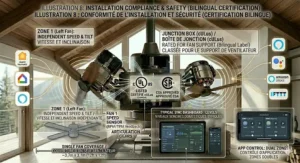
4. Check your electrical box load rating. Dual-motor ceiling fans are heavier than single-motor models. Confirm your ceiling box is rated for the fan’s weight (most quality dual-motor fans hover between 8–14 kg / 18–31 lbs). This is a 10-minute job for an electrician and a warranty-voiding mistake if skipped.
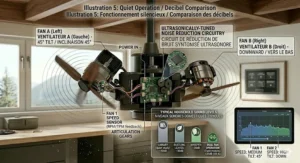
5. Independent control genuinely matters — don’t accept synchronized-only models. The whole proposition of a twin motor ceiling fan with independent control is that each head operates separately. Some lower-cost dual-head fans only run both motors simultaneously at the same speed. That’s a fundamentally different product that misses the point entirely.
6. Budget for installation. Most Canadian electricians charge $150–$300 CAD for a ceiling fan installation, depending on whether new wiring is required. It’s always worth it — particularly for heavier gyro-style units where improper mounting creates long-term vibration issues.
7. Look for CSA or cUL certification. The Canadian Standards Association (CSA) and cUL listing (UL’s Canadian market equivalent) confirm a product meets Canadian electrical safety standards. All models in this roundup carry appropriate North American certifications. Never purchase an uncertified fan — it’s a fire risk and may void your home insurance.
Twin Motor vs. Single Motor Ceiling Fans: What the Numbers Actually Mean
A standard 52″ single-motor ceiling fan in the $150–$300 CAD range moves approximately 4,000–6,000 CFM directly below the fixture in a roughly 4-metre (13-ft) diameter column of air. It’s effective in small, square rooms. It’s mediocre in L-shaped rooms. It’s nearly useless in a large open-concept space where the kitchen is 6 metres from the primary seating area.
A twin motor ceiling fan with independent control changes the geometry. Instead of one column of air pointing straight down, you get two adjustable airflow vectors that can be aimed, angled, and customized. The Matthews Dagny, for instance, delivers 4,168 CFM — but distributes it across a wider and more flexible zone than any single-fan equivalent at the same wattage. The gyro-rotation models (Minka-Aire Vintage Gyro) add another dimension entirely: because the whole assembly rotates at 3 RPM, air is distributed in sweeping patterns that gradually cover every corner of a room.
From a cost standpoint, dual-motor fans draw more power than single-motor fans — typically 80–150 watts versus 50–75 watts for a standard model. But they replace what would otherwise require two separate ceiling fans (two installation points, two electrical circuits, two fixtures). When you account for that comparison, the efficiency math shifts considerably in the dual-motor fan’s favour. According to the US Department of Energy, strategic ceiling fan use allows homeowners to raise the thermostat setting by about 4°F (approximately 2.2°C) without sacrificing comfort — and with two motor heads covering a larger zone, that thermostat adjustment applies to a bigger portion of your home.
Features That Actually Matter (And the Marketing Hype You Can Ignore)
Actually matters — Infinite head positioning vs. fixed positions. The ability to angle both motor heads anywhere within a 180-degree arc (as on the Acqua, Dagny, and all Gyro models) is genuinely valuable. Some budget dual-head fans offer only three preset positions. That’s the difference between a scalpel and a meat cleaver when it comes to airflow precision.
Actually matters — Remote with reverse function. Independent control of each motor head is the point of this product category. A remote that handles individual speed settings AND reversal is non-negotiable. Every model in this roundup includes this; check any product you consider outside this list carefully.
Actually matters — AC vs. DC motor. All models here use AC motors, which are proven, durable, and widely serviceable. DC motors offer slightly better energy efficiency and smoother speed transitions but add meaningfully to cost. For the dual-motor category specifically, AC motors are still the dominant technology and the right choice for most buyers.
Mostly hype — Number of speeds beyond 3. Five-speed and six-speed fans sound like more control. In practice, most Canadians use three settings: low (winter heat recirculation), medium (gentle summer comfort), and high (peak heat days or large gatherings). The marginal value of speeds 4, 5, and 6 is real but small.
Mostly hype — “Ultra-quiet” claims below 35 dB. Reputable brands like Matthews and Minka-Aire genuinely do run quietly. Less reputable brands print the same claim. Real-world quiet means checking actual customer reviews for noise comments, not marketing copy.
Common Mistakes When Buying a Double Motor Oscillating Ceiling Fan in Canada
Buying a US-spec product without verifying Canadian electrical compatibility. Most dual-motor ceiling fans sold on Amazon.com are 120V / 60Hz — identical to Canadian residential standards — but always confirm before ordering. Wiring for 240V (common in some European imports) is genuinely dangerous in a North American home.
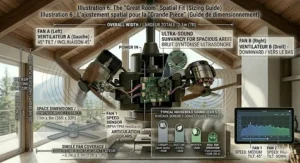
Ignoring the weight of the fixture. A double motor oscillating ceiling fan with two motor housings, blades, and a downrod can weigh 12–18 kg (26–40 lbs). Standard electrical junction boxes in older Canadian homes (built before 1990) are often rated for only 35 lbs. Don’t assume — check the box rating or replace it with a fan-rated brace kit before installation.
Underestimating room dimensions. The most common error I see: someone buys a 37″ dual-head fan for a 12 x 9 metre (40 x 30 ft) great room, cranks it to high, and wonders why the far corners stay stuffy. Match CFM to room volume, not just aesthetics.
Skipping the damp rating for covered outdoor use. Canada’s shoulder seasons are long, and Canadians use covered outdoor spaces from April to October in most provinces. A non-damp-rated fan on a covered porch in humid Ontario will corrode motor windings within 2–3 seasons. The Matthews Acqua and Dagny models exist specifically for this use case.
Ignoring cross-border warranty terms. Some manufacturers offer full warranty coverage in Canada; others explicitly exclude cross-border purchases. Matthews Fan Company and Minka-Aire both offer North American coverage, but if a deal seems suspiciously good through a grey-market seller, verify warranty terms before clicking purchase.
Not accounting for provincial sales tax in the total budget. CAD prices on Amazon.ca are pre-tax. HST in Ontario (13%), GST + PST in BC (12%), and similar combined rates in other provinces will add meaningfully to your total. Budget 12–15% above the listed price for the true out-of-pocket cost.
FAQ
❓ Are twin motor ceiling fans with independent control available on Amazon.ca?
❓ Can I use a double motor oscillating ceiling fan outdoors in Canada?
❓ Do twin motor ceiling fans with independent control meet Canadian electrical safety standards?
❓ How much can a dual motor ceiling fan save on energy bills in Canada?
❓ What ceiling height do I need for a twin motor ceiling fan with independent control in Canada?
Conclusion
The twin motor ceiling fan with independent control is one of those rare home upgrades where the practical benefit and the visual payoff arrive simultaneously. You’re not just buying a better way to move air — you’re buying the ability to design the comfort of a room the way you’d design the lighting or the furniture arrangement.
For Canadian buyers specifically, the combination of our variable climate, our love of open-concept interiors, and our genuine need for both summer cooling and winter heat recirculation makes the dual-motor, independently controlled ceiling fan an unusually sensible investment. The Matthews Acqua and Dagny deliver outdoor-rated dual airflow at accessible price points. The Minka-Aire Gyro family brings decades of proven engineering wrapped in designs that genuinely command attention. The TroposAir Duet oscillates the entire equation for uniform room coverage.
Start with your room dimensions. Match CFM to your space. Verify the damp rating if any outdoor use is possible. Budget for CSA/cUL–certified models only. And if you’re in a province with high electricity rates, pair your new fan with an ENERGY STAR air conditioner for maximum seasonal savings — Natural Resources Canada has excellent guidance on certified products at natural-resources.canada.ca.
The best ceiling fan you’ll ever own is the one that solves your specific room’s airflow problem elegantly. For most Canadian homeowners with open, multi-function spaces, that fan has two motors.
✨ Ready to Transform Your Home’s Airflow?
🔍 Click any product name in this guide to check current pricing and availability on Amazon.ca. Prime members enjoy free shipping on most orders, and with prices in this roundup ranging from $450 to $1,400 CAD, there’s a genuinely right option for every budget and every room. Don’t settle for one motor when two will do the job better.
Recommended for You
- Best 7 Convertible Ceiling Fan Flush or Downrod Canada 2026
- 7 Best Ceiling Fans for High Humidity Basement Canada 2026
- Ceiling Fan Won’t Wobble: 7 Best Stable Fans in Canada (2026)
Disclaimer: This article contains affiliate links. As an Amazon Associate, I earn from qualifying purchases. If you purchase products through these links, we may earn a small commission at no additional cost to you.
✨ Found this helpful? Share it with your friends! 💬🤗
