
In This Article
Nobody brags about their bathroom exhaust fan. Nobody posts it. Yet it’s the unsung bouncer of your home, quietly escorting steam, odours and mould-friendly humidity out the door while you get on with your day. Pick the wrong one and the evidence shows up fast: fogged mirrors that never clear, peeling paint, a musty smell that sticks around.
Canadian homes make this harder. We build tight, we heat for half the year, and we run long, cold duct paths through attics that turn warm shower steam into condensation. A fan that looks fine on a spec sheet can underperform badly in the real world. That’s why this guide focuses on units that suit Canadian conditions and, just as importantly, the ducting they’ll plug into.
Here’s what I’ll cover. We’ll compare seven real models across budget, mid-range and premium tiers. We’ll work out CFM per square foot so you buy the right airflow, not the loudest number. We’ll look at what a 4-inch duct can realistically deliver, and we’ll walk through how to buy a replacement bathroom exhaust fan for an existing duct without turning your ceiling into a construction site. If you’re shopping for a bathroom exhaust fan for small bathroom use, or planning powder room ventilation, there’s a dedicated section for you too.
One honest note up front. This article synthesizes published specs, manufacturer data and aggregated reviewer commentary. It isn’t based on hands-on testing, and where I couldn’t verify something, I say so.
Quick Comparison: 7 Best Bathroom Exhaust Fan Picks for 2026
| Product | Airflow (CFM) | Noise (sones) | Approx. Price (C$)* | Best For |
|---|---|---|---|---|
| Broan-NuTone Economy 50 CFM | 50 | 4.0 | Under C$50 | Tightest budgets, tiny rooms |
| Broan-NuTone AER50 Roomside | 50 | 0.5 | C$80–C$140 | Quiet powder room ventilation |
| Broan-NuTone AERN80BC Roomside | 80 | 1.5 | C$70–C$140 | No-attic-access swaps |
| Delta BreezGreenBuilder GBR80 | 80 | 0.8 | C$130–C$190 | Efficient mid-range upgrade |
| Delta BreezSlim SLM80 | 80 | 1.0 | C$160–C$230 | Shallow ceiling cavities |
| Panasonic WhisperValue DC FV-0510VS1 | 50/80/100 | See listing | C$170–C$260 | Adjustable airflow |
| Panasonic WhisperCeiling DC FV-0511VQ1 | 50/80/110 | 0.3 | C$230–C$330 | Quiet, larger bathrooms |
*Approximate ranges at the time of research. Prices vary by retailer, so check current price before buying.
The table tells a clear story: you pay for silence and flexibility, not raw power. The Broan-NuTone AERN80BC Roomside gives you the best airflow-per-dollar for a typical bathroom, while the Panasonic WhisperCeiling DC FV-0511VQ1 is for people who hate hearing their fan. Budget shoppers should note that the Broan-NuTone Economy 50 CFM moves air adequately for a very small room but is the loudest unit here by a wide margin.
💬 Just one click — help others make better buying decisions too!😊
Top 7 Bathroom Exhaust Fan Picks: Expert Analysis
1. Broan-NuTone Economy 50 CFM — cheapest way to ventilate a tiny room
This is the “get it done” fan. It’s compact, galvanized-steel, and sold through big Canadian retailers for well under C$50.
The spec sheet lists 50 CFM, 4.0 sones, and a rating for rooms up to roughly 45 sq. ft. (about 4.2 m²). In practice, that means a compact half-bath or a closet-sized washroom, not a family bathroom with a tub. The 4.0 sones figure means you’ll hear it clearly, which some people actually prefer in a shared home for privacy. The permanently lubricated AC motor and removable motor assembly make cleaning straightforward.
Based on the spec comparison, this is a smart pick for a rental unit, a basement powder room, or a quick replacement where silence isn’t a priority. Retailer listings flag it as a top-rated value item, but I couldn’t verify a review count worth quoting. Reviewers of basic AC-motor fans generally note they’re louder than DC-motor competitors.
Pros:
- ✅ Lowest purchase price in this round-up
- ✅ Compact housing fits tight spaces
- ✅ Removable motor makes cleaning simple
Cons:
- ❌ 4.0 sones is noticeably loud
- ❌ Only suited to very small rooms
Expect to pay under C$50. Verdict: excellent value if you only need the basics.

2. Broan-NuTone AER50 Roomside — whisper-quiet pick for a powder room
Here’s the same airflow as the budget unit with a completely different personality: 0.5 sones, which Broan describes as “as quiet as a gentle breeze.”
The 50 CFM output is aimed squarely at a smaller powder room or compact bathroom. The EzDuct connector installs from the room side, so a retrofit doesn’t demand attic access, and the TrueSeal damper is claimed to cut air leakage by up to 50%. That matters in a Canadian winter, when a leaky damper means cold air trickling back into the house.
What most buyers overlook is how much a quiet fan changes behaviour. A fan you can barely hear is a fan people actually leave running, and a fan that runs is a fan that removes moisture. For powder room ventilation, this is arguably the sweet spot. It’s ENERGY STAR certified and UL listed, according to the manufacturer. Verified owner-review data was thin, so rely on the specs here.
Pros:
- ✅ 0.5 sones is genuinely quiet
- ✅ Room-side retrofit without attic access
- ✅ Better damper limits cold backdrafts
Cons:
- ❌ 50 CFM is too little for larger bathrooms
- ❌ Costs several times the budget model
Expect roughly C$80–C$140. Verdict: the best-balanced bathroom exhaust fan for small bathroom or powder room use.
3. Broan-NuTone AERN80BC Roomside — easiest swap with no attic access
If you’re replacing a worn-out unit in a standard three-piece bathroom, this is the workhorse. It delivers 80 CFM at 1.5 sones and is rated for rooms up to about 75 sq. ft. (roughly 7 m²).
Eighty CFM covers the classic 1 CFM per square foot guideline for most bathrooms under 80 sq. ft. The 1.5 sones rating is quiet enough to know it’s running without feeling like you’re in a hangar. Broan also lists it as UL listed for use over a tub or shower on a GFCI-protected branch circuit (ceiling mount), plus HVI-2100 certified.
On paper, the biggest advantage is the install. Foldable mounting ears and a room-side duct connector mean you can swap it from below, which is a big deal if your attic is blown-in insulation territory. Reviewers of Roomside-style retrofit fans commonly praise easy installs, though I couldn’t verify a review pool specific to this exact model.
Pros:
- ✅ Strong 80 CFM for typical bathrooms
- ✅ Installs from the room side
- ✅ Certified for use over tub or shower
Cons:
- ❌ Single speed, no airflow adjustment
- ❌ 1.5 sones is audible during showers
Expect around C$70–C$140. Verdict: best everyday value in the round-up.
4. Broan-NuTone-rival Delta BreezGreenBuilder GBR80 — efficient DC motor on a 4-inch duct
Wait, that heading needs to be the Delta model alone. Here is the correct entry.
The Delta BreezGreenBuilder GBR80 moves 80 CFM at 0.8 sones and uses a DC motor, with a published 4-inch duct size. It’s ENERGY STAR certified.
Brushless DC motors are the quiet quality upgrade of the last few years. Compared with comparably priced AC-motor fans, a DC unit tends to run quieter and sip less electricity, which is exactly what you want from a device that may run for 20 minutes after every shower. Because it uses a 4-inch collar, it’s a natural candidate if your existing duct is 4-inch and you don’t want to fuss with adapters.
My read: this is the “smart middle” option. You get roughly the airflow of the Broan-NuTone AERN80BC Roomside at noticeably lower noise. Roundups of 2026 quiet fans repeatedly group Delta’s Breez line alongside Panasonic and Broan in the top tier, though specific per-model owner feedback was limited in what I could verify.
Pros:
- ✅ Quiet 0.8 sones at 80 CFM
- ✅ Efficient DC motor
- ✅ Standard 4-inch duct collar
Cons:
- ❌ Costs more than basic AC-motor fans
- ❌ Fewer retrofit conveniences than Roomside models
Expect roughly C$130–C$190. Verdict: worth the premium if noise and efficiency matter.
5. Delta BreezSlim SLM80 — slimmest housing for tight ceilings
Some ceilings simply don’t have room. Most housings are 7–9 inches (18–23 cm) deep; the Delta BreezSlim SLM80 is about 5.5 inches (14 cm).
It delivers 80 CFM at about 1.0 sone. That shallow profile is the story. If you’re replacing a fan under a low-pitched roof, a finished ceiling with a joist-bound cavity, or a flat roof, depth can make or break the project. A bulky housing may simply not fit between the drywall and the structure above.
Here’s the practical takeaway: before you fall in love with a fan’s CFM, measure the cavity. A fan that doesn’t fit is a fan you’ll return. The SLM80 trades a bit of price for installation freedom, and 1.0 sone sits in the “quiet” range by most guides’ standards. As with others here, I couldn’t verify a robust review pool, so treat this as spec-based analysis.
Pros:
- ✅ Only about 5.5 inches deep
- ✅ 80 CFM suits most standard baths
- ✅ DC motor for quieter, efficient running
Cons:
- ❌ Pricier than comparable 80 CFM fans
- ❌ Shallow design offers fewer extras
Expect around C$160–C$230. Verdict: buy it for the fit, not the frills.

6. Panasonic WhisperValue DC FV-0510VS1 — three selectable airflow settings
Flexibility is the headline. This slim-housing fan lets you pick 50, 80 or 100 CFM, with a housing depth of about 3-3/8 inches.
That “Pick-A-Flow” idea is smart because bathrooms change. Maybe you start with a 60 sq. ft. room and later add a bigger shower. Rather than replacing the fan, you adjust it. The ultra-shallow depth also makes it a rival to the Delta BreezSlim SLM80 in tight ceilings.
One caveat surfaces in reviewer commentary: the outlet is oval, and one roundup notes it needs an adapter for round duct. That’s a real consideration if you’re matching an existing 4-inch round run, so confirm the adapter before ordering. Roundups generally rank this model near the top of the quiet-fan category, though I couldn’t independently verify per-unit owner ratings.
Pros:
- ✅ Selectable 50, 80 or 100 CFM
- ✅ Very shallow housing
- ✅ Efficient DC motor
Cons:
- ❌ May need an adapter for round duct
- ❌ Higher price than basic fans
Expect roughly C$170–C$260. Verdict: ideal if you want future-proof airflow.
7. Panasonic WhisperCeiling DC FV-0511VQ1 — quietest fan here at 0.3 sones
This is the premium pick. It offers 50/80/110 CFM selectable airflow and an impressively low 0.3 sones, with a manufacturer coverage rating of up to about 110 sq. ft.
Three hundred thousandths… sorry, 0.3 sones is close to silence in a house. In practical terms, that’s the difference between a fan you tolerate and a fan you forget exists. One published data table lists a 6-inch duct size for this unit, so it’s the one fan here where you must check the collar before buying. If your existing duct is a 4-inch run, you’ll need a reducer or a different model.
Based on the numbers, it’s the best match for larger bathrooms or anyone sensitive to noise. Multiple 2026 roundups call the WhisperCeiling line a gold standard, but those are editorial opinions, not verified owner statistics.
Pros:
- ✅ Whisper-level 0.3 sones
- ✅ Selectable airflow up to 110 CFM
- ✅ ENERGY STAR certified DC motor
Cons:
- ❌ Highest price in this round-up
- ❌ Duct collar may not suit 4-inch runs
Expect roughly C$230–C$330. Verdict: premium, but justified for larger or noise-sensitive bathrooms.
What Is a Bathroom Exhaust Fan?
A bathroom exhaust fan is a ceiling- or wall-mounted ventilation device, ducted to the outdoors, that removes humid, odour-laden air from a bathroom. Properly installed, it reduces condensation, protects finishes, and helps prevent mould and mildew by moving moist air out of the house instead of letting it settle on surfaces.
Two details separate good fans from decorative ones. First, how much air it moves, measured in CFM (cubic feet per minute, where 1 CFM is about 1.7 m³/h). Second, how loud it is, measured in sones. The Home Ventilating Institute publishes widely used sizing guidance and recommends running the fan for roughly 20 minutes after bathroom use. It also notes that bathroom doors should be undercut so makeup air can enter. That last point is easy to miss: a fan can’t pull air out of a sealed room.
Think of a bathroom exhaust fan as a one-way street. If air has nowhere to come in, traffic jams, and the fan’s rated CFM becomes a polite fiction.

How to Choose a Bathroom Exhaust Fan
Follow these steps and you’ll avoid most buying mistakes.
- Measure your bathroom. Multiply length by width for square footage, and note the ceiling height. Everything else depends on this.
- Match CFM to size. Use roughly 1 CFM per square foot for rooms up to 100 sq. ft. (see the sizing section below).
- Check the duct size. Know whether your existing duct is 4-inch or 6-inch before you shop. This one detail eliminates half the market.
- Set a noise target. Aim for about 1.0 sone or less if you want a quiet bathroom exhaust fan; anything near 4.0 sones will be clearly heard.
- Confirm housing depth. Measure the ceiling cavity so the unit actually fits.
- Look for certification. ENERGY STAR and HVI-certified ratings give you more trustworthy numbers than uncertified claims.
- Verify use over a tub or shower. If the fan sits above wet zones, check that it’s listed for that location and plan for GFCI protection.
Honest warning: the cheapest fan that meets your CFM target isn’t always the best value. A louder fan that nobody switches on protects nothing.
CFM Per Square Foot: How Much Airflow Does Your Bathroom Need?
For bathrooms up to 100 sq. ft., HVI recommends 1 CFM per square foot, which works out to roughly eight air changes per hour at standard ceiling heights. That means an 8 ft by 5 ft bathroom (40 sq. ft., about 3.7 m²) needs about 40 CFM, while an 80 sq. ft. room needs about 80 CFM.
| Bathroom Size | Area (m²) | Minimum CFM | Practical Pick |
|---|---|---|---|
| Powder room, ~20–40 sq. ft. | 1.9–3.7 | 50 (typical floor) | Broan-NuTone AER50 Roomside |
| Standard bath, ~60–80 sq. ft. | 5.6–7.4 | 60–80 | Broan-NuTone AERN80BC Roomside |
| Large bath, ~90–100 sq. ft. | 8.4–9.3 | 90–100 | Panasonic WhisperCeiling DC FV-0511VQ1 |
| 10 ft ceiling, 80 sq. ft. | 7.4 | ~107 | Panasonic WhisperValue DC FV-0510VS1 |
Taller ceilings change the math. An 80 sq. ft. bathroom with a 10 ft ceiling holds 800 cubic feet; at eight air changes per hour that’s roughly 107 CFM. For bathrooms over 100 sq. ft., HVI shifts to a fixture-based method, and its own example suggests either separate smaller fans or a single larger one.
The table shows why “1 CFM per square foot” is a floor, not a ceiling. Real ducts steal airflow, so round up when you’re between sizes.
Bathroom Exhaust Fan for Small Bathroom: Powder Room Ventilation Done Right
Small spaces have a sneaky problem: you’d assume a tiny room needs a tiny fan, and that’s roughly true, but the stakes are different. A powder room is mostly about odour and quick clearing, not hours of shower steam. That’s why a quiet 50 CFM unit usually suffices.
For powder room ventilation, noise matters more than raw airflow. Nobody wants a jet engine next to a dinner party. A quiet 0.5-sone model such as the Broan-NuTone AER50 Roomside will serve far better than a loud bargain unit. If budget wins, the Broan-NuTone Economy 50 CFM still handles the job in a very small room, and it’s rated for roughly 45 sq. ft.
A bathroom exhaust fan for small bathroom use also benefits from smart controls. A timer or humidity sensor takes the “did I leave it on?” question off the table. And remember the HVI guidance: enclosed toilet rooms need either an operable window or a fan, and a fan is the reliable choice in a Canadian winter, when nobody’s cracking a window.
💨 Quick takeaway: for a bathroom exhaust fan for small bathroom spaces, prioritize low sones first, 50 CFM second.
4-Inch Duct: What It Can (and Can’t) Handle
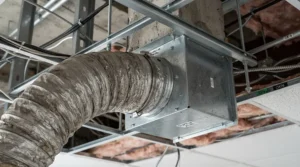
A 4-inch duct (about 100 mm) is the most common size in older Canadian homes, and it’s perfectly workable for fans up to around 80 CFM when the run is short and smooth. Push a 110 CFM fan through a long, kinked 4-inch pipe and you won’t get 110 CFM. You’ll get a lot less.
This isn’t theoretical. Canadian field research summarized in an Air Infiltration and Ventilation Centre guide to exhaust systems found that installed systems often underperformed their ratings. Factors it highlights include flexible ducting and downsized duct runs. Industry best-practice guides also recommend using the larger collar size when a fan offers both 4-inch and 6-inch options, keeping duct runs short, and sloping the duct slightly so condensation drains outdoors.
What this means for you:
- Prefer smooth rigid duct over crinkled flex where possible.
- Limit bends; every elbow costs airflow.
- Insulate attic ducts to reduce condensation in cold weather.
- Choose a 4-inch-collar fan, like the Delta BreezGreenBuilder GBR80, if you’re keeping your existing 4-inch duct.
The sensible way to think about a 4-inch duct is as a garden hose: fine for a trickle, frustrating for a flood. Match the fan to the pipe, not the other way around.
How to Buy Replacement Bathroom Exhaust Fan for Existing Duct: A Step-by-Step Guide
If your old fan works but sounds like a dying lawnmower, swapping it is realistic. Here’s how to buy replacement bathroom exhaust fan for existing duct without regrets.
- Document the old unit. Photograph the housing, note the duct diameter, and check for a model number on the label. Measure the ceiling cutout.
- Confirm the duct goes outdoors. The duct should terminate outside, not in the attic space. If it doesn’t, fix that first.
- Match the collar. If the old duct is 4-inch, shop fans with 4-inch collars. Check adapter needs, especially with oval outlets.
- Check housing depth and cutout. A Roomside-style fan can avoid cutting; a shallow fan like the Delta BreezSlim SLM80 helps in tight cavities.
- Keep CFM realistic. Stay near the old fan’s airflow unless the duct has been upgraded.
- Plan the electrical. Switch off the breaker, and consider a licensed electrician if the circuit, switch or GFCI protection needs work, as rules vary by province.
- Seal and insulate. Air-seal the ceiling opening and consider an insulated cover in the attic to limit condensation.
A good replacement should feel almost boring: same hole, same duct, better fan. If you find yourself cutting new openings, you’ve probably picked the wrong model.
✨ Ready to upgrade?
🔍 Compare the models above, check the duct size first, then click through on any highlighted fan to confirm current pricing and availability. Your ceiling (and your paint) will thank you!
Real-World Scenarios: Which Bathroom Exhaust Fan Fits Your Home?
The condo renter. A 45 sq. ft. bathroom, an existing 4-inch duct and a landlord who won’t pay for extras. The Broan-NuTone Economy 50 CFM is the budget pick, but if the building lets you choose, the Broan-NuTone AER50 Roomside gives you a quieter experience for a modest premium.
The family of four in a 1990s house. A 70 sq. ft. main bath, daily showers, and an attic that nobody wants to crawl through. The Broan-NuTone AERN80BC Roomside installs from below, matches 1 CFM per square foot, and won’t wreck anyone’s weekend.
The renovator with a low ceiling cavity. A finished upper-floor bath with a shallow cavity. Here the Delta BreezSlim SLM80 or the Panasonic WhisperValue DC FV-0510VS1 earns its keep, because both prioritize shallow housings.
The light sleeper with a primary ensuite. A 95 sq. ft. bathroom next to the bedroom. The Panasonic WhisperCeiling DC FV-0511VQ1 is the quiet choice, provided the duct collar suits your run.
Budget, environment and frequency of use drive the choice more than any single spec. Start with the room, not the product.
Common Bathroom Exhaust Fan Problems and How to Fix Them
Problem: the mirror still fogs. Likely causes are a fan that’s undersized, a clogged grille, or a blocked duct. Clean the grille, check the damper moves freely, and consider stepping up a size or using an adjustable model like the Panasonic WhisperValue DC FV-0510VS1.
Problem: it’s loud. Old AC-motor fans get noisier as dust builds up. Clean the blades, or upgrade to a DC-motor unit like the Delta BreezGreenBuilder GBR80.
Problem: cold air drifts in when it’s off. That’s a damper issue. Fans with improved dampers, such as the Broan-NuTone AER50 Roomside, are designed to limit backdrafts.
Problem: moisture drips from the vent. Condensation in a long, uninsulated duct is the usual culprit. Insulate the duct, sloping it toward the outside.
Problem: the fan runs but airflow feels weak. Check for flexible, kinked or crushed duct, and confirm the room has makeup air through an undercut door.
Most “fan failures” turn out to be duct or airflow failures. The motor often gets the blame while the pipe does the damage.
Features That Actually Matter (And Those That Don’t)
Worth paying for:
- Low sones. Silence = usage. A fan people run is a fan that works.
- DC motor. Quieter and more efficient than comparably priced AC models.
- ENERGY STAR certification. According to Natural Resources Canada, an ENERGY STAR certified ventilating fan with lighting uses about 70% less energy on average than a standard model.
- A decent damper. It’s the cheapest way to stop winter backdrafts.
- Timer or humidity sensing. Automates the 20-minute run-on.
Nice but optional: integrated lights, nightlights and Bluetooth speakers. They’re fun, but they won’t clear one wisp of steam.
Mostly marketing: a sky-high CFM number on an undersized duct. Rating claims also vary, and the HVI notes that inflated ratings are common among fans that aren’t HVI-certified.
The honest filter is simple: if a feature doesn’t change how well moisture leaves your home, it’s a bonus, not a buying reason.
Long-Term Cost & Maintenance
A bathroom exhaust fan is cheap to run but easy to neglect. Clean the grille and blades every six to twelve months, check the damper movement, and glance at the outdoor hood each fall before freezing weather arrives.
| Option | Upfront Cost | Noise | Efficiency | Best For |
|---|---|---|---|---|
| Basic AC unit like the Broan-NuTone Economy 50 CFM | Lowest | High | Standard | Rentals, tiny rooms |
| Mid-range DC like the Delta BreezGreenBuilder GBR80 | Moderate | Low | High | Everyday homes |
| Premium DC like the Panasonic WhisperCeiling DC FV-0511VQ1 | Highest | Lowest | High | Larger or noise-sensitive baths |
| Opening a window | Free | Variable | None | Warm months only |
The comparison reveals a pattern: the cheap fan costs less today but may cost you in noise, replacement cycles or unused hours. The DC options typically pay back through efficiency and, more importantly, through being actually used. Over a decade, the price difference between a basic fan and a mid-range DC fan is small compared with the cost of repairing moisture damage.
Safety, Codes and Cold-Climate Rules in Canada
Start with the basics: a bathroom exhaust fan should discharge to the outdoors, not into the attic. Inspection guidance points out that venting into attic insulation is a classic installation fault, and recommends an insulated, airtight cover over the housing and air-sealing any ceiling openings, as outlined in this InternACHI bathroom exhaust guide.
Over a tub or shower, use a fan listed for that location and plan for GFCI-protected wiring. The Broan-NuTone AERN80BC Roomside, for instance, is listed for ceiling-mount use over wet zones on a GFCI branch circuit, according to Broan.
Beyond that, rules vary by province and municipality. Look for CSA or cUL-type certification marks on products sold in Canada, check your local building code, and hire a licensed electrician when wiring changes are involved. Ventilating fans in Canada are also subject to federal energy efficiency regulations, according to Natural Resources Canada.
Cold climates add one more wrinkle: insulate attic ducts and make sure the exterior hood’s damper isn’t frozen shut after a freezing rain.
FAQ
❓ What's the best bathroom exhaust fan for a powder room in Canada?
❓ Can I use a bathroom exhaust fan with an existing 4-inch duct?
❓ How often should I run my bathroom exhaust fan after a shower?
❓ Is a higher CFM bathroom exhaust fan always better?
❓ Where can I buy a replacement bathroom exhaust fan for existing duct?
Conclusion
So, which bathroom exhaust fan should you buy? Start with the room, then the pipe, then the noise. For a small space, the Broan-NuTone AER50 Roomside is the quiet, sensible pick, with the Broan-NuTone Economy 50 CFM as the budget alternative. For a standard bathroom, the Broan-NuTone AERN80BC Roomside is the easy-swap workhorse, and the Delta BreezGreenBuilder GBR80 is the efficient mid-range upgrade. Tight ceiling? The Delta BreezSlim SLM80 and Panasonic WhisperValue DC FV-0510VS1 earn their place. And for a larger or noise-sensitive bathroom, the Panasonic WhisperCeiling DC FV-0511VQ1 is the premium choice, as long as you confirm the duct collar.
The big lesson of this guide is that the CFM number on the box is only half the story. Duct size, run length, makeup air and noise decide whether a fan actually does its job. Get those right and even a modest unit will outperform an expensive one installed badly.
Recommended for You
- Ceiling Fan For Basement Rec Room: 7 Smart Picks For 2026
- Ceiling Fan For Basement Bedroom: 7 Best Damp-Rated Picks 2026
- Hugger Ceiling Fan For Low Basement Ceilings: 7 Best Picks 2026
Disclaimer: This article contains affiliate links. As an Amazon Associate, I earn from qualifying purchases. If you purchase products through these links, we may earn a small commission at no additional cost to you.
✨ Found this helpful? Share it with your friends! 💬🤗
