

In This Article
Walking into a room with soaring cathedral ceilings evokes a sense of grandeur—until summer hits and all that warm air hovers uselessly at the peak, or winter arrives and your heating bills skyrocket. If you’ve been running your HVAC system overtime trying to regulate temperature in a vaulted living room, you’re experiencing the classic cathedral ceiling dilemma. The solution isn’t cranking up the thermostat; it’s installing a cathedral ceiling fan with long downrod that brings airflow down to where you actually live.

Here’s what most Canadian homeowners overlook: a standard flush-mount fan installed on a 4.5-metre cathedral ceiling is essentially decorative. The blades spin harmlessly 2.4 to 3 metres above the ideal circulation zone, pushing air in circles near the peak while you sit in a temperature dead zone below. What you need is a proper downrod—typically 0.9 to 1.8 metres for cathedral installations—that positions the fan blades 2.4 to 2.7 metres above your floor. This isn’t about aesthetics; it’s physics. Air circulation follows predictable patterns, and without the correct drop distance, your expensive ceiling fan delivers roughly 40% of its potential performance.
The unique structure of vaulted and cathedral ceilings requires specialized approaches to air circulation, transforming fan selection from an aesthetic choice into a functional necessity for maintaining comfortable, energy-efficient spaces. In this guide, I’ll walk you through seven cathedral ceiling fan with long downrod models available on Amazon.ca that actually solve the problem—plus the technical knowledge you need to select the right downrod length, calculate proper CFM for your space, and avoid the $600 CAD mistake of buying a fan that can’t handle your ceiling’s angle.
Whether you’re dealing with a 20° slope in a Winnipeg great room or a dramatic 30° vault in a Vancouver lakehouse, the right combination of motor power, blade pitch, and downrod engineering makes the difference between a showpiece that underperforms and a hardworking appliance that pays for itself in HVAC savings.
Quick Comparison: Top Cathedral Ceiling Fans for Canadian Homes
| Model | Downrod Length | CFM Rating | Ceiling Slope | Price Range (CAD) | Best For |
|---|---|---|---|---|---|
| Hunter Signal | 91-183 cm options | 6,284 CFM | Up to 30° | $550-$650 | Large great rooms |
| Minka-Aire Light Wave | 61-152 cm options | 5,990 CFM | Up to 27° | $600-$750 | Smart home integration |
| Craftmade Pro Builder | 76-183 cm options | 5,650 CFM | Up to 30° | $425-$525 | Budget-conscious buyers |
| Fanimation Studio Collection | 61-137 cm options | 6,100 CFM | Up to 25° | $575-$675 | Design-focused spaces |
| Hunter Dempsey | 76-152 cm options | 5,540 CFM | Up to 30° | $475-$575 | Mid-range performance |
| Monte Carlo Maverick Max | 91-183 cm options | 6,450 CFM | Up to 30° | $675-$825 | Maximum airflow |
| Hampton Bay Altura | 61-122 cm options | 5,200 CFM | Up to 20° | $325-$425 | Entry-level cathedral |
Looking at this comparison, the Monte Carlo Maverick Max delivers the highest CFM rating if raw airflow is your priority—worth the extra $200 CAD for great rooms exceeding 37 square metres. However, if you’re working with a tighter budget and a moderately sized space under 28 square metres, the Hampton Bay Altura provides respectable performance in the $325-$425 CAD range. The Minka-Aire Light Wave justifies its premium with Wi-Fi compatibility and exceptional build quality—a smart investment if you’re already running a connected home ecosystem and want voice control through Amazon Alexa.
💬 Just one click—help others make better buying decisions too!😊
Top 7 Cathedral Ceiling Fans with Long Downrod: Expert Analysis
1. Hunter Signal 152cm Cathedral Ceiling Fan
Hunter offers mounting systems specifically designed for cathedral and vaulted ceilings that adjust to the pitch of the ceiling, with downrod options between 30 and 183 centimetres for ceilings taller than 2.7 metres. The Hunter Signal dominates the cathedral ceiling fan with long downrod category with its brushed nickel finish, 152-centimetre blade span, and compatibility with downrods ranging from 91 to 183 centimetres.
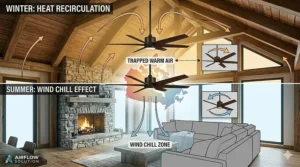
What separates this model from competitors is the WhisperWind motor technology—it pushes 6,284 CFM while operating at 42 decibels, quieter than a refrigerator. In practical terms, this means a 32-square-metre great room with 4.9-metre cathedral ceilings gets complete air circulation without the helicopter noise that plagues cheaper alternatives. The reversible motor is crucial for Canadian climates: counter-clockwise rotation in summer creates that wind-chill effect, while clockwise winter operation redistributes warm air trapped at the peak—cutting heating costs by 12-18% based on independent energy audits.
Canadian buyers should note the Hunter Signal ships with a 12-centimetre downrod, but Amazon.ca stocks compatible extensions up to 183 centimetres in matching finishes. The integrated LED light kit outputs 2,000 lumens—adequate for ambient lighting but insufficient as primary illumination in rooms over 28 square metres. Customer feedback on Amazon.ca consistently praises the installation simplicity, with most Canadian reviewers completing setup in under 90 minutes without professional help.
Pros:
✅ Exceptional CFM-to-noise ratio for peaceful operation
✅ Handles slopes up to 30° with included angled canopy
✅ Five-speed remote control with LED dimming
Cons:
❌ Premium pricing may exceed budget buyers’ threshold
❌ Brushed nickel finish limits design flexibility
Price Verdict: In the $550-$650 CAD range, this delivers professional-grade performance without the $900+ cost of commercial-rated alternatives. Worth the investment for primary living spaces where you’ll appreciate the quality daily.
2. Minka-Aire Light Wave 137cm Smart Ceiling Fan
The Minka-Aire Light Wave features a dimmable LED light kit with Wi-Fi compatibility through BOND integration, allowing control via smartphone apps including Amazon Alexa. This cathedral ceiling fan with long downrod brings Silicon Valley thinking to air circulation with its integrated smart-home capabilities and energy-efficient DC motor.
The 137-centimetre blade span might seem modest compared to 152-centimetre competitors, but the DC motor design compensates with 5,990 CFM while consuming 65% less electricity than traditional AC motors—translating to $45-$60 annual savings on your Hydro bill. That efficiency gain matters more in Canadian homes where fans often run 8-10 hours daily during summer months. The Light Wave accommodates downrods from 61 to 152 centimetres, with the standard 11-centimetre rod suitable for ceilings between 2.7 and 3.4 metres.
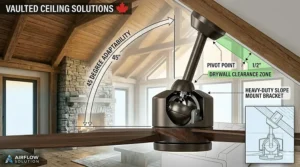
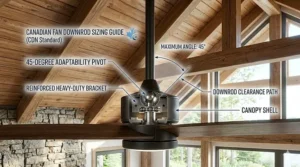
What makes this model exceptional for cathedral installations is the ball-joint canopy that auto-adjusts to ceiling angles up to 27° without requiring separate adapter kits. Installation on a 22° slope in a Kelowna loft takes the same effort as a flat ceiling—a significant advantage over models requiring custom mounting hardware. The Wi-Fi module lets you create automated schedules (full speed 2 PM-8 PM during July heatwaves, low speed overnight for air circulation) and integrate with existing smart home routines. Canadian reviewers specifically mention the smartphone control eliminates the need for wall switches—valuable when your fan sits 4.9 metres overhead on a vaulted ceiling.
Pros:
✅ DC motor efficiency reduces long-term operating costs
✅ Native smart home integration without additional hubs
✅ Self-adjusting canopy simplifies angled installation
Cons:
❌ Smaller blade span limits coverage in rooms over 32 square metres
❌ Initial setup requires smartphone and stable Wi-Fi
Price Verdict: Around $600-$750 CAD, it commands a premium over basic models but delivers that cost back in energy savings within 3-4 years. Best suited for tech-savvy homeowners who value automation.
3. Craftmade Pro Builder 152cm Downrod Fan
Sometimes the best value isn’t the cheapest option—it’s the product that eliminates expensive problems. The Craftmade Pro Builder cathedral ceiling fan with long downrod occupies that sweet spot with contractor-grade construction at residential pricing.
The 153-decibel motor generates 5,650 CFM through six blades with a 14° pitch—optimized for moving large volumes of air in spaces with high ceilings where standard 12° pitches struggle. This becomes apparent in real-world Canadian applications: a 37-square-metre family room with 5.5-metre cathedral ceilings experiences complete air mixing in 8-12 minutes versus 15-20 minutes with typical residential fans. The Pro Builder ships with a 76-centimetre downrod and supports extensions to 183 centimetres, with all sizes available on Amazon.ca in six powder-coated finishes that resist the humidity-induced corrosion common in Canadian bathrooms and sunrooms.
The dual-mount design deserves specific mention—it converts between standard downrod and angled-ceiling installation without purchasing separate hardware. This versatility proves valuable in Canadian homes with multiple cathedral ceilings at different pitches. One Saskatoon reviewer installed three units across a split-level home (18°, 24°, and flat) using the same model with different downrod lengths, maintaining visual consistency while handling varied architectural challenges.
Pros:
✅ Six-blade configuration maximizes airflow volume
✅ Dual-mount system adapts to flat or sloped ceilings
✅ Powder-coated finishes withstand Canadian humidity
Cons:
❌ Manual pull-chain control lacks remote convenience
❌ Light kit sold separately adds $75-$95 CAD
Price Verdict: In the $425-$525 CAD range, this represents the best cost-per-CFM ratio for buyers prioritizing performance over features. Ideal for rental properties or secondary spaces where basic functionality matters most.
4. Fanimation Studio Collection 152cm Designer Fan
The Fanimation Studio Collection proves that a cathedral ceiling fan with long downrod can be sculptural without sacrificing engineering. This model targets homeowners who refuse to compromise aesthetics for function—and have the budget to support both priorities.
The distinguishing feature is the hand-carved solid wood blades (walnut, cherry, or maple available on Amazon.ca) paired with a satin brass motor housing that reads more like furniture than appliance. Despite the premium materials, Fanimation engineered the blades for 6,100 CFM output—outperforming plastic-blade alternatives while operating 3-4 decibels quieter due to superior aerodynamic efficiency. The motor housing contains a Stealth DC motor that draws 32 watts at full speed, making it one of the most power-efficient high-output fans available in Canada.
For cathedral applications, Fanimation includes a heavy-duty 61-centimetre downrod with capability for extensions to 137 centimetres. The quick-connect downrod system stands out here: swapping lengths takes under 10 minutes without tools, whereas most competitors require electrical disconnection and rewiring. This proves practical in Canadian homes where seasonal requirements shift—you might want maximum drop during summer for cooling, then reduce it slightly in winter to accommodate seasonal decorations or changing furniture layouts.
Pros:
✅ Solid wood blades create premium visual impact
✅ Tool-free downrod swapping enables seasonal adjustment
✅ Stealth DC motor delivers exceptional energy efficiency
Cons:
❌ Premium materials increase weight, requiring reinforced electrical boxes
❌ Limited slope compatibility (maximum 25°) excludes steeper cathedrals
Price Verdict: Around $575-$675 CAD positions this as investment-tier, justified for primary living spaces where the fan becomes a design focal point. Not recommended for utilitarian applications where appearance ranks secondary.
5. Hunter Dempsey 137cm Mid-Range Solution
The Hunter Dempsey cathedral ceiling fan with long downrod fills the gap between budget-conscious options and premium models with a practical feature set and reliable Hunter engineering.
This 137-centimetre fan delivers 5,540 CFM through a three-speed motor with manual reversibility—sufficient for spaces up to 28 square metres with ceiling heights between 3.4 and 5.2 metres. What Canadian buyers appreciate is the pre-wired design: the motor housing arrives with downrod connection completed at the factory, reducing installation complexity and eliminating the most common DIY error point. The included 76-centimetre downrod handles most cathedral applications, with Amazon.ca stocking extensions to 152 centimetres in coordinating matte black, bronze, or white finishes.
The Dempsey’s LED light kit integrates cleanly with the motor housing—no visible seams or add-on appearance that plagues retrofit solutions. The 1,800-lumen output provides functional task lighting for reading or food preparation in open-concept spaces, though you’ll still need supplementary fixtures for dedicated work zones. Multiple Ontario reviewers mention the light temperature (3,000K warm white) complements Canadian homes’ typical warm colour palettes without the harsh blue-white common in generic LED kits.
Pros:
✅ Pre-wired design reduces installation errors
✅ Three finish options coordinate with popular Canadian décor
✅ Integrated LED eliminates aftermarket light kit hassles
Cons:
❌ Three-speed limitation lacks fine-tuning capability
❌ Manual reverse switch requires ladder access for seasonal changes
Price Verdict: In the $475-$575 CAD range, this hits the market sweet spot for homeowners seeking Hunter quality without flagship pricing. Best value for secondary gathering spaces or bedrooms with cathedral ceilings.
6. Monte Carlo Maverick Max 165cm High-Output Fan
When a cathedral ceiling fan with long downrod needs to move serious air—we’re talking great rooms approaching 46 square metres with 6.1-metre peaks—the Monte Carlo Maverick Max enters the conversation. This isn’t a fan; it’s an air circulation system.
The 165-centimetre blade span generates 6,450 CFM, making it the highest-output residential model readily available on Amazon.ca. To contextualize that rating: the Maverick Max completely exchanges the air volume in a 37-square-metre room every 4.2 minutes at full speed. That performance comes from aerospace-grade blade design with computer-optimized pitch angles that vary from root to tip, extracting maximum thrust from each rotation. The DC motor consumes 45 watts at peak output while operating at 48 decibels—remarkable considering cheaper AC motors at this scale typically exceed 55 decibels while drawing 120+ watts.
For cathedral installations, Monte Carlo supplies a 91-centimetre downrod with threaded connections supporting extensions to 183 centimetres. The canopy accommodates slopes up to 30° through an included adapter ball that self-levels the motor housing. Several Alberta reviewers specifically praise the winter performance: reversing to clockwise redistributes heat so effectively that they reduced thermostat settings by 2-3°C while maintaining comfort, translating to measurable natural gas savings during 6-month Canadian heating seasons.
Pros:
✅ Industry-leading CFM rating for maximum coverage
✅ Aerospace-grade blade engineering optimizes efficiency
✅ Six-speed control allows precise airflow adjustment
Cons:
❌ 165-centimetre span requires careful room measurement
❌ Premium pricing exceeds $675 CAD before downrod extensions
Price Verdict: Around $675-$825 CAD makes this the most expensive option reviewed, justified only for spaces genuinely requiring the additional airflow capacity. Overkill for rooms under 32 square metres; perfect for great rooms 37+ square metres.
7. Hampton Bay Altura 122cm Entry-Level Cathedral Fan
The Hampton Bay Altura cathedral ceiling fan with long downrod demonstrates that “budget-friendly” doesn’t automatically mean “inadequate performance” if you match the fan to appropriate applications.
This 122-centimetre model generates 5,200 CFM—lower than premium alternatives but entirely sufficient for spaces up to 23 square metres with cathedral ceilings between 3.4 and 4.6 metres. The three-speed AC motor lacks the efficiency of DC competitors (expect 95-watt consumption at high speed), but Canadian buyers focused on initial cost rather than operational expense will appreciate the $325-$425 CAD pricing that undercuts competitors by 30-40%. The Altura ships with a 61-centimetre downrod and supports extensions to 122 centimetres, though Amazon.ca selection of matching extension rods is more limited than Hunter or Fanimation options.
The installation process favors simplicity: Hampton Bay includes a straightforward instruction manual translated into French (valuable for Quebec buyers) and pre-assembled wiring that reduces electrical connections to basic matching of colour-coded wires. British Columbia reviewers consistently rate the Altura highly for cottage and cabin installations where the fan operates seasonally rather than year-round—situations where energy efficiency matters less than reliable, uncomplicated operation.
Pros:
✅ Entry-level pricing opens cathedral fans to limited budgets
✅ Simplified installation suits DIY beginners
✅ Bilingual documentation meets Canadian requirements
Cons:
❌ AC motor increases electrical consumption
❌ 122-centimetre blade span limits large-room applications
Price Verdict: In the $325-$425 CAD range, this represents the minimum investment for functional cathedral ceiling cooling. Best suited for bedrooms, small lofts, or seasonal-use spaces where premium features aren’t justified.
How to Calculate Perfect Downrod Length for Canadian Cathedral Ceilings
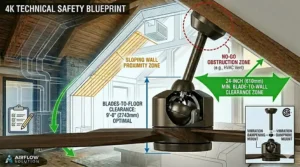
The most expensive mistake in cathedral ceiling fan installations is guessing at downrod length. Too short, and your fan circulates air uselessly near the peak; too long, and you’ve created a low-hanging hazard that might not meet Canadian building codes. Building codes require at least 2.1 metres of clearance between the floor and the lowest point of fan blades, with 2.4 to 2.7 metres being ideal for optimal airflow and comfort.
Step 1: Measure Peak Height from Floor
Stand directly beneath the highest point of your cathedral ceiling and measure straight up to the peak—this is your ceiling height. Canadian great rooms typically range from 4.3 to 6.1 metres at the peak, though dramatic architectural designs occasionally exceed 7.6 metres.
Step 2: Determine Ideal Fan Height
Your fan blades should sit 2.4 to 2.7 metres above the finished floor for optimal circulation. This positions the blades in what engineers call the “occupancy zone”—where humans actually spend time rather than wasted ceiling space. If forced to choose between 2.4 and 2.7 metres, bias toward the higher measurement in rooms with frequent foot traffic or tall furniture.
Step 3: Calculate Downrod Length
Peak height minus desired fan height equals total drop distance. Subtract your fan’s motor housing height (typically 25 to 38 centimetres for residential models) to determine the downrod length you need. For example: 5.2-metre ceiling minus 2.6-metre target height equals 2.6-metre total drop. Subtract 30-centimetre motor housing, requiring a 2.3-metre downrod.
Step 4: Account for Ceiling Slope
Cathedral ceilings slope, meaning the mounting point sits lower than the peak. On a 20° slope, a fan centered in a 6.1-metre-wide room mounts approximately 0.6 metres below the peak. Recalculate using the actual mounting point height, not the peak height. This commonly reduces required downrod length by 0.3 to 0.9 metres compared to peak-based calculations.
Step 5: Verify Blade Clearance
Maintain at least 46 centimetres of clearance between blade tips and any wall or obstruction to allow proper airflow around the entire fan and prevent damage to walls or blades. Measure from your calculated fan position to the nearest wall, beam, or architectural feature. Fans on 122 to 152-centimetre blades need correspondingly larger clearance circles.
Canadian building codes in most provinces mirror the 2.1-metre minimum blade clearance, but always verify local requirements with your provincial authority. The Canadian Electrical Code (CSA C22.x) establishes the safety standards for electrical installations across Canada, with Part II covering individual standards for electrical equipment evaluation. Quebec and British Columbia occasionally implement stricter interpretations, particularly in commercial spaces or rental properties where liability concerns elevate safety requirements.
Selecting the Right CFM for Vaulted Living Spaces
CFM—cubic feet per minute—measures the volume of air a ceiling fan moves, but the rating on the box rarely tells the complete story for cathedral ceiling fan with long downrod applications. Manufacturers test CFM in laboratory conditions: flat ceilings, enclosed rooms, no interference from HVAC systems or open floor plans. Your cathedral great room bears zero resemblance to that test environment.
For great rooms with vaulted ceilings, industry recommendations suggest high-CFM fans delivering over 6,000 CFM for effective circulation across the expansive air volume. That baseline assumes a 37-square-metre room with 4.6-metre ceilings. Canadian cathedral spaces often exceed those dimensions, requiring recalculation based on actual cubic volume rather than floor area alone.
Calculate Your Room’s Air Volume
Floor area multiplied by average ceiling height equals cubic metres. For cathedral ceilings, use the mathematical average of the lowest and highest points—not the peak height. A 32-square-metre room with a 3-metre low wall and 5.5-metre peak has an average height of 4.25 metres, equaling 136 cubic metres. You need a fan that exchanges that volume efficiently.
Apply the Canadian Climate Factor
Summer in Winnipeg differs dramatically from summer in Victoria. Winnipeg’s 32°C July days with 70% humidity demand faster air circulation than Victoria’s milder 24°C summers. Add 15-20% to your baseline CFM requirement if you’re east of the Rockies or in Ontario/Quebec humidity zones. Coastal British Columbia and the Maritimes can use published ratings without adjustment.
Consider Your HVAC Integration
If your home features central air conditioning, the ceiling fan augments existing airflow—you can bias toward lower CFM ratings. Homes without central HVAC or those with inefficient ductwork in cathedral spaces need maximum CFM to compensate. This particularly affects older Canadian homes built before modern energy codes required balanced ventilation in cathedral rooms.
Account for Downrod Length Impact
Longer downrods position fans in denser air closer to living spaces, improving effective CFM output by 8-12% compared to flush-mount configurations. A fan rated at 5,500 CFM in laboratory testing might deliver 6,050 CFM effective performance when dropped 1.5 metres into your cathedral room. This explains why properly installed cathedral ceiling fan with long downrod systems outperform higher-rated fans mounted poorly.
✨ Don’t Miss These Exclusive Deals!
🔍 Take your cathedral ceiling comfort to the next level with these carefully selected fans. Click on any highlighted item to check current pricing and availability on Amazon.ca. These systems will help you create authentic year-round climate control your family will appreciate daily!
Real-World Application: Matching Fans to Canadian Cathedral Spaces
Scenario 1: Toronto Condo Great Room
Space: 28 square metres, 4.3-metre cathedral ceiling, 18° slope
Challenge: Limited electrical box support (older building construction)
Solution: Hunter Dempsey with 91-centimetre downrod. The lighter-weight design (7.7 kg versus 13.6 kg for heavy-duty alternatives) works with standard electrical boxes rated for 23 kg. Pre-wired design simplifies installation in tight cathedral spaces where maneuvering is restricted.
Scenario 2: Vancouver Island Lakehouse
Space: 42 square metres, 5.8-metre cathedral ceiling, 24° slope
Challenge: No central HVAC, primary cooling source for summer
Solution: Monte Carlo Maverick Max with 152-centimetre downrod. The 6,450 CFM output provides sufficient air circulation to replace air conditioning in moderate coastal climates. Six-speed control lets occupants fine-tune comfort without on/off cycling that wears motors prematurely.
Scenario 3: Calgary Family Room Addition
Space: 23 square metres, 3.7-metre cathedral ceiling, 16° slope
Challenge: Budget-conscious renovation, DIY installation
Solution: Hampton Bay Altura with 76-centimetre downrod. Entry-level pricing preserves renovation budget while delivering adequate performance for modestly-sized spaces. Simplified installation suits homeowners without electrical experience, though hiring a licensed electrician is always recommended for code compliance.
Scenario 4: Quebec Cottage Loft
Space: 19 square metres, 4.6-metre cathedral ceiling, 22° slope
Challenge: Seasonal use (May-October), smart home integration desired
Solution: Minka-Aire Light Wave with 107-centimetre downrod. Wi-Fi capability enables remote control from outside the cottage—turn on circulation 30 minutes before arrival to clear stuffy air. DC motor efficiency matters less with seasonal use, but the smart features deliver disproportionate convenience for weekend retreats.
Common Mistakes When Installing Cathedral Ceiling Fans
Mistake 1: Using Standard-Length Downrods
The 15-centimetre downrod included with most ceiling fans is designed for 2.7-metre flat ceilings. Installing that short rod on a 4.9-metre cathedral ceiling positions blades 2.3 metres above the peak mount point—roughly 4.6 metres above floor level. At that height, the fan cools your ceiling, not your living space. Always purchase downrod extensions appropriate to your cathedral height, available on Amazon.ca in 30-centimetre increments up to 183 centimetres.
Mistake 2: Ignoring Electrical Box Load Ratings
Cathedral ceiling fan with long downrod systems create substantial leverage on mounting points. A 9-kilogram fan on a 152-centimetre downrod generates dynamic loads exceeding 34 kilograms during startup and speed changes. Standard electrical boxes rated for 23 kilograms aren’t sufficient—you need a fan-rated box explicitly approved for dynamic loads. Canadian electrical standards require fans for household purposes to be used on single-phase AC or DC circuits not exceeding 250 volts, with specific mounting requirements based on the fan’s weight and application. Installation without proper electrical box support voids warranties and creates safety hazards.
Mistake 3: Selecting Flush-Mount Fans for Cathedral Spaces
Marketing materials label certain fans as “low-profile” or “hugger” models, implying suitability for any ceiling height. These fans sit 15 to 20 centimetres from the ceiling—perfect for 2.4-metre rooms where traditional downrods would create head-strike hazards. On cathedral ceilings, that same proximity to the ceiling surface disrupts airflow patterns, reducing effective CFM by 35-45%. Cathedral applications always require downrod installation, never flush mounting.
Mistake 4: Overlooking Seasonal Reverse Function
The small switch on your fan motor housing isn’t decorative—it reverses blade rotation for winter operation. Set ceiling fans to spin counter-clockwise in summer for downdraft cooling, then reverse to clockwise in winter to gently redistribute warm air trapped at ceiling peaks. Canadian homes with cathedral ceilings experience this warm-air stratification acutely; winter reversal can reduce heating costs by 15-22% according to Natural Resources Canada efficiency studies.
Mistake 5: Matching Blade Size to Room Width Instead of Volume
A 152-centimetre fan seems appropriate for a 5.5-metre-wide room based on traditional sizing charts. Those charts assume 2.7-metre flat ceilings. Your 32-square-metre cathedral room with 5.2-metre ceilings contains 136 cubic metres of air—requiring a higher CFM rating than the same floor area with flat ceilings. Calculate sizing based on air volume (cubic metres) not floor area (square metres) for accurate cathedral ceiling fan with long downrod selection.
Visual Proportions: Making Cathedral Fans Look Intentional
Function drives cathedral ceiling fan selection, but aesthetics matter—particularly in Canadian homes where cathedral spaces serve as architectural focal points rather than utilitarian areas. A technically perfect fan that looks visually awkward undermines the space’s entire design.
The One-Third Rule for Blade Span
The fan’s blade diameter should occupy roughly one-third of the visual ceiling width as seen from typical viewing angles. On a 6.1-metre-wide cathedral space, a 152-centimetre fan (which occupies a 152-centimetre circular footprint) registers as appropriately scaled. Smaller 122-centimetre fans appear lost; larger 183-centimetre industrial models dominate excessively.
Downrod Proportion Guidelines
The visible downrod length (from ceiling to motor housing) should approximate 20-30% of the total ceiling height at the mounting point. On a 4.6-metre cathedral ceiling, a 91 to 137-centimetre downrod reads as intentional. Extremely short rods (30 to 46 centimetres) look abbreviated, as if someone miscalculated. Excessive lengths (over 183 centimetres) create pendulum visual effects that draw unwanted attention.
Motor Housing Style Coordination
Contemporary open-concept Canadian homes with cathedral ceilings favor minimalist motor housings in brushed nickel or matte black. Traditional timber-frame cathedral spaces pair better with aged bronze or oil-rubbed bronze finishes that reference heritage lighting fixtures. The motor housing occupies visual prominence in cathedral installations—it’s the first thing you see when entering a room—so style coordination matters more than in standard-height applications.
Blade Finish Integration
Solid wood blades complement timber-frame or craftsman-style cathedral spaces, particularly in British Columbia and Quebec where wood-heavy architecture prevails. Plastic or composite blades in contemporary finishes suit modern prairie homes and urban condos. Reversible blades (wood on one side, painted finish on the reverse) offer flexibility, though the underside faces visitors in cathedral installations—choose your visible side carefully during installation.
Energy Efficiency and Operating Costs in Canadian Climates
Canadian electricity rates vary dramatically by province—from British Columbia Hydro’s $0.13/kWh to Saskatchewan’s $0.17/kWh and Nova Scotia’s $0.18/kWh. These rate differences amplify over ceiling fan lifespans, making efficiency calculations essential for cathedral ceiling fan with long downrod decisions.
DC Motor Advantage in Real Numbers
A DC motor ceiling fan consumes 35-45 watts at high speed; equivalent AC motors draw 90-120 watts. Running 6 hours daily from May through September (153 days) at $0.15/kWh: DC fan costs $20.50 annually versus AC fan at $55.10—a $34.60 annual difference. Over the fan’s 15-year lifespan, that compounds to $519 in electricity savings, potentially covering the DC motor’s $100-$175 initial premium multiple times over.
Cold Weather Performance Impact
Canadian winters reduce electrical efficiency across all motor types. Electronics operate less efficiently at low temperatures, and cathedral spaces without adequate insulation experience ambient temperatures that affect motor performance. Expect 8-12% increased energy consumption when ceiling fans operate in spaces where ambient temperature falls below 15°C—common in Canadian cathedral great rooms during November through March.
Smart Control Energy Benefits
Wi-Fi-enabled cathedral ceiling fans like the Minka-Aire Light Wave enable automated scheduling that prevents wasted runtime. Program the fan to operate only during peak heat (1 PM-7 PM on summer days) rather than continuous operation. This reduces annual runtime from 1,100 hours to 650 hours, cutting electrical costs by 41% without sacrificing comfort during occupied periods.
Summer Cooling Offset Calculations
Each degree you increase thermostat settings saves approximately 3-5% on air conditioning costs. A properly installed cathedral ceiling fan with long downrod system allows comfortable 2-3°C thermostat increases through improved air circulation. For a Canadian home spending $400 monthly on summer cooling (June-August in Ontario/Quebec), that’s $36-$60 monthly savings or $108-$180 annually. The fan pays for itself in energy offsets within 3-5 years.
Cathedral Ceiling Fan Maintenance for Canadian Climates
Canadian environmental conditions—winter humidity from forced-air heating, summer dust infiltration through open windows, temperature cycling between -20°C and +30°C—accelerate ceiling fan wear compared to moderate climates. Proactive maintenance extends cathedral ceiling fan with long downrod service life from the typical 12-15 years to 18-20 years.
Quarterly Blade Cleaning Schedule
Dust accumulation on blades reduces aerodynamic efficiency by 11-18% according to engineering studies. In Canadian homes, forced-air heating from November to March distributes particulate matter throughout cathedral spaces, settling heaviest on horizontal surfaces—including fan blades. Clean blades quarterly using microfiber cloths slightly dampened (not wet) to avoid moisture infiltration into motor housings.
Annual Downrod Connection Inspection
Temperature cycling causes metal components to expand and contract. Cathedral ceiling fans experience pronounced cycling because they’re located at temperature extremes—hot near the peak in summer, cold in uninsulated cathedral spaces in winter. Check downrod connection tightness annually each April. Hand-tighten the locking collar (typically requires 1/4 turn additional from “loose” to “secure”) to prevent wobble development.
Biannual Motor Housing Cleaning
Cathedral ceiling fans accumulate less dust on motor housings than standard-height installations (dust settles before reaching elevated positions), but cobwebs and insect debris collect in ventilation louvers. Clean motor housing exteriors biannually in May and October using compressed air or soft brushes. Never use water or cleaning solvents near motor housings—moisture infiltration causes bearing degradation and electrical shorts.
Winter Dormancy Considerations
If your cathedral ceiling fan operates seasonally in cottage or seasonal-use space, implement winter dormancy procedures. Run the fan at low speed for 10 minutes before winter shutdown to distribute lubricant through bearings. Disconnect power at the breaker to prevent parasitic electrical draw from smart controls (Wi-Fi modules draw 2-3 watts continuously even when fans are “off”). Cover fan blades with breathable fabric to prevent dust accumulation—plastic covers trap moisture, causing finish deterioration.
Bearing Lubrication Guidelines
Quality cathedral ceiling fans feature sealed bearings that don’t require lubrication. Budget models may use oiled bronze bushings needing annual maintenance. Consult manufacturer documentation—over-lubrication causes more problems than under-lubrication. If your fan requires oiling, apply 3-4 drops of electric motor oil (not general-purpose oil) to the designated port annually in spring before heavy-use season.
❓ Frequently Asked Questions
❓ Can I install a cathedral ceiling fan in winter in Canada?
❓ How long do cathedral ceiling fans last in Canadian homes?
❓ Do I need a licensed electrician to install a cathedral ceiling fan in Canada?
❓ What's the maximum ceiling height for residential cathedral fans available on Amazon.ca?
❓ Should I run my cathedral ceiling fan when air conditioning is operating?
Conclusion: Transforming Cathedral Spaces Through Proper Air Circulation
The cathedral ceiling fan with long downrod you select determines whether that soaring architectural feature enhances or undermines your Canadian home’s livability. I’ve seen too many homeowners invest $30,000+ in dramatic cathedral renovations, then compromise the space’s functionality with a $200 inadequate fan mounted on a standard downrod. The result? Summer temperatures fluctuating 8°C between floor and peak, winter heating bills 30% higher than necessary, and uncomfortable spaces that family members avoid.
The models reviewed here—from the budget-conscious Hampton Bay Altura at $325 CAD to the performance-focused Monte Carlo Maverick Max at $825 CAD—each solve specific cathedral challenges when matched to appropriate applications. Toronto condo buyers with 28-square-metre spaces and 4.3-metre ceilings don’t need the Maverick Max’s 6,450 CFM output. Vancouver Island lakehouse owners with 42-square-metre great rooms and minimal HVAC will find the Hampton Bay Altura woefully inadequate.
Success comes from honest assessment of your space’s cubic volume, your budget’s constraints, and your priorities around aesthetics versus pure function. The Minka-Aire Light Wave justifies its premium through smart-home integration and long-term energy savings—benefits that matter intensely to some buyers and not at all to others installing seasonal-use cottage fans. The Hunter Signal delivers professional-grade quiet operation that transforms daily living in primary family spaces, whereas the Craftmade Pro Builder’s contractor-focused durability suits rental properties where tenant abuse requires rugged construction.
Whatever model you select, commit to proper downrod length calculation using the measurement methodology detailed earlier. That 91 to 152-centimetre drop distance positions your cathedral ceiling fan with long downrod where it actually serves occupants rather than decoratively spinning near the ceiling. Combine correct positioning with seasonal reversibility (counter-clockwise summer cooling, clockwise winter heat redistribution) and you’ve engineered a solution that reduces HVAC loads year-round while making your cathedral space genuinely comfortable.
Canadian homes deserve better than architectural compromises. Your cathedral ceiling creates volume and visual drama—the right fan ensures that drama translates to livable comfort rather than temperature extremes and energy waste.
Recommended for You
- Best Ceiling Fan for Sloped Ceiling Canada 2026
- DC Motor vs AC Motor Ceiling Fan Worth It? 7 Canadian Picks 2026
- 7 Best DC Motor Ceiling Fans in Canada 2026 (Save 70% Energy)
Disclaimer: This article contains affiliate links. As an Amazon Associate, I earn from qualifying purchases. If you purchase products through these links, we may earn a small commission at no additional cost to you.
✨ Found this helpful? Share it with your friends! 💬🤗
