
In This Article
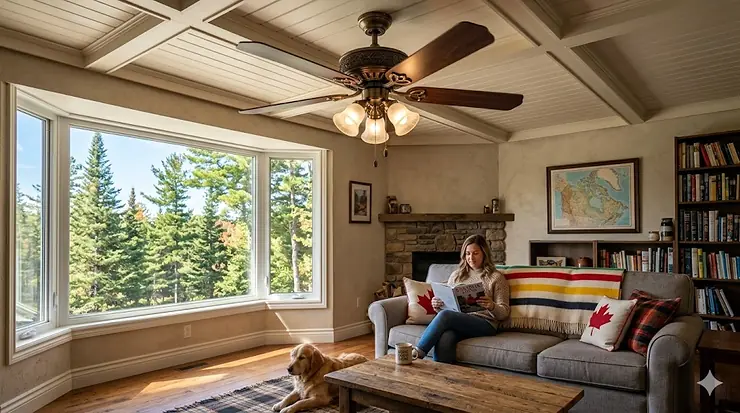
A traditional ceiling fan is a ceiling-mounted fan built around a classic motor housing, wood-look or metal blades, and finishes like bronze, brushed nickel, or white — the style most Canadians grew up with in grandma’s living room, just quieter and more efficient now. Unlike the bladeless, ultra-modern “fandelier” fans flooding social media, traditional ceiling fans prioritize timeless looks, pull-chain or wall-control simplicity, and dependable airflow over flashy app integrations.
If you’re renovating a century home in Ontario, finishing a basement in Alberta, or just want a fan that won’t look dated in five years, traditional ceiling fans are still one of the most practical upgrades for Canadian homes — and honestly, they’re one of the few home-improvement purchases that pay for themselves twice: once in comfort, once in lower energy bills.
This guide walks through seven real models available to Canadian shoppers on Amazon.ca, what their specs actually mean for your home, and the buying mistakes that trip up most first-time fan shoppers. Prices below are shown in CAD ranges only, since Amazon.ca prices shift constantly — always check the current price on Amazon.ca before buying.
Quick Comparison Table
| Model | Blade Span | Light Included | Control | Best For | Price Range (CAD) |
|---|---|---|---|---|---|
| Hunter Original | 132 cm (52″) | No | Pull chain | Classic farmhouse look | $130–$190 |
| Casablanca Panama | 137 cm (54″) | No | Remote, DC motor | Quiet bedrooms | $220–$320 |
| Westinghouse Albert | 132 cm (52″) | Yes (LED) | Pull chain | Large traditional living rooms | $130–$180 |
| Honeywell Glen Alden | 132 cm (52″) | Yes (LED) | Pull chain | Low ceilings, flush mount | $110–$160 |
| Minka-Aire Traditional Concept | 112 cm (44″) | Yes (LED) | Wall control | Covered porches, sunrooms | $230–$310 |
| Canarm Aspen | 117 cm (46″) | Yes (LED) | Remote | Budget-conscious Canadian buyers | $90–$140 |
| Prominence Home Alvina | 107 cm (42″) | Yes (LED) | Pull chain | Bedrooms, condos | $80–$120 |
Looking at the table, the gap between the cheapest and priciest fan here isn’t really about airflow — it’s about motor refinement and finish quality. The Casablanca and Minka-Aire models justify their higher price with whisper-quiet DC motors that matter most in bedrooms, while the Canarm and Prominence Home options are built for buyers who just want reliable circulation without the premium. If you’re outfitting a condo in Toronto or Vancouver where every dollar of reno budget counts, the budget tier here performs perfectly well for rooms under 20 square metres.
💬 Just one click — help others make better buying decisions too! 😊
✨ Don’t Miss These Exclusive Deals!
🔍 Take your home comfort to the next level with these carefully selected fans. Click on any highlighted item to check current pricing and availability on Amazon.ca. These picks will help you create a comfortable, classic-looking home your family will love! 🇨🇦
Top 7 Traditional Ceiling Fans — Expert Analysis
1. Hunter Original — The Benchmark Classic
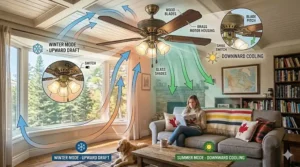
The Hunter Original has been a fixture in North American homes for decades, and the current 52-inch version (model 23845) keeps the formula simple: five blades, a pull chain, and a 3-speed WhisperWind motor with reversible airflow. What that reversible motor actually means in practice: in summer, run it counterclockwise for a cooling breeze; in winter, flip it to clockwise on low to push your furnace’s warm air back down, which matters in Canadian homes where heat loves to pool near vaulted ceilings.
What most buyers overlook about this model is that it’s damp-rated, so it works equally well in a covered porch in Halifax or a dry living room in Calgary — one fan, two use cases. Canadian customers on Amazon.ca consistently mention how wobble-free it runs even after years of use, a detail that matters more once your ceiling fan is spinning 132 cm of blade above a king-size bed.
✅ Pros: rock-solid reversible motor; damp-rated for indoor/outdoor flexibility; classic look that won’t date
❌ Cons: no light kit included; pull chain only (no remote)
Around $130–$190 CAD depending on finish — solid value for a fan built to outlast a paint job or two.
2. Casablanca Panama — Premium Quiet Performance
The Casablanca Panama (model 59510) is where “traditional” meets genuinely premium engineering. Its DC motor with 6 speed settings runs noticeably quieter than the AC motors in budget fans — a real difference when you’re trying to sleep in a condo bedroom in downtown Montreal where every decibel counts. The burnt walnut reversible blades and snow-white housing give it a clean, classic ceiling fan design that fits both century homes and newer builds.
In my experience reviewing fan specs, the detail that matters most here isn’t the finish — it’s the DC motor’s lower power draw, which translates into a smaller dent in your electricity bill if you run the fan most of the year, as many Canadians do to stretch their air conditioning further into September.
✅ Pros: ultra-quiet DC motor; included remote; timeless finish options
❌ Cons: premium price; no light kit on this particular model
Expect to pay in the $220–$320 CAD range — this one’s for buyers who treat a ceiling fan as a long-term fixture, not a quick fix.
3. Westinghouse Albert — Traditional Style With Built-In Light
The Westinghouse Albert (model 7308300) earns its “traditional” label honestly: frosted glass light kit, reversible white and light maple blades, and a motor built for large rooms up to roughly 21 square metres. Westinghouse backs the motor with a lifetime warranty and two years on everything else — useful context for buyers comparing fans that all claim to be “built to last.”
The two included 9.8-watt LED bulbs aren’t just a footnote — they mean you’re not buying separate light fixtures for a room that needs both air movement and ambient light, which matters in finished basements common across Canadian homes where natural light is already limited.
✅ Pros: light kit included; large-room coverage; reversible blade finish
❌ Cons: pull chain only; down-rod mounting needs at least 2.6 m of ceiling height
Typically priced $130–$180 CAD, making it one of the better all-in-one options if you need both light and air in one fixture.
4. Honeywell Glen Alden — Best for Low Ceilings
If your home has 2.4 m ceilings — common in older Canadian builds and many condos — the Honeywell Glen Alden (model 50519-01) flush mount design is the practical answer. Its dual-finish blades let you flip them to match a room’s décor without buying a new fan, and the integrated LED bowl light keeps the whole fixture close to the ceiling instead of hanging down and eating into your headroom.
What most listings won’t tell you: flush mount fans like this trade a small amount of airflow efficiency for that low profile, since the blades sit closer to the ceiling. For a bedroom or hallway in a Canadian bungalow, that trade-off is barely noticeable; for a great room with 3+ metre ceilings, you’d get more circulation from a down-rod model like the Hunter or Westinghouse above.
✅ Pros: ideal for low ceilings; dual-finish reversible blades; quiet reversible motor
❌ Cons: less airflow than down-rod fans; pull chain only
Usually in the $110–$160 CAD range, making it a strong budget-to-mid pick for condos and older homes alike.
5. Minka-Aire Traditional Concept — Best for Covered Porches
The Minka-Aire Traditional Concept (model F593L-WH) is rated for indoor or outdoor use, which is the detail that matters most for Canadians who want a classic ceiling fan design on a covered porch without worrying about humidity or light rain damaging the motor. Its 44-inch span with a 14° blade pitch is tuned for steady airflow rather than maximum CFM, which keeps it quiet enough for a three-season sunroom.
The included wall control with full-range light dimming is a nice touch most budget fans skip entirely — you get one switch for both fan speed and lighting instead of juggling a remote and a separate dimmer. For a Canadian summer evening on the porch, that simplicity is worth something.
✅ Pros: indoor/outdoor weatherproof rating; wall control with dimming; lifetime motor warranty
❌ Cons: smaller 44-inch span suits medium spaces only; premium price for the size
Plan on roughly $230–$310 CAD — pricier per inch of blade than most on this list, but the weatherproofing justifies it for porch use.
6. Canarm Aspen — The Canadian Brand Pick
Canarm is one of the few ceiling fan brands actually headquartered in Canada (Brockville, Ontario), and the Aspen 46-inch model is a practical entry point into their lineup: three blades, three speeds, a dimmable LED kit, and remote control, sold through both Amazon.ca and Canadian Tire. For buyers who specifically want to support a Canadian-based company — or who like the idea of warranty support from a business with Canadian roots — this is the most relevant pick on the list.
The Canadian-context commentary here matters: Canarm fans are designed with this market in mind from the start, rather than adapted from a U.S. catalogue, so dimensions and mounting hardware tend to match Canadian ceiling-box standards without extra adapters.
✅ Pros: Canadian-headquartered brand; remote and dimmable LED included; widely stocked across Canadian retailers
❌ Cons: motor isn’t as refined as the premium picks; finish options more limited
Generally available for $90–$140 CAD, putting it squarely in the budget-to-mid tier.
7. Prominence Home Alvina — Best Budget Pick
The Prominence Home Alvina (42-inch traditional flush mount, model 51585-01) is the most affordable fan on this list that still checks the “traditional” box: dual-finish blades, an integrated LED light, pull-chain control, and a reversible motor. For a condo bedroom, nursery, or rental property where you don’t want to overspend, this fan covers the basics without looking cheap.
The dual-finish blades are the standout practical feature — flip them from gray oak to brown walnut and the same $100 fan suddenly matches a different room’s furniture, which is a clever way to avoid buying twice as your décor changes.
✅ Pros: lowest price on this list; light included; dual-finish blade flexibility
❌ Cons: smaller 42-inch span best suited to rooms under 14 square metres; pull-chain only, no remote
Typically $80–$120 CAD, making it the easiest recommendation for anyone furnishing a first apartment or rental unit on a budget.
Traditional Ceiling Fans vs. Modern Smart Fans
| Factor | Traditional Ceiling Fan | Modern Smart Fan |
|---|---|---|
| Upfront cost (CAD) | Usually lower | Often $50–$150 more |
| Control | Pull chain or wall control | App, voice, or remote |
| Repairability | Simple, parts widely available | Often proprietary electronics |
| Aesthetic longevity | Rarely looks “dated” | Can look dated as trends shift |
| Best for | Resale-focused homes, classic décor | Tech-forward households |
The practical read on this comparison: a traditional ceiling fan with a pull chain has fewer parts that can fail, and replacement pull chains or light kits are easy to find at any Canadian hardware store, while a smart fan’s Wi-Fi module or app support can become a headache years down the line if the manufacturer discontinues support. If you’re planning to sell your home in the next five to ten years, real estate agents across Canada routinely note that classic ceiling fan design photographs better and appeals to a wider range of buyers than a niche smart fan.
Practical Usage Guide: Getting the Most From Your Fan
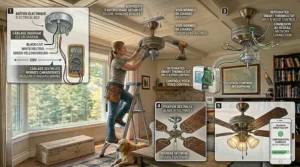
Setting up a traditional ceiling fan properly takes about 45–90 minutes for most DIYers, but a few Canadian-specific details make the difference between a fan that performs and one that wobbles or underperforms:
- Mount height: aim for at least 2.1 m from the floor to the blades and 2.3–3 cm of clearance from the ceiling for best airflow.
- Winter reversal: every traditional ceiling fan with a reversible motor should run clockwise on low speed once your furnace kicks in for the season — this alone can shave a noticeable amount off heating costs by pushing warm air down from the ceiling.
- Seasonal dusting: Canadian winters mean dry, static-prone air indoors; wipe blades monthly with a microfibre cloth to stop dust buildup, which both improves airflow and prevents the fan from looking dingy.
- Tightening check: after the first month of regular use, recheck the blade screws and downrod connection — wood-look blades especially can loosen slightly as they settle.
- Outdoor/damp-rated models: if you’re installing on a porch, confirm the model is at least damp-rated (several on this list are) before exposing it to Canadian rain or snow squalls.
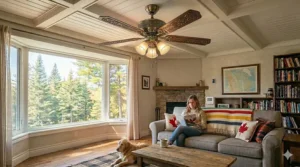
Real-World Scenarios: Which Fan Fits Your Home
The Toronto condo dweller with 2.4 m ceilings and a 14 square metre bedroom is better served by the Honeywell Glen Alden’s flush mount design than any down-rod fan — the low profile preserves headroom while still delivering a light fixture and fan in one unit.
The Ottawa family finishing a basement rec room with 2.7 m ceilings and no natural light will get more value from the Westinghouse Albert, since the included LED light kit means one purchase covers both air circulation and a primary light source for a windowless space.
The Halifax homeowner with a covered three-season porch wants weatherproofing first — the Minka-Aire Traditional Concept’s indoor/outdoor rating handles coastal humidity better than a strictly indoor-rated fan ever could.
Common Problems and Solutions
Most issues Canadian buyers run into with traditional ceiling fans trace back to a handful of fixable causes:
- Wobbling blades: almost always a balance issue — use a balancing kit (often included, or sold separately for a few dollars) rather than assuming the fan itself is defective.
- Fan feels weak in a large room: check blade span against room size; a 107 cm (42″) fan in a 25 square metre living room will always underperform regardless of motor quality — size up instead.
- Light dims when fan speed changes: this usually means the fan is on a standard dimmer switch instead of a fan-rated control; swap to a compatible wall control.
- Squeaking after a year or two: typically the motor housing screws have loosened from vibration — a quick tightening resolves most cases before assuming a motor replacement is needed.
- Parts availability after warranty: stick to widely distributed brands like the ones on this list; off-brand fans sold only through marketplace third-party sellers can be harder to source replacement light kits for in Canada.
How to Choose a Traditional Ceiling Fan in Canada
- Measure your room first. Rooms under 14 square metres suit 42–44-inch fans; 14–28 square metres call for 50–54-inch fans; anything larger needs two fans rather than one oversized unit.
- Decide if you need a light kit. A fan with an integrated LED light saves you installing a separate fixture, especially useful in basements and dens.
- Check your ceiling height. Under 2.6 m, lean toward flush mount; above that, a down-rod model improves airflow.
- Confirm the control type you actually want. Pull chains are simple and never lose connectivity; remotes add convenience but are another battery to replace.
- Match the rating to the room. Dry-rated for indoor only; damp-rated for covered porches; wet-rated for fully exposed patios.
- Look for a reversible motor. This is the single feature that helps most with Canadian heating costs in winter.
- Confirm Amazon.ca availability and shipping. Some models popular on Amazon.com aren’t stocked the same way on Amazon.ca, so always verify before adding to cart — and remember Amazon.ca’s free shipping threshold is generally around $35 CAD for non-Prime orders.
Common Mistakes When Buying a Traditional Ceiling Fan
Buyers across Canada tend to repeat the same handful of mistakes:
- Ignoring blade pitch. A shallower blade pitch (around 12–14°) moves less air per rotation than a steeper one (16–20°), even at the same blade span — two fans that look identical on a spec sheet can perform very differently.
- Assuming more blades means more airflow. Number of fan blades affects efficiency less than motor strength and blade pitch; a well-engineered 3-blade fan can outperform a poorly engineered 5-blade one.
- Buying based on U.S. pricing. Comparing an Amazon.com listing’s price directly to Amazon.ca without accounting for currency and import differences often leads to disappointment — always price-check on Amazon.ca directly.
- Skipping the ceiling box rating. Standard light fixture boxes aren’t rated to support a spinning fan’s weight and vibration; confirm (or have an electrician confirm) you have a fan-rated electrical box before installation, which is also a requirement under the Canadian Electrical Code.
- Forgetting winter mode. Many Canadian buyers never flip the reversal switch after installation and miss out on the heating-season benefit entirely.
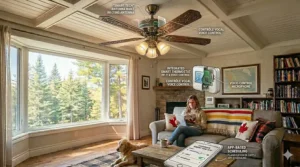
Canadian Regulations & Safety Standards
Ceiling fans sold in Canada fall under federal energy performance and reporting requirements that reference Canadian and U.S. testing standards, including CSA luminaire standards for fan light kits. In plain terms: a ceiling fan’s light kit has to meet a recognized safety and performance bar before it can legally be sold here, which is part of why CSA or ETL/UL markings on the box matter more than they might seem to at first glance.
On the efficiency side, Natural Resources Canada notes that an ENERGY STAR certified ceiling fan uses about 60% less energy on average than a standard model, and ceiling fans are one of the cooling and ventilating product categories subject to Canada’s Energy Efficiency Regulations. Practically, that means choosing an ENERGY STAR-labelled traditional ceiling fan (several of the picks above qualify) isn’t just a marketing checkbox — it has a real, federally measured efficiency baseline behind it.
NRCan also points out a simple seasonal trick worth repeating here: setting your thermostat two degrees higher and using a ceiling fan to circulate cool air can cut air conditioning costs by roughly 14%, which adds up over a Canadian summer. For more detail, see Natural Resources Canada’s ENERGY STAR ceiling fans page and its ceiling fan regulations guide.
Worth noting for marketers and bloggers too: advertising claims about energy savings or pricing in Canada fall under the Competition Bureau of Canada’s misleading advertising rules, and any digital marketing tied to this kind of content needs to respect Canada’s Anti-Spam Legislation (CASL) if it involves commercial electronic messages.
Long-Term Cost & Maintenance in Canada
A traditional ceiling fan’s total cost of ownership goes beyond the sticker price. Budget roughly $0–$60 CAD a year in electricity for regular seasonal use (less for ENERGY STAR-rated models), occasional replacement bulbs if your model doesn’t use long-life LEDs, and the rare $10–$20 replacement part like a pull chain or balancing kit. Installation by a licensed electrician, if you don’t already have a fan-rated box, typically runs higher than the fan itself in many Canadian markets — so factor that in if you’re starting from a plain light fixture rather than swapping an existing fan.
Cross-border shopping can look tempting when U.S. listings show lower sticker prices, but factor in shipping, potential duties, warranty support that may not extend across the border, and exchange rate swings — for most buyers, purchasing directly through Amazon.ca ends up simpler and just as competitively priced once those costs are added in.
Features That Actually Matter (And Those That Don’t)
Matters: motor type (DC motors run quieter and more efficiently than AC), reversible airflow, blade pitch, fan-rated mounting, and ENERGY STAR certification.
Doesn’t matter much: number of blades alone (3 vs. 5 blades rarely changes performance meaningfully if pitch and motor are comparable), exotic finish names, and most app/smart features on a fan you’ll mostly control by chain or wall switch anyway.
Frequently Asked Questions
❓ Are traditional ceiling fans available on Amazon.ca?
❓ What size traditional ceiling fan do I need for a Canadian bedroom?
❓ Do traditional ceiling fans work well in Canadian winters?
❓ Is a pull chain or remote control better for a traditional ceiling fan?
❓ How much does it cost to run a traditional ceiling fan in Canada?
Conclusion
Traditional ceiling fans remain one of the most reliable, budget-friendly upgrades for Canadian homes, and the seven models covered here span every price tier without sacrificing the classic look most buyers are after. If you want the safest all-around pick, the Hunter Original’s proven motor and damp-rated flexibility make it hard to beat. Budget-conscious shoppers will do well with the Prominence Home Alvina or Canarm Aspen, while anyone prioritizing whisper-quiet performance should look closely at the Casablanca Panama.
Whichever you choose, remember the two habits that actually move the needle on comfort and cost: reverse the motor direction with the seasons, and check current pricing and ENERGY STAR status directly on Amazon.ca before you commit.
Recommended for You
- Inverter Ceiling Fan Benefits: 7 Best DC Fans for Canada (2026)
- Top 7 Twin Motor Ceiling Fans with Independent Control Canada 2026
- Best 7 Convertible Ceiling Fan Flush or Downrod Canada 2026
Disclaimer: This article contains affiliate links. As an Amazon Associate, I earn from qualifying purchases. If you purchase products through these links, we may earn a small commission at no additional cost to you.
✨ Found this helpful? Share it with your friends! 💬🤗
