
In This Article
If you’ve ever walked into your Canadian basement in July and felt like you just stepped into a warm, wet sock — you already understand the problem. Basements in Canada are humidity battlegrounds. Between spring snowmelt seeping through foundation walls, summer condensation on cold concrete, and poor air circulation year-round, moisture levels can regularly climb past 60–70% relative humidity (RH). And once that happens? You’re not just uncomfortable — you’re creating the exact conditions that Health Canada warns about, where mould can begin growing within as little as 48 hours on damp surfaces.
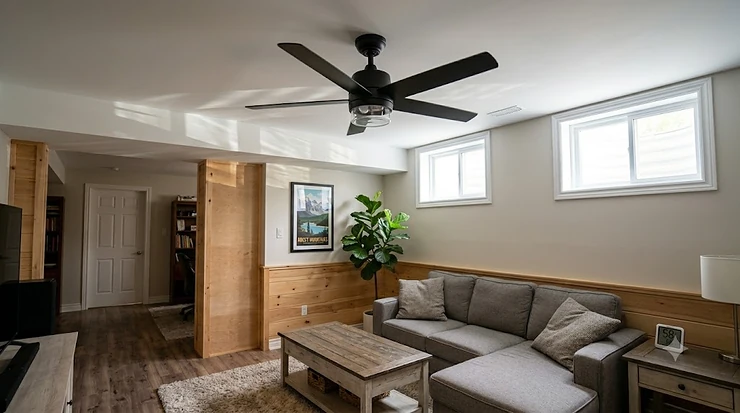
A ceiling fan for high humidity basement isn’t a luxury — it’s a practical line of defence. The right model keeps air moving constantly, which disrupts the still, stagnant conditions that mould and mildew thrive in. It also makes your basement feel noticeably cooler in summer and helps distribute heat more evenly during Canadian winters when you’re running the furnace.
Here’s the catch, though: you can’t just grab any ceiling fan off the shelf. Standard indoor fans are built for dry environments. Expose them to sustained humidity and you’ll see rust on the motor housing, warped wooden blades, and corroded blade brackets within a season or two — which is both a waste of money and a potential electrical hazard. What you need is a damp-rated ceiling fan with moisture protection built in: sealed or corrosion-resistant motor housing, ABS or treated blades, and rust-proof hardware throughout.
In this guide, I’ve researched seven real, verified picks available on Amazon.ca, all suited specifically for a Canadian basement environment. Whether your basement is a finished rec room, an active laundry space, or a raw utility area, there’s a right fan for you — and I’ll help you find it. All prices are listed in CAD.
Quick Comparison: Top 7 Ceiling Fans for High Humidity Basements
| Product | Blade Span | Humidity Rating | Motor Type | Key Feature | Best For |
|---|---|---|---|---|---|
| BiGizmos 72″ Industrial DC Fan | 72″ (183 cm) | Damp Rated (ETL) | DC, 6-Speed | Large coverage, LED light | Big open basements |
| Hunter Newsome 52″ | 52″ (132 cm) | Damp Rated (ETL) | WhisperWind 3-Speed | Stainless steel hardware | Traditional finished basements |
| ZMISHIBO 72″ Indoor/Outdoor | 72″ (183 cm) | Damp Rated | DC, 6-Speed | Dual-finish 8 blades, 3CCT | Modern large basements |
| Honeywell Xerxes 70″ | 70″ (178 cm) | Damp Rated | DC Reversible | 8-blade design, colour-change LED | Premium finished basements |
| Hunter Windbound 52″ (51459) | 52″ (132 cm) | Damp Rated | SureSpeed WhisperWind | Industrial exposed hardware | Utility/workshop basements |
| 52″ Wood Blade Damp Fan (3-Blade) | 52″ (132 cm) | Damp Rated | 6-Speed Reversible | Multiple downrods, farmhouse style | Budget-conscious buyers |
| Hunter Spring Mill 52″ (51470) | 52″ (132 cm) | Damp Rated | SureSpeed WhisperWind | Caged Edison LED design | Industrial-style rec rooms |
What the table tells us: The 72″ models dominate when it comes to coverage — ideal for wide-open basement layouts that Canadian homes often have. The Hunter models earn their spots through proven damp-location engineering and corrosion-resistant stainless steel hardware, which matters enormously in a basement where moisture protection isn’t just a nice-to-have. Budget buyers can absolutely find solid damp-rated options in the $80–$150 CAD range, while those finishing a premium rec room will likely want to invest in the $200–$300+ range for better build quality and aesthetics.
✨ Don’t Miss These Exclusive Deals!
🔍 Take your basement comfort to the next level with these carefully selected fans. Click on any highlighted item to check current pricing and availability on Amazon.ca. These picks will help you create a healthy, comfortable basement space your whole family can actually use!
Top 7 Ceiling Fans for High Humidity Basement: Expert Analysis
1. BiGizmos 72 Inch Industrial DC Motor Ceiling Fan (ETL Damp Rated)
When your basement is the size of a small ballroom — or a serious workshop — the BiGizmos 72″ fan is where I’d point you first. The 72-inch (183 cm) blade span is the real headline here: in practical terms, this fan can circulate air in a space of approximately 46 m² (500 sq. ft.) with genuine efficiency on medium speed alone. The DC motor runs at six speeds, and the difference between speed one and speed six is dramatic — you can whisper-circulate air during winter without creating a wind tunnel, or crank it up in July to make that muggy 70%+ RH basement actually bearable.
The ETL damp-rated certification means it’s been independently tested and certified for use in humid environments — not just a manufacturer claim. The brushed nickel metal shade for the integrated LED light (approximately 2,600 lumens at 31 watts) is non-removable, which is actually a feature in disguise: fewer exposed joints means fewer places for moisture to creep in and cause corrosion over time. The reversible motor lets you flip to clockwise rotation in November to push your furnace heat back down from the ceiling — a trick that Canadian homeowners with high basement ceilings will appreciate.
In practice, buyers who installed this in their basements and workshops report it as genuinely whisper-quiet and confirm the air output is impressive even at low speeds. Installation feedback is mixed — the instructions are sparse and the process can take over three hours on a sloped ceiling — so budget time accordingly.
✅ 72″ span covers large basement areas efficiently
✅ ETL-certified damp rating — independently verified moisture protection
✅ Reversible DC motor with 6 speeds for year-round Canadian use
❌ Installation manual needs significant improvement
❌ LED light quality is average — not ideal if the basement doubles as a bright workspace
Price range: Around $150–$220 CAD. Available on Amazon.ca and ships via Amazon Fulfillment. Excellent value for the blade span and DC motor quality at this price tier.
2. Hunter Newsome 52″ Damp Rated Ceiling Fan (Model 53323/53324)
Hunter is arguably the most trusted ceiling fan brand in North America, and the Newsome earns that trust in a basement context for one simple reason: stainless steel hardware. Rust is the quiet enemy of any fan installed in a damp location — a standard steel screw exposed to 60%+ RH will begin corroding in months. Hunter’s use of stainless steel hardware throughout the Newsome means it’s genuinely built for the long haul in a humid Canadian basement, not just rated for it on paper.
The WhisperWind motor delivers 4,436 CFM at high speed, which is genuinely powerful for a 52″ (132 cm) fan — enough to circulate a roughly 27 m² (290 sq. ft.) room effectively. The three-position mounting system (standard, low-profile, or angled) is a practical Canadian basement consideration: many older Canadian homes have low basement ceilings of around 213–244 cm (7–8 feet), and the flush-mount option here means you won’t lose valuable headroom. The reversible motor handles winter heat redistribution gracefully.
This is the fan I’d recommend to someone finishing their basement as a proper living space — a rec room, home office, or kids’ play area — where you want a traditional, refined aesthetic that won’t look out of place alongside drywall and pot lights. The limited lifetime warranty on the motor and two years on parts gives Canadian buyers solid peace of mind.
✅ Stainless steel hardware — genuine corrosion resistance for basements
✅ 3-position mounting ideal for low Canadian basement ceilings
✅ Trusted brand with lifetime motor warranty
❌ No light kit included — sold separately
❌ Only 3 speeds; less fine-grained control than DC models
Price range: $180–$260 CAD on Amazon.ca. Free shipping for Prime members; $35+ threshold for standard free shipping. Worth every dollar for a finished basement.
3. ZMISHIBO 72 Inch Indoor/Outdoor Ceiling Fan
The ZMISHIBO 72″ fan is what happens when you take the concept of a large-format damp-rated ceiling fan and dress it up for a modern aesthetic. The eight dual-finish reversible blades look right at home in a contemporary finished basement — each blade features two distinct finishes so you can orient them to match your décor. The three colour temperature options (3CCT) on the integrated LED light are genuinely useful in a basement setting: warm white for movie nights, cool white for the home gym or workshop.
The DC motor runs on six speeds and is reversible, which means you get legitimate year-round utility — summer downdraft cooling and winter updraft heat distribution. In a Canadian basement context, that reversibility matters more than in most other rooms: your basement in January likely has a real stratification issue, with furnace-heated air pooling near the ceiling while you’re sitting on the couch at floor level shivering.
The 72″ (183 cm) span and indoor/outdoor damp-rated construction make this a strong choice for Canadian homeowners who want both a functional and attractive basement fan without paying premium Hunter or Minka-Aire pricing. Buyers consistently praise the quiet operation and the fact that airflow is strong even on speed two or three. Note that this ships from Amazon.ca, so Prime members get it quickly even in most Canadian provinces.
✅ Modern dual-finish blades in two reversible options
✅ 3CCT LED light — adaptable for different basement uses
✅ Ships from Amazon.ca — reliable Canadian delivery
❌ Brand is less established than Hunter — warranty service may be harder to navigate
❌ Assembly instructions could be clearer
Price range: $160–$240 CAD. Available on Amazon.ca; Prime-eligible for fast shipping.
4. Honeywell Xerxes 70 Inch Indoor/Outdoor Ceiling Fan (Model 51905-01)
The Honeywell Xerxes 70″ is the premium pick in this roundup — and for finished basements that double as proper entertainment or living spaces, it earns its position. At 70 inches (178 cm), it covers roughly the same floor area as the 72″ models but comes with a substantially more refined aesthetic: eight dual-finish blades, a colour-changing LED light kit, and the polished overall build quality you’d expect from a name like Honeywell.
What sets this apart from a pure performance standpoint is the damp-rated indoor/outdoor certification paired with the reversible DC motor — meaning Honeywell has explicitly built this to handle garages, covered porches, and humid indoor spaces like basements. The colour-changing LED feature is more than a gimmick in a basement context: being able to shift between warm amber and cool daylight helps compensate for the lack of natural light that most Canadian basements struggle with. You can make the space feel cosy for movie night, then shift to a brighter, more energising colour temperature for exercise or hobbies.
Canadian buyers should be aware that Honeywell ceiling fans are typically sold and distributed through Amazon.ca. At the price point, you’re also buying into Honeywell’s established warranty and customer service network — a real advantage if you encounter any issues.
✅ Premium large-span damp-rated fan with refined aesthetics
✅ Colour-changing LED compensates for low natural light in Canadian basements
✅ Established brand warranty and customer service
❌ Higher price point — not suitable for utility or raw basement spaces
❌ 70″ span needs adequate ceiling height (minimum ~274 cm / 9 ft. recommended)
Price range: $250–$350 CAD on Amazon.ca. Investment-level purchase, but the build quality justifies the cost for a properly finished basement.
5. Hunter Windbound 52″ Ceiling Fan (Model 51459, Matte Black)
The Hunter Windbound takes everything Hunter does well — damp rating, WhisperWind quiet operation, corrosion-resistant construction — and wraps it in an industrial-modern exterior that feels intentionally at home in a basement workshop or utility space. The exposed hardware aesthetic, matte black finish, and clean minimal design say “purposeful” rather than “decorative,” which is exactly the right tone for a basement laundry room, workshop, or utility space.
Hunter’s SureSpeed technology is the key functional differentiator here: it’s designed to produce noticeably faster, more focused airflow compared to standard motors — Hunter claims over 33% more air velocity versus competing models at comparable speeds. In practice, this means the Windbound moves meaningful air on a lower speed setting, which matters when you want to run it continuously in a laundry room or workshop without the fan noise becoming irritating. The three-speed WhisperWind motor earns its name.
The damp rating covers use in covered outdoor spaces, but in a Canadian basement context — including laundry rooms, workshop areas, or utility spaces — this is fully appropriate. Stainless steel hardware again features throughout, which is the detail that separates a Hunter from cheaper alternatives when it comes to long-term moisture resistance. No light kit is included, which keeps the profile clean and the price down.
✅ SureSpeed technology for stronger airflow at lower speeds — great for continuous utility use
✅ Industrial matte black aesthetic fits workshop or utility basements perfectly
✅ Stainless steel hardware for genuine corrosion resistance
❌ No light included — needs separate lighting solution for darker utility spaces
❌ Pull chain only — no remote control option out of the box
Price range: $170–$240 CAD. Available on Amazon.ca. Strong value for a workhorse utility basement fan.
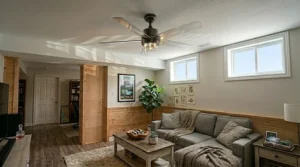
6. 52″ Wood Blade Damp Rated 3-Blade Ceiling Fan (Amazon.ca, B09ZXXZW9V)
For Canadian buyers who want farmhouse or rustic aesthetics without breaking the bank, this 52″ three-blade wood-blade damp-rated option on Amazon.ca is a compelling budget pick. The walnut-finish carved wooden blades are the aesthetic centrepiece — they’re constructed specifically to avoid formaldehyde off-gassing, which is a real consideration in a basement that’s used as living space. The manufacturer confirms the fan is approved for damp locations and includes three downrod options (127 mm, 254 mm, and 610 mm / 5″, 10″, and 24″), plus compatibility with sloped ceilings up to 20° — covering many of the irregular basement ceiling configurations found in older Canadian homes.
The six-speed reversible motor with remote control gives you more granular airflow control than many fans at this price point. The three-blade design provides a cleaner, more modern aesthetic than five-blade alternatives and, contrary to what you might expect, three-blade fans can move air just as effectively as five-blade designs when the motor is properly matched to the blade span.
The honest caveat here: this is a budget purchase, and the build quality reflects that. It’s perfectly fine for a guest bedroom basement, a low-use hobby space, or as a short-to-medium-term solution before you invest in something more substantial. Canadian winters are hard on everything — including ceiling fans in spaces with wide temperature and humidity swings — so manage expectations for long-term durability versus a Hunter or Honeywell.
✅ Excellent value for a damp-rated fan with remote control
✅ Multiple downrod options suit various Canadian basement ceiling heights
✅ Farmhouse/rustic aesthetic works well in finished rec rooms or cabins
❌ Budget build quality — unlikely to match a Hunter for long-term durability
❌ Brand support and warranty terms are less established
Price range: $80–$130 CAD. Available and ships directly from Amazon.ca. Prime-eligible.
7. Hunter Spring Mill 52″ Ceiling Fan with Light (Model 51470, Painted Galvanized)
The Hunter Spring Mill completes this roundup as the pick for Canadian homeowners who want the best of both worlds: Hunter’s proven damp-location engineering and stainless steel hardware reliability, wrapped in an industrial-chic caged Edison LED design that looks stunning in a finished rec room, bar area, or media room basement. The painted galvanized finish is not just aesthetically clever — galvanized metal is significantly more corrosion-resistant than standard painted steel, which is a real, practical advantage in a basement where humidity levels can swing dramatically between seasons.
The SureSpeed guarantee means that Hunter is confident enough in the airflow performance to back it with an explicit standard — faster, focused air movement compared to leading competitors. The caged Edison LED design diffuses light in a warm, ambient way that’s particularly well-suited to entertainment-focused basements where you want atmosphere rather than clinical brightness. The damp rating covers all the scenarios a Canadian basement presents.
What most buyers overlook about the Spring Mill is the seasonal versatility: the reversible motor paired with SureSpeed means it genuinely performs in both directions. Running it on low in clockwise mode during Canadian winters circulates heat efficiently without the “wind chill” effect that makes some basement spaces feel cold even when the thermostat says otherwise.
✅ Galvanized finish offers superior corrosion resistance versus standard painted steel
✅ Caged Edison LED creates warm ambience perfect for basement entertainment spaces
✅ SureSpeed guarantee backs real-world airflow performance
❌ Industrial-caged aesthetic won’t suit every décor style
❌ Higher price within the Hunter lineup
Price range: $200–$280 CAD. Available on Amazon.ca. A premium-to-mid-range investment with a strong design payoff for finished basements.
How to Install and Maintain Your Basement Ceiling Fan in Canada
Installing a ceiling fan in a high-humidity basement requires a bit more thought than a standard bedroom install — and the Canadian context adds a few extra considerations worth knowing about.
Before you pick up a screwdriver: Check that your electrical box is fan-rated. A standard electrical box is designed for a light fixture — typically 23 kg (50 lbs.) maximum — not a ceiling fan that vibrates and can weigh up to 18 kg (40 lbs.) or more. A fan-rated electrical box (clearly marked “acceptable for fan support”) is required under the Canadian Electrical Code (CEC). If your basement ceiling box isn’t fan-rated, the upgrade is simple and inexpensive — typically under $25 CAD at any Canadian hardware store.
Installation tips specific to basement environments:
- Use anti-corrosion electrical connectors (wire nuts designed for damp locations) when making your wiring connections, particularly if your basement sees humidity above 60% regularly.
- Seal the canopy-to-ceiling junction with a small bead of paintable silicone caulk. This prevents moisture from tracking down the wiring into the junction box over time.
- For sloped ceilings (common in older Canadian split-level homes), use the angled canopy hardware included with most damp-rated fans — do not force a standard canopy onto a sloped ceiling, as this stresses the motor housing.
Seasonal maintenance schedule for Canadian basements:
- Spring (April–May): Clean blade surfaces with a microfibre cloth and inspect all hardware for early rust. The spring thaw is when Canadian basements see moisture levels spike — a good time to confirm your fan is in optimal condition.
- Summer (June–August): Run in counterclockwise (downdraft) mode to push cooled air downward. This is peak humidity season in most Canadian provinces.
- Fall (September–October): Wipe blades thoroughly before switching to clockwise (updraft) mode for winter heat redistribution.
- Winter (November–March): Run on low speed in clockwise mode. This costs almost nothing in electricity but can noticeably reduce heating bills by preventing warm air stratification near the ceiling.
A quick note on lubrication: most modern DC motor fans are sealed and require no oiling. Older AC motor fans may have an oil port near the motor housing — check the manual. Using the wrong lubricant in a humid basement can actually attract dust and accelerate wear.
Canadian Homeowner Profiles: Which Fan Is Right for You?
Profile 1 — The Suburban Family in Mississauga with a Finished Rec Room
Mark and Sandra have a 325-square-foot finished basement that serves as the family TV room, the kids’ homework space, and the occasional overflow guest room. Humidity sits around 55–65% in summer. They want something that looks good, keeps the space comfortable, and won’t break down within two seasons.
Best pick: Hunter Spring Mill 52″ or Hunter Newsome 52″. Both offer the build quality to last, the damp rating for their humidity levels, and aesthetics that fit a finished living space. Budget: $200–$280 CAD.
Profile 2 — The DIY Enthusiast in Calgary with a Workshop Basement
Dave has an unfinished 50 m² (540 sq. ft.) basement workshop where he does woodworking year-round. Calgary’s chinook climate means dramatic temperature swings and occasional high humidity periods. He needs powerful airflow, continuous operation, and zero-maintenance reliability. Aesthetics are secondary.
Best pick: BiGizmos 72″ or Hunter Windbound 52″. The 72″ BiGizmos covers his square footage more effectively, but if ceiling height is under 244 cm (8 ft.), the Windbound’s lower profile and SureSpeed airflow wins out. Budget: $150–$220 CAD.
Profile 3 — The Young Renter in Vancouver with a Partially Finished Basement Suite
Aisha rents a basement suite on Vancouver’s North Shore where summer humidity is genuinely relentless — 70–80% RH is not unusual from June through September. Her suite has standard 244 cm (8 ft.) ceilings, a modest square footage, and a tight budget. She needs effective air circulation and damp protection without overspending.
Best pick: The 52″ Wood Blade Damp Rated budget fan ($80–$130 CAD). It covers her space, the remote is convenient, and the damp rating will handle Vancouver’s notorious coastal humidity. When she moves on, the low investment won’t sting.
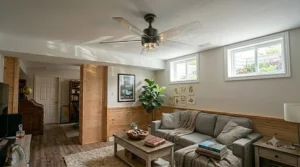
How to Choose a Ceiling Fan for High Humidity Basement in Canada
Choosing the right ceiling fan for a high humidity basement in Canada comes down to five key criteria — and the order matters.
1. Humidity Rating First, Everything Else Second This is non-negotiable. A fan labelled “indoor only” or “dry location” is not appropriate for any Canadian basement. Look explicitly for “damp-rated” as a minimum. A damp-rated ceiling fan is independently tested to handle moisture and humidity exposure — not direct water contact, but sustained atmospheric moisture. For basement laundry rooms or unfinished utility spaces with active water appliances, a wet-rated fan provides an extra margin of safety. The difference between damp-rated and wet-rated fans is substantial: damp-rated fans handle ambient moisture and humidity; wet-rated fans can handle direct water exposure.
2. Blade Span Matched to Your Basement Square Footage Canadian basements vary dramatically in layout:
- Up to 18 m² (200 sq. ft.): 44–48″ blade span
- 18–37 m² (200–400 sq. ft.): 52″ blade span
- 37–55 m² (400–600 sq. ft.): 60–72″ blade span
- Over 55 m² (600 sq. ft.): Multiple fans, or a commercial-grade 72–84″ fan
3. Corrosion-Resistant Hardware Moisture protection isn’t just about the motor. Blade brackets, screws, and canopy hardware all corrode in sustained humidity. Stainless steel hardware (as featured on Hunter fans) or ABS plastic blade brackets will outlast standard painted steel significantly. This is the detail that most buyers overlook until they’re removing a rusted fan two years after installation.
4. Ceiling Height and Mounting Type Many Canadian basements have ceilings between 213–244 cm (7–8 feet). At these heights, a fan with blades must maintain at least 213 cm (7 feet) above floor level by code. For low ceilings, flush-mount (hugger) configuration is essential — look for fans with an explicit low-profile mounting option, as most fans in this guide include one.
5. Reversible Motor for Year-Round Value Canadian seasons make fan direction more valuable than in warmer climates. Counterclockwise (downdraft) in summer creates a cooling wind-chill effect. Clockwise (updraft) on low in winter redistributes furnace-heated air that accumulates near the ceiling. All fans in this guide feature reversible motors.
Common Mistakes When Buying a Basement Ceiling Fan in Canada
Mistake 1: Buying an Indoor-Only Fan Because It Was on Sale I see this constantly. A standard indoor fan might be $40 cheaper than a damp-rated equivalent — but once it’s installed in a humid Canadian basement and the motor housing starts rusting, you’re looking at a full replacement within 12–18 months. The total cost of ownership is far higher than the initial saving suggests.
Mistake 2: Ignoring the Hardware A fan rated for damp locations with standard steel screws is a contradiction in terms. Always check that blade brackets and mounting hardware are explicitly stainless steel or non-corrosive. If the product listing doesn’t mention hardware material, assume it’s standard steel and factor in early rust.
Mistake 3: Choosing a Fan That’s Too Small Undersizing is extremely common. People buy a 44″ fan for a 46 m² (500 sq. ft.) basement because it was cheaper, then wonder why the air barely moves. Use the blade-span-to-square-footage guideline above — in basements specifically, it’s better to oversize than undersize, since basements often have irregular layouts, storage obstructions, and low airflow to begin with.
Mistake 4: Forgetting About Ceiling Height Clearance Under the Canadian Electrical Code (CEC) and the National Building Code of Canada (NBC), fan blades must maintain a minimum clearance of 213 cm (7 feet) above the floor. If your basement ceiling is 244 cm (8 feet), a standard fan with a 30 cm (12″) downrod and a 33 cm (13″) motor-to-blade distance will leave you with blades at 181 cm (71″) — below code. Always calculate your clearance before purchasing.
Mistake 5: Overlooking the Winter Benefit Canadian homeowners sometimes treat ceiling fans as summer-only fixtures and unplug them in October. This is leaving real energy savings on the table. Running a fan on low in clockwise mode during winter can reduce heating costs by keeping warm air circulating through the full volume of the room rather than pooling at the ceiling. According to Health Canada’s guidance on indoor air quality, proper air circulation is a year-round health benefit — not just a comfort consideration.
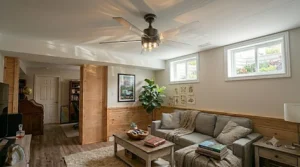
Understanding Humidity Ratings: Damp vs. Wet vs. Dry
If you’ve been shopping for a ceiling fan for high humidity basement use, you’ve likely noticed the terms dry, damp, and wet-rated appearing everywhere. Here’s what they actually mean in the context of a Canadian basement.
Dry-Rated: For indoor use only, in spaces where relative humidity stays below 55% and there is no exposure to water or moisture. A standard living room or bedroom. Never appropriate for a Canadian basement.
Damp-Rated: For spaces exposed to moisture and humidity but not to direct water contact. This covers covered porches, sunrooms, bathrooms, laundry rooms, and — critically — basements. A damp-rated ceiling fan has been tested to operate safely in environments with elevated humidity, typically up to 85–90% RH. Every fan in this guide is at minimum damp-rated, and this is the correct standard for the vast majority of Canadian basement applications.
Wet-Rated: For spaces with direct exposure to water — rain, snow, spray. Built with fully sealed motors and all-weather blade materials. In a Canadian basement context, wet-rated fans are appropriate for basement spaces with active water intrusion problems, sump pump areas, or extremely wet utility spaces. They cost more but provide maximum moisture protection.
The Canadian Home Inspection Services recommend keeping basement humidity at 55% or less to prevent mould growth — and a properly rated ceiling fan running continuously is one of the most energy-efficient tools available to help achieve and maintain that target by preventing stagnant air pockets.
| Rating | Max Humidity | Water Exposure | Basement Use Case |
|---|---|---|---|
| Dry | ~55% RH | None | Not suitable |
| Damp | Up to ~85–90% RH | No direct contact | Standard basement use ✅ |
| Wet | 100% RH | Direct exposure | Severe moisture/utility areas ✅ |
Looking at this comparison, damp-rated is appropriate for the overwhelming majority of Canadian basement applications. Wet-rated makes sense if your basement has a history of flooding, active leaks, or is directly adjacent to water-handling equipment like a sump pump or water heater with a known leak history. Budget buyers should not pay premium for wet-rated when damp-rated is fully sufficient.
✨ Don’t Miss These Exclusive Deals!
🔍 Ready to upgrade your basement? Click on any highlighted fan above to check current pricing and availability on Amazon.ca. These carefully selected damp-rated fans will help you create a healthier, more comfortable basement — and most are Prime-eligible for fast delivery across Canada!
What to Expect: Real-World Performance in Canadian Basements
Here’s what the spec sheets won’t tell you: performance in a Canadian basement is a different animal than performance in a Florida sunroom.
Temperature Swings Are Extreme A typical Ontario or Quebec basement swings from about 10–14°C (50–57°F) in February to 26–30°C (79–86°F) in August. DC motors handle these extremes more gracefully than older AC motors — the electronics are less affected by temperature-driven changes in electrical resistance. This is why the DC motor options in this guide (BiGizmos, ZMISHIBO, Honeywell Xerxes) are particularly well-suited to year-round Canadian use.
Spring Thaw Is the Toughest Period April and May bring the most intense humidity spikes in most Canadian basements. Melting snow, ground water pressure, and warm air hitting cold concrete walls creates condensation that can push basement humidity above 80% for weeks at a time. During this period, a fan running on medium speed 24/7 is not overkill — it’s essential. All the fans in this guide are rated for continuous operation, and the DC motor models do it at approximately 5–15 watts of power consumption, meaning the annual electricity cost is negligible.
Winter Is Actually Where the ROI Shows Up Running a ceiling fan on low in clockwise mode during a Canadian winter isn’t just about comfort — it’s about energy efficiency. Warm air from your furnace naturally rises to the ceiling. Without circulation, you’re heating the ceiling and the joists while sitting in cooler air at floor level. A fan redistributes that heat back into the room. Energy efficiency advocates estimate this can reduce heating costs by 5–15% in basement spaces, depending on ceiling height and insulation. Over a Canadian winter season, that’s a real number.
Noise Matters More in a Basement Basements are often used as media rooms, home offices, or sleeping spaces — and unlike a living room with ambient street noise, a basement is acoustically isolated. A noisy fan motor is far more noticeable. The WhisperWind motors in Hunter models and the DC motors in the BiGizmos and ZMISHIBO are genuinely quiet at low-to-medium speeds. Buyers report that speed 2–3 on the DC fans is effectively inaudible from a normal conversation distance.
Long-Term Cost & Maintenance in Canada
Let’s talk about the full cost of owning a ceiling fan in a Canadian basement — because the sticker price is only the beginning.
Electricity Costs in CAD A standard AC motor ceiling fan running at high speed typically consumes 50–75 watts. A modern DC motor fan at the same perceived airflow typically consumes 15–35 watts. Running a fan 18 hours per day for 12 months, at Ontario’s average electricity rate of approximately $0.17–$0.21/kWh:
- AC motor (60W average): roughly $22–$27 CAD/year
- DC motor (25W average): roughly $9–$11 CAD/year
The difference is modest on an annual basis — but over a 10-year fan lifespan, DC motor fans save $130–$160 CAD in electricity alone at current Canadian rates.
Replacement and Repair Costs Hunter’s limited lifetime motor warranty is a meaningful protection in this category. If the motor fails, Hunter replaces it — a value of $80–$120 CAD on its own. Budget fans typically carry 1–3 year warranties, meaning you absorb the full cost of any failure after that period. In a damp basement environment where wear is accelerated, warranty length is a genuine financial consideration.
Blade Replacement Blade sets for major brands like Hunter are widely available on Amazon.ca, typically in the $30–$60 CAD range. For no-name budget fans, sourcing replacement blades can be nearly impossible — meaning a single warped or cracked blade results in a full fan replacement. This is a hidden cost that makes the initial price gap between budget and brand-name fans narrower than it first appears.
Mould Prevention Value This is harder to quantify but potentially the most significant financial argument for proper basement fan investment. According to Canadian home inspection industry data, mould remediation in a basement can cost $3,000–$15,000 CAD depending on severity and affected area. A damp-rated ceiling fan running continuously costs perhaps $15–$25 CAD per year in electricity and prevents the stagnant air conditions that allow mould to establish. The ROI calculus is not subtle.
Frequently Asked Questions
❓ Is a damp-rated ceiling fan required by code in a Canadian basement?
❓ How do I know if my basement humidity is high enough to require a damp-rated fan?
❓ Will a ceiling fan alone solve my basement moisture problem?
❓ Can I order these fans on Amazon.ca if I live in a remote or northern Canadian community?
❓ What CFM should I look for in a basement ceiling fan?
Conclusion: The Right Fan Transforms Your Canadian Basement
A basement is one of the most underutilised spaces in the average Canadian home — and high humidity is usually the primary reason. A properly selected ceiling fan for high humidity basement use is one of the most cost-effective upgrades you can make: it circulates air constantly, helps your dehumidifier work more efficiently, reduces the risk of mould and mildew, and makes the space genuinely usable year-round.
My top recommendations by use case:
- Large open basements: BiGizmos 72″ Industrial DC — the coverage and efficiency are unmatched at the price point
- Finished rec rooms and living spaces: Hunter Spring Mill 52″ or Hunter Newsome 52″ — build quality and aesthetics justify the investment
- Workshop and utility areas: Hunter Windbound 52″ — SureSpeed airflow and industrial aesthetics built for hard-use spaces
- Budget buyers: 52″ Wood Blade Damp Rated Fan — solid entry-level damp-rated option
Whatever your basement situation, make sure damp rating is non-negotiable on your checklist. It’s not marketing language — it’s the difference between a fan that serves you well through Canadian seasons and one that rusts, corrodes, and fails within a few years.
✨ Don’t Miss These Exclusive Deals!
🔍 Click on any highlighted fan in this guide to check current pricing and availability on Amazon.ca. Whether you’re outfitting a finished rec room, a home gym, or a utility basement, these damp-rated picks are your best bet for long-term comfort and moisture protection in any Canadian home!
Recommended for You
- Ceiling Fan Won’t Wobble: 7 Best Stable Fans in Canada (2026)
- Best Bladeless Ceiling Fan in Canada 2026: 7 Safest, Sleekest Picks
- Best Compact Ceiling Fan for Bedroom in Canada 2026
Disclaimer: This article contains affiliate links. As an Amazon Associate, I earn from qualifying purchases. If you purchase products through these links, we may earn a small commission at no additional cost to you.
✨ Found this helpful? Share it with your friends! 💬🤗
