
In This Article
There’s a specific kind of frustration that comes with an open concept living room in a Canadian summer. You’ve finally merged your kitchen, dining, and living space into one beautiful, airy layout — and then you stand in the dead zone between the sofa and the island wondering why it still feels like a sauna at 29°C. The culprit, more often than not, is an undersized ceiling fan pretending to cover 500 square feet when it was designed for a bedroom.
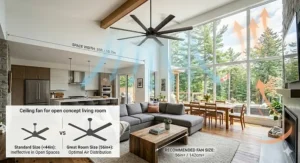
Choosing the right ceiling fan for open concept living room isn’t just about picking the biggest blade span on Amazon.ca. It’s about understanding CFM requirements, blade span selection, motor type, and how a fan behaves across seasons — which in Canada, means both July humidity and January furnace-heated air that pools at the ceiling while your feet stay cold.
I’ve spent considerable time researching what’s actually available on Amazon.ca for 2026, comparing high CFM ceiling fans with powerful AC motor fans and DC alternatives, cross-referencing Canadian customer reviews, and checking compliance with Natural Resources Canada energy standards. What follows is an honest, opinionated guide to the seven best options for Canadian open concept spaces — plus everything you need to know to make a smart decision before you spend hundreds of dollars on a fan that won’t do the job.
All prices are in Canadian dollars (CAD). Amazon.ca pricing fluctuates, so treat any figures here as general ranges at the time of research — always check current pricing before purchasing.
Quick Comparison: Top 7 Ceiling Fans for Open Concept Spaces in Canada
| Fan Model | Blade Span | Motor Type | Approx. CFM | Est. Price Range (CAD) | Best For |
|---|---|---|---|---|---|
| Hunter Phenomenon 60″ | 152 cm (60″) | DC Smart | 6,500+ | $350–$500 | Smart home users, large great rooms |
| Sofucor 60″ Walnut LED | 152 cm (60″) | DC Reversible | 6,000+ | $150–$220 | Budget-conscious, modern farmhouse |
| Chriari 60″ Wood Black | 152 cm (60″) | DC Reversible | ~5,800 | $130–$200 | Open patios + indoor combo spaces |
| 60″ 8-Blade Industrial Fan (B08ZXPYCBD) | 152 cm (60″) | DC Reversible | 7,000+ | $120–$180 | Industrial/modern loft aesthetic |
| NWIASS 60″ Solid Wood Propeller | 152 cm (60″) | AC Motor | ~5,500 | $160–$240 | High/sloped ceilings, farmhouse style |
| DIKHEE 60″ Modern 3-Blade | 152 cm (60″) | DC Quiet | ~5,500 | $140–$210 | Minimalist design, mid-range budget |
| 60″ Industrial 8-Blade 7000 CFM (B0D6GNX5HH) | 152 cm (60″) | AC Heavy Duty | 7,000 | $170–$260 | Warehouses, garages, large open rooms |
Prices are approximate CAD ranges at time of research. Always check Amazon.ca for current pricing.
Every fan in this table covers the 152 cm (60″) blade span range — the sweet spot for open concept spaces between roughly 21 m² and 37 m² (225–400 sq ft). What separates them is motor quality, CFM output, and how well they handle Canadian seasonal needs: both cooling downdraughts in summer and warm-air recirculation in winter. The industrial models at the bottom of this list deliver the highest raw CFM but sacrifice finesse; the smart DC models at the top cost more but earn their keep through year-round efficiency.
💬 Just one click — help others make better buying decisions too! 😊
✨ Don’t Miss These Exclusive Deals!
🔍 Take your open concept comfort to the next level with these carefully selected fans. Click on any highlighted product name to check current pricing and availability on Amazon.ca. These fans will transform how you experience every season in your home!
Top 7 Ceiling Fans for Open Concept Living Rooms: Expert Analysis
1. Hunter Phenomenon 60″ WiFi Smart Ceiling Fan with LED Light
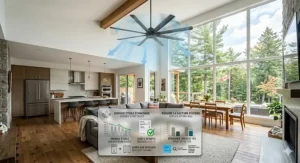
If you want a ceiling fan that your whole home setup can communicate with — and you want it to actually move a serious volume of air — the Hunter Phenomenon 60″ is the standout choice for large Canadian open concept spaces. Hunter’s SureSpeed® Guarantee backs up the airflow claims: the company certifies this model delivers over 33% higher air velocity than leading competitors at the same blade speed, which matters enormously when you’re trying to push air across a combined kitchen-dining-living footprint.
The 60″ (152 cm) blade span covers rooms from 21 m² to 37 m² (225–400 sq ft) effectively, and the 6-speed DC motor means you can dial in a whisper-quiet low speed for background circulation or crank it up on a humid Ontario August afternoon. DC motors are typically 60–70% more efficient than traditional AC motors — for a fan you’ll run six to eight months of the year across Canada’s variable climate, that efficiency adds up meaningfully on your electricity bill.
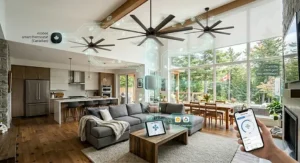
Where this fan earns its premium price tag in a Canadian context is its WiFi smart home integration. Compatible with Amazon Alexa, Apple HomeKit, and Google Home, you can automate the fan to run at low speed whenever your thermostat reads above 21°C — no remote to lose, no pull chains to fumble with in the dark. The reversible motor also makes it genuinely useful in winter: run it clockwise at low speed to push warm air from your vaulted ceiling back down to living level, which can reduce furnace runtime in cold Prairie winters.
Canadian buyers note the ENERGY STAR® certification aligns with Natural Resources Canada’s energy efficiency standards for ceiling fans. Hunter is a widely recognized brand in Canada and units are available through Amazon.ca, typically with Prime-eligible shipping.
✅ Smart home integration (Alexa, Google, HomeKit)
✅ SureSpeed® high-velocity airflow guarantee
✅ ENERGY STAR® certified — aligns with NRC standards
❌ Premium price range (~$350–$500 CAD) not ideal for tight budgets
❌ Smart features require stable home WiFi — less useful in rural/remote areas
Price range: ~$350–$500 CAD. Worth every dollar for large spaces with smart home setups.
2. Sofucor 60″ Ceiling Fan with Lights and Remote — Modern Walnut DC Motor
The Sofucor 60″ is the fan I’d recommend to someone renovating a new-build open concept on a sensible budget. It won’t impress your guests with a brand name, but it punches above its price point in a way that genuinely matters: quiet DC motor, 6 reversible speeds, dimmable LED lighting, and three downrod options (13 cm, 25 cm, and 61 cm — or approximately 5″, 10″, and 24″) to handle everything from a standard 2.4 m (8 ft) ceiling to a vaulted 3.7 m (12 ft) space.
What most Canadian buyers overlook about this model is the downrod flexibility. In a typical open concept Canadian build — especially post-2010 construction in Alberta and BC that trends toward 9–10 ft ceilings — you need at least a 25 cm (10″) downrod to position the blades at the optimal 2.4 m (8 ft) off the floor for airflow. The fact that this fan includes three downrods in the box means you won’t have to order separately before you can install.
The walnut wood blade finish photographs beautifully against white ceilings and integrates naturally with the shiplap-and-warm-wood aesthetic popular in Canadian open concept renovations. The DC motor is reversible for year-round use: counterclockwise in summer for a cooling wind-chill effect, clockwise in winter to redistribute heat pooling near the ceiling.
Canadian customer feedback on Amazon.ca is generally positive, with reviewers noting solid build quality for the price range and straightforward installation. A few note the included instructions could be clearer — typical for this price tier.
✅ Three downrod options for different ceiling heights
✅ Reversible DC motor for year-round use
✅ Great value for modern farmhouse/Scandinavian interiors
❌ Brand is less established than Hunter or Honeywell in Canada
❌ Instructions reportedly less clear than premium brands
Price range: ~$150–$220 CAD. Excellent value for budget-conscious Canadian open concept renovators.
3. Chriari 60″ Wood Ceiling Fan with Remote — Farmhouse DC Motor
The Chriari 60″ is a strong contender for Canadian homes where the “open concept” includes a covered porch or outdoor living area. Rated IP44 moisture-resistant, this fan handles damp installations — meaning it transitions seamlessly between your indoor great room and a screened-in porch or covered deck without requiring a separate fan for each zone. That’s genuinely useful in British Columbia’s wet climate or in Ontario cottages where covered porches are common.
The 6-speed DC motor and remote control mean you get granular airflow control, which matters more than most people realise. The difference between speed 2 and speed 4 on a 60″ fan is the difference between barely-perceptible background circulation and a gentle breeze you can actually feel from the sofa. Canadian open concept spaces often have dead air zones — particularly near kitchen islands and away from windows — and being able to tune the fan to the exact speed that eliminates those zones without creating an uncomfortable draught takes trial and error that multiple speed settings enable.
The walnut wood blades and black motor housing align with one of the most popular Canadian interior aesthetics right now: the “warm industrial” look that mixes black metal fixtures with natural wood. It’s available on Amazon.ca and ships with Prime, making it accessible even in provinces like Nova Scotia or Manitoba where appliance selection at local stores can be limited.
✅ IP44 moisture-rated for covered outdoor/patio use
✅ 6-speed fine control for eliminating dead air zones
✅ Black + walnut aesthetic popular in Canadian interiors
❌ CFM slightly lower than industrial competitors at this blade span
❌ Three blades means less visual presence than 5–6 blade models
Price range: ~$130–$200 CAD. Best for homes bridging indoor and covered outdoor open spaces.
4. 60″ 8-Blade Modern Black LED Ceiling Fan (DC Motor, 6-Speed, Reversible)
This unnamed-brand 60″ fan with eight aluminium blades is the kind of product that defies its generic packaging. The high blade count combined with a 60″ (152 cm) span creates one of the smoothest airflow profiles in this price range — eight blades moving slightly less air per blade results in quieter, more balanced rotation compared to a three-blade fan spinning harder to achieve the same CFM. Think of it as the difference between a wide-geared bicycle and a single-speed: the eight-blade configuration keeps noise levels low even at medium-high speeds.
With a quoted 7,000 CFM output, this fan handles open concept spaces at the larger end of the spectrum — combined kitchen-dining-living areas up to roughly 55 m² (600 sq ft) with standard 2.4 m (8 ft) ceilings. Canadian buyers in Toronto condos with large combined living floors have noted this fan eliminates the hot pocket near the kitchen without overcooling the sofa area, which is precisely what you want in an open plan.
The dimmable 3000K LED integrated light provides warm, inviting illumination appropriate for living room use — not the cold blue-white light that makes a great room feel like a hospital corridor. The remote includes a 1/3/6-hour timer, useful for overnight circulation without leaving the fan running all night.
At this price point, don’t expect premium packaging or a recognisable brand name. What you get is a workhorse ceiling fan with legitimately good specs. Available and ships from Amazon.ca.
✅ 8-blade design for ultra-quiet, smooth airflow
✅ High 7,000 CFM output for larger open concept spaces
✅ 3000K warm LED and 1/3/6-hour timer included
❌ No-name brand with limited Canadian service support
❌ Generic aesthetics won’t suit premium or heritage interiors
Price range: ~$120–$180 CAD. High-performance value buy for function-over-form shoppers.
5. NWIASS 60″ Solid Wood Propeller Ceiling Fan with Light
The NWIASS 60″ takes a different design philosophy than most fans on this list: it leans into the solid wood propeller aesthetic — three wide, aeroplane-style blades in natural wood that make an immediate visual statement. In a Canadian open concept space with exposed beams or a vaulted ceiling, this fan reads as a deliberate design choice rather than an appliance. That matters when your living room ceiling is a focal point.
Functionally, the AC motor on this model performs reliably across a range of temperatures — important if you’re installing in a space that gets genuinely cold in winter. Some DC motors show slightly reduced efficiency at very low ambient temperatures (below 5°C), which can affect performance in Canadian garages, sunrooms, or spaces that aren’t fully heated. The AC motor in the NWIASS doesn’t have this sensitivity, making it a pragmatic choice for transitional or semi-conditioned spaces.
The fan includes a forward/reverse switch for seasonal airflow direction changes, and three colour temperature settings (2700K warm white, 4500K natural, and 6000K cool white) give you unusual flexibility — many open concept spaces transition from daytime task lighting to evening relaxed ambiance, and 2700K versus 6000K is a genuine difference in atmosphere. The NWIASS is compatible with high and sloped ceilings, including angled cathedral rooflines common in Canadian ski chalets and cottage-country builds.
Canadian reviews appreciate the visual impact and solid wood build quality.
✅ Solid wood propeller blades — major visual statement
✅ AC motor stable at varied Canadian ambient temperatures
✅ 3CCT lighting for daytime/evening flexibility
❌ AC motor slightly less energy-efficient than DC equivalents
❌ Three-blade span means slightly uneven airflow at very low speeds
Price range: ~$160–$240 CAD. Best for design-forward spaces where aesthetics matter as much as airflow.
6. DIKHEE 60″ Modern Ceiling Fan with 3 Reversible Blades and Remote
The DIKHEE 60″ lands in the middle of this list for a reason: it’s the most versatile option here, managing to look sufficiently modern for a 2026 renovation while offering three downrod options and straightforward installation that genuinely does not require calling an electrician for a fan swap. Canadian electrical code (CSA C22.1) requires all ceiling fans to carry a CSA or equivalent certification mark, and the DIKHEE includes the necessary safety certifications for sale in Canada — always check this before purchasing any no-name brand fan.
The quiet DC motor runs at noise levels reviewers describe as comparable to ambient room sound — you notice the airflow before you notice the fan itself. For open concept spaces in Canadian homes where the kitchen, dining, and living areas share acoustic space, a noisy motor is genuinely disruptive during conversations or Netflix sessions in a way that a bedroom fan isn’t. The DIKHEE’s quiet performance is its standout practical feature.
Three reversible blade options mean you can match the blade finish to your interior rather than accepting what came in the box. The 3-speed remote control is simple and reliable, and the included LED light kit provides adequate illumination for combined living spaces without requiring supplementary fixtures.
One honest note for Canadian buyers: the installation instructions have been flagged by some Amazon.ca reviewers as inconsistent with the actual hardware. Budget 90 minutes for installation and read the instruction booklet fully before starting — it’s more manageable than it sounds.
✅ Certified for Canadian sale — meets CSA/safety requirements
✅ Whisper-quiet DC motor for shared acoustic spaces
✅ Reversible blade options to match your interior finish
❌ Installation instructions reportedly inconsistent with hardware
❌ No smart home integration at this price point
Price range: ~$140–$210 CAD. Solid all-rounder for mid-budget open concept upgrades.
7. 60″ Industrial 8-Blade High CFM Fan — Heavy Duty AC Motor (7,000 CFM)
This is the heavy duty AC motor ceiling fan on the list — and it earns the descriptor. With eight aluminium blades set at a 32-degree pitch, a powerful industrial-grade AC motor, and a rated 7,000 CFM output, this fan is engineered for spaces that standard residential fans simply can’t handle. Think oversized open concept great rooms over 55 m² (600 sq ft), combined workshop-living spaces, converted loft apartments with 4.5 m (15 ft) ceilings, or garages that double as entertaining areas — common in Western Canada especially.
What most buyers overlook about this model is the blade pitch. The 32-degree angle is significantly steeper than the 12–15 degrees on typical residential fans. That angle creates greater air displacement per revolution — meaning the fan doesn’t need to spin as fast to achieve 7,000 CFM, which reduces mechanical wear and operating noise compared to a shallow-pitched blade spinning at maximum RPM to chase the same numbers.
The AC motor on this unit is built for continuous operation. Unlike some DC motors that throttle performance during extended high-speed runs, this fan handles warehouse environments and large open rooms without thermal throttling. For a Canadian workshop or garage that doubles as a living space (a more common setup than you might think, particularly in rural Alberta, Saskatchewan, and BC), this durability matters.
Six adjustable speeds and reversible rotation cover both summer cooling and winter warm-air recirculation. The fan is available on Amazon.ca with downrod mounting.
✅ 32-degree blade pitch for maximum air displacement efficiency
✅ Heavy-duty AC motor built for large room coverage and continuous use
✅ 7,000 CFM for the largest open concept spaces (55 m²+)
❌ Industrial aesthetic doesn’t suit contemporary living room decor
❌ AC motor draws more electricity than DC equivalents over time
Price range: ~$170–$260 CAD. The right tool for oversized, high-ceiling, or workshop-adjacent open spaces.
How to Match These Fans to Your Canadian Open Concept Space: Real Scenarios
Open concept living looks different across Canada — a Vancouver condo combined kitchen-living, a Calgary suburban new-build with a vaulted great room, and a Nova Scotia heritage home with a knocked-through dining-living are three genuinely different fan-selection challenges. Here’s how to think through each.
Profile 1: The Urban Condo (Toronto, Vancouver, Montreal) — 30–45 m² (320–485 sq ft), 2.4–2.7 m (8–9 ft) standard ceiling. In a condo context, noise is your primary constraint — shared walls and floors mean a rattling fan motor will bother both you and your neighbours. The Hunter Phenomenon or Sofucor 60″ DC motor options are your best fits here. Both run quietly enough to keep on while you’re asleep, and the reversible motor helps in winter when condo units can overheat due to central building heating systems you can’t fully control. Budget CAD $150–$500 depending on smart features.
Profile 2: Suburban New-Build Great Room (Ottawa, Calgary, Winnipeg) — 45–65 m² (485–700 sq ft), 2.7–3.7 m (9–12 ft) ceiling. The larger square footage and higher ceiling are the defining variables here. One 60″ fan placed centrally may not be sufficient for 65 m² — consider the 7,000 CFM industrial option or pair two 52″ fans if the layout is rectangular rather than square. The extra ceiling height means you’ll need a 30–45 cm (12–18″) downrod to bring blades to the optimal 2.4 m (8 ft) above floor level. The NWIASS 60″ with its high-ceiling compatibility is a strong single-fan solution in this range.
Profile 3: Cottage or Rural Property (Muskoka, Okanagan, Cape Breton) — variable sizes, potential for covered porch extension. Here the IP44-rated Chriari is the smart pick. Canadian cottage environments involve humidity, temperature swings between seasons, and the desire to extend the living space onto a screened porch. A single moisture-rated fan that covers both the indoor great room and the covered outdoor area is cleaner and cheaper than buying two separate units. Budget CAD $130–$200.
Practical Setup Guide: Getting Maximum Performance in a Canadian Home
Installing a ceiling fan correctly in a Canadian open concept space involves a few steps that Amazon listings won’t walk you through — and getting them right makes the difference between a fan that transforms your comfort and one that vibrates annoyingly or throws the wrong airflow pattern.
Step 1: Measure your space and calculate CFM requirements. For rooms with standard 2.4 m (8 ft) ceilings, a useful rule of thumb is approximately 1 CFM per square foot — so a 37 m² (400 sq ft) open concept space needs roughly 4,000 CFM minimum. For ceilings 3 m (10 ft) or higher, increase your target CFM by 20–25% to compensate for the extra air volume. Natural Resources Canada’s energy efficiency page for ceiling fans (natural-resources.canada.ca) provides the Canadian formula: CFM efficiency is measured as CFM/W (airflow per watt).
Step 2: Select the right downrod length. The goal is blade height of approximately 2.1–2.4 m (7–8 ft) above the floor. If your ceiling is 3 m (10 ft), you need a 60–90 cm (24–36″) downrod. Most fans in this list include one or two downrod options; for very high ceilings, purchase a downrod extension separately before installation.
Step 3: Verify the electrical box is fan-rated. Under the Canadian Electrical Code (CSA C22.1), ceiling fans must be mounted on an outlet box specifically rated for fan support — a standard light fixture box is not sufficient for the dynamic load of a spinning fan. In Ontario and most provinces, fan installation is considered a minor electrical task, but all work must comply with the local version of the CEC.
Step 4: Set direction for the season. In summer, the fan should spin counterclockwise (when viewed from below) to push cool air downward. In winter, switch to clockwise rotation at low speed to gently push warm air — which naturally rises — back toward the living level. In a Canadian winter, this simple reversal can reduce furnace runtime meaningfully; Natural Resources Canada notes that ceiling fans used in winter can contribute to home heating efficiency.
Step 5: Find the right position in an open concept space. In a combined kitchen-dining-living footprint, position the fan to cover the seating area rather than the cooking zone. You don’t want a powerful fan blowing over a gas range or scattering flour from a baking station. For very large spaces (over 55 m²), consider two fans positioned in the living and dining zones rather than one fan in the geometric centre.
Common first-30-day mistakes: Running the fan at maximum speed constantly (it wears the motor and doesn’t proportionally increase comfort); not balancing the blades after installation (wobble causes long-term bearing wear); forgetting to reverse direction in October when heating season begins.
How to Choose a Ceiling Fan for Open Concept Living Room in Canada: 7 Key Criteria
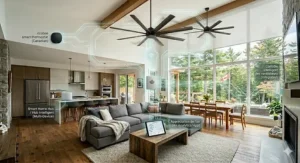
Choosing the right ceiling fan for open concept living room in Canada involves more variables than the average product listing covers. Here are the criteria that actually matter — in priority order.
1. CFM output relative to room volume. This is the non-negotiable starting point. A fan rated at 3,500 CFM in a 50 m² (540 sq ft) open concept space with 3 m (10 ft) ceilings will leave dead air zones in every corner. Use the Natural Resources Canada CFM guidance as your baseline: for large open rooms, target 6,000–8,000 CFM minimum.
2. Blade span selection. For open concept spaces between 21 m² and 37 m² (225–400 sq ft), a 60″ (152 cm) blade span is the industry standard recommendation. For spaces over 37 m² (400 sq ft), consider 72″ (183 cm) fans or dual-fan configurations. A properly sized fan reaches more of the room with each rotation, reducing the number of RPM — and therefore the noise — required to achieve target airflow.
3. Motor type (DC vs. AC). DC motors consume 60–70% less electricity than traditional AC motors and offer finer speed control (typically 6 speeds versus 3). For a fan you’ll run year-round in a Canadian home — cooling downdraughts in summer, warm-air recirculation in winter — the energy savings of DC over a 10-year fan lifespan are significant in CAD terms. Heavy duty AC motor fans are appropriate for very large rooms (over 55 m²) and industrial/workshop spaces where durability under continuous high-speed operation matters more than efficiency.
4. Reversibility for Canadian seasons. This is non-negotiable in Canada. A fan you can only run in summer mode is a fan you’ll unplug for six months. Every fan on this list has a reversible motor. Look for fans with a clearly accessible direction switch — some are on the motor housing, others on the remote.
5. Canadian safety certification. Under Canadian law, all electrical products — including ceiling fans — must bear certification from an accredited body recognised by the Standards Council of Canada (SCC). CSA Group, UL Solutions Canada, and Intertek Canada are the three most common. The certification mark should be physically present on the product or its packaging. Fans sold on Amazon.ca should meet this standard, but for no-name imports, confirm this before installation, particularly in provinces like Ontario and BC where electrical inspections are common.
6. Mounting system compatibility. Open concept Canadian homes often have angled or vaulted ceilings — especially in post-2000 construction and cottage-country properties. Confirm the fan you select includes an angled mounting bracket or canopy adapter. Most modern 60″ fans include one, but not all.
7. Light integration and colour temperature. In an open concept space that serves as living room, dining room, and kitchen, integrated LED lighting needs to work at multiple colour temperatures. Look for 3CCT (three colour temperature) options or at minimum a warm 2700–3000K setting for evening atmosphere. Dimmable LEDs are essential — fixed-brightness integrated lights are immediately limiting in a space used for both dinner parties and morning coffee.
Common Mistakes When Buying a Ceiling Fan for Open Concept Living Room in Canada
Mistake 1: Choosing blade span based on aesthetics rather than room size. A 42″ fan looks perfectly elegant on a showroom website. In a 40 m² open concept space, it creates a frustrating pocket of moving air directly beneath it and leaves the rest of the room stagnant. The sizing math isn’t complex: open concept spaces over 21 m² need 60″ minimum.
Mistake 2: Ignoring the CFM/W efficiency rating. High CFM is good. High CFM per watt is better. Natural Resources Canada regulates ceiling fan energy efficiency and publishes efficiency standards — a fan that moves 7,000 CFM while drawing 100W is measurably better than one that achieves the same output at 160W, particularly across a Canadian heating-and-cooling season that runs 8–10 months.
Mistake 3: Buying a fan from Amazon.com instead of Amazon.ca. Products listed on .com don’t always ship to Canada, and those that do may carry US voltage ratings (120V/60Hz), different warranty terms, and lack CSA certification. Import duties and brokerage fees can add 20–40% to the sticker price. Always start your search at Amazon.ca.
Mistake 4: Overlooking the ceiling box rating. Many Canadian homes, particularly pre-1990 construction in Quebec and the Maritimes, have light fixture boxes that aren’t rated for the dynamic load of a ceiling fan. Installing a 7 kg (15 lb) spinning fan on an unrated box is a safety issue under the Canadian Electrical Code. Replacing the box costs $20–$50 at any Canadian hardware store — it’s not an optional step.
Mistake 5: Not accounting for winter use. Many Canadian buyers select a ceiling fan thinking primarily about summer cooling. But a high-quality reversible fan in a Canadian home pays for itself faster through winter heating efficiency than through summer cooling — particularly in homes with high ceilings where warm air stratification is significant. Factor in winter performance when evaluating CFM and motor reversibility.
Mistake 6: Buying based on blade count alone. “More blades = more airflow” is a persistent myth. What matters is blade pitch (angle), blade span, and motor power. A three-blade 60″ fan with a 15-degree pitch and a strong DC motor will outperform a five-blade 52″ fan with 10-degree blades and a weak motor on every measurable metric.
DC Motor vs. AC Motor: What Canadian Open Concept Buyers Actually Need to Know
The marketing on most ceiling fan listings makes motor selection sound simple: DC = good, AC = old and noisy. Reality is more nuanced, and for Canadian buyers specifically, the distinction matters in ways Amazon product descriptions won’t tell you.
DC motors use direct current converted from your home’s AC supply. The control electronics enable smooth, stepless speed adjustment across 6 or more settings, quiet operation (typically 25–40 decibels at low speeds), and 60–70% lower energy consumption than equivalent AC models. The trade-off is cost — DC motor fans run $30–$80 CAD higher than equivalent AC models at each price tier. For a fan you’ll run year-round in a heated, occupied Canadian home, the energy savings over five years generally exceed the price premium. DC motors also perform better in smart home integrations because the control electronics interface naturally with WiFi receivers.
AC motors use alternating current directly without conversion electronics, making them simpler, more robust under continuous high-load operation, and less sensitive to voltage fluctuations. For very large open concept spaces — warehouse-adjacent, workshop-connected, or rooms over 55 m² with high ceilings — a heavy duty AC motor ceiling fan that can run at maximum speed for six hours on a July long weekend without thermal throttling is often the better choice. AC motors are also slightly more stable at very low ambient temperatures, which matters in Canadian semi-conditioned spaces like garages and sunrooms that see sub-5°C temperatures in winter.
The honest verdict for most Canadian open concept living rooms: A DC motor fan in the 60″ blade span range, targeting 6,000–7,000 CFM at high speed, is the right choice for the majority of combined kitchen-dining-living spaces in standard Canadian residential construction. Reserve heavy duty AC motor options for the genuinely large, high-ceiling, or semi-conditioned spaces where durability under sustained load justifies the efficiency trade-off.
✨ Don’t Miss These Exclusive Deals!
🔍 Ready to upgrade your open concept comfort? Click on any highlighted product name above to check current pricing and availability directly on Amazon.ca. Prime members often enjoy free shipping on these fans — check your eligibility before purchasing.
Canadian Regulations, Safety Standards & What You Need to Know Before Installing
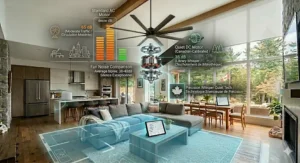
Ceiling fans in Canada are regulated by a more robust framework than most homeowners realise. Understanding the relevant standards protects your safety, your home insurance, and your installation’s legality under the Canadian Electrical Code.
CSA Certification is legally required. Under Canadian law, all electrical products sold and installed in Canada must be certified by a body recognised by the Standards Council of Canada (SCC). For ceiling fans, the applicable standard is CAN/CSA-C22.2 No. 113-18 (Fans and Ventilators). The three most commonly encountered certification marks are CSA Group, UL Solutions Canada (cUL), and Intertek Canada (cETL). All three are accepted. A fan without one of these marks should not be installed in a Canadian home — this applies whether you purchased it on Amazon.ca or brought it across the border.
Natural Resources Canada (NRC) energy efficiency standards govern ceiling fan efficiency ratings. The NRC regulates ceiling fans under the Energy Efficiency Act and associated Regulations, and publishes efficiency standards in CFM/W (airflow per watt). Fans labelled ENERGY STAR® meet or exceed the NRC’s minimum energy performance standards (MEPS). You can verify a product’s compliance on the NRC’s website at natural-resources.canada.ca.
The Canadian Electrical Code (CSA C22.1), currently in its 26th edition (published 2024), governs ceiling fan installation. Key requirements: the electrical box must be rated for fan support (marked for ceiling fan use), the installation must be performed or inspected per provincial regulations, and the fan must be installed per the manufacturer’s instructions. In Ontario, most provinces require electrical work to be performed by a licensed electrician; however, many jurisdictions consider a ceiling fan swap (replacing an existing fan on a fan-rated box) a minor installation that doesn’t require a permit. Always confirm with your local authority having jurisdiction (AHJ).
Provincial variations to be aware of: Quebec requires all electrical work to be performed by a licensed electrician under the Construction Code of Quebec. British Columbia and Ontario have similar requirements with some homeowner exemptions for minor work. The Maritime provinces generally allow homeowner permits with inspection requirements. Always check your municipality’s specific requirements — particularly in larger cities where building departments may have additional rules.
Bilingual labelling note: Under the Canadian Consumer Product Safety Act and federal language legislation, products sold in Canada must include French-language labelling and instructions. Most major brands on Amazon.ca comply with this; for no-name imports, verify that French installation instructions are included before purchasing, particularly if you’re in Quebec where enforcement is strongest.

FAQ
❓ What size ceiling fan do I need for an open concept living room in Canada?
❓ Is a DC motor or AC motor ceiling fan better for Canadian open concept homes?
❓ Do I need a licensed electrician to install a ceiling fan in Canada?
❓ Are ceiling fans on Amazon.ca CSA-certified for Canadian installation?
❓ Can I use an open concept ceiling fan in winter in Canada to save on heating?
Conclusion: The Right Fan Makes Open Concept Living Work in Canada
The single biggest mistake Canadian homeowners make when choosing a ceiling fan for open concept living room is underbuying on CFM and blade span. A 42″ fan that looks proportionate on a website will leave 80% of your combined kitchen-dining-living footprint untouched. The fans on this list — all 60″ (152 cm) span models available on Amazon.ca — are sized for the actual square footage of Canadian open concept builds.
Beyond size, the motor choice is the detail that separates a fan you’ll love from one you’ll tolerate. DC motor fans are the right default for most Canadian residential open concept spaces: quieter, more efficient across an 8–10 month Canadian use season, and better suited for smart home integration. Heavy duty AC motor fans earn their place in oversized or industrial-adjacent spaces where sustained high-speed performance matters more than electricity costs.
Finally — and this is a point no Amazon listing will make for you — the reversible motor is what transforms a ceiling fan from a summer appliance into a year-round tool for Canadian comfort. Running your fan clockwise at low speed on a January evening, pushing warm air from your 3 m (10 ft) ceiling back down to where your family is actually sitting, is the kind of quiet win that shows up on your hydro bill rather than your Instagram feed. That’s the kind of smart Canadian buying decision this guide is designed to support.
✨ Don’t Miss These Exclusive Deals!
🔍 Check current pricing and availability for all 7 fans directly on Amazon.ca. Click any highlighted product name in this article to view the latest deals. Prime members often qualify for free shipping on orders over $35 CAD — worth checking before you add to cart!
Recommended for You
- 7 Best Ceiling Fan for Canadian Winter 2026
- 7 Best Budget Ceiling Fan Under $200 Canada (2026 Picks)
- 7 Best Smart Ceiling Fan Alexa Compatible in Canada 2026
Disclaimer: This article contains affiliate links. As an Amazon Associate, I earn from qualifying purchases. If you purchase products through these links, we may earn a small commission at no additional cost to you.
✨ Found this helpful? Share it with your friends! 💬🤗
