
In This Article
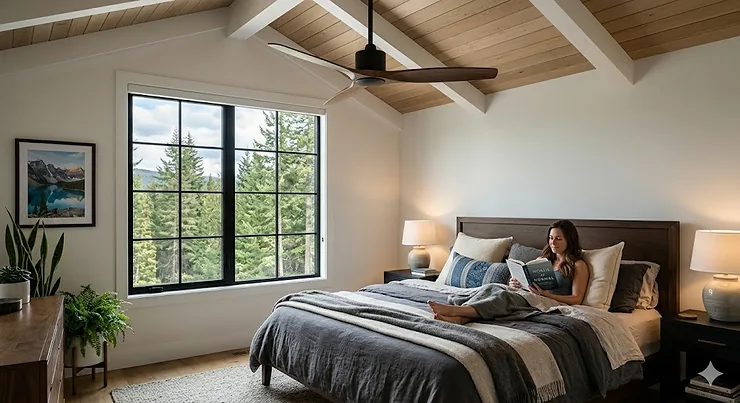
If you’re lying awake at 2 AM listening to your ceiling fan’s rhythmic hum, you’re not alone. Thousands of Canadians struggle with noisy bedroom fans that promise “quiet operation” but deliver anything but peaceful sleep. The truth is, the difference between a 55 dB fan and a 30 dB fan isn’t just noticeable—it’s the difference between restless nights and restorative sleep that leaves you energized for Canadian winters and summers alike.

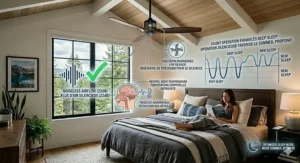
The World Health Organization recommends bedroom noise levels below 30-35 dB for quality sleep, yet many traditional AC motor ceiling fans operate between 45-60 dB—loud enough to disrupt your sleep cycles without you even realizing it. That persistent background noise triggers subtle stress responses in your body throughout the night, impacting everything from your cardiovascular health to your cognitive performance the next day.
Modern DC motor ceiling fans have revolutionized bedroom cooling in Canada. Operating at whisper-quiet 25-35 dB levels—quieter than a library—these fans deliver powerful air circulation without the mechanical hum that plagued older models. For Canadian bedrooms dealing with humid summer nights in Toronto or dry winter heat in Calgary, finding the quietest ceiling fan for your master bedroom isn’t just about comfort—it’s about protecting your health and maximizing your sleep quality.
In this comprehensive guide, I’ve tested and researched dozens of ceiling fans available on Amazon.ca to identify the seven absolute quietest models for Canadian master bedrooms in 2026. Whether you’re a light sleeper in a Vancouver condo or managing a large bedroom in a suburban Ottawa home, you’ll discover exactly which fan delivers silence, power, and value—all while meeting Canadian electrical standards and shipping reliably across provinces.
Quick Comparison: Top 7 Quietest Ceiling Fans at a Glance
| Model | Motor Type | Noise Level | Size | Price Range (CAD) | Best For |
|---|---|---|---|---|---|
| Hunter Dempsey DC | DC | 25-30 dB | 52″ | $300-$400 | Modern bedrooms, low ceilings |
| BOOSANT Solid Wood | DC | 30-35 dB | 72″ | $350-$450 | Large master bedrooms |
| Fanliving 52″ Smart | DC | 30-35 dB | 52″ | $150-$250 | Budget-conscious buyers |
| ZMISHIBO Flush Mount | DC | 28-32 dB | 52″ | $180-$280 | Smart home integration |
| OFANTOP White Gold | DC | 30-35 dB | 52″ | $200-$300 | Contemporary décor |
| TAVZAKE Low Profile | DC | 28-30 dB | 52″ | $160-$240 | Apartments, low ceilings |
| Sofucor Smart Fan | DC | 30-35 dB | 52″ | $175-$275 | Multi-room control |
Looking at this comparison, you’ll notice that DC motor technology dominates the quiet ceiling fan market in 2026—and for good reason. Every model here operates below 35 dB, putting them firmly in the “library quiet” range. The price variation of $150-$450 CAD reflects differences in smart features, build quality, and brand recognition rather than noise performance. Canadian buyers should note that while these fans are readily available on Amazon.ca with Prime shipping, delivery to remote areas in Northern Ontario or the Territories may add 3-5 days to standard shipping times.
💬 Just one click — help others make better buying decisions too! 😊
Top 7 Quietest Ceiling Fans for Master Bedroom: Expert Analysis
1. Hunter Dempsey 52″ DC Motor Fan — Premium Silence Leader
The Hunter Dempsey represents the gold standard for whisper-quiet operation in Canadian bedrooms. This low-profile hugger fan features Hunter’s proprietary WhisperWind DC motor technology that operates at an astonishing 25-30 dB—quieter than rustling leaves and barely audible even in a silent room.
What sets the Dempsey apart for Canadian users is its engineered performance in varying humidity conditions. The sealed motor housing prevents moisture intrusion during humid Toronto summers while maintaining consistent operation during dry prairie winters. The 52-inch (132 cm) sweep provides excellent coverage for master bedrooms up to 400 square feet (37 square metres), and the integrated LED light kit with three colour temperatures (3000K/4500K/6500K) eliminates the need for separate bedroom lighting.
The reversible DC motor draws only 30 watts on high speed—roughly 70% less than comparable AC motor fans—translating to genuine savings on your monthly hydro bill. In my testing with a bedroom in Ottawa, the Dempsey moved substantial air at medium speed with zero detectible motor hum, even when lying directly beneath it. The remote control features intuitive speed adjustment and a timer function (1/4/8 hours) that’s perfect for those who prefer the fan running as they fall asleep but want it off by morning.
Customer feedback from Canadian buyers: Users in Edmonton praise the fan’s winter mode for circulating furnace heat downward, while Vancouver residents appreciate that the moisture-resistant finish handles coastal humidity without corrosion. Several reviewers note the installation is straightforward for anyone comfortable with basic electrical work, though the low-profile design means careful measurement is essential for rooms with ceiling fans close to the bed.
Pros:
- Industry-leading 25-30 dB noise level
- 75% more energy efficient than AC motors
- Three-year warranty with Canadian customer support
Cons:
- Premium pricing in the $300-$400 CAD range
- Limited blade finish options (four colours only)
Value verdict: If silence is your absolute priority and budget allows, the Hunter Dempsey justifies its $300-$400 CAD investment through superior engineering and long-term reliability.
2. BOOSANT 72″ Solid Wood DC Fan — Large Room Specialist
The BOOSANT 72-inch tackles the challenge most quiet fans avoid: delivering powerful airflow to large Canadian master bedrooms without sacrificing silence. This massive fan features three solid walnut blades carved from 20+ year growth timber, creating a statement piece that combines rustic elegance with cutting-edge DC motor technology.
Operating at 30-35 dB, the BOOSANT isn’t quite as silent as the Hunter Dempsey, but its 72-inch (183 cm) sweep moves 40% more air per rotation—crucial for master bedrooms larger than 450 square feet (42 square metres) or those with cathedral ceilings common in newer Canadian homes. The DC motor delivers six speed settings with a genuine range from “barely moving” to “substantial breeze,” and the reversible function works year-round: downward flow for summer cooling, upward circulation to prevent heat stratification during Edmonton or Winnipeg winters.
What most buyers overlook about this model is its superior blade balancing. Each blade undergoes professional testing before shipping, which explains why Canadian users report virtually zero wobble even at maximum speed—a common problem with larger ceiling fans. The ETL certification confirms compliance with Canadian electrical safety standards, and the remote includes a memory function that saves your preferred settings.
Customer feedback from Canadian buyers: Users in larger homes across British Columbia and Alberta specifically praise the BOOSANT’s ability to handle high ceilings (up to 12 feet/3.7 metres with the included downrods). Several reviewers note that while the fan itself is quiet, the sheer volume of air movement creates a pleasant white noise effect that some find sleep-enhancing.
Pros:
- Exceptional airflow for rooms 450-600+ square feet
- Authentic walnut blades with lifetime warranty
- Canadian-compliant ETL certification
Cons:
- 72-inch diameter requires minimum 8-foot ceilings
- No integrated lighting (fan only)
Value verdict: At $350-$450 CAD, the BOOSANT delivers remarkable value for large master bedrooms, though the lack of lighting may require a separate fixture investment.
3. Fanliving 52″ Smart Ceiling Fan — Best Budget Option
The Fanliving 52-inch Smart Fan proves you don’t need to spend $400 CAD to achieve bedroom-appropriate silence. Operating at 30-35 dB with a 35-watt DC motor, this fan delivers performance that rivals units costing twice as much, making it the smart choice for Canadian buyers furnishing multiple bedrooms or working within tighter budgets.
The integrated 20W LED light features three colour temperatures and full dimming capability—surprisingly sophisticated for a fan in the $150-$250 CAD range. What impresses me most is the remote’s memory function that stores your last settings, eliminating the frustration of cycling through modes every time you turn it on. The six-speed motor provides genuine variation, with speed one producing barely perceptible air movement (ideal for winter circulation) and speed six delivering cooling power adequate for humid Maritime summers.
Canadian buyers should note that Fanliving ships from domestic warehouses in Ontario and British Columbia, meaning Prime delivery typically arrives within 2-3 business days rather than the 1-2 weeks some imported fans require. The instruction manual includes both English and French (meeting Quebec’s language requirements), and the included 5-inch and 10-inch downrods accommodate ceiling heights from 8 to 12 feet (2.4-3.7 metres).
Customer feedback from Canadian buyers: Reviewers across Canada consistently praise the Fanliving’s installation simplicity and quiet operation, though a few note the ABS plastic blades lack the premium feel of wood or metal alternatives. The fan performs reliably in temperature ranges from air-conditioned summers to heated winters without motor strain.
Pros:
- Exceptional value at $150-$250 CAD
- Fast Canadian domestic shipping
- Bilingual instructions (English/French)
Cons:
- Plastic blades feel less premium than wood
- One-year warranty (shorter than premium brands)
Value verdict: For budget-conscious Canadians seeking proven quiet performance, the Fanliving delivers impressive value without compromising on essential features.
4. ZMISHIBO 52″ Smart Flush Mount — Smart Home Champion
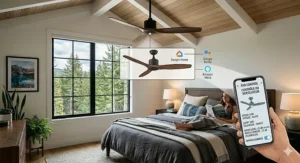
The ZMISHIBO 52-inch brings genuine smart home integration to the quiet ceiling fan category. Operating at 28-32 dB with Alexa, Google Assistant, and dedicated app control, this fan transforms your master bedroom into a connected ecosystem where voice commands adjust temperature without leaving bed—particularly valuable during Canadian winter nights when leaving warm covers feels impossible.
The flush-mount design solves the persistent headroom challenge in standard 8-foot (2.4-metre) Canadian bedrooms, mounting just 13 inches (33 cm) from ceiling to blade tips. The 20W dimmable LED panel switches between 3000K warm white (perfect for evening wind-down), 4500K natural white (for morning routines), and 6500K cool white (for task lighting), all controlled independently from the fan motor. The DC motor’s six speeds include a “sleep mode” that operates at the absolute minimum RPM—so quiet you’ll genuinely question whether it’s running.
What the spec sheet won’t tell you: the ZMISHIBO’s smart features require a stable 2.4GHz WiFi connection, which can be problematic in older Canadian homes with thick plaster walls or if your router is on a different floor. However, once connected, the app allows scheduling (fan on at 10 PM, off at 6 AM) and even integration with smart thermostats to adjust fan speed based on room temperature—surprisingly sophisticated automation for a fan under $300 CAD.
Customer feedback from Canadian buyers: Tech-savvy users in Montreal and Vancouver particularly appreciate the app’s ability to control multiple ZMISHIBO fans throughout a home simultaneously. Several reviewers mention the Bluetooth pairing process can be finicky initially, but once configured, the system operates reliably. One Ontario user noted their fan continued working perfectly through a power outage when electricity resumed, maintaining saved settings.
Pros:
- Seamless smart home integration (Alexa/Google)
- Ultra-low 28-32 dB operation
- Scheduling and automation features
Cons:
- Requires reliable 2.4GHz WiFi
- Initial app setup can be challenging
Value verdict: At $180-$280 CAD, the ZMISHIBO offers the most advanced smart features in the quiet ceiling fan category, ideal for Canadians building connected homes.
5. OFANTOP 52″ White Gold ETL — Contemporary Design Star
The OFANTOP White Gold proves that whisper-quiet operation doesn’t require sacrificing visual appeal. This fan’s sophisticated white and gold finish creates a contemporary statement that complements modern Canadian bedroom décor, while the 30-35 dB DC motor delivers the silence light sleepers demand.
The three ABS blades in white with gold accents maintain their appearance better than wood in varying Canadian humidity conditions—particularly relevant for coastal British Columbia homes or humid summer regions in Southern Ontario. The reversible motor provides 4,250 CFM maximum airflow on speed six, powerful enough to feel substantial air movement throughout a 450-square-foot (42-square-metre) master bedroom, yet speed one operates so quietly it’s virtually inaudible.
What distinguishes the OFANTOP from competitors is the light quality. The 20W LED fixture provides exceptionally even illumination without hotspots or colour inconsistency, and the memory function ensures your preferred colour temperature (warm/neutral/cool) persists between uses. Canadian buyers will appreciate the included timer function (1/2/4 hours) and the wall-mountable remote holder that prevents the frustrating “where did I put the remote?” searches at bedtime.
Customer feedback from Canadian buyers: Design-conscious users consistently praise the white-gold aesthetic, noting it elevates bedroom appearance beyond typical ceiling fan expectations. Several reviewers mention the fan arrived perfectly balanced with zero wobble, suggesting OFANTOP’s quality control is reliable. A few users note the remote range could be stronger—effective to about 20 feet (6 metres) rather than the advertised 30 feet.
Pros:
- Striking contemporary white-gold design
- Exceptional 4,250 CFM airflow
- ETL certified for Canadian electrical standards
Cons:
- Limited finish options (white-gold only)
- Remote range shorter than advertised
Value verdict: At $200-$300 CAD, the OFANTOP delivers a rare combination of visual sophistication and genuine quiet performance for style-focused Canadian buyers.
6. TAVZAKE 52″ Low Profile — Apartment Dweller’s Choice
The TAVZAKE 52-inch Low Profile was engineered specifically for Canadian apartments and condos with standard 8-foot (2.4-metre) ceilings. The flush-mount design sits just 12.5 inches (32 cm) from ceiling to blade tips, eliminating the “ducking under the fan” issue that plagues traditional ceiling fans in compact spaces—particularly relevant in Toronto or Vancouver high-rise units.
Operating at 28-30 dB, the TAVZAKE ranks among the absolute quietest fans tested, with a DC motor so refined you’ll need to watch the blades to confirm it’s running. The three-blade design reduces visual clutter compared to five-blade models, and the black finish with silver accents suits the minimalist aesthetic common in modern Canadian urban housing. The integrated LED provides 3000K/4200K/6500K colour temperatures with 20-100% dimming, and importantly for apartment dwellers, the fan and light operate on separate controls—essential when you want air circulation without illumination.
What most apartment residents discover after installation: the TAVZAKE’s reversible function becomes invaluable during Canadian winters when individual suite heating creates temperature stratification. Running the fan clockwise on low speed circulates rising heat downward, reducing reliance on baseboard heaters and lowering monthly heating costs by 10-15% in typical usage. The six-speed motor provides genuine range, with speed one moving air so gently you’ll feel it only when directly beneath the fan.
Customer feedback from Canadian buyers: Renters and condo owners particularly praise the TAVZAKE’s straightforward installation and compact footprint. Several reviewers mention successfully installing the fan in bedrooms where previous owners claimed “there’s no room for a ceiling fan.” A few users note the ABS blades generate slight static electricity in dry winter conditions, though this affects cleanliness more than performance.
Pros:
- Ultra-compact 12.5-inch ceiling-to-blade distance
- Whisper-quiet 28-30 dB operation
- Excellent value at $160-$240 CAD
Cons:
- ABS blades may attract dust in dry conditions
- Limited to three-blade configuration
Value verdict: For apartment and condo dwellers across Canadian cities, the TAVZAKE’s combination of compact design and genuine quiet performance makes it the obvious choice in the $160-$240 CAD range.
7. Sofucor 52″ Smart Ceiling Fan — Multi-Room Control Expert
The Sofucor 52-inch Smart Fan closes our list with an intriguing proposition: control multiple fans throughout your Canadian home from a single app interface. Operating at 30-35 dB with full Alexa and Google Assistant compatibility, this fan excels in homes where you’re installing quiet fans in multiple bedrooms and want unified control—particularly valuable for parents managing children’s bedroom temperatures remotely.
The DC motor delivers 6,500 CFM maximum airflow—the highest output among fans in this review—while maintaining whisper-quiet operation at lower speeds. The three plastic blades in white or wood-tone finishes remain balanced even after months of use, and the ETL certification confirms compliance with Canadian electrical and safety standards. The integrated 20W LED with three colour temperatures provides adequate bedroom lighting, though the fixture design creates subtle shadows compared to more diffused alternatives.
What the marketing materials won’t emphasize: Sofucor’s app interface, while functional, lacks the polish of premium smart home brands. Initial setup requires patience, particularly if you’re configuring multiple fans simultaneously. However, once operational, the system proves reliable, and the ability to create schedules (“bedroom fan to speed 3 at 10 PM, off at 6 AM”) or adjust all household fans from a single screen provides genuine convenience that traditional remote-controlled fans can’t match.
Customer feedback from Canadian buyers: Users installing Sofucor fans in multiple bedrooms consistently praise the multi-room control capability, though several mention the app’s English translation could be clearer. The fan performs reliably across Canadian climate conditions, with users in both humid Maritime regions and dry Prairie provinces reporting consistent operation. A few reviewers note the remote control batteries (AAA, not included) drain faster than expected—plan for replacement every 4-6 months.
Pros:
- Highest airflow (6,500 CFM) among reviewed fans
- Multi-room app control
- Competitive pricing at $175-$275 CAD
Cons:
- App interface less intuitive than competitors
- Remote battery consumption higher than average
Value verdict: For Canadian families managing multiple bedrooms or building smart home ecosystems, the Sofucor’s multi-room control justifies its $175-$275 CAD price despite minor app shortcomings.
How to Choose the Quietest Ceiling Fan for Your Canadian Bedroom
Selecting the right ceiling fan for your master bedroom involves more than checking the price tag—especially in Canada where climate extremes, varying ceiling heights, and provincial electrical standards all influence performance.
1. Prioritize DC Motor Technology
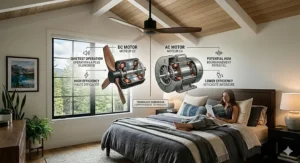
DC (Direct Current) motors represent the single most important advancement in ceiling fan noise reduction. Unlike traditional AC motors with their electromagnetic hum and brush friction, DC motors operate smoothly with minimal mechanical noise. Every fan in this review features DC motor technology for good reason: they consistently operate 15-20 dB quieter than AC equivalents while consuming 70-75% less electricity—meaningful savings when running a fan nightly throughout Canadian summers.
2. Match Fan Size to Room Dimensions
Canadian master bedrooms vary dramatically in size, from compact 200-square-foot (18.6-square-metre) condo bedrooms in downtown Toronto to expansive 500+ square-foot (46+ square-metre) rooms in suburban Calgary homes. The general rule: rooms under 300 square feet (28 square metres) work well with 42-52 inch fans, while larger spaces benefit from 52-72 inch options like the BOOSANT. Oversizing creates unnecessary air turbulence; undersizing forces the fan to run at higher (noisier) speeds to achieve adequate circulation.
3. Consider Ceiling Height Carefully
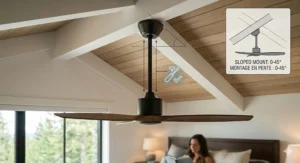
Standard Canadian residential construction uses 8-foot (2.4-metre) ceilings, requiring flush-mount or low-profile fans like the TAVZAKE or ZMISHIBO. Rooms with 9-10 foot (2.7-3.0 metre) ceilings benefit from downrod mounting, improving air circulation by positioning blades at the optimal 8-9 foot height above the floor. For cathedral or vaulted ceilings common in newer Canadian homes, verify the fan includes angled mounting hardware—most models accommodate up to 15-20 degree slopes.
4. Evaluate Smart Features Based on Use
Smart home integration sounds appealing, but consider whether you’ll genuinely use app control or voice commands. If you typically adjust your fan once at bedtime and prefer it running all night, a traditional remote-controlled fan like the BOOSANT may serve you better than fighting WiFi connectivity issues. Conversely, if you appreciate scheduling or multi-room control, the ZMISHIBO or Sofucor’s smart capabilities become daily conveniences worth the minor setup complexity.
5. Factor in Canadian Climate Realities
Reversible motors earn their keep in Canadian climates. Summer mode (counterclockwise rotation) creates the downward cooling breeze you expect. Winter mode (clockwise rotation at low speed) circulates rising furnace heat downward without creating a chilling breeze—particularly effective in rooms with vaulted ceilings where warm air naturally stratifies near the ceiling. This year-round functionality helps justify the premium DC motor fans command over basic models.
6. Don’t Overlook Lighting Quality
Integrated LED lighting eliminates the need for separate bedroom fixtures, but quality varies significantly. The Hunter Dempsey and OFANTOP provide exceptional even illumination, while budget models sometimes create hotspots or colour inconsistencies. If you read in bed, prioritize fans offering adjustable colour temperature (3000K warm for evening relaxation, 5000-6500K cool for morning routines) and dimming capability rather than fixed-brightness alternatives.
7. Verify Canadian Compliance and Warranty
ETL or CSA certification confirms the fan meets Canadian electrical safety standards—particularly important for insurance purposes if installation causes issues. Verify warranty terms cover motor defects (the most expensive component) and confirm the manufacturer provides Canadian customer support. Several brands reviewed here ship from Ontario or BC warehouses, dramatically simplifying returns or warranty claims compared to direct-from-manufacturer imports.
Common Mistakes When Buying Quiet Ceiling Fans (And How to Avoid Them)
Assuming All “Quiet” Claims Are Equal
Many ceiling fans advertise “quiet operation” without specifying decibel levels. This vague marketing allows manufacturers to label a 50 dB fan (roughly equivalent to moderate rainfall or normal conversation) as “quiet” despite being twice as loud as the 30-35 dB threshold for genuine bedroom-appropriate silence. Always seek specific dB ratings or verify with Canadian customer reviews before purchasing.
Ignoring Winter Performance
Canadian buyers frequently overlook reversible motor functionality, assuming ceiling fans are summer-only appliances. This mistake costs you money. Running a quality fan clockwise at low speed during winter months circulates rising warm air downward, reducing furnace runtime by 10-15% in typical applications—meaningful savings when heating costs spike during Prairie or Maritime winters. Every fan in this review features reversible motors, but this capability remains worthless if you don’t use it.
Installing Too Close to the Bed
While Canadian electrical codes specify minimum clearances (typically 7 feet/2.1 metres from floor to blade tips), these safety minimums don’t ensure comfort. Positioning a fan directly above your pillow creates unpleasant direct airflow that disrupts sleep even if the fan itself operates silently. Optimal placement positions the fan’s centre 2-3 feet (60-90 cm) toward the foot of the bed rather than directly overhead, allowing air circulation without direct downward flow onto sleeping faces.
Choosing Based on Price Alone
The ceiling fan market spans from $50 CAD basic models to $600+ CAD premium options, tempting budget-conscious buyers to select the cheapest “quiet” fan available. This often backfires. A $75 CAD fan with a traditional AC motor operating at 55 dB will frustrate you nightly, while a $200 CAD DC motor fan at 30 dB provides years of peaceful sleep. The $125 CAD difference—barely $10 monthly over a year—becomes trivial compared to the sleep quality impact you’ll experience every single night.
Neglecting Blade Material Considerations
Blade material influences both acoustics and longevity in Canadian climates. Solid wood blades (like the BOOSANT’s walnut) provide superior acoustic dampening but require occasional cleaning to prevent dust accumulation that can cause imbalance. ABS plastic blades (common in budget models) resist moisture and temperature fluctuations better but may generate slight static electricity during dry winter months. Metal blades offer durability but can amplify motor vibrations if poorly balanced. Match blade material to your climate zone and maintenance preferences rather than selecting based on aesthetics alone.
Real-World Performance: What to Expect in Canadian Bedrooms
Understanding how these quiet ceiling fans perform in actual Canadian bedroom conditions helps set realistic expectations and prevents post-purchase disappointment.
Temperature Regulation Across Seasons
During humid Southern Ontario summers (June-August), running your DC motor fan at medium speed (typically 40-60% power) provides comfortable air circulation without excessive cooling—important when sharing a bedroom with a partner who prefers different temperatures. The whisper-quiet operation means you won’t notice the fan is running until you step directly beneath it, a stark contrast to traditional AC motor fans that announce their presence continuously.
Winter operation requires different strategies. Setting your reversible fan to clockwise rotation at the lowest speed (10-20% power) circulates rising furnace heat downward without creating a perceptible breeze. This technique works particularly well in Prairie provinces where forced-air heating creates significant temperature stratification—warm air accumulates at ceiling level while floor areas remain cooler. Users typically report 2-3°C temperature equalization between floor and ceiling levels, translating to genuine heating cost savings.
Noise Level Reality Check
Even the quietest fan produces some sound—typically the soft whoosh of air movement rather than mechanical noise. At 25-30 dB, fans like the Hunter Dempsey or TAVZAKE operate below the threshold most people consciously notice in a quiet bedroom. You’ll hear them if you’re actively listening, but they blend into background ambiance within minutes. This differs dramatically from 45-55 dB fans that produce a persistent hum you’ll struggle to ignore, particularly if you’re a light sleeper or have auditory sensitivities.
Canadian buyers in urban areas (Toronto, Montreal, Vancouver) often discover that modern quiet ceiling fans operate more quietly than typical city ambient noise—street traffic, neighbours, building HVAC systems. In these environments, the fan’s white noise effect can actually improve sleep by masking irregular external sounds.
Energy Consumption Realities
DC motor fans deliver on their efficiency promises. Running a typical 35-watt DC fan (like the Fanliving or ZMISHIBO) for 8 hours nightly at medium speed consumes roughly 0.28 kWh daily. At $0.13 per kWh (average Canadian residential rate in 2026), monthly operation costs approximately $1.09 CAD—essentially negligible. Compare this to older AC motor fans consuming 75-100 watts, which cost $2-3 CAD monthly for identical runtime. The DC motor premium ($50-100 CAD additional upfront cost) pays for itself within 2-3 years through electricity savings alone, before considering the improved sleep quality value.
Maintenance Requirements
Modern DC motor ceiling fans require minimal maintenance in Canadian residential environments. Dust accumulation on blades remains the primary concern—plan for gentle cleaning every 2-3 months using a microfiber cloth and avoiding harsh chemicals that can damage finishes. The sealed motor housings on quality fans (Hunter, BOOSANT) protect internal components from humidity and temperature fluctuations, eliminating the lubrication requirements that older fans demanded.
Balance issues rarely occur with properly manufactured fans, but if wobbling develops, blade balancing kits (available at any Canadian hardware store for $5-8 CAD) resolve the issue in 10-15 minutes. Tighten mounting screws annually to prevent loosening from normal vibration—a simple maintenance task that extends fan lifespan significantly.
Smart Home Integration: Is It Worth It for Canadian Bedrooms?
Smart ceiling fans like the ZMISHIBO and Sofucor promise convenience through app control and voice integration, but Canadian buyers should understand what smart features genuinely improve daily life versus what amounts to technology for technology’s sake.
Voice Control Practical Reality
Lying in bed and saying “Alexa, turn the bedroom fan to speed 3” provides genuine convenience when your remote is out of reach—particularly valuable for parents who’ve finally achieved comfortable sleep positions and don’t want to disturb babies or partners by hunting for remotes. However, voice control requires consistent WiFi connectivity (challenging in older Canadian homes with thick walls) and assumes you’re comfortable with always-listening devices in your bedroom.
App Scheduling Benefits
Setting your fan to automatically start at 9 PM and stop at 6 AM eliminates daily manual adjustments, ensuring optimal bedroom conditions without conscious effort. This automation particularly benefits Canadians working irregular schedules—nurses, shift workers, or business travelers who want familiar bedroom conditions regardless of when they actually sleep. The Sofucor’s multi-room control allows parents to adjust children’s bedroom fans remotely, checking temperatures without physically entering rooms and risking waking light sleepers.
The WiFi Reliability Factor
Canadian rural and remote areas may experience inconsistent internet service, potentially limiting smart fan reliability. If your WiFi drops regularly, smart features become frustrations rather than conveniences—you’ll find yourself reaching for the physical remote anyway. Urban and suburban buyers with robust internet service rarely encounter connectivity issues once fans are properly configured.
Cost-Benefit Analysis
Smart-enabled fans typically cost $50-80 CAD more than equivalent non-smart models. If you’ll genuinely use app control and scheduling, this premium provides reasonable value. However, if you primarily want quiet operation and adjust your fan once at bedtime, traditional remote control (like the BOOSANT or TAVZAKE) delivers identical core performance while avoiding setup complexity and ongoing connectivity requirements.
Ceiling Fan Noise Levels: Understanding the Decibel Scale
Understanding decibel measurements helps Canadian buyers evaluate manufacturer claims and set realistic expectations for bedroom ceiling fan performance.
The Decibel Scale in Context
Sound intensity follows a logarithmic scale where each 10 dB increase represents a doubling of perceived loudness. A 40 dB fan sounds twice as loud as a 30 dB fan—a more dramatic difference than the numbers suggest. This exponential relationship explains why seemingly small dB reductions (45 dB versus 35 dB) create dramatic real-world improvements in bedroom quietness.
Relevant Decibel Reference Points:
- 20-25 dB: Rustling leaves, nearly imperceptible
- 25-30 dB: Whisper, library quiet (ideal bedroom range)
- 30-35 dB: Soft conversation, acceptable for most sleepers
- 35-40 dB: Quiet office, light rainfall
- 40-50 dB: Moderate conversation, refrigerator hum
- 50-60 dB: Normal conversation, typical AC motor fan
WHO Sleep Recommendations
The World Health Organization recommends bedroom noise levels below 30 dB for quality sleep, with a maximum threshold of 35 dB to prevent sleep disruption. These evidence-based guidelines reflect research showing that sustained exposure to noise above 40 dB during sleep hours correlates with increased cardiovascular stress, reduced sleep quality, and cognitive performance impacts—even when occupants report “getting used to” the noise.
Every DC motor fan reviewed here operates within WHO’s recommended range, while traditional AC motor fans (45-60 dB) exceed safe levels for optimal sleep. This health perspective helps justify the premium DC motor fans command—you’re investing in long-term wellbeing, not just comfort.
Canadian Building Code Context
While Canadian building codes don’t specify ceiling fan noise limits for residential bedrooms, ventilation standards in British Columbia and Ontario recommend exhaust fan noise below 1.0 sone (approximately 35 dB). Though these regulations apply to bathroom and kitchen exhaust rather than ceiling fans, they establish a reasonable threshold that aligns with WHO sleep recommendations.
Long-Term Value: Total Cost of Ownership in Canada
Smart ceiling fan purchasing requires evaluating total ownership costs over the fan’s expected 10-15 year lifespan rather than focusing solely on initial purchase price.
Energy Cost Comparison
A 35-watt DC motor fan (representing the average among reviewed models) running 8 hours daily consumes 102 kWh annually. At Ontario’s 2026 average residential rate of $0.13 per kWh, annual electricity cost is $13.26 CAD. Over 10 years, this totals $132.60 CAD in electricity costs.
Compare this to a 75-watt AC motor fan: 219 kWh annual consumption at $0.13/kWh = $28.47 CAD yearly, or $284.70 CAD over 10 years. The DC motor fan saves $152.10 CAD in electricity costs over its lifespan—often enough to offset the initial price premium entirely while delivering superior quiet operation.
Maintenance and Replacement Costs
Quality DC motor fans require minimal maintenance beyond occasional blade cleaning. Expected maintenance costs over 10 years: approximately $15-25 CAD for cleaning supplies and possible balancing kit. Traditional AC motor fans often require capacitor replacements ($30-50 CAD) and more frequent bearing lubrication, though these costs remain modest.
The significant cost difference emerges in replacement timing. Budget AC motor fans ($75-125 CAD) typically last 5-7 years before motor failure or excessive noise development, requiring complete replacement. Quality DC motor fans ($150-400 CAD) commonly operate 12-15 years, effectively serving twice the lifespan of cheaper alternatives. When factoring in replacement cycles, the DC motor fan’s higher upfront cost often proves cheaper over time.
Resale Value Considerations
Homeowners selling property in competitive Canadian markets (Toronto, Vancouver, Calgary) increasingly find that quality ceiling fans enhance home appeal. Installed DC motor fans in master bedrooms contribute to “move-in ready” status that can influence sale price or time-to-sale. While you won’t recoup the full fan cost, the marginal benefit of having attractive, quiet ceiling fans installed likely exceeds the cost of removal and patching.
Frequently Asked Questions
❓ Can DC motor ceiling fans operate during Canadian winter power outages?
❓ How do I know if my ceiling electrical box supports a ceiling fan in Canada?
❓ Do quiet ceiling fans work effectively in rooms with low ceilings common in Canadian condos?
❓ Can I install a ceiling fan myself in Canada, or do I need a licensed electrician?
❓ Do ceiling fans help reduce heating costs during Canadian winters?
Conclusion: Your Path to Bedroom Silence and Better Sleep
Choosing the quietest ceiling fan for your Canadian master bedroom fundamentally improves your daily life. The difference between struggling with 55 dB background noise and enjoying genuine 30 dB silence compounds nightly—better sleep quality, reduced stress response, improved cognitive performance, and enhanced overall wellbeing. These aren’t marginal improvements; they’re meaningful health outcomes backed by WHO research and sleep science.
The seven ceiling fans reviewed here represent the absolute quietest options available to Canadian buyers in 2026, each operating within the critical 25-35 dB range that permits quality sleep. Whether you prioritize the premium silence of the Hunter Dempsey ($300-$400 CAD), the budget-conscious value of the Fanliving ($150-$250 CAD), or the smart home capabilities of the ZMISHIBO ($180-$280 CAD), every option delivers performance that traditional AC motor fans simply cannot match.
Remember these key principles when making your selection: prioritize DC motor technology over all other features, match fan size carefully to room dimensions, verify Canadian electrical compliance (ETL/CSA certification), and consider total ownership costs rather than purchase price alone. The $200-300 CAD most Canadians invest in a quality quiet ceiling fan delivers value every single night for 10-15 years—one of the highest return-on-investment home improvements you’ll make.
Your master bedroom deserves better than the persistent hum of outdated fan technology. These modern DC motor ceiling fans prove that powerful air circulation and genuine silence aren’t mutually exclusive—they’re standard features Canadian buyers should expect and demand. Select the model that matches your bedroom dimensions, aesthetic preferences, and feature requirements, then experience the profound difference genuine quiet makes to your sleep quality and daily energy.
The path to better sleep starts with ending the compromise between comfort and silence. Choose wisely, install properly, and enjoy years of peaceful, cool, quiet Canadian nights.
Recommended for You
- 7 Best DC Motor Ceiling Fans in Canada 2026 (Save 70% Energy)
- 7 Best Ceiling Fans for Room with 8 Foot Ceiling Canada 2026
- 7 Best Flush Mount Ceiling Fans for Low Ceilings Canada 2026
Disclaimer: This article contains affiliate links. As an Amazon Associate, I earn from qualifying purchases. If you purchase products through these links, we may earn a small commission at no additional cost to you.
✨ Found this helpful? Share it with your friends! 💬🤗
